Every spring, thousands of NYC residents — from Brooklyn brownstones to Manhattan high-rises — panic when winged insects suddenly pour out of walls, window frames, or hallway cracks. But are they actually flying termites, or something else entirely? This guide gives you the NYC-specific answers you need: how to identify what you’re seeing, what to do in the next 60 minutes, and how to protect your home or navigate your landlord if you’re a renter.
What Exactly Are Flying Termites and Why Are They Swarming in Your NYC Building?
Termite swarmers and the reproductive cycle
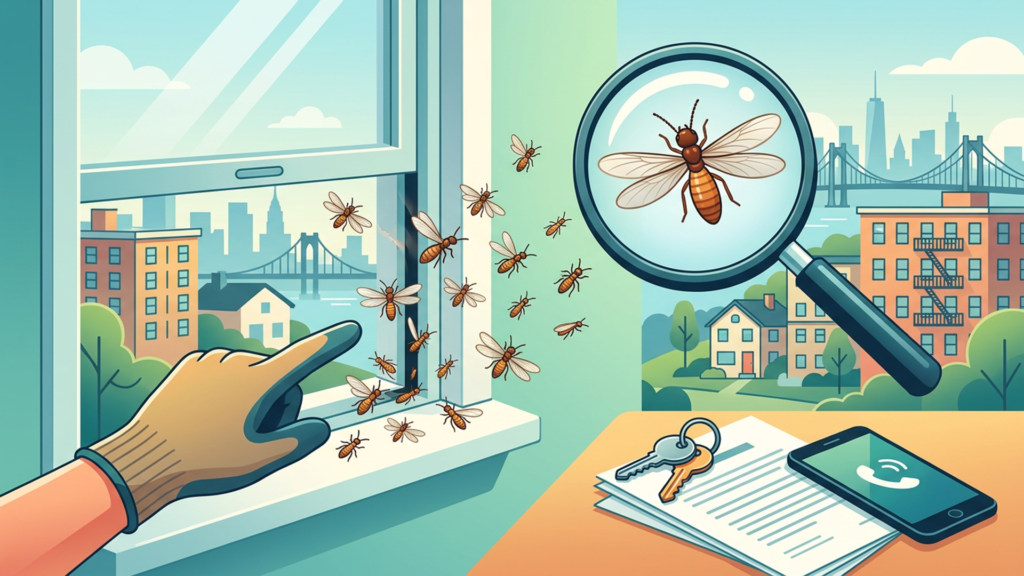
Flying termites — called alates — are the reproductive caste that leave a mature colony to mate and establish new ones. Their presence indoors almost always signals a well-established colony nearby. Swarms appear suddenly and en masse, with hundreds emerging from hidden nests inside walls, but the underlying colony remains fully active long after the swarm ends. Light attracts swarmers, which is why NYC residents typically find them clustered near windows, light fixtures, and well-lit hallways.
Swarming season in the New York City area
Subterranean termites in NYC typically swarm from late March through June, often triggered by warm rain followed by humid conditions. Drywood termites — an underreported threat most NYC resources overlook — can swarm later in summer and fall, and have been confirmed in city apartments by pest control professionals. Expect multiple waves over days or weeks; a single swarming event is never the end of the problem.
Types of termites found in New York City
Eastern subterranean termites are the most common species across all five boroughs, building mud tubes from soil to wood structures. Drywood termites live entirely within wood and don’t need soil contact, making them significantly harder to detect. Species identification often requires examining soldier caste specimens, so saving samples is critical for accurate diagnosis — professionals offering termite control in New York County can help with definitive identification.
How Do You Tell Flying Termites Apart from Flying Ants and Other NYC Insects?
Key body differences: termites vs flying ants
Termites have a straight, broad waist with no pinch between body segments, while flying ants have a distinctly narrow, pinched waist — this is the single most reliable visual cue. Termite antennae are straight and beaded; ant antennae are elbowed at a sharp angle. Termite wings are equal in length and extend well past the body, whereas ant wings are unequal, with front wings noticeably longer, as detailed in this guide to identifying household pests.
Commonly misidentified insects in NYC apartments
Flying ants are the most common misidentification — panicked residents frequently assume any winged insect near wood is a termite. Brown lacewings and small wasps also get confused for termites, and insect identification resources offer useful reference images for distinguishing these species. If your insects turn out to be ants rather than termites, you may need ant control in Manhattan or your specific borough instead.
How to preserve a specimen for professional ID
Capture several specimens in a sealed plastic bag or tape them to white paper — clear photos of the body segments, wings, and antennae are essential. Save any discarded wings on windowsills, as piles of shed wings with crawling wingless bodies nearby is classic confirmation of a termite swarm. Bring or send specimens to a licensed professional for definitive identification before spending money on treatment.
What Should You Do Immediately When You Find a Termite Swarm in Your NYC Apartment?
Step-by-step emergency checklist
Do not spray insecticide on swarmers. Killing visible swarmers does nothing to the colony and can contaminate specimens needed for identification. Collect 5–10 specimens in a sealed bag, photograph the swarm location and any visible damage, and note the exact date, time, and conditions. Vacuum up remaining swarmers, seal the vacuum bag, and keep it as additional evidence.
Documenting evidence for landlords and inspections
Take timestamped photos and video of the swarm, any mud tubes, discarded wings, and damaged wood. Send written notice — email or certified letter — to your landlord immediately, since verbal reports are insufficient for establishing a legal record. File a residential pest complaint with NYC 311 if your landlord doesn’t respond within a reasonable timeframe.
Assessing the scope: indoor swarm vs outdoor sighting
Swarmers emerging inside your home strongly indicate an active colony within or directly beneath the structure — this requires professional inspection. Worker termites found outside near trees or garden mulch don’t necessarily mean your home is infested, but proximity within 20 feet warrants evaluation. In multi-unit buildings, a swarm in one apartment likely affects the entire structure, so building-wide inspection is essential.
What Are Your Rights as an NYC Renter When Your Landlord Ignores Termite Problems?
NYC housing code and landlord pest control obligations
Under the NYC Housing Maintenance Code, landlords are responsible for maintaining buildings free of pest infestations, including termites, in all residential units. The landlord and tenant guide to pest management clarifies that landlords must hire licensed pest control operators and cannot shift this responsibility to tenants. Termite infestations can constitute a housing code violation, and persistent neglect may qualify as a reduction in services in rent-stabilized apartments.
Steps to escalate an unresponsive landlord
Document every communication attempt, save specimens and photos, and send a formal written demand for inspection and treatment. If necessary, contact NYC Housing Preservation and Development (HPD) to request an inspection. Tenants in rent-stabilized units can also file a complaint with the Division of Housing and Community Renewal (DHCR) for failure to maintain habitable conditions.
What renters should never pay for
Professional termite inspection and treatment costs are the landlord’s legal obligation in NYC rental properties — do not pay out of pocket without written agreement for reimbursement. If a landlord claims the infestation is your fault, request a licensed inspector’s written report identifying the colony origin and species. Consult a tenant rights organization or housing attorney if your landlord refuses to act, especially if structural damage is progressing — residents can find termite control services in Manhattan for borough-specific professional help.
How Do You Get Rid of Flying Termites and Prevent Them from Coming Back?
Professional termite treatment options for NYC properties
Liquid barrier treatments applied around foundations are the standard for subterranean termites in NYC houses, brownstones, and townhomes, as outlined in the EPA’s guide to pest control safety. Bait station systems are often preferred for apartment buildings and multi-unit structures where full liquid treatment isn’t feasible. Drywood infestations may require localized wood treatment or fumigation — review your termite control options to determine the right approach.
DIY prevention tips specific to NYC building types
In pre-war buildings and brownstones, seal cracks in facades, foundation walls, and around utility pipe penetrations where subterranean termites build mud tubes — the residential code of New York State outlines structural standards that help inform proper sealing and moisture management. Reduce moisture in basements and ground-floor units by fixing leaks, improving ventilation, and using dehumidifiers — NYC’s aging plumbing creates ideal termite conditions. Remove wood-to-soil contact around stoops and cellar doors, and replace mulch near foundations with gravel or stone as recommended in USDA guidance on subterranean termites.
What to expect from a professional inspection in NYC
A licensed termite inspection typically costs $100–$300, with many companies offering free inspections as part of a treatment proposal. Full subterranean termite treatment for a NYC townhome or brownstone generally ranges from $1,500–$5,000+ depending on severity and method. The inspector will examine the foundation, basement, window frames, and wood structural elements — find borough-specific providers for termite control in Brooklyn, Queens, the Bronx, and Staten Island.
What Are the Signs of a Larger Termite Infestation Beyond the Swarm?
Visible damage and structural warning signs
Mud tubes running along foundation walls, floor joists, or pipes are the hallmark of subterranean termite activity — even pencil-thin tubes indicate an active colony. Hollow-sounding wood when tapped, buckling floors, and bubbling paint that resembles water damage can all indicate termites feeding behind surfaces. Termite damage in NYC’s older wood-frame and brownstone buildings can compromise structural integrity quickly, making early detection critical as noted in the healthy housing reference manual.
Hidden signs NYC residents often miss
Small piles of frass — tiny wood-colored pellets — near baseboards or windowsills indicate drywood termites, a sign most NYC resources fail to mention. Discarded wings on windowsills, near light fixtures, or in spider webs inside your home are often the first evidence of a swarm that happened while you were away. Tight-fitting doors and windows that suddenly stick can signal termite damage warping the surrounding wood framing, and research on urban pest health risks highlights how infestations in dense urban environments can escalate rapidly.
Apartments vs houses: different risk profiles
In single-family homes, termites typically enter through the foundation and homeowners bear full responsibility for inspection and treatment. In multi-unit apartment buildings, a colony can affect the entire structure while only swarming in one unit — the responsibility falls on the landlord or building management. Co-op and condo owners should review their building’s pest management policy and proprietary lease, as responsibility may be shared between the board and individual unit owners; other common building pests like roaches may also require attention through cockroach control in New York County.
Found Flying Termites in NYC — What’s Your Next Move?
Identify before you act. Collect specimens, compare body segments and wing size, and rule out flying ants, lacewings, and other lookalikes before assuming the worst. Document everything with photos, timestamps, and written communication — whether you’re a homeowner scheduling an inspection or a renter notifying your landlord.
Act fast but don’t panic: the swarm is a symptom, not the full problem. The colony behind the wall is what needs professional treatment. Indoor swarms, mud tubes, or discarded wings inside your home always warrant immediate professional inspection — there is no safe “wait and see” scenario.
Whether you’re dealing with ant control confusion or confirmed termite activity, connecting with a licensed NYC termite professional is the single most important step you can take today.