If you’ve noticed tiny, fuzzy-winged flies hovering around your bathroom sink or shower drain, you’re not alone — drain flies are one of the most common and frustrating pest problems in NYC apartments, especially in pre-war buildings across Brooklyn, Queens, and Manhattan. The challenge is that most online guides offer generic advice that completely ignores the realities of shared plumbing, aging infrastructure, and unresponsive landlords. This guide is built specifically for NYC renters, covering everything from correctly identifying what’s actually flying around your apartment to escalating the problem with your building management when DIY methods aren’t enough.
What Exactly Are Drain Flies and Why Are They Infesting Your NYC Apartment?
Drain fly biology and what makes them thrive
Drain flies (Psychodidae) are small, moth-like flies that breed in the organic biofilm lining the inside of drains, pipes, and overflow holes. They lay 30–100 eggs at a time in moist organic buildup, and larvae can mature in as little as 8–24 days — which explains why infestations seem to explode overnight, according to Cornell’s guide on non-biting flies.
What makes them especially maddening is that flies can detect moisture and organic matter from a distance, as Colorado State University Extension explains, which is why even spotlessly clean NYC apartments can attract them through shared building plumbing.
Why NYC buildings are uniquely vulnerable
Pre-war buildings in Manhattan, Brooklyn, and Queens often have cast-iron or galvanized pipes that corrode internally, creating rough surfaces where biofilm accumulates far faster than in modern PVC plumbing. Shared vertical plumbing stacks mean that biofilm buildup or a break in one unit can send drain flies into neighboring apartments — treating only your unit is often not enough.
NYC’s hot, humid summers create peak breeding conditions, and building HVAC systems can circulate moisture that sustains infestations year-round. If you’re in an older building, the deck is stacked against you from the start.
Signs you have a drain fly infestation
Look for multiple small, fuzzy-winged flies resting on bathroom or kitchen walls, especially near sinks, showers, and floor drains. They appear most actively in the evening and at night, and they tend to hover rather than fly quickly.
Here’s the definitive test: place a strip of clear tape over suspect drains overnight. If you find flies stuck to the underside by morning, you’ve confirmed the breeding source.
Are You Sure They’re Drain Flies — and Not Fruit Flies, Fungus Gnats, or Phorid Flies?
Visual identification guide
Misidentification is the number one reason people waste weeks on the wrong treatment. Here’s how to tell them apart:
- Drain flies: Fuzzy, moth-like wings held roof-like over the body; gray or tan; poor fliers that make short hopping flights. The San Mateo County Mosquito and Vector Control District offers a helpful visual comparison of mosquito-like insects that can help you confirm what you’re seeing.
- Fruit flies: Smooth wings, red or dark eyes, tan body; found near fruit, garbage, and fermented liquids — not drains.
- Fungus gnats: Dark, slender, mosquito-like; found hovering around houseplant soil — extremely common in NYC apartments with indoor plants and frequently misdiagnosed as drain flies.
- Phorid flies (hunchback flies): Humped thorax, run rapidly across surfaces before flying; may indicate a broken sewer pipe or hidden moisture source behind walls.
The University of Maryland’s household insect pest identification guide is another excellent resource for narrowing down what you’re dealing with.
Why misidentification leads to failed treatment
Treating drains won’t solve a fungus gnat problem originating from overwatered houseplant soil — a hydrogen peroxide soil drench (1 part 3% H₂O₂ to 4 parts water) is the correct approach for gnats. Phorid flies near drains may signal a cracked sewer line inside walls, which no amount of drain cleaning will fix.
Fruit flies require eliminating food sources like ripening produce, recycling bins, and open containers rather than drain treatments — as this NPR segment explains, they don’t appear out of nowhere, and understanding their origins is key to prevention. If you’ve been battling “drain flies” for weeks without success, double-check that you’ve identified the right pest.
What Are the Most Effective DIY Methods to Eliminate Drain Flies?
Cleaning the biofilm — the only permanent fix
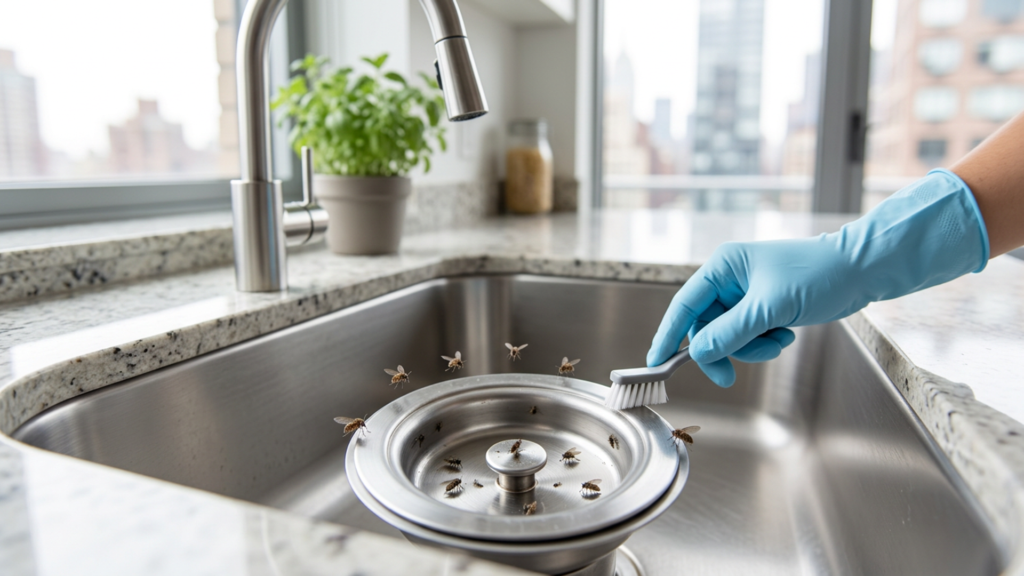
The single most important step is physically removing the organic biofilm inside drains using a stiff drain brush or pipe brush — no chemical can fully replace mechanical cleaning. After brushing, flush with boiling water to dislodge loosened buildup from pipe walls.
Repeat every few days for at least two weeks to break the full egg-to-adult lifecycle. Skip this step and everything else is a temporary bandage.
Enzyme drain cleaners vs. bleach vs. boiling water vs. vinegar
- Enzyme cleaners (InVade Bio Drain, Zep, Green Gobbler): The most effective long-term solution — enzymes digest the biofilm where larvae live rather than just killing adults on contact.
- Baking soda + vinegar + boiling water: A decent first attempt that loosens surface-level grime, but typically insufficient for heavy biofilm in old NYC pipes.
- Bleach: Kills on contact but doesn’t break down biofilm, evaporates quickly, and can damage older plumbing — not recommended as a primary treatment.
- Boiling water alone: Helpful as a supplement but won’t penetrate thick biofilm without mechanical brushing first.
DIY traps to reduce adult fly populations
Fill a jar with apple cider vinegar, add a drop of dish soap to break surface tension, and cover with plastic wrap poked with small holes. This is effective for monitoring population levels but won’t stop breeding.
Traps only catch adults — they do not address larvae in drains, so always pair trapping with drain treatment. Place traps near confirmed breeding sites to gauge whether your treatment is actually working over time.
What Hidden Breeding Sites Are You Probably Missing?
Overflow drain holes in bathroom sinks
The small overflow hole near the rim of bathroom sinks is one of the most overlooked breeding grounds for drain flies in NYC apartments. Biofilm builds up inside the overflow channel and is never reached by normal drain cleaning — use a small bottle brush or pipe cleaner and flush with enzyme cleaner.
Multiple homeowners and renters have confirmed that their persistent infestations were solved only after treating the overflow hole, not the main drain, as this extension service Q&A thread documents.
Broken sewer lines and hidden moisture behind walls
If you’ve thoroughly cleaned every visible drain and flies persist, the source may be a cracked or broken sewer line inside walls or beneath the floor. Signs include persistent sewer smell, damp spots on walls or ceilings, or phorid flies appearing far from any drain.
This requires professional plumbing inspection — a camera scope of the sewer line is the definitive diagnostic step, and it’s something your landlord should be arranging.
Shared plumbing in multi-unit NYC buildings
NYC apartment plumbing stacks are shared between units, meaning your neighbor’s untreated drain can continuously reinfest your apartment. Floor drains in basements, laundry rooms, and utility closets are often forgotten breeding sites that building management must address. Much like dealing with bed bugs in Queens, drain fly problems in multi-unit buildings require a coordinated, building-wide approach to truly resolve.
When Should You Call a Professional Exterminator — and What Are Your Rights as an NYC Tenant?
Recognizing when DIY has reached its limits
If drain flies return within days of thorough cleaning and enzyme treatment across all drains including overflows, the problem likely involves infrastructure you can’t access. Persistent infestations in multiple units confirm a building-wide plumbing issue that requires professional intervention.
A licensed pest control professional can identify species, locate hidden breeding sites, and apply targeted treatments like insect growth regulators (IGRs) — such as those described in the NyGuard IGR product label — that prevent larvae from developing into adults.
NYC tenant rights and how to escalate with your landlord
Under NYC’s Warranty of Habitability, landlords are legally required to maintain pest-free conditions — persistent drain fly infestations caused by plumbing defects are the landlord’s responsibility to resolve, as outlined in the Warranty of Habitability guidelines. Document the infestation with photos, dates, and written complaints to your landlord or management company, and keep copies of everything.
If your landlord fails to act, file a complaint through NYC 311’s pest complaint portal and contact HPD for an inspection — you may also have grounds to withhold a portion of rent or pursue an HP action in housing court.
Dual-purpose drain treatment for roaches and flies
NYC drains serve as entry points for both drain flies and American cockroaches — enzyme drain treatments and drain covers address both pests simultaneously. If you’re dealing with roaches alongside drain flies, consider cockroach control in Brooklyn or cockroach control in Manhattan to treat the shared infrastructure holistically.
Using drain stoppers overnight after treatment serves double duty: it traps emerging drain flies and blocks roach entry from the sewer system.
How Do You Keep Drain Flies From Coming Back for Good?
Ongoing maintenance routine for NYC apartments
Run water in every drain at least once a week — unused drains in guest bathrooms and floor drains dry out and lose their water trap seal, creating an open path from the sewer. Apply enzyme drain cleaner monthly as preventive maintenance, especially during humid summer months (June–September) when NYC drain fly activity peaks.
Don’t forget to clean overflow holes in bathroom sinks monthly with a pipe cleaner and enzyme solution. Residents dealing with pest issues in New York County know that prevention is always cheaper than repeated treatments.
Building-level prevention strategies
Request that your super or building management treat common-area drains — basement, laundry, and utility rooms — on a regular schedule. Advocate for plumbing inspections in older buildings, particularly if multiple tenants report drain flies.
For persistent building-wide problems, pest control in Queens or pest control in the Bronx services can implement comprehensive treatment plans that coordinate across units. Similarly, buildings near green spaces may benefit from mosquito control in Ridgewood and surrounding neighborhoods during summer months when multiple flying insects peak simultaneously.
Sealing and monitoring to prevent re-emergence
Install fine-mesh drain covers on all shower, tub, and floor drains to physically block adult flies from emerging while allowing water flow. Plug drains with stoppers overnight and during extended absences — this is especially effective in the two weeks following treatment.
Continue using tape tests monthly to monitor for early signs of reinfestation before it becomes visible. Catching it early means a simple enzyme treatment rather than a full restart — and for renters needing pest control in Brooklyn or pest control in Manhattan, early detection can save you weeks of frustration.
Key Takeaways for NYC Renters
Drain flies are a solvable problem, but in NYC’s aging multi-unit buildings, the solution almost always goes beyond what a single renter can do alone. Mechanically clean and enzyme-treat every drain and overflow hole in your apartment for at least two full weeks. If flies persist, the breeding source is likely in shared plumbing infrastructure you can’t reach — and that’s your landlord’s legal responsibility to fix.
Document everything, know your rights under the Warranty of Habitability, and don’t hesitate to file a 311 complaint if your building management won’t act. The flies won’t go away on their own, but with the right approach and the right pressure, they will go away.