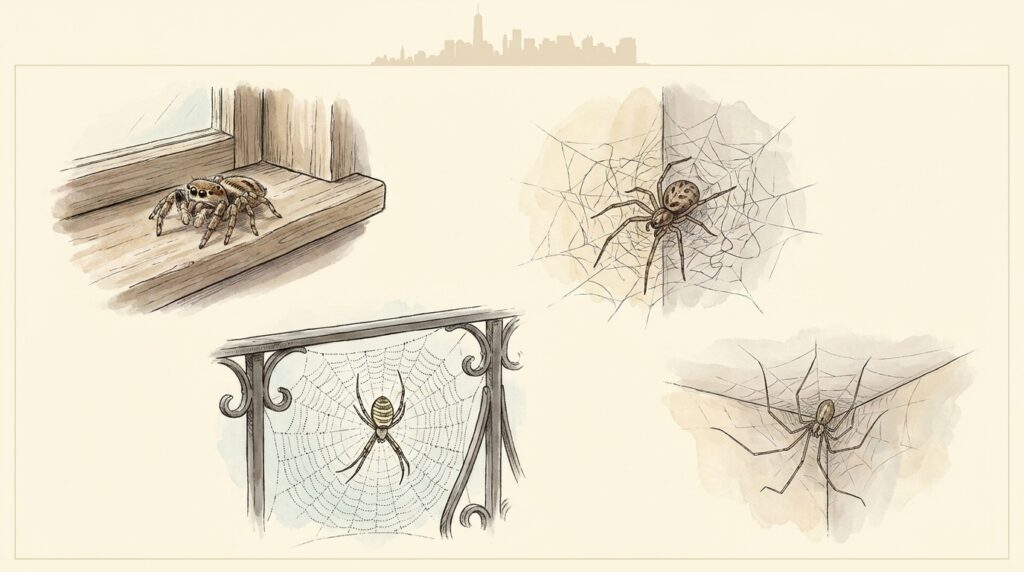
Found a spider in your New York apartment and wondering if it’s dangerous? You’re not alone — New Yorkers from Manhattan to the Adirondacks encounter spiders year-round, and the vast majority are completely harmless. This guide covers every common spider species you’re likely to find in your NY home or yard, helps you tell apart the look-alikes that confuse even experienced residents, and gives you honest answers about which ones bite, which ones are beneficial, and when (if ever) you should actually worry.
Spiders showing up around your home?
26+ years across NYC and Long Island. We reduce the prey insects spiders eat instead of just spraying webs, kid-friendly and pet-friendly methods, no annual contracts.
What Are the Most Common House Spiders in New York?
American House Spider (Parasteatoda tepidariorum)
This small, tan-to-brown spider is the one responsible for those messy cobwebs in your corners, basements, and window frames. It’s one of the most synanthropic spiders in New York, meaning it has biologically adapted over centuries to live alongside humans — it’s not just wandering in by accident.
The American house spider is completely harmless, and its tangled webs are surprisingly effective at catching flies, mosquitoes, and other household pests. If you’re already dealing with mosquito issues, especially in warmer months, you might also look into mosquito control in New York County for a more comprehensive approach. You’ll find this spider equally in NYC high-rises, Long Island colonials, and upstate farmhouses.
Yellow Sac Spider (Cheiracanthium spp.)
If you live in a New York City apartment, this is likely the spider you’ve seen. The yellow sac spider is pale yellow-green, roughly the size of a nickel, and builds small silk “sacs” tucked into upper wall corners and ceiling edges rather than spinning traditional webs. It’s an active nocturnal hunter, which is why you’ll sometimes spot one cruising across your wall at night.
Online sources often hype this spider as dangerously venomous, but that’s largely internet misinformation. According to Michigan State’s diagnostics lab, bites can occur — especially when the spider is trapped against skin — but they’re comparable to a bee sting and not medically significant. Real-world reports from NY residents describe uncomfortable redness and mild swelling lasting one to three days, with no lasting harm.
Cellar Spider / “Daddy Long Legs” (Pholcidae)
You know this one: long, impossibly delicate legs, a tiny body, and loose wispy webs draped across basement ceilings and dark closet corners. The cellar spider is the species parents ask about most often when they spot one dangling in a child’s bedroom. Rest easy — it’s completely harmless and cannot bite through human skin.
And that old claim that cellar spiders have “the most potent venom but fangs too small to bite”? According to NYC Health’s spider page, that’s entirely false. These spiders are actually excellent pest controllers that eat other spiders, ants, and small insects sharing your home.
Which Outdoor Spiders Will You Find in Your New York Yard?
Black and Yellow Garden Spider (Argiope aurantia)
This is the showstopper — a large, striking spider with bold black and yellow markings that builds iconic zigzag-patterned orb webs in gardens and shrubs. Females can reach over an inch in body length, which understandably startles people. But despite that intimidating size, they’re completely harmless to humans.
Garden spiders are most visible in late summer and early fall. As New York’s DEC guide to common spiders notes, they’re beneficial garden predators that consume grasshoppers, flies, and crop-damaging insects.
Cross Orb Weaver (Araneus diadematus)
This brown spider sports a distinctive white cross pattern on its abdomen and builds large, geometrically precise orb webs. If you’ve ever walked face-first into a web stretched across your doorway or between your car mirrors, you’ve likely met a cross orb weaver.
Here’s a fascinating detail: orb weavers consume and recycle their own silk each morning, then spin a brand-new web every evening. They’re common across all of New York state, completely harmless, and ecologically valuable.
Funnel Web / Grass Spider (Agelenopsis spp.)
Look for distinctive funnel-shaped sheet webs in your lawn, ground cover, and around home foundations. Grass spiders are extremely fast runners that retreat deep into their funnel when disturbed, and they’re rarely encountered indoors except in basements and garages.
They’re also one of the most commonly misidentified spiders in New York — a point emphasized by Cornell’s pest management program, which receives frequent inquiries about spider identification from concerned residents.
Why Do Spiders Enter New York Homes and Are They Actually Beneficial?
Synanthropic Species — Spiders Evolved to Live With Us
Here’s something that surprises most people: many indoor spiders aren’t “lost” outdoor spiders that wandered in through a crack. Species like the American house spider, cellar spider, and yellow sac spider are synanthropic — they’ve adapted over centuries to thrive in human structures. Most were born inside your home and would actually struggle to survive if released outside.
These spiders fill an ecological niche indoors, controlling populations of flies, cockroaches, and other pests. As Cornell’s Master Gardener program explains, spiders are among the most underappreciated beneficial creatures living alongside us.
Seasonal Spider Activity in New York
Understanding seasonal patterns helps explain why you suddenly see more spiders at certain times of year:
- Spring (March–May): Spiderlings emerge and small juvenile spiders appear indoors as populations grow.
- Summer (June–August): Outdoor species peak — garden spiders, orb weavers, and jumping spiders are most visible.
- Fall (September–November): Male spiders wander indoors seeking mates, causing the biggest spike in home sightings. As the Adirondack Explorer notes, wolf spiders and grass spiders commonly turn up in basements during this period.
- Winter (December–February): Indoor species remain active year-round while outdoor species overwinter as eggs or in sheltered crevices.
NYC Apartments vs. Upstate and Suburban Homes
NYC apartments are dominated by yellow sac spiders, cellar spiders, and American house spiders, with fewer species overall due to sealed urban environments. Long Island and suburban homes see a wider variety — wolf spiders, grass spiders, and garden spiders all find more ground-level entry points to wander through.
Upstate and rural New York has the highest diversity, including nursery web spiders, fishing spiders, sheet web weavers, and crab spiders near wooded and wetland areas. If you encounter a particularly large spider you can’t identify, extension services can help, and pest control services can provide region-specific guidance if spider populations become a concern.
How Do You Tell Apart Commonly Confused Spiders in New York?
Grass Spider vs. Wolf Spider
This is the single most common misidentification in New York. Both are brown, fast-moving, and roughly similar in size. The key difference: grass spiders have prominent spinnerets — finger-like appendages visibly extending from the rear of their abdomen — while wolf spiders do not.
Behaviorally, grass spiders build funnel webs and wait for prey, while wolf spiders are free-roaming ground hunters that carry their egg sacs on their bodies. Both are harmless to humans.
Yellow Sac Spider vs. Brown Recluse
Let’s put this one to rest: brown recluse spiders do NOT have established populations in New York. Their native range is the south-central United States — Missouri, Kansas, Oklahoma, and Arkansas. Yellow sac spiders are pale yellow-green with uniform coloring, while brown recluses have a distinct dark violin-shaped marking and only six eyes instead of the typical eight.
If you’re in New York and found a small, pale spider in your home, it is almost certainly a yellow sac spider.
Ghost Spiders and Parson Spiders — The Overlooked NY Species
Eastern parson spiders are dark brown with a distinctive white dorsal marking resembling a clergy cravat — fast nocturnal ground hunters commonly found in homes. Ghost spiders are pale, translucent, and frequently confused with yellow sac spiders.
Both species are regularly identified in entomology communities but missing from most mainstream guides, and resources like the iNaturalist guide to Southern Tier spiders can help New Yorkers make more accurate identifications.
Spiders showing up around your home?
26+ years across NYC and Long Island. We reduce the prey insects spiders eat instead of just spraying webs, kid-friendly and pet-friendly methods, no annual contracts.
Are There Any Dangerous Spiders in New York?
Black Widow Spiders — Rare but Present
Northern black widows (Latrodectus variolus) do exist in New York, but they’re uncommon. Most residents will never encounter one. They’re found primarily in undisturbed outdoor areas like woodpiles, stone walls, and sheds.
Bites are medically significant and require medical attention, though fatalities are extremely rare with modern treatment. If you suspect a black widow in or around your home, contact a pest control provider in New York County for professional identification and safe removal.
Brown Recluse — The Myth in New York
It bears repeating: brown recluse spiders are not established anywhere in New York state. Isolated specimens may occasionally arrive via shipped goods, but they cannot survive or reproduce in NY’s climate. Nearly every “brown recluse sighting” in New York turns out to be a yellow sac spider, grass spider, or southern house spider.
What About the Joro Spider Invasion?
Joro spiders — large, colorful orb weavers from East Asia — have been spreading northward through the eastern US since establishing in Georgia around 2014. They travel via “ballooning,” using silk threads to catch wind currents, and climate models suggest they could reach New York in coming years.
The potential ecological concern is that Joro spiders may compete with and displace native orb weavers like garden spiders and cross orb weavers. If you spot an unusually large orb weaver with blue-yellow-red markings, report it to the NYSDEC species tracking page or your local extension service.
Is It Safe to Live With Spiders in Your New York Home?
Spider Safety Around Children and Pets
The overwhelming majority of NY spiders — cellar spiders, house spiders, jumping spiders, grass spiders — pose zero risk to children or pets. Yellow sac spiders can bite if trapped against skin, but bites cause only mild, temporary irritation even in small children. Teach kids not to handle spiders directly, and use the cup-and-paper method for relocation if needed.
For homes with infants or immunocompromised family members, regular pest control in Manhattan can reduce indoor spider populations while also keeping your home safe from more concerning pests like bed bugs and mice.
The Case for Cohabitation
Spiders are among the most effective natural pest controllers in your home — as one habitat garden resource illustrates, a single house spider can consume dozens of insects per week. Killing spiders often leads to increased populations of the very pests they were eating: flies, gnats, and even cockroach nymphs.
If you can’t tolerate spiders indoors, relocate rather than kill. But keep in mind that truly indoor species often don’t survive outside.
When to Call a Professional
Most spider encounters in New York require no professional intervention. However, you should consider professional spider control in NYC if you find a suspected black widow, experience recurring large spider populations, or have a spider problem alongside other infestations like termites or ticks. A professional can identify species accurately, treat entry points, and address the underlying pest issues that attract spiders in the first place.
What’s the Bottom Line on Common Spiders in New York?
Here’s your quick-reference recap:
- Harmless and common indoors: American house spider, yellow sac spider, cellar spider, ghost spider, parson spider, jumping spiders
- Harmless and common outdoors: Garden spider, cross orb weaver, grass spider, wolf spider, nursery web spider, crab spider
- Rare and medically significant: Northern black widow (uncommon, mostly outdoors)
- Not established in NY: Brown recluse
- Incoming invasive: Joro spider (not yet here but worth watching)
New York is genuinely one of the safest states in the country when it comes to spider danger — far safer than southern or southwestern states. Learning to identify even two or three common species eliminates most spider anxiety for good. When in doubt, snap a photo and consult reliable local resources for identification help. The spider in your apartment is almost certainly on your side.