If our team has learned one thing from inspecting Manhattan apartments since 1999, it is this — a bed bug call from a 30th-floor co-op looks nothing like a bed bug call from a brownstone. The architecture is different, the legal framework is different, and the way bugs travel between units is different. We’ve watched a single neglected unit infect half an 80-unit tower in under a month, and we’ve also helped tenants stop a problem at one apartment with a careful inspection grid. The difference is almost always how quickly someone identified the signs and triggered the right response.
This guide is built for tenants and shareholders living in Manhattan towers, condos, and co-ops. If you suspect an issue right now, our professional bed bug treatment in Manhattan program handles co-op coordination, doorman buildings, K9 verification, and the prep checklist that makes treatment work the first time. For everyone else, here is what we tell tenants who call us scared at 2 AM with a fresh welt and a mattress photo.
Bed bugs in your NYC apartment?
26+ years treating NYC bed bugs. Crossfire residual where it counts, no annual contracts, and a free inspection that's waived when you book.
How Common Are Bed Bugs in Manhattan in 2025-2026?
The good news first — Manhattan is winning. Orkin’s 2025 ranking dropped New York from the #2 worst U.S. bed bug city all the way to #15, a 13-spot improvement in one year. The NYC Department of Health tracks self-reported infestations through its Community Health Survey data explorer, and the trend has been flat-to-declining for several years.
The harder news — bed bugs in Manhattan are still common enough that the state passed a brand-new law to deal with them. As of December 22, 2024, New York State Real Property Law §235-J requires landlords to notify tenants in adjacent, above, and below units within 72 hours of becoming aware of an infestation. That joins NYC’s Local Law 69 of 2017, which forces every multiple-dwelling owner to file an annual bed bug report with HPD between December 1 and December 31. Fewer bed bugs citywide does not mean fewer bed bugs in your specific 40-story building.
What Are the First Signs of Bed Bugs in a Manhattan Apartment?
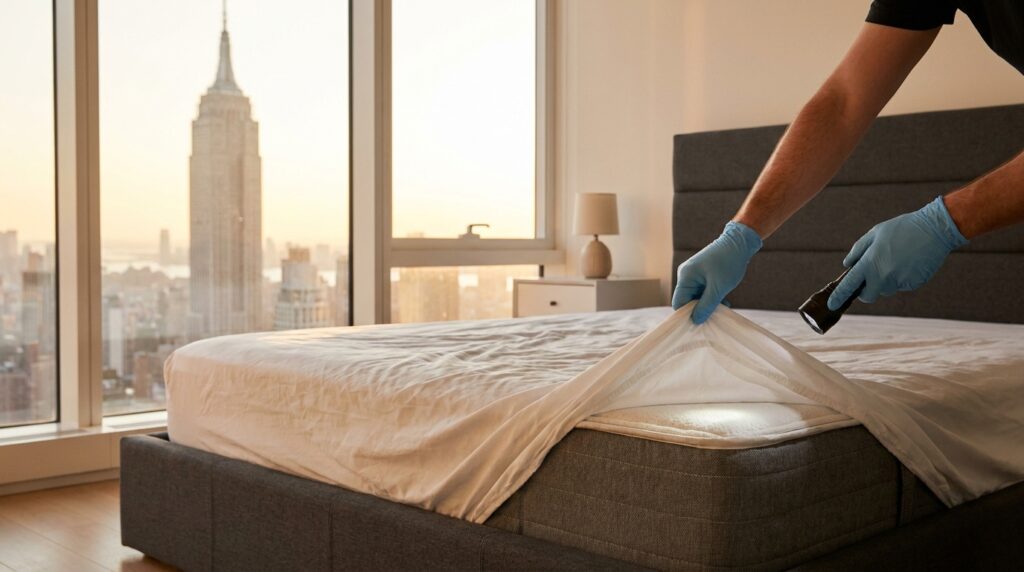
The most reliable early sign is rust-colored or dark fecal spotting on sheets, pillowcases, and mattress seams. These dots look like ink from a felt-tip pen and “bleed” into fabric when touched with a damp cloth. You may also see translucent, popcorn-shell-shaped molted skins (exuviae) tucked into seams, or reddish-brown adults the size and shape of an apple seed. Per Penn State Extension’s guide on bed bug biology and management, visual inspection alone catches roughly 72% of infestations. Pull your fitted sheet entirely off, run a flashlight beam parallel to the mattress seam, and look at the box spring corners.
Bed bug bites often appear in a linear “breakfast, lunch, and dinner” cluster — three or four red welts in a row along the line where your skin met the mattress. But bite reactions vary wildly between people — one roommate can be covered in welts while another shows nothing, and bites can take up to 14 days to appear. Never use bites alone for a diagnosis. Once a Manhattan tenant suspects bed bugs, every itch feels like a crawling insect — the fastest cure is certainty. Our overview on the broader signs of bed bugs across NYC walks through bite patterns and common misidentifications.
Where Do Bed Bugs Hide in High-Rise Manhattan Apartments?
The hiding spots in a Manhattan high-rise are not the same as in a single-family home, and they are not even the same between a 1920s pre-war building and a 2018 luxury tower.
Pre-war Manhattan buildings (Upper East Side, Upper West Side, Murray Hill, Tudor City) were built with plaster-and-wood-lath walls, deep crown molding, original baseboards, and parquet floors. All of those features create cracks and crevices that bed bugs love. The crown molding alone offers a continuous hiding seam that runs the full perimeter of the room. We always inspect crown molding seams, the joints where baseboards meet the floor, and any picture rail moldings before we leave a pre-war unit.
New construction high-rises in Hudson Yards, the Financial District, and waterfront towers use sheetrock construction with fewer surface crevices. But they have something pre-war buildings often lack — a dense web of electrical outlets, USB charging ports, and recessed light fixtures that all open into the wall void. Those wall voids connect units. We pull outlet covers (with the breaker off) on Manhattan high-rise inspections more than anywhere else we work.
Beyond beds, the unobvious spots include behind wall-mounted headboards, inside the pleats of heavy blackout curtains, picture frames, and the gap where a built-in HVAC unit meets the exterior wall. In compact studios, we also check the seams of fold-out couches and built-in storage benches. Bed bugs fit anywhere you can slide a credit card.
How Do Bed Bugs Spread Between Units in a Manhattan High-Rise?
This is the question that separates Manhattan from every other borough. Bed bugs do not fly. But in a 40-story Manhattan tower, they don’t have to.
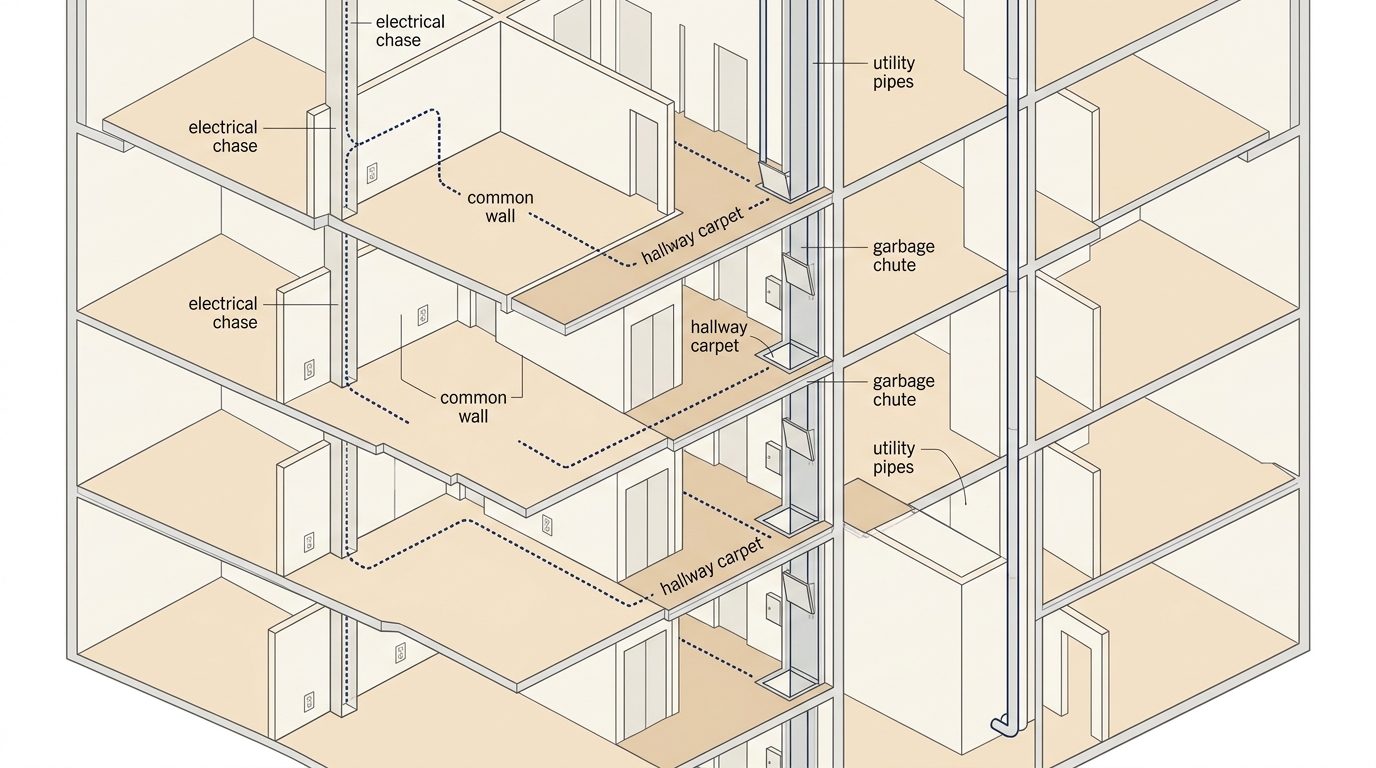
In a high-rise, bed bugs migrate between units through electrical chases, common walls, hallway carpet, garbage chutes, and utility pipes that act like highways for the entire building. The NYC Department of Health confirms this directly — “If an apartment is found to have bedbugs, notify and inspect all units that are across, above and below the infested one.” Common pathways:
- Electrical chases — vertical shafts carrying wiring between floors. Outlets and switches open into them.
- Common walls — bed bugs walk along stud bays inside drywall partitions between adjacent units.
- Hallway carpet — bed bugs hitch on shoes and rolling luggage, then drop off at a different door.
- Garbage chutes — discarded bedding and mattresses move bugs vertically inside the chute walls.
- Utility pipes — plumbing risers, HVAC chases, cable conduit, anywhere drywall is penetrated.
When we confirm a positive unit in a Manhattan tower, the standard professional response — and what your co-op board is legally required to coordinate — is to immediately inspect the four surrounding apartments: above, below, left, and right. If any come back positive, the grid expands again from each new positive. We’ve seen this play out — a management company once skipped the grid in an 80-to-100-unit building. Within one month, almost half the units had infestation. The cleanup cost more than $40,000 over three months. The whole spiral could have been prevented by one timely grid inspection.
Bed bugs in your NYC apartment?
26+ years treating NYC bed bugs. Crossfire residual where it counts, no annual contracts, and a free inspection that's waived when you book.
What Are Your Co-op Board’s Legal Obligations for Bed Bugs?

If you live in a Manhattan co-op or condo, the legal framework is heavily on your side — even though most shareholders don’t know it.
Class B violation, 30-day window. NYC HPD classifies a bed bug infestation as a Class B housing violation. Once HPD issues a Notice of Violation, the property owner — in a co-op, the Cooperative Corporation, not the individual shareholder — has 30 days to address it. The owner must hire a NY State DEC-licensed pest management professional, inspect, and check all adjacent units. There is no version of NYC law where a co-op board can punt the bill to an individual shareholder.
Multiple Dwelling Law and warranty of habitability. Under New York Multiple Dwelling Law §78(1) and the implied warranty of habitability in Real Property Law §235-b, a landlord — including a Cooperative Corporation — must warrant that an apartment is habitable and free of conditions that adversely affect a tenant’s health. Habitat Magazine summarized it cleanly — co-op boards are legally obligated to exterminate bedbug infestations and prevent them from returning.
The 2024 72-hour notification rule. Effective December 22, 2024, New York State Real Property Law §235-J requires landlords to notify tenants of a bed bug infestation within 72 hours of becoming aware of it. That notification must go to tenants in units adjacent to, above, or below the infested unit, plus a notice posted in a common area. The notice may not identify the specific affected unit.
Local Law 69 and the annual bed bug report. Local Law 69 of 2017 requires every Manhattan multiple-dwelling owner to file an annual bed bug report with HPD between December 1 and December 31. Once filed, the property owner must distribute the receipt at lease commencement and renewal. NYC HPD’s official guidance spells out the property owner’s full set of obligations.
Lease clauses pushing cost to you. We’ve seen Manhattan leases attempt language saying the landlord won’t pay for bed bug extermination. Almost without exception, these clauses are unenforceable — the warranty of habitability cannot be waived by lease language under §235-b. Document everything in writing, then call 311 to file a formal HPD complaint.
How Do Doorman Buildings and Concierges Handle Bed Bug Inspections?
Doorman buildings add a coordination layer that smaller walk-ups don’t have. Most doorman co-ops require management approval before allowing a K9 bed bug inspection team into the lobby. The dog handlers usually coordinate arrival times to avoid peak resident traffic and use the freight or service entrance rather than the main lobby — for resident discretion and so the K9 isn’t distracted by foot traffic. Bed bug treatment teams in Manhattan high-rises almost always enter through service corridors.
Once an infestation is confirmed, the building must comply with the 72-hour notification rule. In doorman buildings, the notice is usually posted near the elevator banks and the lobby bulletin board — the law specifies a “common area accessible to all tenants” but does not require door-to-door delivery. Adjacent, above, and below units get a separate written notice. The doorman is usually the one who fields tenant questions about the posting, so they need a brief on what they can and cannot say.
When Should a Manhattan Co-op Choose Building-Wide vs Unit-by-Unit Treatment?
This is one of the toughest calls a Manhattan co-op board can make.
Single confirmed unit + clean grid → unit-by-unit. If we confirm bed bugs in one apartment and the four-apartment grid comes back clean (including K9 verification), the smart move is targeted treatment of the original unit plus K9 follow-up at 30 and 60 days. This respects the budget of a building that doesn’t actually have a building-wide problem.
Multiple positives across the grid → building-wide justified. If the grid expansion turns up bed bugs in three or four neighboring units — or the building has filed multiple positive units in the past 12 months — boards should consider a building-wide K9 sweep. Some Manhattan co-ops keep an annual K9 inspection contract specifically to catch quiet infestations early. The “$40,000 in three months” scenario was the result of skipping the grid and waiting too long.
The middle ground — floor-wide K9 sweep. A floor-wide K9 inspection of all units on the same floor as the positive unit, plus the floors directly above and below, catches the most likely vertical spread paths without the cost of treating every unit.
What Should You Do About Bed Bugs in a Manhattan Airbnb or Short-Term Rental?
Manhattan’s short-term rental market — even after recent regulation tightened it — adds a unique transmission risk that almost no other guide addresses. Whether you’re booking an Airbnb in Chelsea or a corporate housing unit in Midtown, run a five-minute inspection before you unpack. Place luggage in the bathtub or on a luggage rack pulled away from the wall. Pull back the fitted sheet at all four corners and inspect the mattress seam with a flashlight. Pull the headboard slightly away from the wall (most are wall-mounted) and look at the back surface for fecal spotting.
If you find evidence, photograph it, leave the unit immediately, and report to the platform. Do not move your luggage from the bathtub until you can launder all clothing on high heat. The Northeast IPM Center’s travel guidance for bed bugs is the cleanest summary we’ve seen of post-trip prevention. Many Manhattan condo and co-op boards now restrict short-term rentals specifically because of pest history — if you’re a host whose unit gets a confirmed infestation, the 72-hour notification requirement still applies to your neighbors, so address it through a licensed pest control professional and report to your board to stay ahead of the disclosure cycle.
How Should You Look Up a Manhattan Building’s Bed Bug History Before Signing a Lease?
The single best piece of due diligence a prospective Manhattan tenant can do is look up the building’s bed bug history before signing. NYC has built one of the most transparent disclosure systems in the country and almost no one uses it.
Step 1 — HPD Online. Enter the building’s address. The overview page shows the BuildingID number, plus tabs for complaints and violations. Bed bug complaints are listed under “pests” in the complaint condition column. Open violations mean the landlord has not yet remediated.
Step 2 — NYC OpenData for closed violations. HPD Online doesn’t show closed violations, so use NYC OpenData’s Housing Maintenance Code Violation dataset. Query by BuildingID for violations dating back to 2013. Compare the notice-of-violation issued date to the certified-correction date — that delta tells you how quickly the building responds.
Step 3 — The annual bed bug report. Per Local Law 69, every multiple-dwelling owner files an annual report between December 1 and December 31. Ask your prospective landlord for the latest filing receipt — they’re required to provide it at lease signing, and a refusal is itself a red flag.
Step 4 — Crowdsourced sources. Apartment review sites like OpenIgloo and borough Reddit communities surface “off-the-books” reports — tenants self-treating without filing through the landlord.
If a building has multiple recent bed bug complaints, multiple open violations, or a slow correction time, walk away. Bed bug history is one of the few data points where the Manhattan rental market reliably underprices risk.
What Treatment Options Work Best for Bed Bugs in a Manhattan High-Rise?
Treatment in a Manhattan tower has to balance three things — eradicating bugs, respecting co-op pesticide notification rules, and not displacing residents for longer than necessary.
Heat treatment. Whole-room heat is one of the fastest paths to eradication. Per Penn State Extension, temperatures of 131°F or above are lethal to all bed bug life stages — a typical treatment heats the room to 140°F for two hours or 130°F for three hours. No chemical residue, single visit. The constraint in Manhattan high-rises is that not every co-op approves whole-room heat because of equipment power draw and the need to seal HVAC supply registers. For more on the science, see our deep dive on the temperatures that actually kill bed bugs.
Chemical treatment with IPM. Chemical treatment using pyrethroid sprays, neonicotinoid mixes, and crack-and-crevice dust is the most common path. We pair this with mechanical control — vacuuming, steam treatment of mattresses and couches, and interceptor cup monitoring under bed legs. The biopesticide Aprehend (Beauveria bassiana) has become a useful low-residue, family and pet-friendly option for shared walls.
Cryonite (CO2 freezing). Cryonite uses liquid CO2 to deposit a super-cooled “snow” that kills bed bugs on contact. It’s especially useful in luxury Manhattan apartments with sensitive electronics, antique furniture, or art that can’t be exposed to chemical residue or whole-room heat.
K9 detection follow-up. After any treatment, a K9 inspection at 30 and 60 days verifies eradication. Trained bed bug dogs detect infestations with 97% accuracy across all life stages, including viable eggs that visual inspection often misses.
For high-rise jobs, we typically combine targeted chemical + steam in the affected unit, pull and dust electrical outlets in adjacent units, recommend interceptor cups under all beds in the four-apartment grid, and schedule K9 verification at the 30-day mark. We coordinate directly with management agents on resident notifications, freight elevator scheduling, and the official NYC notification posting language. If you’re a board member or property manager dealing with a confirmed positive, our citywide bed bug treatment program handles the multi-unit coordination piece.
What Should Manhattan Tenants Do to Prevent Bringing Bed Bugs Home?
The risk on a typical NYC subway car is genuinely low. After any hotel stay or short-term rental, run all laundry — clean items included — through the dryer on high heat for 30 minutes. Per the New York State Department of Health bed bug guidance, high heat is one of the most reliable ways to kill all life stages on fabrics.
Manhattan’s “stoop-finding” culture is the highest-risk single behavior we see in our customer base. A free vintage dresser left on the curb has a non-trivial chance of harboring bed bug eggs in the drawer slides. If you absolutely must take street furniture, bag it before bringing it in the building, then disassemble and treat every joint — or skip it entirely.
A high-quality mattress encasement won’t stop bed bugs from entering your apartment, but it will trap any that get into the mattress and make the bed easier to inspect. Pair it with interceptor cups under every bed leg. Penn State’s research showed a 99% detection rate when interceptors and visual inspection are used together.
When treatment becomes necessary, ask any pest control company you call about family and pet-friendly options. We use products that have low-toxicity profiles for households with kids and animals. For context on what NYC pest control typically costs, our breakdown on what NYC pest control actually costs covers ranges and what changes the price. We also handle the broader Manhattan pest control work for cockroaches, mice, and seasonal pests.
Bed bugs in your NYC apartment?
26+ years treating NYC bed bugs. Crossfire residual where it counts, no annual contracts, and a free inspection that's waived when you book.
Key Takeaways for Manhattan Bed Bug Vigilance
Manhattan high-rises are a unique pest environment, and our team has spent more than 25 years figuring out the rhythms of co-op boards, doorman buildings, pre-war crevices, and new-construction wall voids. If you take only a few things from this guide, take these:
- The 2025-2026 trend is improving but Manhattan high-rises remain prime habitat. Orkin dropped NYC from #2 to #15, but density still matters in your specific 40-story building.
- The 72-hour notification rule (RPL §235-J, effective December 22, 2024) is your right. Adjacent, above, and below units must be notified within 72 hours of confirmation.
- Co-op boards must pay for treatment. Class B violation, 30-day correction window, no version of NYC law where shareholders eat the bill.
- Vertical spread is the rule. Electrical chases, common walls, hallway carpet, and garbage chutes act like highways. Inspecting only the affected unit is almost always a mistake.
- The four-apartment grid (above, below, left, right) catches problems before they become $40,000 building-wide events.
- HPD Online + NYC OpenData + the annual bed bug report give you all the data you need to vet a building before you sign a lease.
- Heat, chemical-plus-IPM, and Cryonite all work — but K9 verification at 30 days is what proves the bugs are gone.
If you’re spotting evidence right now, get a professional inspection on the calendar. Document everything in writing to your board or building manager, and take time-stamped photos of any spotting or live bugs. We’ve built our Manhattan practice for 26 years and we know how to navigate doorman buildings, condo board approvals, and the four-apartment grid without disrupting your life more than necessary.