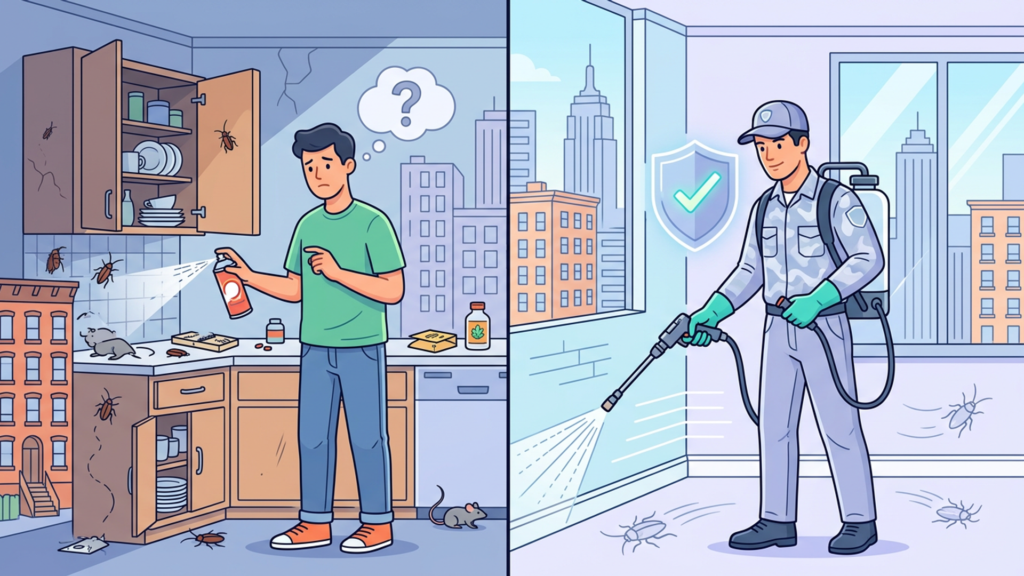
If you’ve spotted a roach darting across your NYC kitchen at 2 a.m., your first instinct was probably to grab a can of Raid — not call an exterminator. You’re not alone: studies show 54% of homeowners try DIY pest control first, only to end up hiring a professional anyway, effectively paying twice. This guide breaks down exactly when DIY makes sense in a New York City apartment, when it’s a waste of money (or even illegal), and how NYC’s unique building dynamics, tenant laws, and pest pressures change the calculus compared to the rest of the country.
Got a pest problem in NYC?
26+ years treating NYC homes. No contracts, month-to-month plans, and $50 to $100 off your first service.
What Are the Real Pros and Cons of DIY Pest Control in NYC?
Situations Where DIY Can Work
Minor ant trails, occasional silverfish, or a single mouse sighting in an otherwise well-sealed apartment can often be managed with targeted bait stations and basic exclusion work. Gel bait products like Advion and Vendetta, combined with an IGR like Gentrol, contain the same active ingredients many pest control professionals use for German roaches — and they’re available online for a fraction of the service call cost.
YouTube tutorials now show step-by-step professional application techniques that renters can replicate with the right equipment and products. For minor, isolated infestations, DIY can cost as little as $20–$50 in products versus $200–$400 for a single professional visit in NYC.
Hidden Risks and Costs Most NYC Renters Don’t Consider
NYC has stricter pesticide regulations than most states. Some professional-grade products like Crossfire may have restrictions on consumer use, and improper application can trigger indoor air quality violations under city health codes. Store-bought foggers and repellent sprays scatter pests into walls and neighboring units rather than eliminating them, making the building-wide problem worse.
The science backs this up: research from the University of Kentucky found that common consumer residual insecticides lack efficacy against both susceptible and resistant German cockroach populations. That means even when you buy the “professional strength” spray at the hardware store, it may not actually kill the roaches in your apartment.
The 54% “double payment” statistic hits especially hard in a high-cost city. The average NYC renter who tries DIY first spends $50–$100 on products that don’t work, then $250–$500 on a professional — totaling more than just calling a pro from the start.
NYC-Specific Challenges That Undermine DIY Efforts
Pre-war buildings with plaster walls, old pipe penetrations, and shared wall cavities create pest highways that no amount of apartment-level spraying can address. Population density means your neighbor’s hygiene and pest situation directly impacts yours — individual DIY efforts are often futile without building-wide coordination.
Many NYC tenants avoid participating in building pest control due to stigma, but opting out allows infestations to persist and spread to units that are actively being treated. As one NYU study on ant infestations illustrates, it’s a collective action problem that DIY simply can’t solve alone.
How Do DIY Treatments Interfere With Professional Pest Control in NYC Apartments?
Chemical Incompatibility Between DIY and Pro Products
Here’s something most renters don’t realize: repellent sprays (which make up most over-the-counter products) are chemically incompatible with the non-repellent bait strategies professionals deploy. The repellent residue is undetectable to the technician but actively drives pests away from bait stations, undermining the entire treatment plan.
When tenants spray baseboards with DIY products before a scheduled professional treatment, roaches and rodents scatter deeper into walls, making the pro visit less effective. Pest control technicians consistently report that tenant DIY interference is one of the top reasons treatments fail in multi-unit NYC buildings.
The Multi-Unit Building Problem
In a multi-family building, pests displaced by DIY spraying in one unit simply migrate to adjacent apartments through shared plumbing chases, electrical conduits, and wall voids. Effective cockroach control in NYC apartments requires a coordinated, building-wide IPM (Integrated Pest Management) approach — something the EPA’s IPM guidelines have long recommended for urban multi-family housing.
Landlords and property managers who allow uncoordinated tenant DIY treatments risk prolonging infestations and increasing long-term costs. Industry estimates suggest $160/month per building for ongoing professional service as a baseline for multi-family properties — far cheaper than the compounding costs of failed individual efforts.
What to Do If Your Building Already Has a Pest Service
Communicate with your building’s exterminator before using any products — even “natural” sprays can interfere with professional bait placements. If the building’s contracted exterminator is doing bare-minimum work (a quick spray and leave), advocate for better service or file an HPD complaint rather than layering on DIY products.
Ask the professional specifically what products they’re using so you can avoid chemical conflicts if you supplement with targeted bait between visits. Knowledge is your best tool here.
Which NYC Pests Absolutely Require Professional Treatment?
Bed Bugs: The NYC Pest You Cannot DIY
There is overwhelming consensus from pest professionals and Cornell’s bed bug FAQ alike: bed bugs require professional treatment — period. Heat treatment combined with targeted chemical application is the gold standard, and typical NYC costs run $1,800+ per apartment for bed bug control.
DIY bed bug attempts — foggers, rubbing alcohol, diatomaceous earth alone — consistently fail and can spread the infestation to other rooms or units, a pattern well-documented in NYC Civil Court proceedings involving tenant-landlord disputes. Canine detection services help confirm infestations before committing to expensive treatment — a worthwhile $300–$500 investment in NYC where false alarms are common.
German Cockroach Infestations Beyond the Early Stage
A few roaches can be managed with gel bait (Advion + Gentrol IGR), but once you’re seeing roaches during the daytime, the infestation is severe and likely embedded in walls. At that point, professional intervention is needed.
German roach eggs hatch on a 28-day cycle, so any DIY protocol requires consistent reapplication over 2–3 months — most renters give up too early. Building-wide infestations are extremely common in NYC and require coordinated professional treatment across multiple units, which is why cockroach control in Manhattan often involves whole-building strategies rather than unit-by-unit approaches.
Rodents and Termites in NYC Structures
Mice and rats in NYC require professional exclusion work — sealing entry points with steel wool and caulk at every pipe penetration, gap, and crevice — before any trapping or baiting program can succeed. This is skilled labor, not a weekend DIY project. Proper rodent control in multi-unit buildings demands a structural approach; snap traps in one apartment won’t address the colony living in the basement or between floors.
Termites are relatively rare in NYC high-rises but present in brownstones and wood-frame homes in the outer boroughs. Termite control always requires licensed professional treatment and often a warranty-backed plan, as the structural damage at stake far exceeds any DIY savings.
What Are Your Legal Rights as an NYC Tenant When It Comes to Pest Control?
Landlord Obligations Under NYC Housing Law
NYC landlords are legally required to maintain pest-free conditions under the warranty of habitability and the NYC pest management guide — pest infestations are a violation, full stop. Rent-stabilized tenants have specific protections: landlords cannot pass pest control costs to tenants, and persistent infestations can be grounds for rent reduction through DHCR proceedings.
Landlords must also provide notice of pesticide applications and use least-toxic methods first under NYC’s Pesticide Notification Law (Local Law 37). If your landlord is ignoring your complaints, you have legal leverage.
How to File an HPD Complaint and Protect Yourself
If your landlord ignores pest complaints, file a complaint with NYC HPD (Housing Preservation & Development) online or by calling 311. An inspector will be assigned to verify the violation.
Document everything: photos, dates of sightings, written complaints to your landlord, and any receipts for DIY products you purchased due to landlord inaction. Tenants who pay out-of-pocket for professional pest control due to landlord negligence may be able to deduct costs from rent or recover them in housing court — but consult a tenant attorney before withholding rent.
Renter vs. Owner Considerations
Homeowners and condo owners bear full responsibility and can choose any licensed provider; co-op shareholders should check their proprietary lease for pest control provisions. Small multi-family landlords should budget for ongoing professional service rather than relying on tenant DIY — liability exposure from improper pesticide use by tenants can far exceed the cost of a monthly contract.
If you’re a renter spending your own money on pest control, keep every receipt. You may have legal recourse, and you’ll want to avoid products that could violate your lease or NYC pesticide regulations.
Got a pest problem in NYC?
26+ years treating NYC homes. No contracts, month-to-month plans, and $50 to $100 off your first service.
How Do You Choose a Legitimate Pest Control Company in NYC and Avoid Scams?
Verifying Licenses and Credentials
All pest control operators in New York must hold a valid Commercial Pesticide Applicator or Technician certification from the NYS Department of Environmental Conservation (DEC). Ask for the license number and verify it on the DEC website before any work begins.
Nearly 200 violations have been issued to unlicensed companies going door-to-door in NYC. Never hire a company that cold-calls or knocks on your door offering same-day service without credentials. Reputable pest control providers in Manhattan will gladly share their license information, carry liability insurance, and provide written treatment plans.
Red Flags and Quality Indicators
A technician who spends less than 15 minutes in your apartment is likely doing the bare minimum — thorough inspections and treatments take 30–60 minutes for a standard NYC unit. As Consumer Reports notes, modern IPM protocols use targeted baits, dusts, monitors, and exclusion work rather than baseboard spraying alone.
Ask whether the company uses non-repellent products and IPM strategies. This is especially important in multi-unit buildings where repellent chemicals scatter pests to neighbors, creating an expensive cycle of re-infestation.
Eco-Friendly and Non-Toxic Professional Options in NYC
NYC-based pest professionals increasingly use 25b (minimum risk) products that are exempt from EPA registration and offer solid efficacy with residual effects — these are pet-safe and child-safe. Green pest control services are a practical middle ground for renters who want professional expertise without harsh chemicals.
Non-toxic options work best as part of an IPM approach that prioritizes exclusion and sanitation. They’re less effective as standalone treatments for heavy infestations, but for prevention and mild issues, they’re a smart choice.
What Is the Real Cost Breakdown of DIY vs. Professional Pest Control in NYC?
NYC-Specific Pricing by Pest Type
- Roaches (German): DIY gel bait kit $25–$60 vs. professional one-time treatment $200–$400 vs. monthly service $80–$150/visit
- Bed bugs: DIY attempts $50–$150 (almost always fail) vs. professional heat + chemical treatment $1,800–$3,000+ per unit — see bed bug control in Manhattan for local pricing context
- Mice/rats: DIY traps and steel wool $30–$75 vs. professional exclusion + trapping program $300–$600 initial + $100–$200/month for rodent control in Manhattan
- Ants: DIY bait stations $10–$30 (often effective for minor issues) vs. professional treatment $150–$300
The True Cost of Doing It Twice
The 54% statistic bears repeating: most DIY attempts are not savings — they’re sunk costs added on top of the eventual professional bill. Factor in your time: hours spent researching products, applying treatments, cleaning up, and reapplying over weeks have real value, especially in a city where time is already scarce.
Failed DIY attempts can worsen infestations, leading to more expensive professional treatments than if you’d called early. A moderate roach problem at $250 can become a severe infestation requiring $800+ in treatments after weeks of ineffective spraying.
When DIY Delivers Genuine Savings
Exclusion work — sealing cracks, installing door sweeps, caulking pipe penetrations — is the highest-ROI DIY activity and should be done regardless of whether you hire a pro. For minor, early-stage ant or roach sightings in a well-sealed apartment, targeted gel bait with proper technique can resolve the issue for under $50.
Ongoing prevention — cleaning protocols, proper food storage, reducing moisture — is always DIY and always essential. No professional treatment succeeds long-term without tenant cooperation.
Should You DIY or Hire a Professional for Pest Control in Your NYC Apartment?
DIY first if you’ve spotted a few ants or a single mouse, your apartment is well-sealed, you’re willing to research proper products and techniques, and your building doesn’t have an active professional service you’d be undermining. A helpful resource for DIY versus professional pest control can guide that decision based on your specific situation.
Call a pro immediately if you see bed bugs, daytime roach activity, rodent droppings in multiple areas, or any pest issue in a multi-unit building where coordination matters. Start with your landlord and escalate to HPD if needed.
Always DIY exclusion and sanitation regardless of your treatment choice — sealing entry points and eliminating food and water sources is the foundation that makes any treatment actually work.
Review your lease and know your rights. Your NYC landlord likely owes you pest-free conditions under the law, and you shouldn’t be paying for their obligation. If you hire a pro, verify their NYS DEC license, ask about IPM protocols, and request a written treatment plan.
If you go DIY, stick to targeted baits (not repellent sprays), follow the 28-day reapplication cycle for roaches, and monitor results honestly. If the problem isn’t improving in 4–6 weeks, it’s time to call in a pest control professional before the infestation spreads further, as we explore in our guide on getting rid of bed bugs in Queens. The cheapest pest control is the one that actually works the first time.