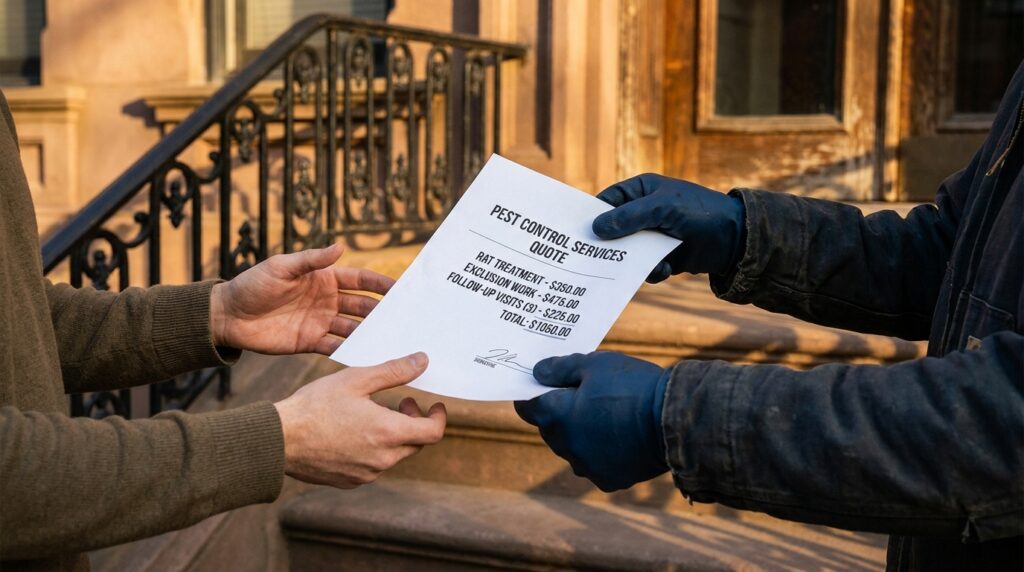
If you’ve ever asked a NYC pest control company “how much for the rats?” and gotten a vague “we’ll need to inspect first,” you’re not alone. Rat extermination is one of the few home-services categories where the published “average price” articles online — most pulled from national survey data — have very little to do with what New Yorkers actually pay. We’ve quoted thousands of rat jobs across all five boroughs and out to Nassau and Suffolk over the last 26 years, and the gap between Angi’s national averages and what shows up on a real Brooklyn brownstone invoice is wider than most homeowners expect.
This guide breaks down what we actually charge (and what we see other NYC companies charging) for professional rat removal in NYC in 2026 — by visit type, infestation severity, building type, and contract structure. We’ll also walk through which line items belong on a real quote, where the cheap-out traps are, and what you legally don’t have to pay for if you rent.
Rats in your NYC building?
26+ years on NYC rat work. Wall-void exclusion plus exterior bait stations from a team that knows how rats move through pre-war buildings, no annual contracts.
What Does a NYC Rat Exterminator Cost on Average?
For a typical one-time rat treatment in a NYC apartment or small home, expect to pay between $250 and $700. A thorough rat job that includes exclusion (sealing entry points so they don’t come back) usually runs $1,200 to $1,800 based on what we and our peers in the industry charge — that range was actually validated on r/pestcontrol, where working pros pushed back on a homeowner who’d been quoted $6,000 and called the real number $1,200–$1,800 for a typical exclusion + extermination job.
Angi’s 2026 New York rat exterminator cost data puts the city-specific normal range at $216 to $495 with an average around $345 — but that figure represents a single visit, not a full resolution. National chains like Orkin and Terminix tend to run 20–40% above local NYC operators for the same scope of work; one Reddit user shared a $920 contract from Orkin that broke down as a $360 first visit plus four monthly $140 follow-ups. For comparison, our own initial rat visit in NYC starts at $450, and most of our rat customers move onto either a one-year seasonal plan or a monthly recurring program once the immediate problem is handled.
What makes the cost wider than just “a flat rate per visit” is that a single treatment rarely solves a NYC rat problem on its own. Norway rats — the dominant species across the city — produce up to six litters a year and don’t move on their own once they’ve found a food and water source. So the real cost question is rarely “how much for one visit?” — it’s “how much to actually make this stop?”
Why Is Rat Extermination in NYC Pricier Than Mouse Treatment?
The single biggest reason rat work costs more than mouse work is rat behavior. Mice are curious — they investigate new objects (snap traps, bait stations) within hours. Rats exhibit something called neophobia, a genuine fear of new objects, and they’ll often avoid a freshly placed trap or bait station for days or even a full week. That single biological fact changes the entire job. Where a mouse treatment can sometimes be wrapped in two visits, rats almost always require a pre-baiting strategy, multiple visits to seed the area before traps go live, and patience between visits to let the colony adjust.
That alone adds two to four visits to a typical rat job versus a mouse job. And the labor isn’t the only difference. Norway rats — body length 7 to 9 inches, thick build, tail shorter than the body — burrow in soil, force their way through foundation gaps, and are strong swimmers tied to NYC sewer infrastructure. Roof rats (5 to 8 inches, longer tail) prefer height: attics, roof lines, utility lines. Each requires a different exclusion strategy and different equipment, which is why correctly identifying which rodent you actually have matters financially. Misidentification — assuming you have mice when it’s actually rats — is one of the most expensive mistakes a homeowner can make on a DIY first round, since mouse-sized snap traps and 1/4-inch entry-point sealing won’t touch a Norway rat infestation.
If you’re not sure what you’re dealing with, our walkthrough on the telltale signs of rats in a NYC apartment covers the droppings, gnaw marks, and grease trails that distinguish a true rat problem from a mouse one. If the evidence still looks ambiguous, our companion guide to mouse-specific signs in NYC walk-ups shows what mouse droppings, tracks, and gnaw marks look like for direct comparison — getting the ID right before you call a pro is the difference between a $250 trap-and-bait visit and a $1,500 exclusion job that actually finishes.
What’s Actually Included in a Rat Exterminator Visit?
A real rat extermination quote should have at least five distinct line items, even if it’s bundled into one flat fee. When a quote shows up as just “$X for rat treatment,” that’s almost always a sign you’re being underbid on a job that won’t actually finish. Here’s what we include in every NYC rat job — and what to look for in any quote you’re comparing:
- Inspection and identification — Before any chemical or trap goes down, our technicians walk the unit, check for active signs (droppings, gnaw marks, grease trails, burrow openings), and identify whether it’s Norway, roof, or house mouse. This is usually $150–$200 as a standalone fee, but most of our colleagues in NYC waive it if they get the work.
- Treatment plan and product selection — Bait stations (we use Bell Labs First Strike Softbait), snap traps, multi-catch traps, and rodenticide selection based on the property type. Tracking powder like Tempo Dust gets used in wall voids when rats are nesting inside the structure.
- Initial baiting and trap deployment — Strategic placement based on travel routes, food sources, and entry points. For rats, this usually involves pre-baiting (food only, no traps) for the first 24–72 hours to overcome neophobia.
- Exclusion work (sealing entry points) — This is the line item most cheap quotes leave out, and it’s why those quotes don’t actually solve the problem. Real exclusion runs $175 to $525 for typical apartment work per Angi’s NYC data and well into the four figures for whole-home jobs with foundation work, basement gaps, or sidewalk burrow access. We use steel mesh, hydraulic cement, and pipe-collar sealing — not foam.
- Follow-up visits and guarantees — At least one return visit to check trap activity, refresh bait, and verify exclusion holds. Reputable companies bundle 1–3 follow-ups into the initial price; cheaper companies charge $44–$131 per return.
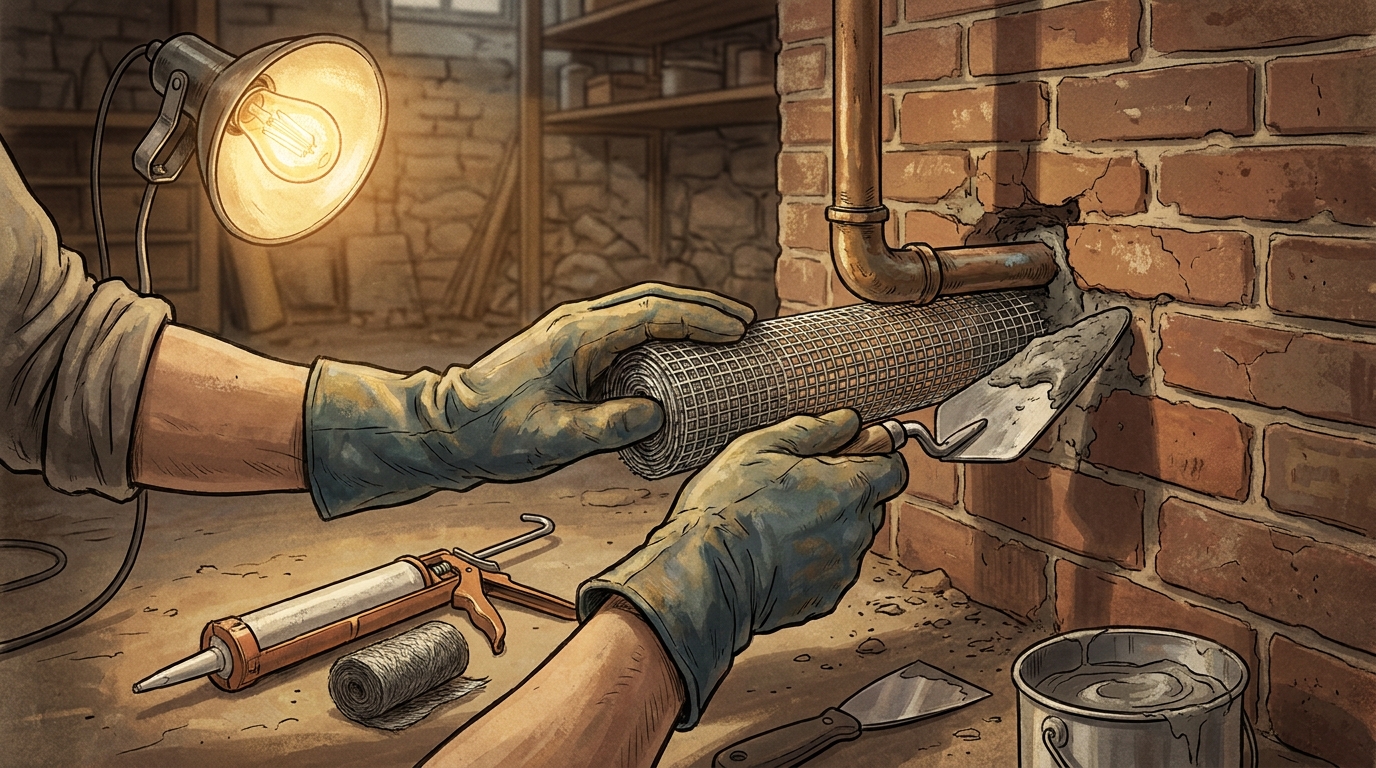
A real example from a recent Reddit thread that matched our typical Brooklyn brownstone job: $1,600 inclusive of removal, a one-way exclusion door for any rats still inside, and post-remediation cleanup, plus $35/month for ongoing monitoring afterward. That’s the kind of itemization a serious quote should look like.
How Do Rat Exterminator Costs Break Down by Infestation Severity?
Severity is the second-biggest cost driver after building type. Most NYC homeowners underestimate where their problem actually sits on the severity scale, which is why first quotes often feel high — the technician is pricing the actual work, not the “I saw one rat in my kitchen once” version.
| Severity | What it looks like | Typical NYC cost range |
|---|---|---|
| Mild | One or two rats spotted, fresh activity in a single room, no nesting evidence | $250–$500 |
| Moderate | Active droppings in multiple rooms, evidence of feeding, signs of an entry point | $600–$1,200 |
| Severe | Visible activity day and night, multiple entry points, established burrows or wall-void nesting | $1,500–$5,000+ |
| Whole-home or commercial | Multi-unit infestations, basement burrows, brownstone yard nests, restaurant infestations | $2,000–$10,000+ |
Angi’s national severity ladder for rat work tracks similarly — small or mild $88 to $438, moderate $263 to $613, large or severe $876 to $7,005. Whole-home fumigation (very rare in NYC; typically reserved for warehouses or extreme commercial cases) runs $1 to $3 per square foot.
What pushes a job from “moderate” to “severe” in our experience is almost always one of three things: (1) the rats have been active for more than 90 days before someone called, (2) there’s an outdoor nesting site (a yard burrow, a sidewalk tree-pit, a sewer line break) that’s continuously feeding rats into the unit, or (3) the building has shared infrastructure (a multi-unit walk-up, a pre-war wall void) that means treating one apartment without coordinating the whole building won’t actually finish the job.
What NYC-Specific Factors Drive Rat Treatment Cost Up?
NYC isn’t priced like Long Island, and it’s certainly not priced like the national average. A few city-specific realities push our quotes — and every legitimate competitor’s quotes — higher than what online cost calculators predict:
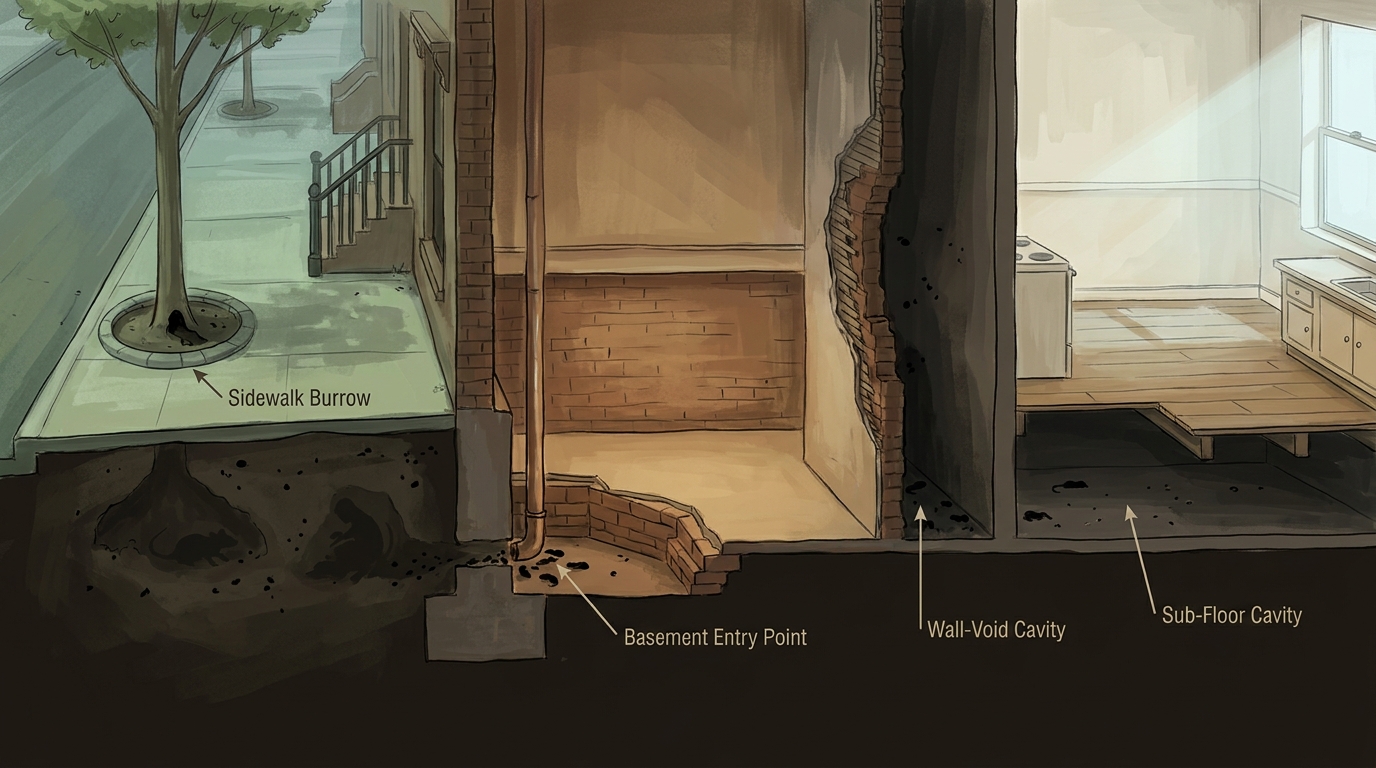
Pre-war buildings and wall voids. A 1920s Brooklyn brownstone or a Manhattan walk-up has plaster walls, old plumbing, and decades of accumulated openings around radiators, gas pipes, and elevator shafts. Rats use these as highways between units. Treating a single apartment in this kind of building without addressing the wall-void network is a guaranteed callback. Our techs use wall void drilling and dusting for these jobs, and that adds equipment and labor time to the base price.
Brownstones with yard access. Brooklyn and parts of Queens have a unique cost factor: backyard or sidewalk burrows. We’ve worked Brownstones in Bed-Stuy, Park Slope, and Crown Heights where the rats were nesting in a yard burrow 15 feet from the basement door. Eliminating those requires exterior burrow treatment plus interior exclusion plus often coordination with neighboring buildings — that’s a $1,500–$3,000 job, not a $300 one.
Sidewalk tree-pit burrows and the carbon monoxide method. A small but growing number of NYC exterminators are using carbon monoxide injected into sidewalk tree-pit burrows to knock down street-level rat populations. PIX11 News profiled Brooklyn exterminator Matt Deodato using this method on East 86th Street, where Council Member Julie Menin commissioned the program. The carbon monoxide machines cost about $3,000 each — which is why only a handful of city operators offer it — but Deodato reported 90 to 95% knockdown success across the 100+ burrows treated. If your building’s rat problem is being fed by sidewalk burrows, this kind of specialized work is where pricing climbs above the standard residential range.
Multi-unit coordination. When one apartment in a six-unit walk-up treats and the others don’t, the rats just shift to a neighboring unit. We’ve seen homeowners spend $800 on three rounds of treatment that fail because the source was the basement next door. NYC.gov’s Pest Control Guidance portal recommends building-wide Integrated Pest Management (IPM) for exactly this reason, and the NYC Health Department offers free IPM technical assistance to multi-residential building owners willing to commit to it.
DSNY 2024 containerization rules. New York’s mandatory sealed-container rules for residential trash (rolled out through 2024) are starting to reduce surface food access for rats — but buildings out of compliance still create active feeding stations that no amount of interior treatment will overcome. Some of our quotes now include a recommendation memo for the building owner about containerization, because without it the work won’t hold.
Rats in your NYC building?
26+ years on NYC rat work. Wall-void exclusion plus exterior bait stations from a team that knows how rats move through pre-war buildings, no annual contracts.
One-Time Visit vs Monthly Plan vs Annual Contract — Which Saves NYC Rat Customers Money?
We get asked this constantly, and the answer depends entirely on whether the rats are a one-time problem or a chronic one. Here’s the honest math:
| Plan type | Typical NYC pricing | Best for |
|---|---|---|
| One-time treatment | $250–$700 (apartment), up to $2,000+ (whole home with exclusion) | First-time problem in a building with no rat history |
| Monthly recurring | $65–$175/month (after initial $250–$450) | Multi-unit buildings, restaurants, properties with chronic pressure |
| Quarterly maintenance | $150–$450/quarter | Single-family homes, post-remediation monitoring |
| Annual seasonal plan | $700/year (our seasonal plan rate) for 4 visits + 1-year guarantee + unlimited callbacks for covered pests | Homeowners who want predictable budgeting and coverage |
For a typical Brooklyn or Queens apartment dealing with a fresh rat problem, a one-time treatment plus 30-day guarantee usually settles things — that’s the right call when the source is identifiable and contained. For brownstones, multi-unit buildings, restaurants, or anywhere with sidewalk-fed pressure, a monthly or annual plan saves real money over the long run because you’re not paying for repeat full-price visits every time activity returns.
Our annual seasonal plan at $700/year is a strong fit for single-family homes in Nassau and Suffolk where rat pressure tends to be seasonal (fall and winter spikes) and where the home will benefit from a structured 4-visit schedule — our rat exterminator coverage in Nassau County is built around exactly that perimeter work. Quarterly plans tend to make sense in Nassau and Suffolk yards where the perimeter work matters more than the interior. Recurring monthly programs are the standard for restaurants, multi-unit residential buildings, and any commercial property covered by NYC Health Department inspection requirements — and we structure those through our ongoing rodent control program with consistent technicians and detailed service logs.
For a broader view of pricing across all NYC pest categories — bed bugs, roaches, ants, mosquitoes — see our comprehensive pricing guide for NYC pest control. This rat-specific post is meant to be the deep dive; the general guide covers the rest.
Who Pays for Rat Extermination in NYC — You or Your Landlord?
If you’re a renter in NYC, this is the most important question on the page, and the answer is almost always: your landlord pays, not you. Under NYC Local Law 55 and Housing Maintenance Code Section 27-2017, NYC landlords are legally required to maintain rental apartments free from rats, mice, cockroaches, and bed bugs — it’s part of the warranty of habitability, not an optional service. The NYC Health Department’s pest control guidance for residents makes this clear, and tenants can file complaints through 311 if a landlord refuses to act, which results in HPD violations and mandatory remediation timelines.
We see two common situations on our calls. The first is a tenant who’s been told “you brought the rats” or “this is your problem” — that’s almost never accurate, and our front-office team coaches tenants through the 311 process so they don’t end up paying out of pocket for a building-level problem. The second is a tenant who’s offered a “skip the wait” deal — one Reddit user shared a real NYC scenario where their landlord offered them $120 to bring the building’s exterminator earlier than the scheduled monthly visit. That’s a different situation, and sometimes it’s worth it for the speed; just don’t pay it under the impression that you’re legally required to.
For NYCHA residents, pest control runs through NYCHA’s own program, and tenants should call the NYCHA customer contact center rather than booking private exterminators. For co-ops and condos, the responsibility usually falls on the building (covered by common-charge budgets), not the individual unit owner — though specifics vary by building bylaws.
If you own the building (one-family home, brownstone, multi-unit landlord), the cost is on you — but a well-handled extermination + exclusion job usually pays for itself through avoided HPD violations, reduced tenant turnover, and protected property value. Federal cost data on the broader economic burden of rodent infestations puts the U.S. total in the billions, much of it absorbed by property owners who delayed treatment.
What Are Red Flags in Cheap (or Inflated) NYC Rat Exterminator Quotes?
Both ends of the price spectrum have their warning signs. Here’s what we’ve learned from 26 years of getting called in to fix what other companies left behind:
Cheap-quote red flags (under ~$200 for a real rat job):
- The quote includes only baiting or only trapping, with no exclusion line item. Without sealing entry points, you’re paying for a recurring bill, not a solution.
- The company doesn’t ask about building type or unit history before quoting. Real rat work depends on whether you’re in a pre-war walk-up, a brownstone with a yard, or a high-rise — anyone quoting flat without that context is guessing.
- No NYC DEC pesticide applicator license number on the invoice or website. New York requires licensing for commercial pesticide application; reputable companies put this prominently.
- “30-day guarantee” only on a job that clearly needs follow-up. For real rat work, look for at least a 90-day to one-year guarantee.
Inflated-quote red flags (north of $3,000–$5,000 for a typical residential job):
- The $6,000 quote we mentioned earlier — when that came up on r/pestcontrol, working professionals pegged the real number for a typical exclusion + extermination at $1,200 to $1,800. If your quote is more than 3x the local industry standard, get two more quotes before signing.
- Door-to-door salespeople with same-day pressure tactics (“if you sign now, we’ll waive the inspection fee”). National chains like Orkin and Terminix often use this script — local NYC companies almost never do.
- Bundled long-term contracts (24+ months) you can’t cancel without penalty. Reputable NYC pest companies offer month-to-month recurring service after the initial. Lock-in contracts protect the company, not you.
- Treatments billed by the rat (some companies charge $44 per live rat removed). This is legitimate for live-relocation services but inflates fast on an active infestation; flat-fee + exclusion is almost always cheaper.
For industry-wide cost benchmarking, the NPMA Pest Control Industry Cost Study 2025 is a useful sanity check — it covers operating costs and gross margins across the U.S. pest management industry, so you can see what reasonable markup looks like.
The bottom line on red flags: a thorough free inspection from a licensed local NYC company should give you a written quote with at least the five line items we listed above, a clear scope of work, and a guarantee window in writing. If any of that’s missing, get another quote.
The Bottom Line: What to Budget for Rat Extermination in NYC
For most NYC homeowners and commercial property owners, the realistic 2026 budget for serious rat work breaks down like this: $250–$700 for a single-visit treatment in a small apartment with limited scope, $1,200–$1,800 for a thorough exclusion + treatment job that actually solves the problem, and $2,000–$5,000+ for whole-home or multi-unit work with significant exclusion or commercial scope. Rent? Your landlord almost certainly owes the cost — call 311 before you reach for your wallet.
We’ve been doing rat work in NYC since 1999, and the most common mistake we see is paying twice — once for a too-cheap job that didn’t include exclusion, then again three months later when the rats come back. Pay once for a real job from a licensed local company, get the exclusion done, and budget for one or two follow-ups within the guarantee window. That’s how NYC rat costs actually pencil out.
If you’re staring at a rat problem right now and want a real number for your specific building, our team offers free estimates across all five boroughs and out to Nassau and Suffolk — same-day service during business hours, with 27 technicians who’ve worked everything from Bed-Stuy brownstones to Long Island City warehouses. Lisa or one of our front-office team can typically get you a same-day inspection scheduled, and the quote you get will itemize exactly what’s included so you can compare it apples-to-apples against anyone else.