If you spent the last weekend in Sunken Meadow, the Greenbelt on Staten Island, or even just doing yardwork off Sunrise Highway, we believe you should run a careful tick check before you sit down to dinner. Ticks have been on a tear across the New York City + Long Island region for the last few seasons, and 2025 set a record we don’t want to see beaten. NYC’s Department of Health has confirmed five tick species inside the five boroughs, and Suffolk County reported 3,152 Lyme cases in 2024 — still near its all-time high.
We’ve been treating yards and apartments across NYC and Long Island for 26+ years at Advanced Pest Management, and ticks are the pest we’ve seen change fastest. Species that didn’t live here in 1999 — lone star ticks, Asian longhorned ticks — are now established in Suffolk, the North Bronx, and Staten Island. We’ll cover the three tick species that matter most, the borough and county hot zones, real Lyme risk, and what we do (and don’t do) when homeowners call us. If you already know you’ve got a tick problem and need a yard sprayed, our professional tick control across NYC and Long Island is the fastest way to drop the population on your property.
Ticks in your NYC or Long Island yard?
26+ years on NYC and Long Island tick work. Ecovia MT yard treatments during peak nymph season May through July, kid-friendly and pet-friendly, no annual contracts.
What Are the 3 Tick Species You’ll Actually Find in NYC and Long Island?
The NYC Health Department lists five tick species in the five boroughs, but three of them account for nearly every meaningful bite our customers report. We’ll focus on those.
Blacklegged (Deer) Tick — Ixodes scapularis
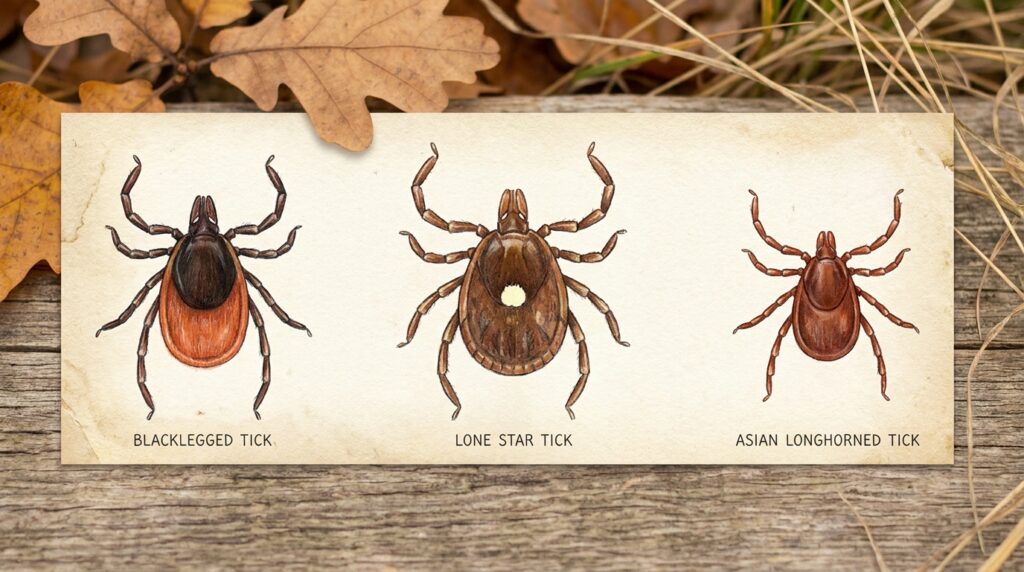
This is the one that carries Lyme disease, and the one Long Islanders fear most. The blacklegged tick is small — a sesame seed at adulthood, a poppy seed as a nymph — with a dark brown to black scutum (the shield behind the head), reddish-orange rear, and visibly black legs. According to Dr. Tom Mather at the University of Rhode Island’s TickEncounter program, about half of all adult female blacklegged ticks across the Northeast carry the Lyme disease germ. Half. That’s one in two ticks rolling the dice on whether you get sick.
Counterintuitively, adult blacklegged tick season actually starts AFTER the first frost — late September into October — and they stay active any day the temperature climbs above 40°F. That means you can pick one up in November or even January during a warm stretch. Our team has pulled adult deer ticks off customers in February.
Lone Star Tick — Amblyomma americanum
Ten years ago, lone star ticks were a southern problem. Today they’re firmly established on Long Island, the North Bronx, and Staten Island, and Long Islanders on r/longisland have a colorful nickname for them: bastards. The female is easy to identify — she’s got a single bright white spot dead-center on her brown back. They’re the most aggressive biter of the three, all life stages will bite humans, and their saliva is irritating enough that a fresh bite can itch for a week. The lone star tick is also the one we mention every time a customer asks about the alpha-gal red meat allergy — after a bite, some people develop a delayed allergic reaction to mammal meat (beef, pork, lamb) that can be severe.
Asian Longhorned Tick — Haemaphysalis longicornis
This is the new one. The first Asian longhorned ticks in Suffolk County were collected in 2018 and they’ve spread fast. They’re small, uniformly reddish-brown, and have one biological superpower that freaks out our techs: they reproduce without males. A single female can clone herself thousands of times — a behavior called parthenogenesis. So far in the U.S. they haven’t been confirmed to spread human disease, but Stony Brook Medicine and Suffolk County DOH are watching them closely. There are also American dog ticks (everywhere in NYC) and Gulf Coast ticks (rare, mostly Staten Island), but the three above are the ones we plan our yard treatments around.
Where Are NYC’s Tick Hot Zones — And Which Boroughs Are Worst?
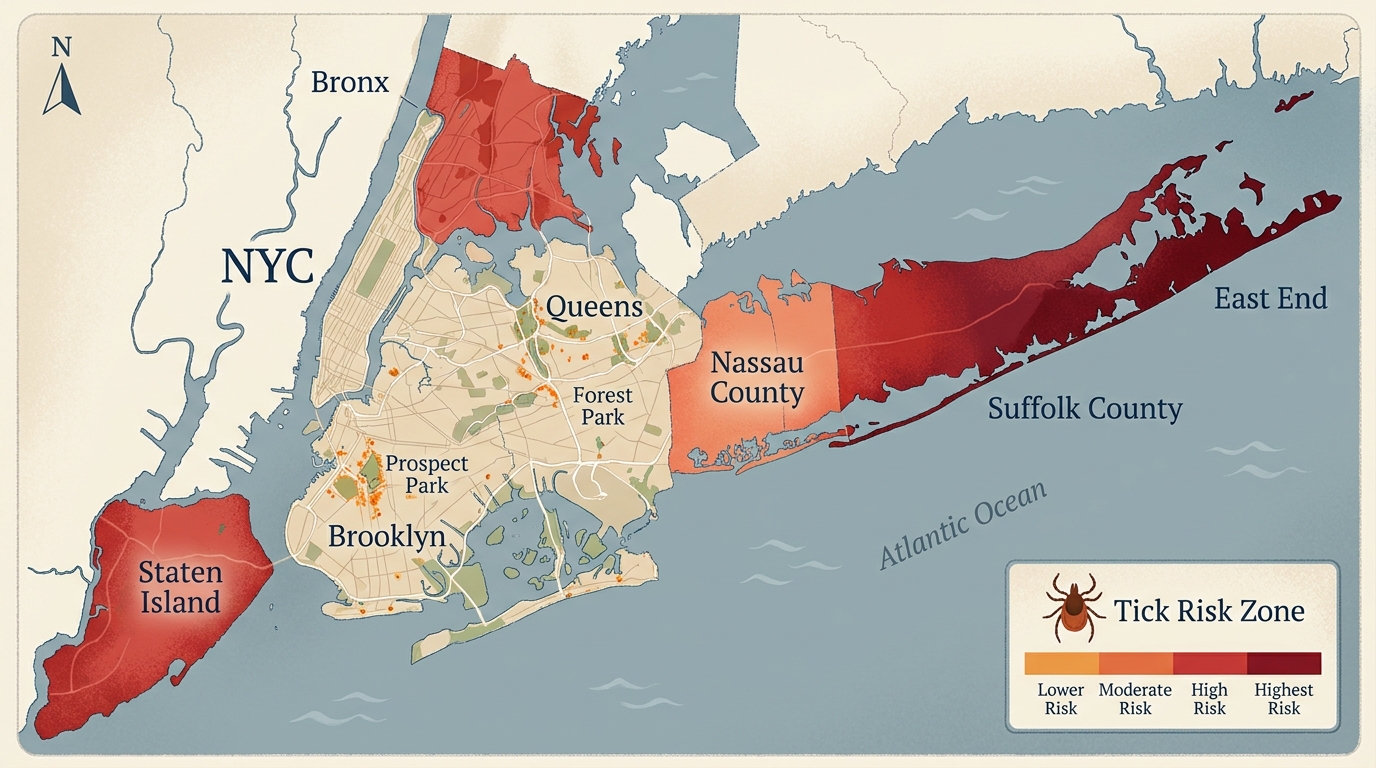
Most New Yorkers diagnosed with a tick-borne disease didn’t pick up the tick in Manhattan or central Brooklyn. Per the NYC Department of Health, they got it visiting Long Island, upstate, or one of the city’s pockets of woods. But the city absolutely does have hot zones. Staten Island is the worst NYC borough for ticks, full stop — Columbia University’s Eco-Epidemiology Lab runs the NYC Ticks research project almost entirely on Staten Island because that’s where deer, white-footed mice, and tick populations stack up. The Greenbelt, Clay Pit Ponds, Conference House Park, and Freshkills are all live tick zones.
The North Bronx is the city’s #2 — Pelham Bay Park is the largest park in NYC and harbors all five species, while Van Cortlandt Park and the Bronx River Forest see deer ticks regularly. Brooklyn and Queens are riskier than people think — in June 2025, Fox 5 NY ran a live segment from Prospect Park warning that the Fordham Tick Index (coined by Professor Thomas Daniel at Fordham University) had hit a perfect 10/10. Forest Park and the wooded edges of Prospect Park are not zero-risk. Manhattan is the safest borough, but Inwood Hill Park and the wooded sections of Central Park have produced ticks too — we’ve removed ticks from customers who insisted “I never leave Manhattan.”
Which Long Island County Has the Worst Tick Problem?
Suffolk County. It isn’t close.
Per Suffolk County’s Department of Health Services, Suffolk’s 1.8 million residents report the highest absolute number of tick-borne disease cases in New York State. The recorded Lyme case counts tell the story:
| Year | Suffolk Lyme cases |
|---|---|
| 2014 | 654 |
| 2018 | 476 |
| 2020 | 340 |
| 2022 | 2,668 |
| 2023 | 3,299 |
| 2024 | 3,152 |
The jump from 2021 to 2022 is partly a case-definition change (NY simplified its Lyme reporting that year), but the underlying trend is real and ugly. Add babesiosis (140 cases in 2024), ehrlichiosis (56 cases), and anaplasmosis (34 cases), and Suffolk County is dealing with a tick-borne disease load that no other downstate county comes close to matching.
Within Suffolk, the East End is the worst. Our customers in Southampton, East Hampton, Montauk, Shelter Island, and Sag Harbor live with tick pressure from May through November that approaches Lyme-belt Connecticut levels. Long Island Reddit threads back this up — locals describe finding 15 ticks crawling on them after a single afternoon in the grass. One r/longisland user put it bluntly: “Ticks are EVERYWHERE on Long Island. Permethrin is most effective. Lyme disease is no joke. I ended up in the hospital last year with sepsis from it.”
Nassau County is meaningfully better than Suffolk but still not safe. Roslyn, Brookville, Old Westbury, and the wooded North Shore towns we serve all see deer ticks. The further west you go (Hempstead, Garden City, Long Beach), the lower the risk — but it’s never zero.
How Bad Is the Lyme Disease Risk From a Single Tick Bite?
A single tick bite is not the same thing as a Lyme infection. Three things have to line up: the tick has to be carrying Borrelia burgdorferi (roughly 25-30% of blacklegged ticks in NYC do, rising to about 50% in adult females across the Northeast), the tick has to stay attached long enough (the CDC and NY State Department of Health cite a 36-hour attachment window as the rough threshold for Lyme transmission), and the bite has to actually break skin and start a blood meal. Other diseases — Powassan virus, anaplasmosis — can transmit much faster, sometimes in 15 minutes.
The classic warning sign is the bull’s-eye rash (erythema migrans), which appears in 60-80% of Lyme infections. It looks like a target — central red dot, clearing ring, outer red ring — and can show up at the bite site OR anywhere on the body. Other early symptoms: fever, headache, fatigue, stiff neck, joint pain. If you develop any of these within a month of a tick bite, see your doctor. Lyme is highly treatable with antibiotics if you catch it early.
Ticks in your NYC or Long Island yard?
26+ years on NYC and Long Island tick work. Ecovia MT yard treatments during peak nymph season May through July, kid-friendly and pet-friendly, no annual contracts.
When Are Ticks Active in NYC and Long Island Throughout the Year?
The short answer is “any day above 40°F,” which in our region means most of the year. March–May: adult blacklegged ticks finish their winter activity, lone star adults emerge. June–August: peak nymphal blacklegged tick season — these poppy-seed-sized ticks are responsible for most Lyme transmission because they’re so easy to miss. Lone star nymphs and adults peak too. This is when we get the most yard-treatment calls. September–October: tick activity drops slightly, then surges again as adult blacklegged ticks emerge after the first frost. This catches people off guard every single year. November–February: adult blacklegged ticks remain active any time temperatures climb above 40°F — we’ve removed ticks from dogs in January.
How Do You Check For and Remove a Tick the Right Way?
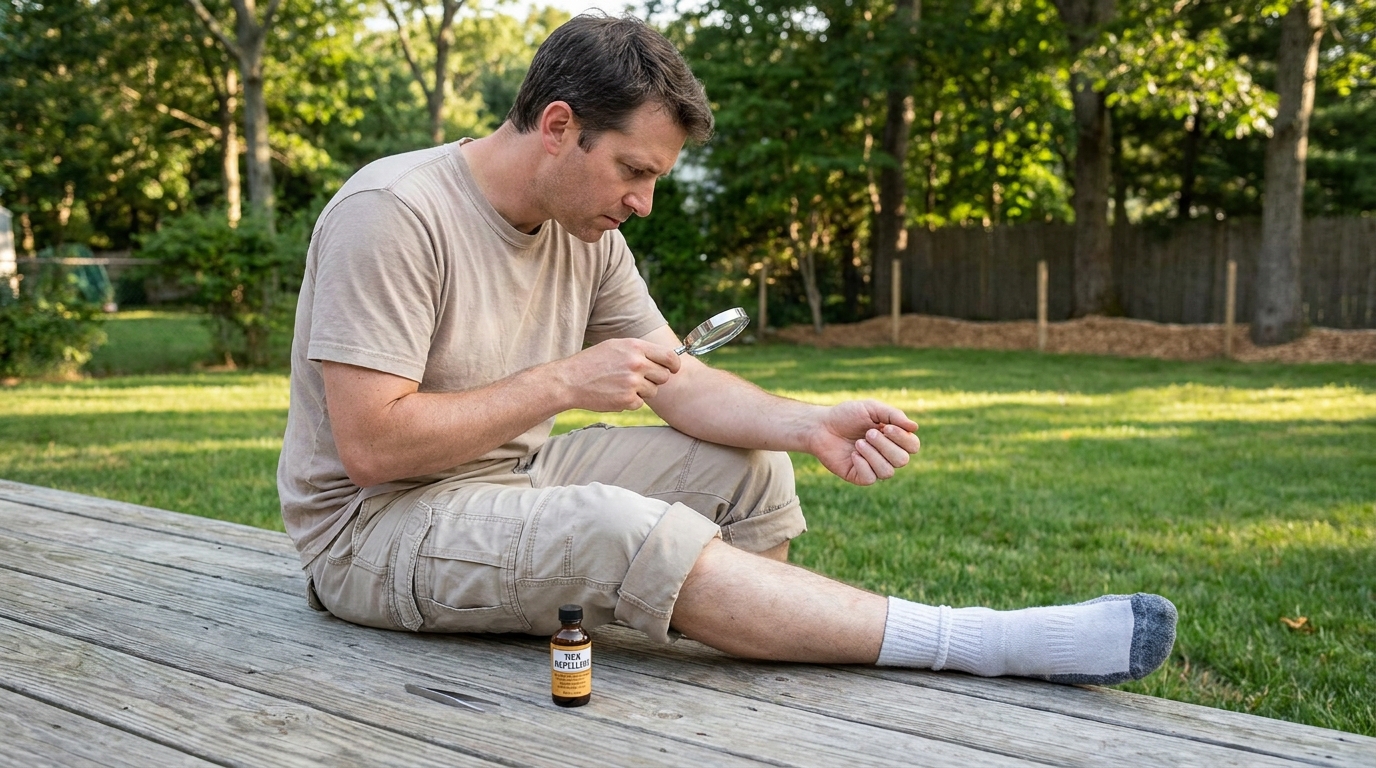
Two things our techs wish more people knew. First, ticks have numbing enzymes in their saliva — you literally cannot feel them attaching. Second, the daily tick check is the single most effective thing you can do, and most people skip it.
The right way to check: within 2 hours of coming inside, get in the shower and look behind your ears and hairline, under your arms, around your waist and belly button, behind your knees, and around the groin. Have a partner check your back and scalp. Run any worn clothing through the dryer on high heat for 10 minutes — heat kills ticks better than washing.
The right way to remove an attached tick: use fine-tipped tweezers (not a tick key, not your fingers), grasp the tick as close to the skin as you can — at the head, not the body — and pull straight up with slow, steady pressure. Don’t twist. Wash the bite area with soap and water and save the tick in a sealed bag in case symptoms appear later. Do NOT use Vaseline, nail polish, a hot match, or any home remedy — NYC DOH explicitly warns against these because they raise infection risk and can make the tick regurgitate pathogens into the bite.
Are There Tick Hot Zones to Avoid in Your Long Island Yard?
Yes — and the layout of your yard probably tells you where they are. Ticks concentrate where the conditions are right: shade, moisture, leaf litter, and host animals. The highest-risk yard zones are the 10-foot perimeter where lawn meets woods or brush, stone walls and log piles, tall ornamental grasses and ground cover (pachysandra, ivy, vinca), the area around bird feeders (which attract mice, and mice carry ticks), and shaded foundation plantings against the house. Lower-risk zones are open mowed lawn in full sun (ticks dry out and die in sun), concrete patios and decks, and the center of the yard well away from the woods edge.
The single most effective DIY change you can make is what Cornell’s Integrated Pest Management program (which runs the Don’t Get Ticked NY outreach) calls a tick-safe zone: a 3-foot-wide wood chip or gravel barrier between your lawn and any wooded area. It physically blocks tick migration. Combine that with mowed grass under 3 inches, no leaf litter, and trimmed shrubs, and you cut your yard’s tick density meaningfully. For pets, stick with vet-recommended monthly preventives — most of our customers with dogs use Bravecto, Simparica, or Frontline depending on what their vet prefers.
Should You Treat Your Yard Yourself, or Call a Tick Control Pro?
Honest answer: it depends on how bad your yard is and how much risk tolerance you have for chemicals. DIY can work if your tick pressure is mild and you’re willing to treat your clothing with permethrin (which is genuinely effective — Long Island Reddit treats it like religion), wear EPA-registered repellent (DEET, picaridin, IR3535, or oil of lemon eucalyptus) every time you go outside, and stick to over-the-counter products. Call a pro if you’ve been bitten more than once or had a tick-borne illness, you have kids or pets who play in the yard daily, your property backs up to woods or a park, or you see deer in your yard.
A note on a topic that comes up constantly on Long Island gardening forums: Talstar P (bifenthrin) is a restricted-use pesticide in New York, which means you legally need a Department of Environmental Conservation applicator license to buy and apply it. Online retailers sometimes ship it to homeowners anyway — don’t. Misapplication causes drift onto neighbors, water contamination, and pet exposure. Our licensed applicators apply targeted, properly-dosed barrier treatments to the perimeter, leaf-litter zones, stone walls, and woodpiles (not the open lawn), scheduled in late spring and again in late summer to hit both the nymph and adult cycles. Our annual seasonal plan includes a 1-year guarantee with unlimited callbacks if ticks return between visits.
When Should You Call APM Versus When Should You Call a Doctor for a Tick Bite?
We treat yards. We don’t treat people. If you’ve been bitten and you’re worried about a tick-borne illness, call your doctor — not us. Specifically, call your doctor if you have a known tick bite and develop fever, headache, fatigue, joint pain, or a rash within 30 days, if you see a bull’s-eye rash anywhere on your body, if the tick was attached longer than 24 hours, if you feel suddenly flu-like in the middle of summer, or if a dog in your household has tested positive for Lyme.
Call us if you’re finding ticks crawling on you, your kids, or your pets after time in your own yard, if you’ve had a Lyme-positive household member or pet, if you’re moving into a wooded property and want to set up a treatment plan before peak season, if you manage a multi-unit Suffolk property where tenants are reporting ticks, or if you simply want a free estimate. For pricing context, a one-time tick yard treatment for a typical Long Island property starts around the same range as our seasonal pest plan — and includes the 1-year guarantee. Larger properties (over half an acre) and properties with severe leaf-litter zones cost more.
If you live anywhere from Queens out through Nassau County and east into Suffolk and the East End, our team has been on yards in your zip code. Same-day service during business hours is the norm, and the office can usually book a tick assessment within 24 hours.
Quick Recap
Three tick species drive almost all the bites we see across NYC and Long Island: blacklegged (deer), lone star, and Asian longhorned. Suffolk County is the regional epicenter, with Staten Island and the North Bronx as NYC’s worst hot zones. Lyme risk is real but not deterministic — the tick has to be carrying it, attached for ~36 hours, and you have to miss it. The most powerful things you can do yourself are wear permethrin-treated clothing, do a daily tick check, keep your lawn short with a wood-chip woods barrier, and remove attached ticks correctly with fine-tipped tweezers.
If you’ve got a property with serious tick pressure or a household member who’s already had a tick-borne illness, professional yard treatment makes a significant difference and is what we’ve been doing for our NYC and Long Island customers since 1999. For a free estimate, give us a call or request a quote on the tick control service page — we’ll come walk the property and give you straight answers about what’s worth doing.
If you want more on what we see across the rest of the city’s pest landscape, our blog covers everything from signs of rats in Manhattan apartments to identifying common spiders found in New York homes and the very confusing water bugs in NYC question. Different pests, same city, same goal: helping you understand what you’re looking at before you call anyone.