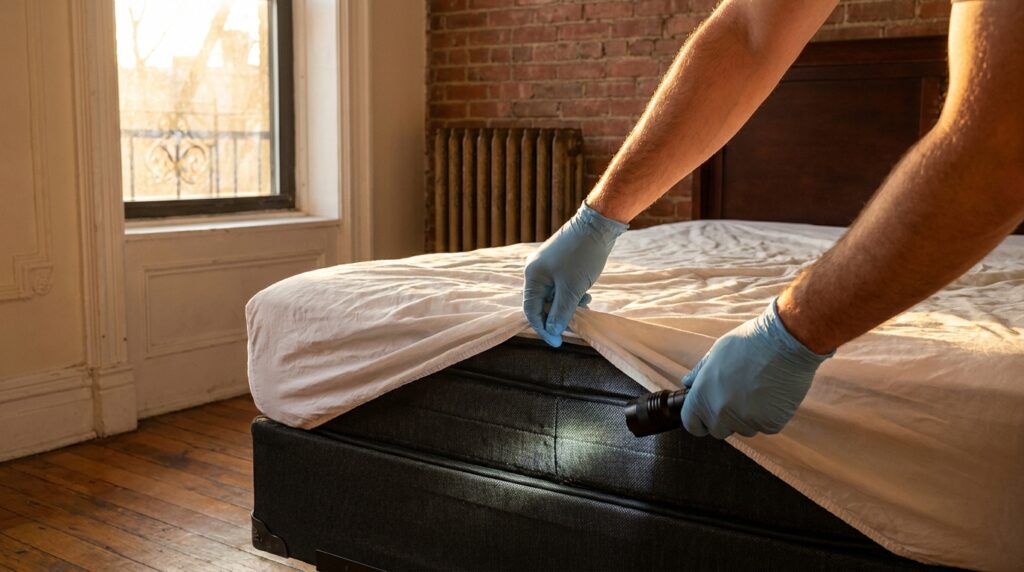
There are two kinds of phone calls we field after sundown. The first is the panicked one: a Park Slope renter spotted something dark in the mattress seam after stripping the sheets. The second is calmer but no less serious: a Bed-Stuy tenant has been dismissing welts for three weeks, and a roommate finally said the word out loud — bedbugs.
We’ve spent 26 years inside Brooklyn apartments, and the borough’s housing stock — brownstones with shared wall voids, walk-ups built before the war, garden apartments with shallow basements, lofts carved out of old factories — gives bed bugs plenty of places to hide and several routes between units. If you suspect an issue and you’re searching for professional bed bug treatment in Brooklyn, the first thing you owe yourself is an honest inspection. This guide is exactly that — borough-specific, building-specific, and grounded in NYC tenant law as it stands today.
Bed bugs in your NYC apartment?
26+ years treating NYC bed bugs. Crossfire residual where it counts, no annual contracts, and a free inspection that's waived when you book.
What Are the First 5 Places to Check for Bed Bugs in a Brooklyn Apartment?
We always start at the bed and work outward in concentric rings. Bed bugs are nocturnal, they feed on you for ten minutes at a stretch, and they retreat to the closest dark crevice when the meal is done. Pre-war Brooklyn apartments give them dozens of those crevices within four feet of your pillow.
Grab a small flashlight (your phone works), a credit card, and a piece of clear tape. Strip the bed down to the bare mattress. The five spots that catch infestations the fastest, in our experience:
- Mattress seams and tufts. Run the credit card edge along every seam, especially the head end and the corners. You’re looking for live bugs (apple-seed-sized, reddish-brown), translucent young about the thickness of a credit card, pearl-white eggs the size of a pinhead, and dark fecal “ink dot” stains that smear if you wipe them with a damp paper towel.
- The headboard and the joint where it meets the wall. Pull the headboard a few inches off the wall if you can. Wall-mounted headboards in Brooklyn rentals often hide the heaviest concentration of bugs because nobody ever moves them. Check the back surface and the screws.
- Box spring perimeter and underside. Flip the box spring up. The thin fabric stapled to the bottom is a top hiding spot. If you see fecal spotting through the fabric, the bugs are inside.
- Baseboards and the seam where the floor meets the wall within four feet of the bed. The Cornell IPM team teaches a step-by-step bed bug inspection method that emphasizes shining a flashlight at a sharp angle along these seams to throw shadows.
- Electrical outlets and switch plates near the bed. This one surprises people. Bed bugs travel along wiring conduits, which means an outlet two feet from your headboard is a textbook nesting site. We do not recommend opening the cover yourself, but a flashlight pointed at the slots will sometimes reveal fecal spotting around the edges.
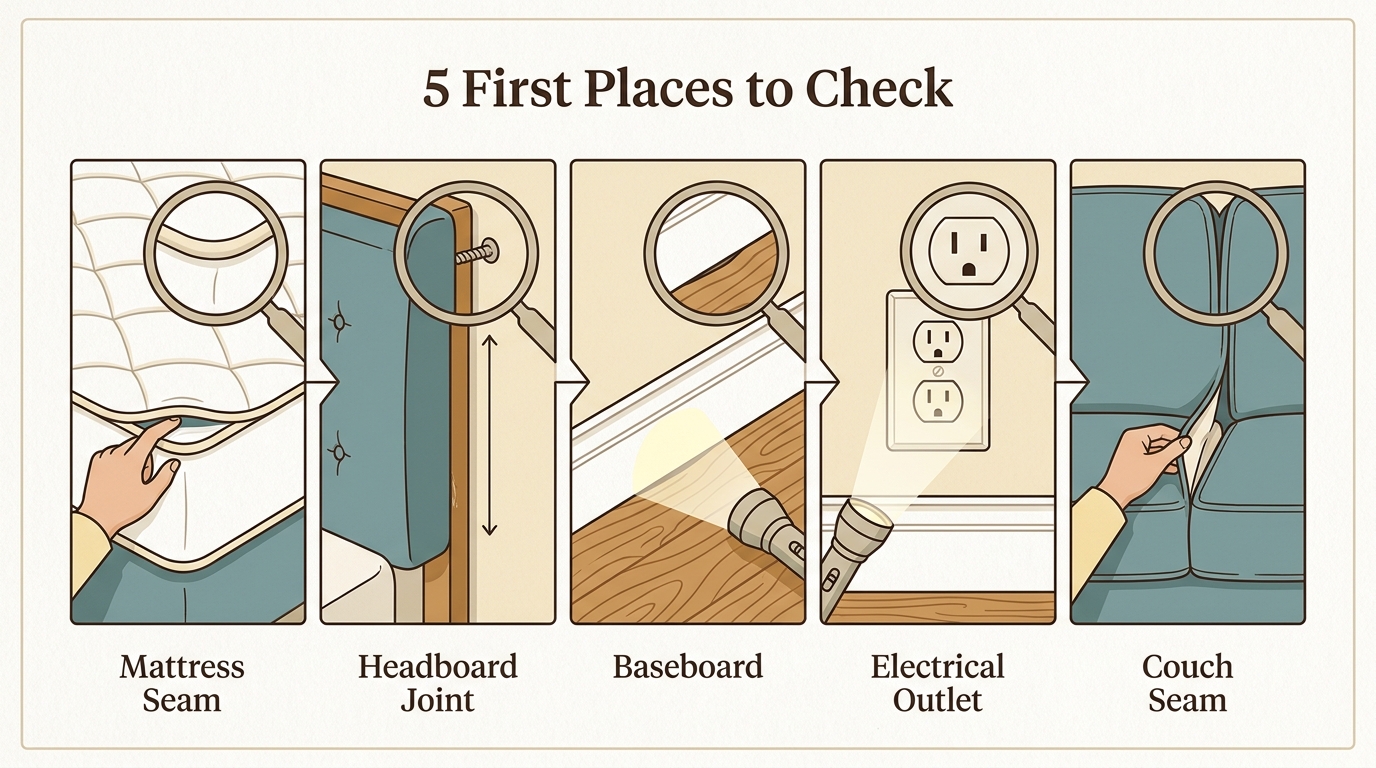
If those five turn up nothing, expand to the upholstered furniture in your bedroom (chairs, ottomans, the head end of a couch if your bed is in a studio), then to picture frames and the underside of nightstand drawers. We’ve found bugs nesting in a vintage clock radio more than once.
What Do Real Bed Bug Bites and Bedbug Evidence Look Like?
The bug itself is roughly the size and color of an apple seed when adult, flattens out to a credit-card thickness when hungry, and swells to a darker reddish-brown after a meal. The NYC Department of Health publishes a clear identification page on bedbugs we send to anxious clients regularly. The young (called nymphs) start out the size of the period at the end of this sentence and are nearly transparent — easy to mistake for lint, dust, or simply nothing at all.
The evidence on your sheets and mattress is often more reliable than spotting a live bug:
- Rust or “ink dot” fecal spots — tiny black smudges that look like felt-tip pen dots and bleed into the fabric when wet. This is digested blood. We treat clusters of these as a confirmed infestation until proven otherwise.
- Tiny blood smears — these happen when a fed bug gets crushed by a sleeper rolling over.
- Shed skins (exuviae) — pale, hollow versions of the bug. Bed bugs molt five times before adulthood, so an established colony leaves a lot of these behind.
- Pearl-white eggs about a millimeter long — glued to the surface where the female lays them. These are not pulled out by vacuuming, which is why we see so many “I vacuumed and they came back” calls.
Bites in our experience tend to follow what entomologists call the “breakfast, lunch, and dinner” pattern — three or four welts in a tight line or cluster, often along the edge where your skin met the mattress. They show up on exposed skin: forearms, ankles, the side of the neck. But here’s the part that catches people: roughly one in three adults has no visible skin reaction at all. We’ve inspected Brooklyn apartments where one partner is covered in welts and the other has nothing — and the bugs were biting both of them.
A separate trap is misidentification. The Brooklyn Reddit threads we read every week are full of panicked photos of carpet beetles, spider beetles, and booklice that turn out to be harmless. If you can capture the specimen on clear tape and slide it onto a piece of white paper, a professional can ID it in seconds. We do this for free during inspections.
How Do Bed Bugs Spread Between Brooklyn Brownstones, Walk-Ups, and Garden Apartments?
This is the part most generic bed bug guides miss, and it’s the reason “we treated and they came back” is the most common refrain we hear from Brooklyn tenants.
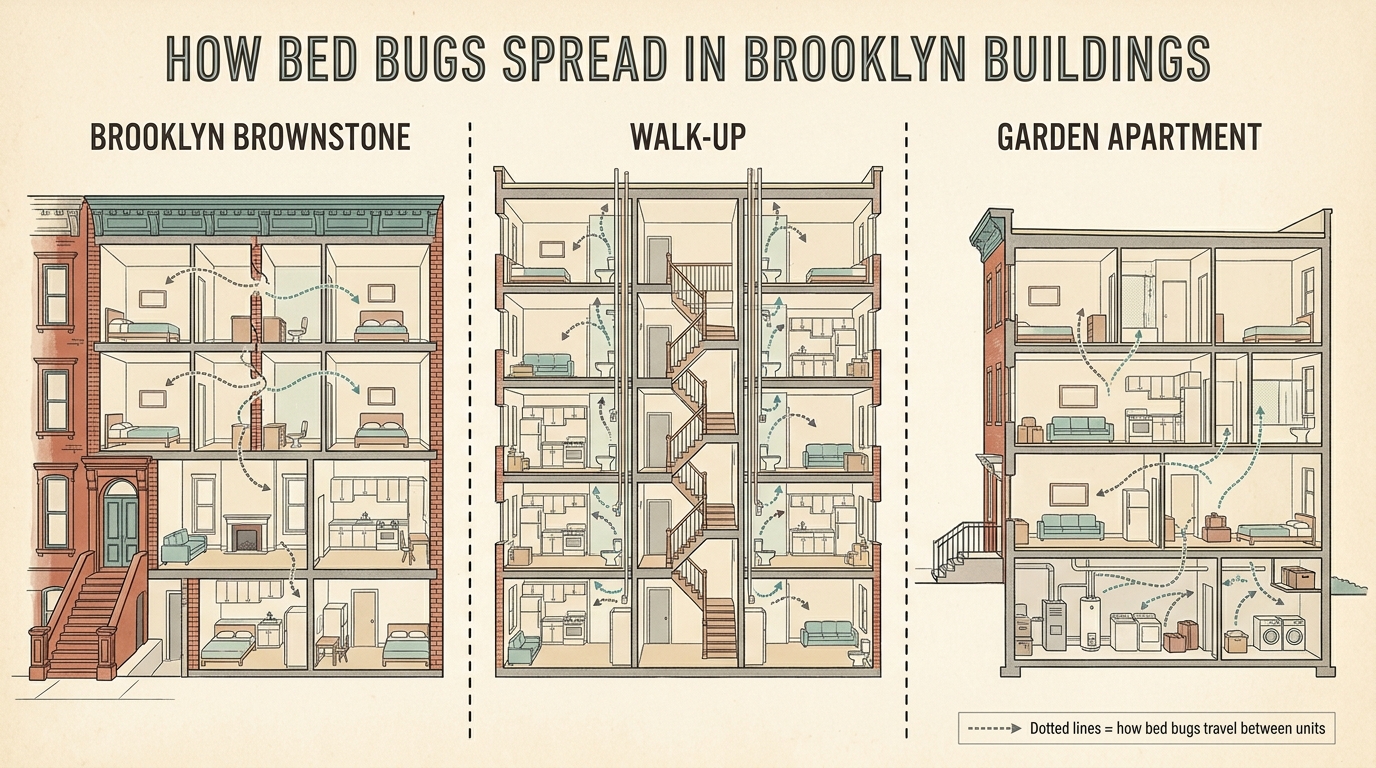
Brownstones (typically subdivided into 2 to 6 units): The shared wall voids on the brownstone party walls are the highway. We’ve seen Brooklyn brownstones where one unit’s infestation crawled through the wall behind the bed into the adjacent unit’s living room over the course of a few weeks. There’s a Reddit case study in r/legaladvice about a Brooklyn brownstone where a tenant’s exterminator finally admitted the bugs were “in the walls” and “the room is improperly sealed from the outside” — that diagnosis is depressingly common in the borough’s row houses. Effective treatment in a brownstone almost always means inspecting and treating the unit above, the unit below, and the adjacent unit on the party wall.
Walk-ups (typically 3 to 12 units, often pre-war): The risers — the vertical chases that carry plumbing and wiring up the building — are the inter-unit transmission path. Bed bugs travel along electrical wiring as readily as they travel along baseboards, so a single unit on the third floor can seed units on the second and fourth within a treatment cycle. This is why NYC’s HPD requires landlords to inspect adjoining units when an infestation is confirmed.
Garden apartments (typically subdivided ground-floor and basement units in row houses): The shared utility room is usually the central node. We treat a lot of garden-apartment cases where the bugs started in a basement storage area and migrated up through a closet wall. These units also see the highest rate of “stoop find” introductions — discarded furniture left on the curb that gets pulled inside before anyone realizes what’s living in it.
Lofts in Williamsburg, Bushwick, and DUMBO: The exposed brick and the long, open floor plans actually favor the tenant — fewer hiding spots within four feet of the bed. But the original wood beams, when reused from older industrial buildings, sometimes harbor longstanding harborage points that we have to treat with localized heat or targeted dust applications.
The takeaway, regardless of building type: a one-unit-only treatment in a multi-unit Brooklyn building is almost guaranteed to fail. The only reliable approach is to inspect and treat all units sharing a wall, ceiling, or floor with the confirmed unit. This is also what the law requires.
What Are Your HPD Tenant Rights Around Bed Bugs in Brooklyn?
NYC has some of the strongest bed bug tenant protections in the country, and they exist because the borough was at the center of the early-2000s infestation surge. Three rules every Brooklyn renter should know cold:
1. Bed bugs are a Class B violation under the NYC Housing Maintenance Code. That means your landlord has 30 days to correct the condition once it’s officially documented. The full HPD bed bug overview is published at the NYC HPD bedbug services page, and it’s required reading if you’re in a dispute.
2. The Bed Bug Disclosure Act (Local Law 69 of 2017) requires landlords to file an annual bed bug report with HPD every December. Owners of multiple-dwelling buildings have to disclose how many units had infestations the previous year, how many were treated, and how many had recurrences. They also have to either give you the filing receipt at lease signing and renewal or post it in a prominent spot in the building. Brick Underground has a useful walkthrough on how to research a building’s bed bug history before you sign a lease — we recommend running the address through HPD Online before you commit.
3. As of December 22, 2024, New York Real Property Law 235-J requires landlords to notify nearby tenants within 72 hours of becoming aware of a confirmed infestation. The notification has to go to tenants in the units adjacent to, above, and below the infested apartment, plus a posted notice in a common area. The posted notice cannot identify the specific unit, but it does give your neighbors a heads-up so they can inspect their own apartments.
Who pays? In Brooklyn buildings with three or more units, the landlord is responsible for paying for treatment under the Housing Maintenance Code. The landlord is generally entitled to use their own contracted exterminator, but we’ve seen tenants successfully negotiate a 50/50 split when they want to bring in a specialist with a different treatment method (heat, biological products like Aprehend, or canine confirmation). What is not always covered: the cost of an independent inspection if you want a second opinion.
If your landlord stalls or ghosts you — and the Reddit cases tell us this happens in Brooklyn brownstones owned by smaller landlords more often than tenants would believe — your next move is calling 311 to file a bed bug complaint, which triggers an official HPD inspection. Document everything: dated photos of bugs and bites, the dates you reported the issue in writing, and the dates of any treatment visits. The Met Council on Housing maintains a thorough tenant-side bed bug rights and remedies guide that’s worth bookmarking before you need it.
How Should You Prep Your Brooklyn Apartment for Bed Bug Treatment?
Treatment fails far more often because of bad prep than because of a bad exterminator. The broad strokes we send to every Brooklyn client:
- Do not throw your mattress on the curb in a panic. A bare, infested mattress dragged through your hallway and out the door is the single most efficient way to seed bugs into every unit it touches. If it truly has to go, seal it in a plastic mattress bag and label it BEDBUGS.
- Wash and dry every soft good on the highest heat your fabric can tolerate — sheets, pillowcases, blankets, curtains, every piece of clothing in the bedroom. The dryer is what kills the bugs and eggs. Aim for 30 minutes minimum on high heat.
- Bag laundered items in sealed trash bags until treatment is finished.
- Pull furniture six inches from the walls so the technician can reach baseboards and outlets along the perimeter.
- Empty the bottom two feet of every closet that shares a wall with the bedroom.
- Do not use store-bought bug bombs or foggers. Cornell IPM, the EPA, and the NYC DOH all agree. Foggers scatter bugs deeper into the walls — and in a Brooklyn brownstone, deeper into the walls means into your neighbor’s apartment.
We also ask Brooklyn clients to inspect their living-room couch and any upholstered chair before treatment day. If bugs are in the couch too, we fold that into the same visit so the colony cannot retreat there and re-emerge in the bed two weeks later.
Bed bugs in your NYC apartment?
26+ years treating NYC bed bugs. Crossfire residual where it counts, no annual contracts, and a free inspection that's waived when you book.
What Treatment Options Actually Work for Bed Bugs in a Brooklyn Apartment?
There is no magic spray. Anyone selling you one is selling you a return visit in three weeks. The treatments we use, and the trade-offs we explain to every Brooklyn client:
Conventional chemical treatment. Targeted application of professional pyrethroid and non-pyrethroid products to the perimeter, harborage points, baseboards, and bed frame. We follow NYC DEC licensing rules and use products from manufacturers like Bayer/Envu (Suspend, Tempo Dust) and MGK (Crossfire, our go-to for confirmed bed bug infestations). Two visits two weeks apart is the standard cadence — the second visit catches eggs that hatched after the first treatment.
Heat treatment (thermal remediation). The whole apartment is heated to 135°F for several hours, killing bed bugs and eggs in every life stage. Heat is the most effective single approach and works well for cluttered apartments and lofts. The trade-off is cost (typically 2–3x conventional) and prep — anything that can melt or warp has to leave for the day.
Biological products (Aprehend) and Cryonite (CO₂ freezing). Newer lower-toxicity add-ons. Aprehend is a fungal spore bugs carry back to harborage; Cryonite freezes them on contact at -110°F. We use these as targeted supplements, especially where pets, infants, or chemical sensitivities make conventional applications less appealing. Family and pet-friendly when applied correctly.
Mattress and box spring encasements + interceptors under bed legs. Zippered encasements trap surviving bugs and block new ones from nesting in the mattress. Plastic cup-style interceptors catch any bug trying to climb onto your bed and serve as an early-warning system. We leave both with every Brooklyn client for at least 8 weeks post-treatment to confirm the colony is dead.
For most Brooklyn one or two-bedroom apartments with normal furniture and no extreme clutter, we use chemical treatment plus encasements plus interceptors, with a follow-up at the two-week mark. For heavily infested units, lofts, or apartments where bugs are entrenched in wall voids, we recommend heat. For tenants who’ve already done two failed rounds with another company, we run canine confirmation on day one before deciding the protocol.
Why Do Bed Bug Treatments Fail in Multi-Unit Brooklyn Buildings?
We get called as the second or third exterminator on Brooklyn jobs more often than we’d like. The pattern is consistent. Treatments fail because of three predictable mistakes:
Single-unit treatment in a multi-unit building. As we covered above, treating one apartment in a brownstone or walk-up while the bugs reservoir in the adjacent unit guarantees reinfestation. The Reddit case from the Brooklyn brownstone — five exterminator visits over 18 months — is the worst-case version of this mistake.
Missing the second visit. Bed bug eggs are largely unaffected by most chemical treatments. They hatch 6–17 days after they’re laid. If there is no second treatment around the two-week mark to catch the freshly hatched nymphs, the colony rebuilds.
Tenant prep gaps. A perfect treatment fails if half the laundry never makes it into the dryer, if the bed is shoved back against the wall the same night, or if the tenant brings a “clean” suitcase out from under the bed and starts using it again before the all-clear.
In every Brooklyn case we’ve worked, addressing all three of these — multi-unit inspection, two-visit cadence, and rigorous prep — gets to eradication in 4 to 8 weeks. Skipping any one of them stretches the job into months.
How Do You Stop Bed Bugs From Coming Back to Your Brooklyn Apartment?
Once the bugs are out, three habits keep them out:
Inspect quarterly. Spend 15 minutes once a quarter doing the same five-point inspection from the top of this guide. The NYC DOH and Cornell IPM both recommend this as a standing routine, and it catches reintroductions long before they spread.
Treat your luggage and clothes after travel. When you come back from a hotel — anywhere, including hotels you trust — toss the entire suitcase contents directly into the dryer on high heat for 30 minutes before they touch the bedroom. The luggage itself stays out of the bedroom permanently. We keep a hard-sided bin in the hallway closet for our own travel gear.
Stop the stoop find. We love a Park Slope curb-find as much as the next Brooklynite, but discarded mattresses, upholstered chairs, and headboards are the single highest-risk source of new infestations in the borough. If a piece is irresistible, freeze it (a non-running car in the dead of January gets cold enough; otherwise a commercial freezer service) or run it through a heat treatment before it crosses your threshold.
For tenants who live in buildings with a known recent infestation history, we also recommend keeping interceptors under each bed leg permanently. They are unobtrusive, they cost almost nothing, and they will tell you within days if a bug has returned.
If you’re already past prevention and you need help, we offer same-day inspections across all 5 boroughs, including same-day pest control across Brooklyn and the broader NYC service area. We’ll walk every room with you, ID anything you’ve already trapped, and give you a straight answer about what we recommend. You can also read more on our bed bug treatment service page for product detail and warranty terms.
Quick Recap: Brooklyn Bed Bug Inspection Checklist
The five-minute version, for the next time you can’t sleep at 3 a.m. wondering whether you should be worried:
- Strip the bed. Run a flashlight along mattress seams, the headboard joint, the box spring perimeter, baseboards within four feet, and electrical outlets near the bed.
- Look for live bugs (apple seed size, reddish-brown), translucent young, pearl-white eggs, dark fecal ink dots, and pale shed skins.
- Tape any specimen to white paper for ID. If you’re still unsure, photograph and call a professional.
- Remember the bites can show up on only one person — the absence of welts on a partner doesn’t rule it out.
- If confirmed, file a 311 complaint to start the HPD clock and document everything in writing to your landlord.
- Demand inspection of adjoining units. Single-unit treatment in a Brooklyn brownstone or walk-up rarely holds.
Bed bugs in Brooklyn are stressful, but they are absolutely treatable when the inspection is honest, the treatment plan accounts for the building’s structure, and the prep is done right. We’ve worked through hundreds of borough infestations since 1999, and every one of them ended the same way — with a quiet, bed-bug-free apartment. Yours can too.
If you want a professional to take a look at your signs of bed bugs situation or you’ve already read our heat treatment temperature guide and want to talk through what’s right for your unit, give our team a call at (718) 418-8986 and we’ll set up a same-day inspection. (Curious about ballpark pricing first? Our NYC pest control cost guide covers the typical ranges.) We’ll bring the flashlight.