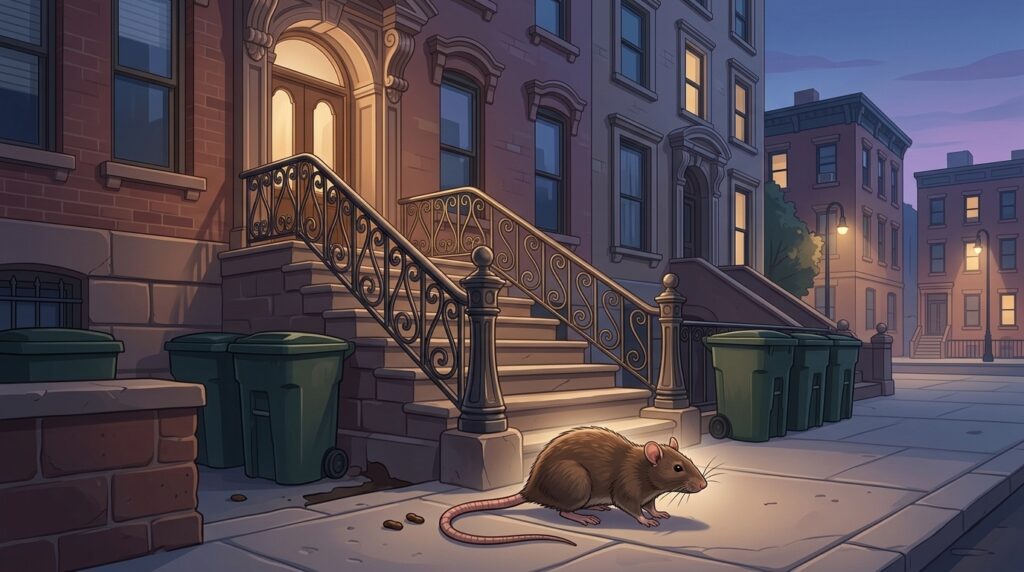
If you have lived in Brooklyn for more than a few months, you have a rat story. Maybe it is the brownstone basement on St. Johns Place where the trash sits in plastic bags overnight. Maybe it is the Flatbush block where you watch them pour out of a tree pit on a hot July evening. Maybe it is the scratching at 3 a.m. in the wall behind your radiator. The truth — backed up by the city’s own 311 data — is that Brooklyn now leads NYC in rat complaints, and that pressure is showing up inside apartments more than ever before.
We have been doing professional rodent control in Brooklyn since 1999, and the calls we take from Bed-Stuy, Crown Heights, Flatbush, Bushwick, and East New York have changed in tone. Tenants show up better informed, with photos and Rat Map screenshots. Landlords are dealing with new DSNY containerization rules. And the city’s only Brooklyn Rat Mitigation Zone now sits on top of one of the densest stretches of housing in the borough.
This guide breaks down what the 311 numbers say about your block, what the signs look like inside an apartment, how brownstones differ from walk-ups and garden apartments for rat entry, and what your landlord is legally required to do.
Rats in your NYC building?
26+ years on NYC rat work. Wall-void exclusion plus exterior bait stations from a team that knows how rats move through pre-war buildings, no annual contracts.
Why Has Brooklyn Become NYC’s #1 Rat Complaint Borough?
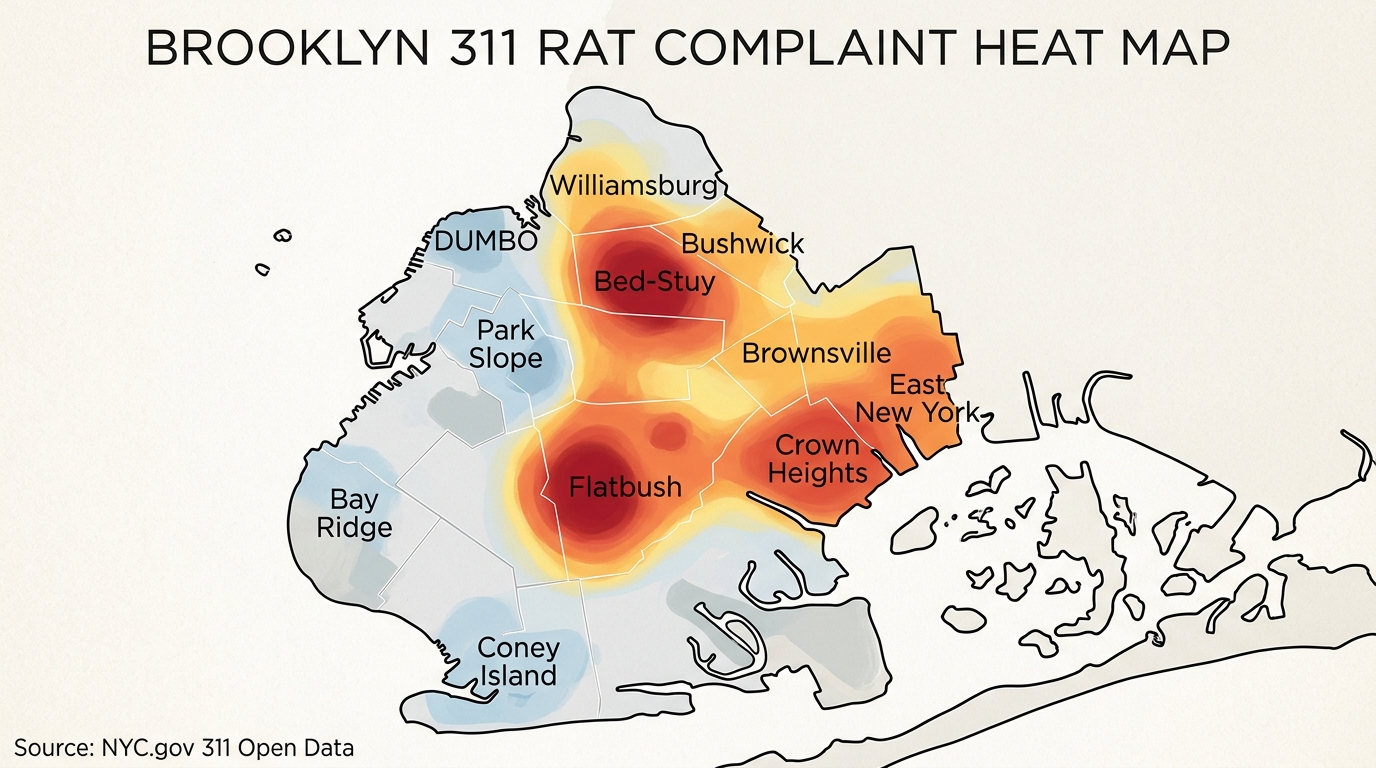
For most of the 2010s, Manhattan and the Bronx traded the title of “most rat complaints per capita.” That changed in 2024. According to a RentHop study covered by PIX11, Brooklyn led the city in absolute 311 rat complaints in 2024 and also led on a per-10,000-residents basis. The NYC Health Department’s own data story confirms the city receives roughly 40,000 rat-activity complaints through 311 every year. Of the 18,000+ complaints recorded in the period News 12 reported on, more than 7,000 came from Brooklyn alone.
Why Brooklyn? In our experience treating buildings here, three things stack up. First, Brooklyn has the densest mix of pre-war brownstones, walk-ups, and small multi-unit buildings in the city — the exact housing stock with the most basement areaways, sub-sidewalk vaults, and tree-pit entry points where Norway rats thrive. Second, ground-floor restaurants are a documented predictor of rat pressure for the apartments above, and Brooklyn has been adding restaurants faster than any other borough. Third, DSNY’s containerization rollout has been uneven block-to-block, so the “Trash Castle” of black plastic bags on the curb is still a Brooklyn reality on plenty of streets.
Which Brooklyn Neighborhoods Are 311 Rat Hot Zones?
The tightest concentration of complaints in Brooklyn sits in the 11226 ZIP code — Prospect Park South, Ditmas Park, and Flatbush. News 12 Brooklyn reported these three recorded the highest 311 rat complaint volume in the borough through 2024. Bed-Stuy is second, with nearly 1,500 calls to 311 last year — the second-highest total of any neighborhood citywide, per the city’s Rat Portal data covered by Patch.
Beyond the top tier, the persistent Brooklyn hot zones we see in our service calls and in the inspection data are:
- Bed-Stuy: Hot spots on Lafayette Gardens Playground, around K455 Boys and Girls High School, and along Myrtle Avenue. The Bed-Stuy / Bushwick stretch is the only Rat Mitigation Zone in Brooklyn.
- Crown Heights and Prospect Heights: Tenants on Reddit have flagged St. Johns Place between Underhill and Washington as roughly 80% “purple” on the Rat Map (failed inspections). Walking that block at night is “an absolute nightmare.”
- Flatbush (11226): A viral 2025 r/Brooklyn post from a Flatbush tenant documented rats pouring out of the curb at night and triggered a wave of QR-code 311 posters in lobbies. The same tenant suspected rat mites — bites that look like bed bug bites but come from mites abandoning a rat’s body after the rat dies or moves on.
- Bushwick and East Williamsburg: Older inspection cycles documented by City Limits showed roughly 50% of East Williamsburg inspections turned up active rat signs.
- Brooklyn Heights: The borough’s oldest brownstones, sub-sidewalk vaults, and the dense restaurant strip on Montague have historically produced one of the highest “active rat sign” rates per inspection in Brooklyn.
- Brooklyn Navy Yard / Wallabout / Vinegar Hill: Fence-line and vacant-lot conditions create steady burrow habitat. Tenants on Reddit call the rat infestations near the old Navy Yard “terrible.”
- East New York and Brownsville: Brownsville historically shows fewer “active rat sign” inspections than neighbors, but East New York has been climbing in 311 volume as garbage-collection coverage shifted.
The cleanest way to see your own block is to look it up on the city’s NYC Rat Map. Type in your address and the map shows the most recent inspection result for your building and the surrounding buildings. Pink and purple are bad signs. Gray means your block has not been inspected in the last six months — which, in Brooklyn, often means a 311 complaint is overdue.
What Are the Signs of Rats Inside Your Brooklyn Apartment?
You usually do not see the rat. You see what the rat leaves behind. Our techs use the same identification framework we walk through for Manhattan apartment rat signs, tuned to Brooklyn’s specific apartment stock.
Droppings the Size of Olive Pits
Rat droppings are the most reliable way to confirm an infestation without seeing the animal. Norway rat droppings are blunt-ended, dark, and roughly the size of an olive pit or a large bean — clearly bigger than the rice-grain droppings of a house mouse. You will find them in clusters along baseboards, behind the stove, in the back of cabinets under the sink, or near the gas line where it enters the wall. Fresh droppings are dark and slightly moist; older ones turn gray and crumble. The rule of thumb our techs use: olive pits = rat, rice grains = mouse. The treatment plan is very different for the two species, so getting the ID right matters — we cover the smaller-rodent profile in our guide to the signs of mice in NYC apartments.
Sebum Trails, Rub Marks, and Greasy Smudges
Norway rats have terrible eyesight and rely on whiskers and touch. They follow the same path along a wall night after night, and the oils in their fur leave dark, waxy stains — sebum trails, or “rub marks.” On a white baseboard or the bottom of a doorframe, these look like a 1-2 inch dark smear that does not wipe off easily. We have seen them where pipes enter walls, along basement steps, and on vent covers. This is also the evidence that disappears fastest before a 311 inspection: building managers know that if they wipe rub marks before DOHMH arrives, the inspector marks “no active signs” and closes the case. Photograph rub marks the moment you see them.
Gnaw Marks, Runways, and Burrows
Rats must gnaw constantly to keep their incisors from overgrowing — they will chew through wood, plastic conduit, soft metals, and the bottom corners of doors. Fresh gnaw marks look light-colored and sharp; older marks are dark. Outside the building, look at the dirt around tree pits, the strip between sidewalk and fence, or along basement areaways. A clean, 2-4 inch round hole that goes straight down is a rat burrow. Fresh burrows have loose dirt at the entrance.
Scratching at Night and the Ammonia Smell
Rats are nocturnal. The most common phone call we get from a Brooklyn tenant starts: “I hear scratching in the wall around 2 or 3 in the morning.” That sound, especially traveling up from a basement or down from a shared attic, is rats moving in their runways. A persistent ammonia-like smell near a baseboard or in a closet usually means active urine concentration — rats use scent to mark routes.
Bites That Look Like Bed Bug Bites — But Are Not
One of the most under-discussed signs in NYC is rat mite bites. When a rat colony dies off or moves on, the parasitic mites that lived on those rats abandon ship and look for the next warm-blooded host — which can be you. The bites look almost identical to bed bug bites: small, red, itchy welts in lines on exposed skin. Brooklyn tenants on Reddit have reported being told they had a bed bug problem, paying for a heat treatment, and only later figuring out the actual source was a collapsed rat colony in the basement. If your building has known rat activity and you start getting bites that look like bed bugs but no inspector finds them, ask about rat mites.
How Do Rats Get Into Brooklyn Brownstones, Walk-ups, and Garden Apartments?
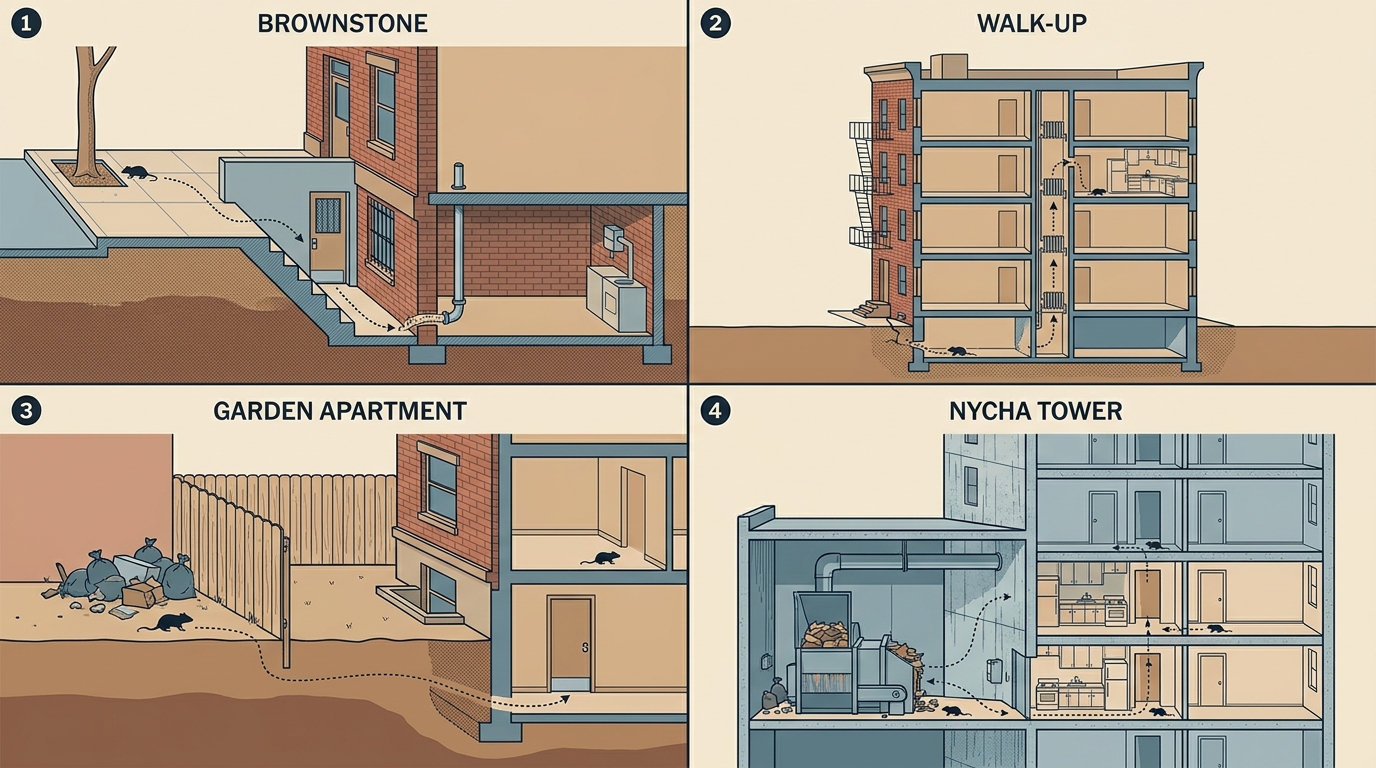
Brooklyn does not have one apartment archetype — it has at least four, and rats use each differently. After 26 years of comprehensive rat removal across the borough, our team can usually predict the entry pattern from the building type alone.
Brownstones and the Sub-Sidewalk Vault Problem
Brooklyn brownstones — the stoop-and-garden-level townhouses that line Park Slope, Bed-Stuy, Crown Heights, and Brooklyn Heights — share a structural feature most newer buildings do not have: the “areaway,” the sunken concrete space in front of the garden-level door. Rats burrow in from the tree pit, get into the areaway, and then exploit any gap around the garden-level door, the gas pipe, or the basement window. The fix is hardening every penetration in the basement perimeter — gas line, water main, electrical conduit, drain line — using steel wool packed into hardware cloth, then sealed with hydraulic cement. Anything larger than a quarter is a rat-sized opening.
Walk-Ups and Airshaft Routes
Older 4-6 story walk-ups, especially in Bushwick, East Williamsburg, and Sunset Park, share airshafts and party walls. Rats that get into the basement (often from a backyard burrow or from a neighboring lot) can climb internal pipe chases and emerge on any floor. We have pulled rats out of upper-floor kitchens where the basement entry was five stories below. Seal points to focus on: behind each radiator riser, where the gas pipe enters the kitchen wall behind the stove, and the bottom corner of the apartment door where the rubber sweep has worn down.
Garden Apartments, Back-Yard Burrows, and NYCHA Towers
“Garden” apartments — the half-below-grade units common in Brooklyn brownstones and small multi-family buildings — face the highest rat exposure of any apartment type. The rear yard is usually shared, often poorly maintained, and the rear door is at grade with the soil. We have inspected garden units where rats burrowed under the back fence from a neighboring restaurant’s garbage area and entered through a gap at the bottom of the back door. NYCHA towers — Marcy Houses, Stuyvesant Gardens on Gates Avenue, Red Hook Houses — face a different challenge: trash compactor rooms, when they back up, become open buffets. Tenants in Stuyvesant Gardens have told local news they wake up to rats walking across couches and dressers in first-floor units. Most fixes require coordination beyond the tenant’s apartment, which is why our borough-wide Brooklyn pest control program usually starts with a building-wide inspection.
Rats in your NYC building?
26+ years on NYC rat work. Wall-void exclusion plus exterior bait stations from a team that knows how rats move through pre-war buildings, no annual contracts.
What Is a Rat Mitigation Zone — and Is Your Brooklyn Block In One?
The NYC Health Department designates certain neighborhoods as Rat Mitigation Zones, or RMZs. There are currently four RMZs citywide, and exactly one is in Brooklyn: the Bed-Stuy / Bushwick zone. Inside an RMZ, the city coordinates between the Health Department, DSNY, Parks, and DOE on a multi-agency, data-driven approach. That means more frequent inspections, faster turnaround on 311 complaints, and proactive sweeps block-by-block.
If you live in the Bed-Stuy / Bushwick RMZ, three things are true: your building is more likely to be inspected even without a 311 complaint, compliance standards are tighter, and the city is putting actual resources into the streetscape around you (tree-pit cleanup, vacant-lot baiting, NYCHA waste-management upgrades). The flip side: “RMZ” is also a flag that this is a high-pressure rat environment, and your apartment-level prevention needs to be just as serious as your landlord’s. Outside the RMZ, the city still inspects properties — in many community districts, 100% of properties get inspected over a six-month window — but the resources are more reactive, so a 311 complaint matters more.
How Have DSNY’s 2024 Containerization Rules Changed Brooklyn’s Rat Game?
The single biggest policy change for rat control in Brooklyn over the past two years was the DSNY containerization rollout. Per the official DSNY Residential Containerization page, all properties with 1-9 residential units are now required to use sealed bins of 55 gallons or less, with secure lids, instead of loose black plastic bags on the curb. Mandatory enforcement began November 12, 2024. Buildings with 10+ units begin required containerization in June 2026.
This matters because the “Trash Castle” — the curbside mountain of plastic bags — has been the biggest food source for Brooklyn rats for decades. The city’s Rat Czar, Kathleen Corradi, has noted that a Norway rat needs only one ounce of food per day to survive, and the oil left in a discarded potato chip bag can sustain one for over a week. Compliance has been climbing and DOHMH inspection passing rates were higher in 2025 than 2023.
Brooklyn complications: small landlords have been slow to comply, especially in Flatbush and East New York where the housing stock skews to non-owner-occupied 2-4 unit buildings. Pizza-box recycling pilots have rolled out in some neighborhoods, but the failure mode Corradi keeps calling out is the same — tenants and supers who open a “rat-proof” bin to stuff a pizza box on top defeat the seal. If your building has bins but you are still seeing rats, the question is usually how the bins are being used.
What Are Your Landlord’s Legal Obligations for Brooklyn Rat Control?
Brooklyn tenants are not on their own. The NYC Health Department guidance for tenants and property owners spells it out: under Health Code Article 151 and the city’s Housing Maintenance Code (HMC § 27-2017), property owners are legally required to keep their property rat-free, address conditions that attract rats, and hire a licensed pest management professional when needed. This is enforceable, with fines that escalate from $300 to $2,000 per violation.
The workflow: a tenant files a 311 complaint, a DOHMH inspector visits and finds active rat signs or conditions that support rats. The owner gets a Commissioner’s Order to Abate (COTA) by mail. About ten days later, a compliance inspection follows. If conditions have not been corrected, the owner is issued a summons and fined. In severe cases, a Health Department exterminator may treat the property and bill the owner directly. What this means for you: your landlord cannot legally ignore a documented rat problem. If they are dragging their feet, the 311 paper trail is the lever — when the COTA arrives, even slow landlords usually act.
How Do You File a 311 Rat Complaint That Actually Triggers an Inspection?
Not every 311 complaint produces an inspection. The Health Department checks each complaint against existing inspection records — if your property was recently inspected, a duplicate complaint will not generate a new visit. Here is the process Brooklyn tenants have shared on Reddit that actually works:
- Photograph everything before you file. Droppings, gnaw marks, rub marks, and burrows in the dirt. Date the photos.
- File at NYC.gov/311 or call 311. Pick “Rodent” → “Rat or Mouse Sighting” or “Conditions Attracting Rodents.” Save the reference number.
- If your building also has non-rat housing complaints, file them too. Once HPD is involved alongside DOHMH, slow landlords move much faster.
- Document the inspection itself. If the inspector finds nothing because the super wiped down the sebum trails that morning, file a follow-up 311 with the timeline.
- Repeat as needed. Multiple complaints from the same building over weeks is what DOHMH treats as a real problem.
If you want to go further than complaining, the city runs a free Rat Academy training class open to any New Yorker, plus a volunteer corps called the Rat Pack. Both are good options for organizing at the block level.
When Should You Call a Brooklyn Rat Exterminator Instead of Waiting for 311?
The 311 process is the right tool when the rat conditions are outside your apartment — basement, rear yard, trash compactor room, tree pit. It is the wrong tool when rats are already inside your unit. By the time you are seeing droppings on your kitchen floor or hearing scratching in your bedroom wall at 3 a.m., the colony has matured and the city’s reactive workflow is too slow.
Other red flags that mean it is time to call a Brooklyn pest control team rather than wait for a city inspector:
- Daytime sightings. Rats are nocturnal. Daylight activity means the colony is overcrowded and lower-status rats are foraging at dangerous times.
- Boldness around humans or pets. A rat that does not flee a room has been habituated to human presence — a high-density sign.
- Signs of nesting in walls. Shredded paper, fabric, or insulation pulled into a void in a wall, closet, or under a cabinet.
- Multiple burrows in your rear yard. Three or more on a single property is a colony — usually 5-10 rats per visible burrow.
- Gnawing through structural materials. Plastic conduit chewed open, or chewed-through cabinet doors.
- Rat mite bites, especially after the rat sightings stop. The mites need a new host.
What we do in those situations goes well beyond bait stations. Our year-round rodent control across all five boroughs combines exclusion (sealing every penetration with steel wool, hardware cloth, and hydraulic cement), strategic baiting with tamper-resistant stations, tracking-powder application along confirmed runways, and follow-up inspections at 2-week intervals until activity stops. For multi-unit buildings — much of our Brooklyn book — we coordinate with management, supers, and adjoining property owners, because rats moving from a neighbor’s lot into yours will defeat any single-property treatment. If you want to know what this kind of work costs in NYC before you call, our breakdown of what NYC pest control actually costs walks through ranges for one-time treatments, recurring service, and full rodent-proofing jobs.
Rats in your NYC building?
26+ years on NYC rat work. Wall-void exclusion plus exterior bait stations from a team that knows how rats move through pre-war buildings, no annual contracts.
Key Takeaways for Brooklyn Tenants and Property Owners
- Brooklyn now leads NYC in 311 rat complaints. The 11226 ZIP (Flatbush, Ditmas Park, Prospect Park South), Bed-Stuy, Crown Heights, Bushwick, East New York, and Brooklyn Heights are the most consistent hot zones.
- Bed-Stuy / Bushwick is the only Rat Mitigation Zone in Brooklyn — expect more inspections and faster city response.
- Inside your apartment, look for olive-pit droppings, dark rub marks along baseboards, gnaw marks, nighttime scratching, and an ammonia smell. Photograph before you call.
- Brownstones, walk-ups, garden apartments, and NYCHA towers each have their own rat-entry pattern. Garden apartments face the highest exposure.
- DSNY’s containerization rule (in effect for 1-9 unit buildings since Nov 12, 2024) is changing the food supply — but only when bins are used correctly.
- Your landlord is legally obligated under HMC § 27-2017 and Health Code Article 151. The 311 → COTA → compliance inspection → summons workflow is the lever.
- If rats are inside your apartment, do not wait for 311. Call a professional rodent control team for inspection, exclusion, and follow-up.
- Rat mite bites can look like bed bug bites — if your building has rats and inspectors find no bed bugs, ask about mites.
If you are dealing with rats in your Brooklyn apartment or building right now, our team has been doing this since 1999 across all five boroughs and Long Island. We can usually get an inspector out same-day during business hours, walk through what we see, and give you a free estimate on whatever exclusion and treatment work you need. Brooklyn rats are stubborn — but with the city’s containerization push and a real exclusion plan, they are very much beatable.