If you’ve ever Googled “mosquito control cost” and ended up staring at a $50 number from a national cost calculator next to a $1,000 quote from a NYC operator, you’re not alone. After 26 years quoting mosquito jobs across all five NYC boroughs, our team has watched the gap between national average pricing and what New Yorkers actually pay get wider every season — driven by tight courtyards, mild winters, and Asian tiger mosquito populations that breed on a three-week cycle instead of the four to six week cycle most national pricing models assume.
This guide breaks down what real NYC mosquito control pricing looks like in 2026 — by property type, frequency, organic vs synthetic chemistry, and the local realities (neighbor effect, the city’s public spray program, pollinator concerns) that almost every national cost article ignores. If you’d rather skip the research and book professional mosquito control in NYC for a free yard walkthrough today, our front-office team can usually schedule something same-day. But if you want to walk into that conversation knowing exactly what your property should cost — read on.
Mosquitoes ruining your NYC yard or courtyard?
26+ years treating mosquitoes across all five NYC boroughs. We use Bti larvicide on standing water and Ecovia MT eco-friendly barrier spray for pollinator-sensitive properties, no annual contracts, and a free yard walk-through that's waived when you book.
What Does Mosquito Control Cost in NYC?
For a typical NYC property in 2026, real pricing breaks down like this: $80–$150 per single barrier-spray visit on a small backyard, $400–$900 for a full season of recurring service (six to eight visits from May through September), and $1,200–$2,500 for a misting-system install if you want a permanent automated solution. A standalone yard inspection runs $50–$150 and is usually waived if you book the work.
Those numbers track closely with Angi’s 2026 mosquito treatment cost data at the national level ($350 average, $50–$2,500 range), but the floor and ceiling both shift inside the five boroughs. Outer-borough properties with real yard space (Brooklyn brownstones, Queens row homes with side yards, Staten Island and Bronx larger lots) typically land at the upper end of single-visit pricing because there’s actual square footage to treat. Apartment-building common courtyards and small co-op gardens often land at the lower end because the perimeter is smaller and access is easier.
Here’s how we typically see real NYC quotes shake out by property type:
| Property type | Typical NYC single-visit | Typical seasonal (6–8 visits) |
|---|---|---|
| Apartment building common courtyard / co-op garden | $100–$175 | $500–$900 |
| Brooklyn brownstone or Queens row-home yard (under 5,000 sq ft) | $90–$150 | $400–$750 |
| Staten Island or Bronx larger yard (5,000–10,000 sq ft) | $130–$200 | $600–$1,100 |
| Commercial property / restaurant patio | $200–$400 | $1,000–$2,500 |
We’ve seen the cheap end of the NYC market too — there are operators who will quote $60 to “spray the perimeter once.” That number is real, but the result usually isn’t. A single barrier pass without larvicide treatment of standing water, follow-up visits matched to the 3-week mosquito breeding cycle, or any honest conversation about the neighbor effect doesn’t end your mosquito problem; it pauses it for about two weeks. The question worth asking isn’t “what’s the cheapest quote I can get?” — it’s “what’s the all-in cost to actually be able to use my yard?”
What Does a Real NYC Mosquito Control Quote Include?
A serious mosquito quote should have at least five distinct line items, even if it’s bundled into one flat fee. When a quote shows up as just “$X for the season” with no breakdown, that’s almost always a sign the operator is offering a cookie-cutter barrier spray without the IPM layers that actually keep mosquitoes down. Here’s what we include in every NYC mosquito treatment, and what to look for when comparing quotes:
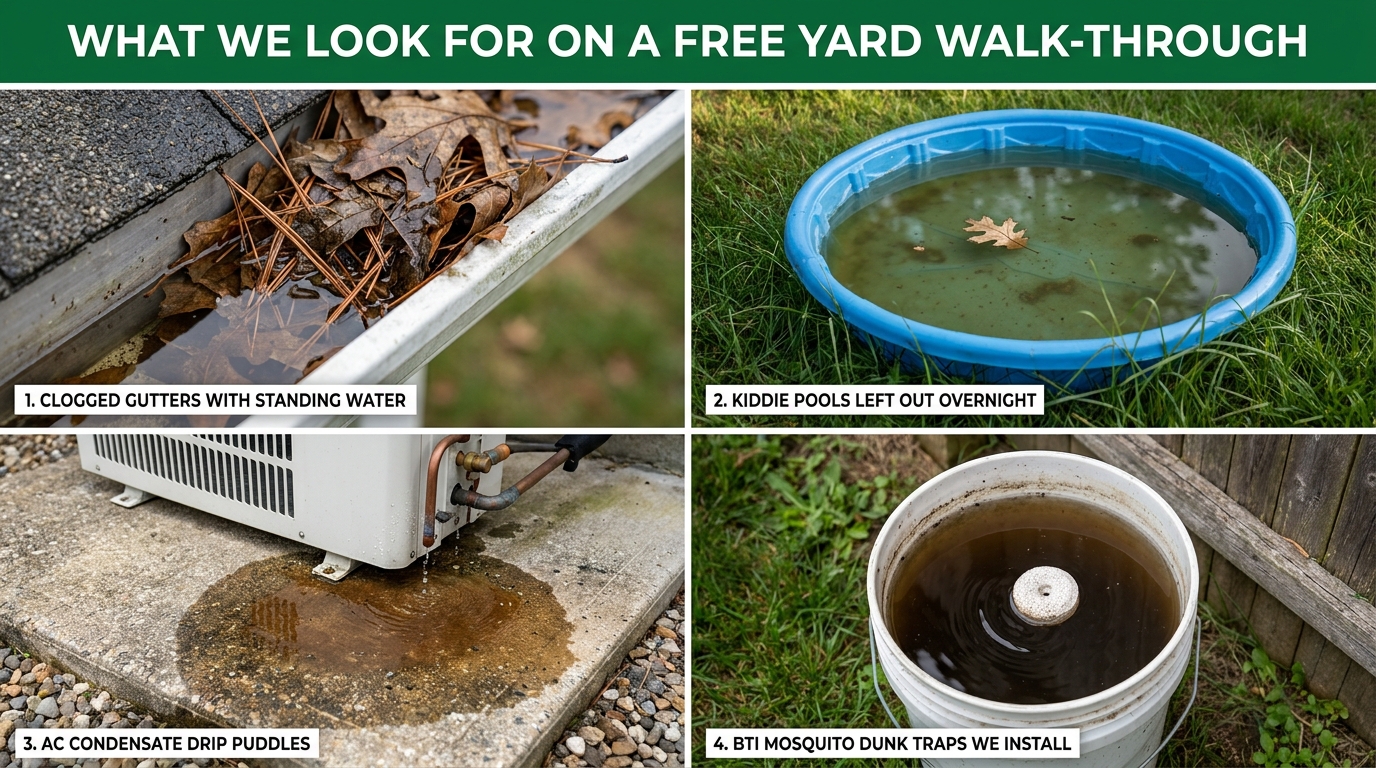
- Property walkthrough and breeding-source inspection. Before any chemical goes down, our technicians walk the perimeter and identify every standing-water source on the property — bird baths, clogged gutters, kiddie pools, plant saucers, sagging tarps, French drains, low spots in the lawn, dog water bowls, and (the one almost everyone forgets) the puddle that forms at the base of an air-conditioner condensate line. Standalone inspections run $50–$150; almost always waived if you book the service.
- Larvicide treatment of standing water that can’t be removed. For water features, French drains, and chronic low spots, we apply Bacillus thuringiensis israelensis (Bti) larvicide — the same bacterial product NYC Health uses on city marshes and parks during aerial treatment. Bti kills mosquito larvae specifically without harming fish, birds, dragonflies, bees, or other pollinators. A reputable quote names Bti or Bs (Bacillus sphaericus); a cheap quote skips this entirely.
- Barrier spray application. Targeted treatment of mosquito resting areas — the underside of leaves, dense shrubs, fence lines, the shaded north-facing wall of the house, deck undersides. Mosquitoes rest upside-down in shaded foliage during the day; that’s where the spray needs to go, not on the lawn. A real quote names the specific active ingredient (synthetic pyrethroid like bifenthrin, or eco-friendly like our Ecovia MT) rather than “EPA-approved spray.”
- Recurring service cadence. Cornell’s Integrated Pest Management research on Asian tiger mosquito biology established that this species breeds on a 3-week cycle, which is why legitimate seasonal plans run on a 3-week visit cadence from early May through end of September — about 6-8 visits per season. Plans that promise “monthly” treatment are missing one full breeding cycle every month.
- Free re-treatments between visits. If mosquitoes are biting before the next scheduled visit, a reputable operator will come back at no charge to spot-treat. Without this, the per-visit price is misleading because you’ll end up paying $80–$150 every time the population rebounds early. Our seasonal plans include unlimited free callbacks within the service window.
A real example we tracked from an NYC homeowner: one Brooklyn brownstone owner reported $130 per spray every 3 weeks from a local operator (about $900 across a season) — that’s right in line with what we quote for a brownstone yard with moderate tree cover. The benefit of a serious itemization is that you can compare apples-to-apples; if you’re getting a one-line $250-for-the-season offer with no detail, you’re going to be back on Google researching the next operator by July. Borough-specific options like our Brooklyn mosquito control program spell out every line item the same way.
How Do Single-Visit, Seasonal, and Monthly NYC Mosquito Control Costs Compare?
This is the single biggest source of sticker shock on NYC mosquito quotes, because the gap between the cheapest and most expensive plan types can be enormous — and the way different operators price each tier varies more than for almost any other pest service we sell. Here’s the honest math we walk our customers through:
| Plan type | Typical NYC pricing | Best for | Honest tradeoff |
|---|---|---|---|
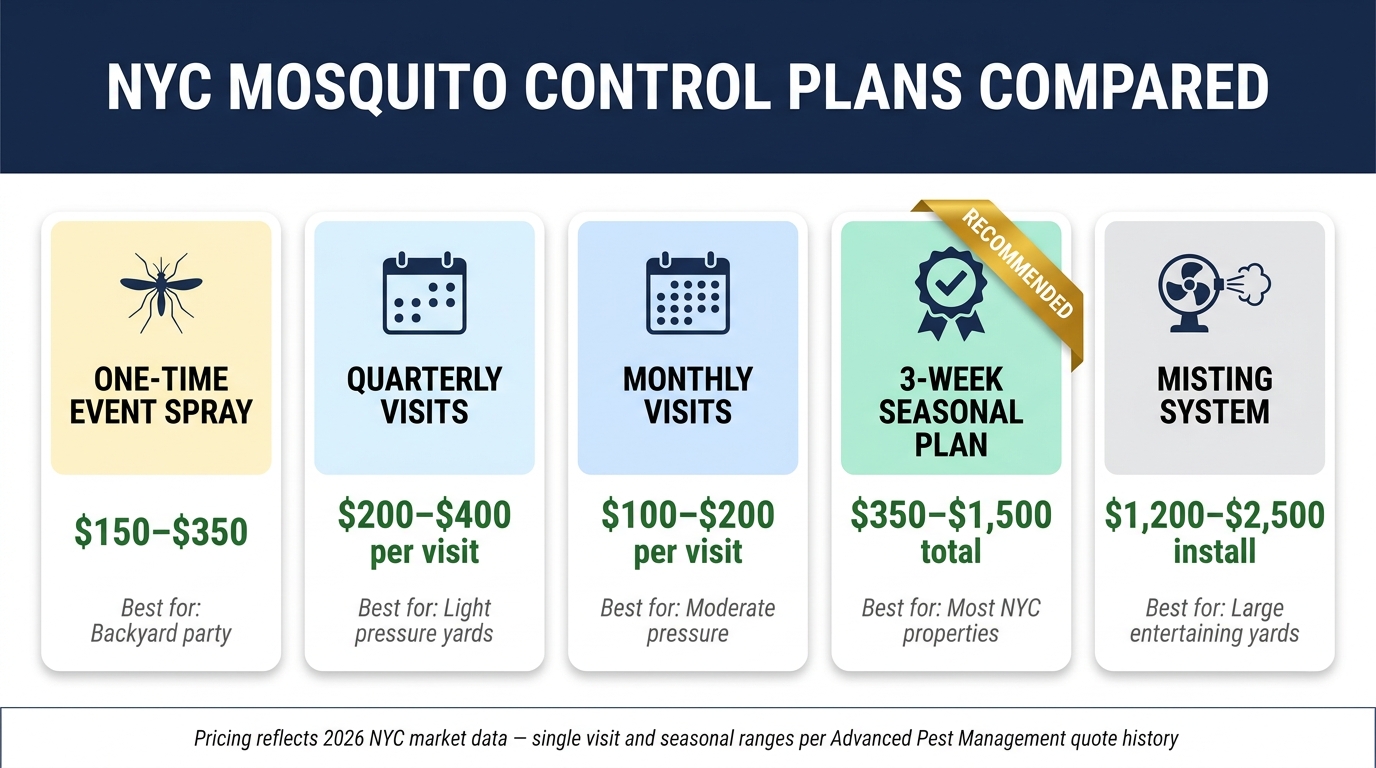
| One-time / event spray | $150–$350 | Backyard wedding, graduation, single party | Lasts 14–21 days max; not a long-term solution |
| Quarterly visits | $200–$400 per visit | Light mosquito pressure, low-tree-cover yards | Misses 2 of 3 breeding cycles per quarter — only works in low-pressure yards |
| Monthly visits | $100–$200 per visit | Moderate pressure | Misses one breeding cycle per month — not the optimal cadence for the local biology |
| 3-week seasonal plan (6–8 visits, May–Sept) | $350–$1,500 total | Most NYC properties — the standard | Best price per visit AND matches mosquito biology; the recommended plan for almost everyone |
| Misting system install + maintenance | $1,200–$2,500 install + $400–$700/yr | Large outdoor entertaining property, no kids/pets sensitivity | High upfront cost; chemical use is continuous; requires winterization |
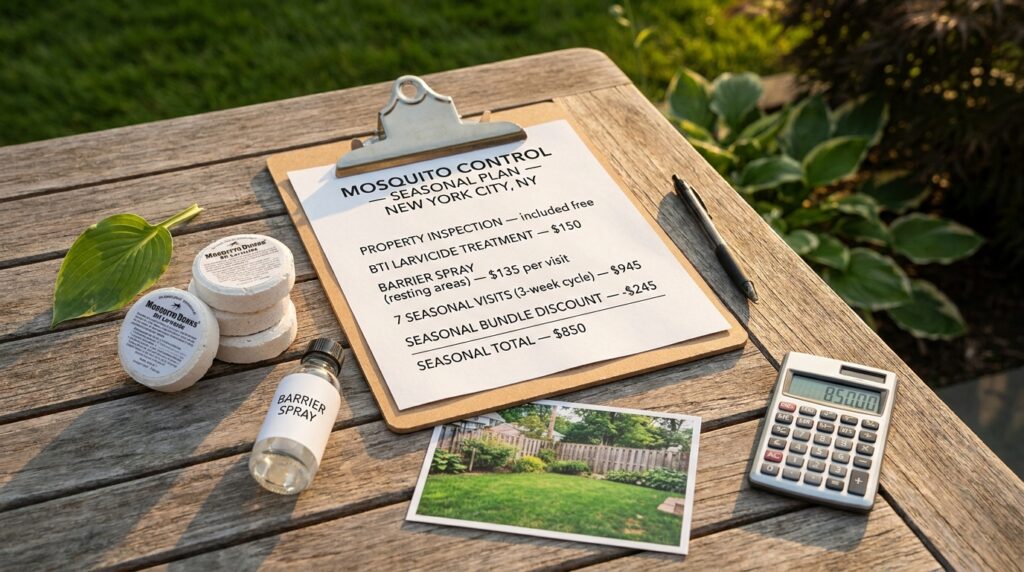
For most NYC homeowners and tenants who actually want to use their yard, the answer is the 3-week seasonal plan. It’s the lowest cost per visit, it matches the biology of the dominant local mosquito species, and it includes the free callback margin that one-time sprays don’t. The math on per-visit pricing makes this obvious: a $135 single visit done seven times a season costs you $945; the same seven visits bundled into a seasonal plan typically lands at $700–$900 — and the seasonal plan includes the free callbacks.
The exception is the event spray. If you’re hosting a graduation party in mid-July and the rest of the summer is fine, a $200–$300 event spray applied 3-4 days before the event is the right call. Don’t sign up for a $900 seasonal plan to cover a single Saturday night.
We rarely recommend misting systems unless the property is large, frequently used for outdoor entertaining, and the homeowner has no concerns about ongoing chemical exposure. The upfront install is real money, and the ongoing maintenance ($400–$700/yr) plus the continuous chemical use changes the household’s exposure profile in a way most NYC families haven’t thought through.
Should You Pay a Higher Cost for Organic or Eco-Friendly Mosquito Control in NYC?
This is the most contentious question in NYC mosquito control, and the honest answer is more nuanced than either side of the debate usually admits. Per the NY State Department of Health and Cornell IPM, the conventional active ingredients used in most professional mosquito barrier sprays are synthetic pyrethroids (bifenthrin, deltamethrin, lambda-cyhalothrin) — the same chemistry as common household ant and roach sprays. These are EPA-registered, effective against mosquitoes, and break down in sunlight within 3-4 weeks.
The concern that drives the organic conversation in NYC is pollinator and non-target safety. Pyrethroids are non-selective — they kill bees, butterflies, ladybugs, and other beneficial insects in the spray zone just as effectively as they kill mosquitoes. For NYC households with rooftop vegetable gardens, brownstone backyard pollinator plants, koi water features, or young children playing in the treated zones, this is a real concern, not a hypothetical one.
Here’s the cost reality of the organic vs synthetic decision across the boroughs:
| Treatment chemistry | Active ingredient | NYC seasonal cost | Effectiveness duration | Pollinator/pet impact |
|---|---|---|---|---|
| Synthetic pyrethroid (industry standard) | Bifenthrin, deltamethrin, lambda-cyhalothrin | $350–$900 | 3–4 weeks per visit | Kills bees and other pollinators on contact; toxic to fish; reduced toxicity once dry |
| Eco-friendly botanical (our Ecovia MT) | Rosemary, peppermint, geraniol | $500–$1,200 | 2–3 weeks per visit (shorter) | Pollinator-friendly when applied per label; family- and pet-friendly once dry |
| Garlic juice / cedar oil organic | Garlic extract, cedar oil | $400–$1,100 | 2–3 weeks per visit (shorter) | Strongly pollinator-friendly; some users report 3-week-or-shorter knockdown |
Our team uses Rockwell Labs’ Ecovia MT for customers who specifically request eco-friendly chemistry — particularly common on brownstone backyards with vegetable gardens, rooftop garden setups, and households with young children. The honest tradeoffs: it costs 20-30% more per season because the application has to be slightly more frequent (the residual is shorter), and the knockdown isn’t quite as fast as bifenthrin in the first 24 hours after spray. But it doesn’t kill the butterflies in your butterfly garden or stress the beehive at the neighborhood community garden two doors down.
If your property doesn’t have those specific concerns — no vegetable garden, no koi pond, no beekeeping neighbors, no toddlers playing in the spray zones — the standard synthetic barrier spray is what we’d recommend on cost-effectiveness alone. The honest answer most operators won’t give you: there’s no chemistry-free option that delivers the same knockdown speed. The choice is real.
Mosquitoes ruining your NYC yard or courtyard?
26+ years treating mosquitoes across all five NYC boroughs. We use Bti larvicide on standing water and Ecovia MT eco-friendly barrier spray for pollinator-sensitive properties, no annual contracts, and a free yard walk-through that's waived when you book.
Why Do Some NYC Mosquito Sprays Fail Even at a Cost of $1,000 a Season?
Here’s the part of the cost conversation that almost no SERP article will give you straight: a $1,000 seasonal mosquito plan can still leave you swatting bugs in August. The reason is mosquito travel range and the neighbor effect. Adult mosquitoes routinely travel one to three miles from their breeding source to find a blood meal. If your yard gets sprayed but the brownstone across the street has a clogged gutter breeding mosquitoes, those mosquitoes simply fly over the property line and find you anyway.
This is a real frustration we hear constantly from Queens mosquito treatment customers in particular — and it’s the reason renowned American entomologist Doug Tallamy has been publicly skeptical of fogging-only programs. His critique is that you have to kill 90% of the local adult population to actually reduce biting, and a single-property spray service typically achieves closer to 10% of the regional mosquito population on any given day. We don’t fully agree with his “spray doesn’t work” framing — well-applied barrier spray on resting areas combined with Bti larvicide on breeding sources does meaningfully reduce biting in our experience. But the underlying math is right: solo-yard treatment alone is fighting upstream.
The three things that actually drive mosquito control results in NYC, in order of impact:
- Eliminate standing water on YOUR property first. Our team walks every customer property looking for the puddles people forget — clogged gutters, plant saucers, kiddie pools left out overnight, sagging pool covers, even bottle caps in the lawn. A clean property reduces local breeding by 60-80% before any chemical goes down.
- Treat any standing water you can’t eliminate with Bti larvicide. Bti briquets cost $5-$15 retail for DIY use; a professional larvicide pass covers French drains, low spots, and water features for the season. This is what kills the next generation before they bite.
- Apply barrier spray to resting areas (not the open lawn) on a 3-week cycle. This catches adult mosquitoes that fly in from neighboring properties before they reproduce on yours.
If your neighbors are also breeding mosquitoes on their property — birdbaths, pools, unmaintained tree pits — even our most aggressive 8-visit seasonal plan will produce some breakthrough biting in peak July and August. The honest framing is that pro mosquito control reduces your biting load by 70-85%, not 100%. If a competitor promises 100% bite-free, ask them to put it in writing.
For NYC apartment buildings and brownstones specifically, we also point customers at NYC Health’s public-park spray schedule and the city’s 311 reporting line for standing-water complaints on neighboring properties — your local mosquito environment isn’t only what you and your service can control.
Can DIY Mosquito Control Replace the Cost of a NYC Mosquito Pro?
We get asked this constantly, and unlike most pest companies, we’ll give you the honest answer: partially, yes — and we’ll tell you exactly when DIY is the right call. The most-recommended DIY methods on NYC homeowner forums (and we’ve verified that they actually work in our customers’ yards) are:
- Mosquito dunks (Bti larvicide) in 5-gallon buckets. Place 2-3 buckets of dirty water around the property, each with one mosquito dunk floating in it. The mosquitoes lay eggs in the bucket, the Bti kills the larvae, and the local generation gets broken. Cost: ~$20 for a 20-pack of dunks that lasts a whole summer. Effectiveness: legitimate, especially on properties without heavy nearby breeding pressure.
- Bifen IT (bifenthrin) DIY barrier spray. A 128-oz bottle of Bifen IT from Amazon runs about $50 and includes the same active ingredient most pro barrier sprays use. With a $20 hose-end sprayer, you can treat your own small yard for about $0.50 per application versus $130 for a pro visit. Effectiveness: real, if you apply correctly to mosquito resting areas (under leaves, in shrubs) on a 3-week cycle.
- ThermaCell devices and oscillating fans on the patio. ThermaCells protect a 15-foot radius around the device for 4-12 hours per cartridge ($30-$50 device, $5-$10 per refill). Fans create wind that mosquitoes can’t fly through. Cost: under $100 total for a permanent patio setup. Effectiveness: excellent for the specific area being protected, useless for the rest of the yard.
So why do thousands of NYC households still pay for pro service every year? Three honest reasons:
- Time and access. Applying Bifen IT correctly requires walking the property with a sprayer every 21 days, getting under leaves and in shrubs, then washing equipment. Most working NYC households don’t have an hour every three weeks for this.
- NY State Category 7C license. Commercial pesticide application in New York requires a state license, and the chemicals available to licensed applicators (like our Ecovia MT for eco-friendly accounts, or the longer-residual professional formulations of bifenthrin) outperform the retail-shelf versions on duration and knockdown.
- The honest broker effect. A licensed pro doing a property walkthrough every 3 weeks catches problems a homeowner misses — a new puddle behind the AC unit, a clogged gutter that re-flooded after a storm, an unnoticed tarp collecting rainwater. The recurring inspection is part of the value, not just the chemical.
Our recommendation to most cost-sensitive customers: if your property has light mosquito pressure (no chronic standing water on your block, minimal tree cover, no marsh nearby), DIY with mosquito dunks plus a couple ThermaCells is genuinely enough for under $150 for the season. If you’re in a high-pressure area, have allergic family members where bites are a medical issue, or simply don’t want to spend an hour every 3 weeks doing it yourself, the pro service pays for itself in time and consistency.
For NYC apartment renters and homeowners, our broader guide to year-round NYC pest control pricing covers how mosquito service fits into year-round pest management plans (often bundled with general perimeter, ant, and roach service for a lower combined monthly rate).
What Does NYC’s Public Mosquito Spraying Program Cover at No Cost?
This is the question almost no private mosquito company will answer honestly, because the answer is uncomfortable: a meaningful portion of mosquito control in NYC is already being handled by the city for free. Per NYC DOH’s mosquito control program, the city runs active mosquito surveillance and treatment funded by tax dollars. Here’s what they do and don’t cover:
What NYC Health does:
- Aerial larviciding (helicopter drops of Bti briquets) over large natural areas — Marine Park, Pelham Bay Park, Jamaica Bay, Forest Park, and other large city wetlands
- Ground-truck adulticide spraying (typically Anvil 10+10 or Duet ULV) when West Nile virus testing in mosquito pools detects a public health risk in a specific neighborhood
- Surveillance trapping across all five boroughs (DOH maintains mosquito traps in every borough; results inform when and where they spray)
- Free 311 reporting for standing-water complaints on private property and abandoned pools — the city will inspect and order remediation
- Real-time alerts via Notify NYC when a truck-spray event is scheduled in your neighborhood
- Public dataset on data.gov of every spray event (“Mosquito control events in NYC”) — anyone can search by ZIP, date, or borough
What NYC Health does NOT do:
- Treat residential lawns, brownstone backyards, courtyards, or any private property
- Apply barrier sprays to your fence line, shrubs, or rooftop garden
- Larvicide your bird bath, koi pond, or window-box water feature
- Respond to “mosquitoes are bad in my yard” complaints — only to public-health-relevant breeding sources reported via 311
What this means for your budget: if you live near Marine Park, Pelham Bay, Forest Park, Prospect Park, or other large city green spaces the city already treats, your private mosquito service is doing the “last mile” of property-specific control — and the public program is doing the heavy lifting on the regional population. That’s actually a positive — it means private barrier spray on your yard has a multiplier effect when the regional population is also being managed.
If you live in a neighborhood without a nearby city-treated park, your private service is doing 100% of the work in your immediate area, which is why our quotes for a brownstone in Crown Heights versus an apartment courtyard in Battery Park City can look so different even on similar square footage. Knowing whether the city is already spraying near you should be the first call you make before signing up for a private plan. Borough-level coverage — including specialized routes through Manhattan pest control service areas and the outer boroughs — is mapped on the DOH event tracker.
For households also dealing with tick exposure on tree-lined blocks or near parks, the same Cornell IPM approach applies. Our yard tick treatment guide walks through how tick treatments overlap with mosquito barrier sprays and where you can bundle the two on a single visit.
What Are Red Flags in NYC Mosquito Control Quotes?
Both ends of the price spectrum have warning signs. Here’s what we’ve learned from 26 years of getting called in to fix what other operators left behind:
Cheap-quote red flags (under $250 for a NYC seasonal plan):
- No inspection step in the quote — just a price and a start date. Real mosquito service starts with a property walkthrough identifying breeding sources; a quote that skips this is selling chemical, not control.
- No mention of larvicide (Bti). Adulticide-only programs ignore the entire next generation, which is why some homeowners pay $400 for the season and still get bitten in August.
- “Monthly” visit cadence instead of 3-week. Monthly cadence misses a full mosquito breeding cycle every visit. Real seasonal plans run 3-week cadence to match Asian tiger mosquito biology per Cornell IPM research.
- No NY State Category 7C pesticide applicator license on the invoice or website. Commercial pesticide application in New York requires state licensing; reputable companies put this prominently. You can verify on the NYS DEC’s pesticide applicator registry if you have any doubt.
- “Guaranteed to be bite-free” with no fine print. No legitimate operator promises 100% bite-free — that promise is a sign someone is going to disappear when reality hits in July.
Inflated-quote red flags (north of $1,800 for a small NYC seasonal plan):
- Misting system pressure on small properties. If a brownstone backyard or apartment courtyard is being quoted at $3,000+ for a permanent misting system install, the operator is upselling on hardware most NYC properties don’t need.
- Year-round 12-month contracts with cancellation penalties. Mosquito season in NYC runs May through September. A reputable operator offers May-to-September seasonal pricing — never a forced 12-month lock-in.
- Add-on tick treatments billed separately at full price. Tick treatments overlap with mosquito barrier spray on the same shrub-and-fence-line zones; reputable operators bundle these into a single visit at a marginal upcharge, not at full per-visit pricing.
- Pressure to add chemical mosquito misting indoors. Mosquitoes are an outdoor pest in NYC; any pitch to spray inside your apartment or home for mosquitoes is either selling something you don’t need or solving a problem that isn’t mosquitoes.
A thorough free walk-through from a licensed local NYC operator should produce a written quote with the five line items we listed above, a clear scope of work, the active-ingredient name, and a written guarantee window with explicit callback language. If any of that’s missing on either end of the price spectrum, get another quote. The EPA’s mosquito control guidance and Cornell Cooperative Extension’s Integrated Pest Management resources are both useful references if you want to evaluate any quote against an objective standard.
The Bottom Line: What to Budget for Mosquito Control in NYC
For most NYC homeowners and tenants, the realistic 2026 budget for serious mosquito control breaks down like this: $150–$350 for a one-time event spray ahead of a backyard party, $400–$900 for a full 3-week seasonal plan on a typical NYC property (apartment courtyard, brownstone backyard, row-home yard), and $900–$1,500+ for a larger Staten Island, Bronx, or Riverdale yard with heavy tree cover (our Staten Island mosquito control route handles these larger lots) or active nearby breeding pressure. If you opt for our eco-friendly Ecovia MT chemistry to protect pollinators or sensitive household members, add roughly 20-30% to those ranges.
We’ve been doing mosquito work across NYC since 1999, and the most common mistake we see is paying for a one-time spray and assuming it will hold the property through August — it won’t. Asian tiger mosquito biology means you need either a 3-week recurring cadence or honest acceptance that mosquitoes will be back in 14-21 days. The next most common mistake is overlooking the standing water on your own property: even the best $1,200 seasonal plan can’t outcompete a clogged gutter that’s been breeding mosquitoes since June.
If you’re staring at swarming mosquitoes in your yard right now and want a real number for your specific property, our team offers free yard walk-throughs across all five NYC boroughs — same-day service during business hours, with a 27-person team and 26 years of route experience across the brownstone backyards, apartment courtyards, and outer-borough yards that make up our service area. Lisa or one of our front-office team can typically get you a same-day inspection scheduled, and the quote you get will itemize exactly what’s included, what the timeline looks like, and whether eco-friendly or synthetic chemistry is the right call for your property — so you can compare it apples-to-apples against anyone else.