It happens a hundred times a summer across the five boroughs and Long Island. You’re refilling a planter on your Bayside patio, or sitting on a Park Slope stoop with an iced coffee, and a black-and-yellow insect drops in out of nowhere. Your first instinct is to freeze and ask the only question that matters in that moment: is that a bee or a wasp?
We get a version of that call almost every day from May through October, and the answer matters more than most people think, because it changes what you should do next. If the culprit turns out to be a paper wasp umbrella under your eave or a yellowjacket nest in the lawn, professional wasp nest removal in NYC is a quick, targeted job. But if that fuzzy little visitor is a honey bee working your flowers, the right move is usually to leave it completely alone, or to call a beekeeper instead of an exterminator.
After 26+ years working stinging-insect jobs from Queens out to Suffolk County, we’ve learned that telling a bee from a wasp is a skill any homeowner can pick up in about two minutes. Here’s the field guide we wish everyone had before they grabbed a can of spray.
Wasps nesting around your NYC home?
26+ years handling NYC wasps, hornets, and yellowjackets. We do the high ladder work most competitors avoid, offer same-day service during business hours, keep everything month to month with no annual contracts, and start with a free estimate.
What Is the Real Difference Between the Bees and Wasps You See in NYC?
Bees and wasps are cousins. Both belong to the order Hymenoptera, alongside ants and sawflies, which is why they can look so similar at a glance. But they make their living in opposite ways, and that single fact drives almost every difference you’ll notice.
Bees are pollinators. They’re essentially vegetarian, living on nectar and pollen they gather from flowers, and their whole body is built to carry that pollen from bloom to bloom. Wasps are hunters and scavengers. As Cornell’s Integrated Pest Management program puts it, bees feed on nectar and pollen while wasps are predators of other insects. Adult wasps sip sugar, but they hunt caterpillars, flies, and spiders to feed their young, which is exactly why they crash your barbecue and fight you for a soda.
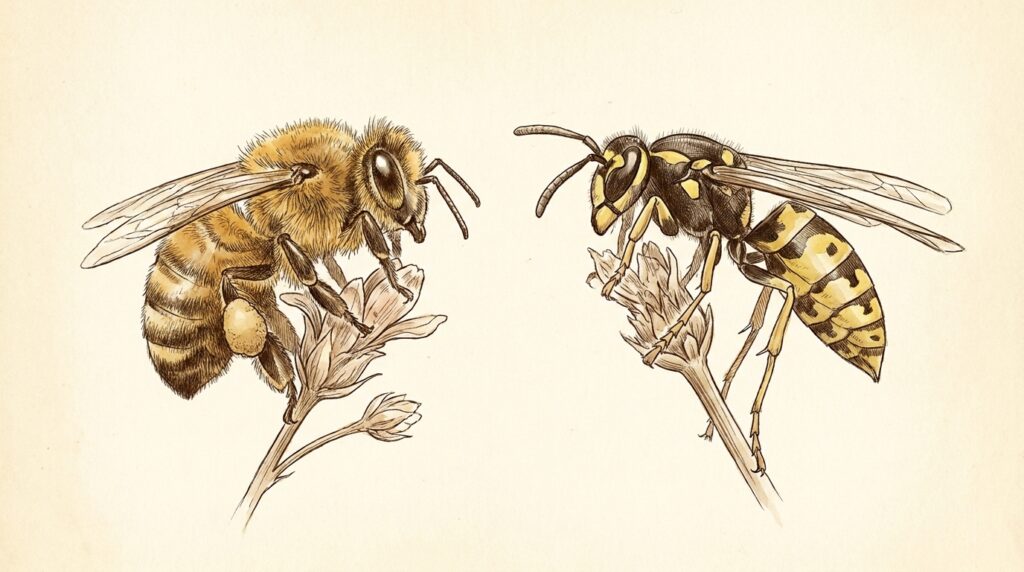
Here’s the part that trips up almost everyone: yellowjackets and hornets are wasps. All hornets are wasps, but not all wasps are hornets. So when you ask “bee or wasp,” the wasp side of the ledger really means the whole slender, smooth-bodied family, from paper wasps to yellowjackets to the big bald-faced hornet on the corner of your garage. A simple way to hold it in your head: a bee looks like it’s wearing a fuzzy sweater, and a wasp looks like it’s wearing a polished, tailored suit with a sharp waist.
How Can You Tell a Bee From a Wasp Around Your NYC Home?
You don’t need a hand lens or a biology degree. When a striped insect lands near you, run through four fast checks, in order, and you’ll almost always land on the right answer before it flies off.
- Fuzz. Bees are visibly hairy, covered in soft branched hairs that grab pollen. Wasps look smooth, shiny, and almost plasticky. If it looks fuzzy, lean bee.
- Waist. Wasps have that famous sharply pinched “wasp waist” between the thorax and abdomen. Bees are thicker and more uniform through the middle.
- Legs. This is the tell most people miss. A foraging bee often carries visible clumps of pollen packed onto its flattened hind legs, like tiny yellow saddlebags. Wasps don’t collect pollen that way, and paper wasps tend to let their long legs dangle in flight. Yellow leg-luggage means bee, every time.
- Behavior. A bee works the flowers methodically and has zero interest in you. A wasp patrols, hovers around your food, drinks, and trash can, and investigates anything that smells like a meal.
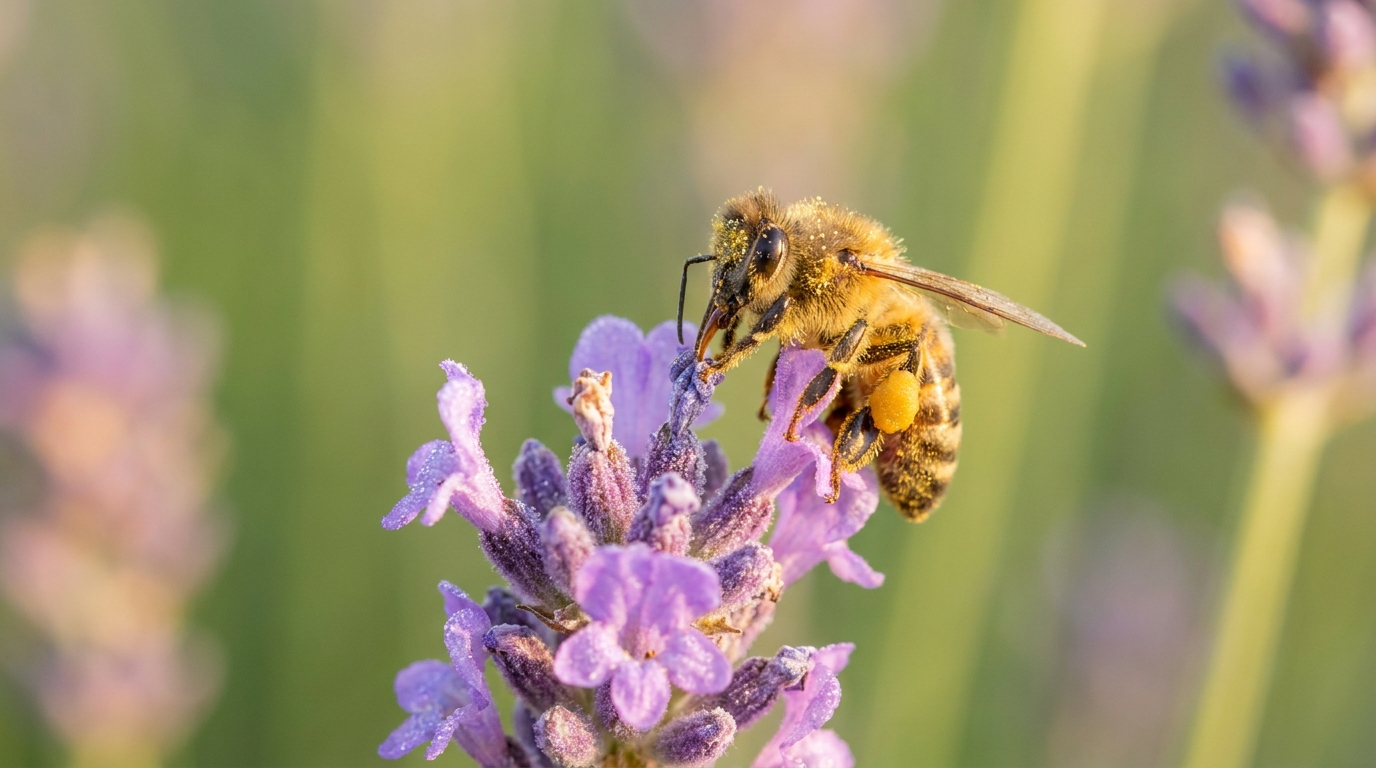
Put those together and the picture gets clear fast. Here’s the same comparison side by side:
| What to check | Bees | Wasps (including yellowjackets & hornets) |
|---|---|---|
| Body & hair | Round, robust, visibly fuzzy with branched hairs that trap pollen | Slender, smooth, and shiny with little to no visible hair |
| Waist | Thick and fairly uniform between thorax and abdomen | Sharply pinched “wasp waist” |
| Sting behavior | Honey bee stings once and dies (barbed stinger); bumble and carpenter bees can sting but rarely bother | Smooth stinger, can sting again and again; yellowjackets swarm to defend the nest |
| Nest | Wax honeycomb; honey bees in cavities and walls, bumble bees in the ground, carpenter bees in wood | Gray paper (chewed wood pulp); an umbrella under eaves, a hole in the lawn, a wall void, or a football in a tree |
| Aggression | Low; focused on flowers and happy to ignore you | Higher near a nest, especially late summer; drawn to food and sweet drinks |
| Role & benefit | Major pollinators; honey bees are protected and beneficial | Predators that control other pests; only minor pollinators |
Which Bees and Wasps Actually Show Up Around NYC and Long Island?
Most of the stinging insects we get called about in the city and out on the Island fall into a short, familiar cast. Learn these six and you’ve covered the vast majority of backyard encounters.
The bees you’ll meet:
- Honey bee — tan-and-amber, fuzzy, about half an inch. A managed, beneficial pollinator that nests in wax comb inside cavities. In our area that sometimes means a wall void or soffit of a pre-war building.
- Bumble bee — big, round, and very fuzzy, black with yellow (sometimes orange) bands. Nests in the ground, buzzes loudly, and is famously docile. A key pollinator you want in your garden.
- Carpenter bee — looks like a bumble bee but with a shiny, hairless black abdomen. Bores clean, round holes into decks, fascia boards, and railings, which is common on Long Island homes. The wood damage is the real issue; the bees themselves are gentle and the males can’t even sting.
The wasps you’ll meet:
- Paper wasp — slender, long-legged, with legs that dangle in flight. Builds the open, upside-down umbrella nest you find under porch ceilings and deck rafters.
- Yellowjacket — compact, bright black-and-yellow, and the number-one picnic raider. Nests in the ground or in wall voids and turns aggressive in late summer.
- Bald-faced hornet — big, black-and-white, and the builder of that gray basketball-sized football nest in a tree or on a building. Despite the name, it’s technically a yellowjacket, not a true hornet.
The only true hornet in our region is the brown European hornet, which favors hollow trees and wall voids and is one of the few that flies at night. For the full wasp-versus-hornet breakdown, including why that bald-faced “hornet” is really a yellowjacket, see our hornets vs wasps field guide for NYC and Long Island.
Where Do Bees and Wasps Nest Around NYC Homes and Yards?
Sometimes you never get a clear look at the insect, but you can see where it’s coming and going. The nest itself is one of the fastest ways to tell bees from wasps, because the two build in completely different materials.
Bees build with wax. A honey bee colony makes that classic hexagonal honeycomb, and in the wild they tuck it into a cavity: a hollow tree, or the wall or attic of a building. Cornell notes that honey bees can even become structural pests when a colony sets up inside a wall. Bumble bees nest in the ground, often in an abandoned rodent burrow, and carpenter bees drill into bare wood.
Wasps build with paper. They chew wood fibers into a gray papery pulp. A paper wasp makes an open umbrella of cells hanging from a stalk under your eave. Yellowjackets hide their nests in the ground or inside a wall cavity. Bald-faced hornets build the enclosed gray football up in a tree or on the side of the house.
So use the location as a shortcut. A hole in the lawn with steady two-way traffic is a ground bee or, more likely, a yellowjacket. Neat round holes in your deck or fascia are carpenter bees. A papery umbrella under the porch is a paper wasp. Buzzing coming from inside a wall could be honey bees or yellowjackets, and those two call for very different responses. If you suspect a nest but can’t find it, our guide to the early signs of a wasp nest walks through what to look and listen for. One more useful fact: most wasp nests die out every winter and only the queens survive, while a honey bee colony lives on, so a wasp nest is far less likely to come back in the same spot next year.
Why Can an NYC Wasp Sting Again and Again When a Honey Bee Can’t?
This is the difference that actually affects your body, and it comes down to the shape of the stinger.
A honey bee has a barbed stinger. When it stings, the barb catches in your skin, and as the bee pulls away the stinger tears loose and the bee dies shortly after. According to the Pollinator Partnership, that self-sacrifice is why a honey bee stings only as a genuine last resort. It isn’t out to get you; stinging costs it its life.
Wasps are the opposite. Yellowjackets, paper wasps, and hornets have smooth stingers that slide right back out, so a single wasp can sting you over and over. Worse, when a yellowjacket stings or gets crushed it releases an alarm pheromone that recruits the rest of the colony, which is how one wrong step near a ground nest turns into a dozen stings. Bumble bees and carpenter bees also have smooth stingers and technically can sting more than once, but they’re mild-mannered and almost never do.
The practical takeaway is simple. A lone fuzzy bee bumbling across your flowers is about the lowest-risk insect in your yard, and it’s doing important work. A wasp defending a nested colony is the one worth backing away from and handling with a plan.
Wasp or yellowjacket nest too close for comfort?
We have treated NYC stinging insects for 26+ years, from ground yellowjackets in the lawn to wall-void colonies in your siding. Same-day service during business hours, no annual contracts, and a free estimate with every visit.
When Is a Bee or Wasp Sting an Emergency for an NYC Family?
For most people, most of the time, a sting is painful but not dangerous. You get pain, swelling, and redness at the spot, and it fades within a week. The real risk isn’t the venom itself; it’s an allergic reaction.
According to the NIH’s MedlinePlus, the warning signs of a serious reaction come on fast: swelling of the throat, lips, or tongue, difficulty breathing, hives spreading across the body, a rapid heart rate, dizziness, or nausea. If you or someone with you shows any of those after a sting, call 911 immediately and don’t try to drive yourself to the hospital. If you know you’re allergic, carry an epinephrine auto-injector and use it at the first sign. Even for people who aren’t allergic, a flurry of stings from a disturbed yellowjacket or hornet colony can be a medical problem on its own.
For an ordinary sting, the care is straightforward: scrape the stinger out sideways with the edge of a credit card rather than pinching it, which can squeeze in more venom; wash with soap and water; ice it ten minutes on and ten minutes off; and take an antihistamine if you need one. The people most likely to blunder into a hidden ground nest are kids and dogs, so keep them clear of any spot with steady wasp traffic, and ask us about family and pet-friendly treatment options when a nest is near a play area or patio.
Should You Ever Kill a Honey Bee Colony on Your NYC Property?
Almost never, and this is the heart of the whole bee-versus-wasp question. Honey bees are beneficial, protected pollinators, and pollinators are under real pressure. Mass Audubon reports that three eastern bumble bee species have declined by more than 90% over the past 30 years. Reaching for a can of spray on a honey bee colony is the wrong move both for the ecosystem and, usually, for you.
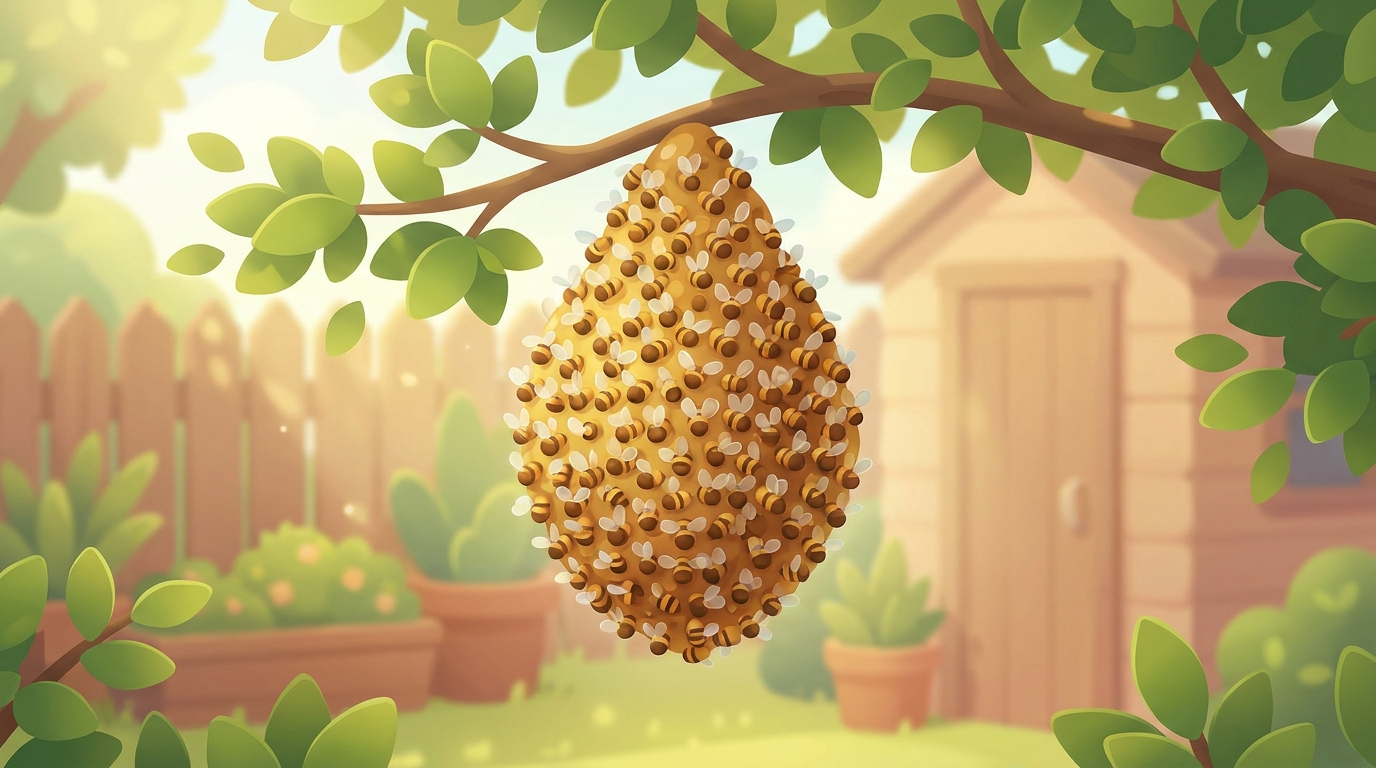
If you find a honey bee swarm in late spring, a basketball-sized cluster of bees hanging quietly on a branch or fence, don’t panic and don’t spray. A swarm is honey bees between homes; they’re gorged on honey, docile, and just resting while scouts look for a new cavity. The right call is a beekeeper, who will collect and relocate the swarm, often for free. New York City legally permits beekeeping, and local beekeepers and associations actively want these swarms, so a quick call or a 311 note usually gets one placed into a hive instead of a trash bag.
A honey bee colony that has already moved into a wall void or soffit is trickier, because there’s comb and honey involved and it can turn into a structural problem, but the goal is still live removal and relocation coordinated with a beekeeper wherever it’s workable, not a spray-and-forget. Here’s where we fit: our stinging-insect work centers on wasps, hornets, and yellowjackets and the nuisance stingers that threaten your family. When the visitor turns out to be honey bees, we help you confirm the ID and point you toward relocation rather than extermination. Carpenter bees, where the concern is wood damage rather than stings, and bumble bees we assess case by case. The short version of the whole post: many of the stingers in your yard are ones to leave alone.
Why Is DIY Wasp and Hornet Removal So Risky in NYC?
Every August our phones light up with the same story. Someone spotted a nest, grabbed a can of wasp spray, climbed an extension ladder at dusk, and got chased back inside with a handful of stings. Here’s why that goes wrong so reliably.
The aerosol jet falls short of a high nest, so half the spray drifts and the nest stays alive. Hitting a yellowjacket or hornet nest triggers that alarm pheromone and brings the whole colony out at once. And ladders plus a panicking person equals falls, which is often the injury that actually sends people to the ER, not the stings. A botched spray on a wall-void nest can also drive the colony deeper into your siding, turning a small problem into a demolition job.
The high eaves, wall voids, and second-story soffits are exactly the spots DIY can’t reach without real risk, and they’re the everyday work for the crew that handles this every day. We come with proper protective gear, do the ladder work most competitors quietly refuse, treat colonies inside wall voids, use family and pet-friendly products where it counts, and offer same-day service with no annual contracts. Whether you’re on a Nassau County lawn and want a crew that covers pest control across Long Island, or you’re in a two-family here in Queens, the plan is the same: identify the species, find the nest, and treat it without anyone getting stung. For the ground-nest version specifically, our guide on getting rid of yellowjackets in your NYC yard covers where the DIY line really is.
Bees vs Wasps: The Bottom Line for Your NYC Home
When something buzzes past on your stoop or your back deck, run the quick test. Fuzzy body, pollen on the legs, calmly working the flowers? That’s a bee, and it’s almost always one to leave alone; a honey bee swarm gets a beekeeper, not an exterminator. Smooth and shiny, sharp waist, patrolling your food and drinks? That’s a wasp, and a nest near people is worth treating. Remember that yellowjackets and hornets are wasps, that a honey bee stings once and dies while a wasp stings again and again, and that the real danger with any of them is an allergic reaction, which is a 911 call, not a wait-and-see.
And if you’d rather have a second set of eyes, photograph it from a distance and send it over. We’ve spent 26+ years identifying and treating wasps, hornets, and yellowjackets across the five boroughs and Long Island, and steering the honey bees toward a hive instead of a can of spray.