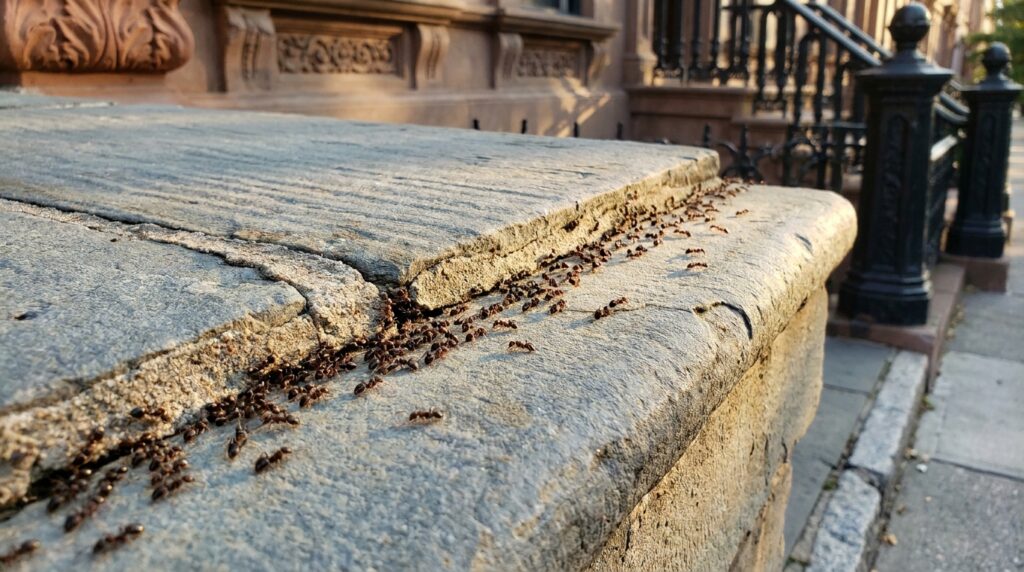
If you’ve watched a thick line of tiny dark ants snake out of a crack in your Brooklyn stoop, swarm a Queens sidewalk after a summer rain, or pour out of the seam between your apartment baseboard and the kitchen floor, you’re looking at pavement ants — and you’re far from alone. After 26 years running ant jobs across every NYC borough, our team has learned that pavement ants are the single most stubborn outdoor ant species New Yorkers deal with. They’re not dangerous, they don’t damage wood like carpenter ants, and they rarely sting. But they’re smarter than the bait stations most homeowners reach for, they have the bizarre habit of fighting other colonies in spectacular sidewalk battles, and they will come back every spring for years if you don’t break the cycle right.
This guide walks through what pavement ants are, where they nest on NYC sidewalks and stoops, the 4 DIY methods that actually work, what NYC-specific rules limit your options near tree pits, and when to skip the experiment and book professional ant control in NYC for a free inspection. If your problem is severe — multi-unit, indoor trails as well as outdoor mounds, or a colony that’s been there for years — Lisa or one of our front-office team can usually book a same-day inspection during business hours. But if you want to walk into that conversation knowing exactly what you’re up against, read on.
Pavement ants taking over your NYC stoop or sidewalk?
26+ years treating NYC ants. Targeted bait and perimeter work that finishes the colony, not just the trail you see, no annual contracts, and a free inspection that's waived when you book.
What Are Pavement Ants and Why Do You Have to Get Rid of Them on NYC Sidewalks?
Pavement ants (Tetramorium caespitum, sometimes also T. immigrans or what entomologists informally call “T. species E”) are small ants about 1/8 inch long, dark brown to nearly black, with two distinct nodes between the thorax and abdomen, parallel grooves running along the head and thorax, and a pair of small spines on the back. According to Penn State Extension’s pavement ant biology guide, the species was introduced to the United States from Europe in the holds of merchant ships during the 1700s and 1800s, where ballast soil dumped at East Coast ports gave the founding colonies their first North American homes. New York City has been pavement ant territory for nearly three centuries.
The reason you see them everywhere in NYC isn’t bad luck — it’s that pavement ants nest under sidewalks, slabs, stoops, and curbs by design, and our service area is, structurally, one giant sidewalk. A typical pavement ant colony has anywhere from a few thousand to over 10,000 workers, per NC State Extension’s pavement ant factsheet, and individual colonies hold territories roughly 18 to 20 feet across. Multiply that across a single Brooklyn block and you have dozens of colonies sharing a sidewalk, which is exactly why you sometimes see those bizarre Reddit-famous “ant wars” where thousands of tiny ants tangle in a moving carpet of bodies on the concrete. That’s two neighboring pavement ant colonies fighting to re-establish territory lines that winter erased — completely normal Tetramorium behavior, almost never a sign of disease or chemical exposure.
NYC apartments and brownstones get pavement ants indoors for one of three reasons: the colony under the sidewalk has found a crack into the basement and is foraging up; a ground-floor unit has a gap between the baseboard and the floor that leads directly to a colony under the building slab; or a swarmer flight in June dropped winged reproductive ants near your window, and a queen successfully founded a colony in the wall void or under the kitchen tile. The first two are by far the most common in our experience.
Where Do You Treat Pavement Ant Nests on NYC Stoops, Sidewalks, and Tree Pits?
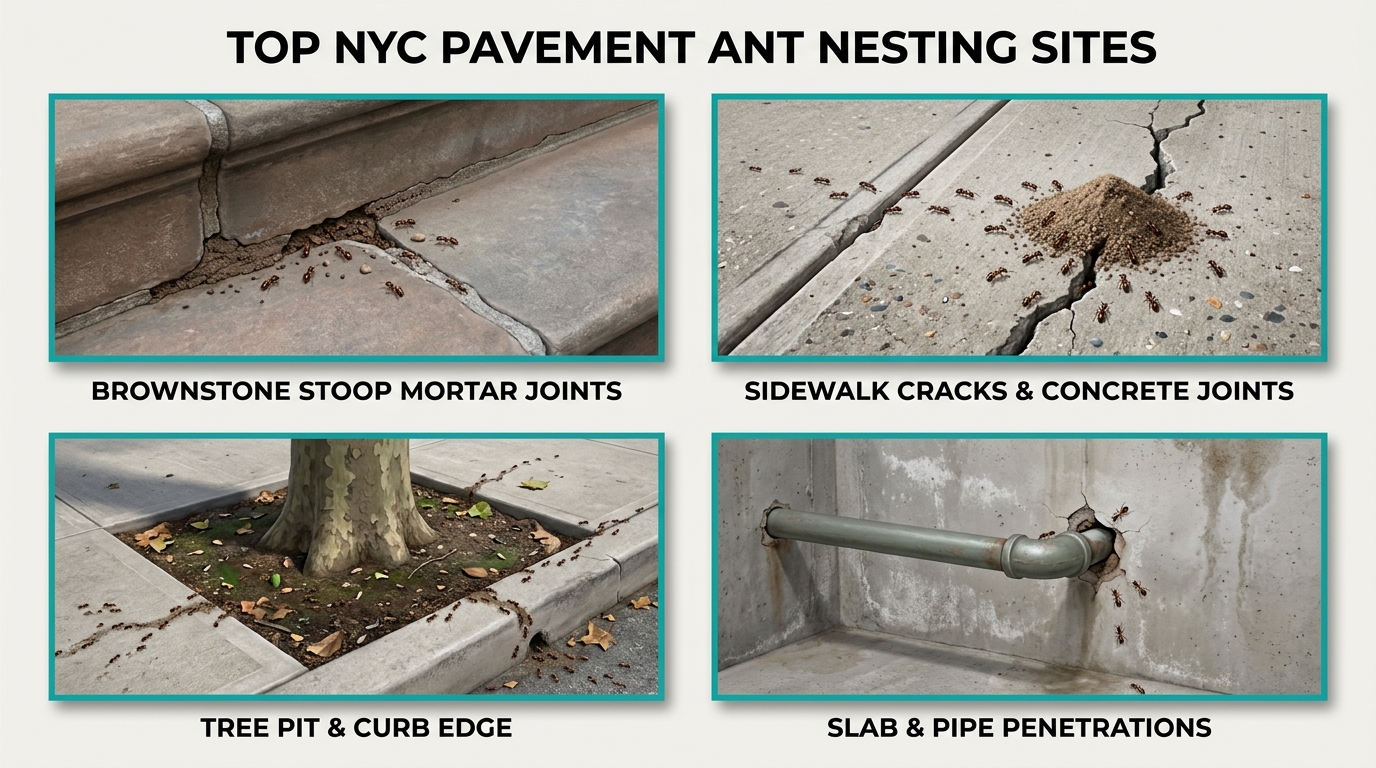
After thousands of NYC ant calls, our team has narrowed down the top 6 places pavement ants actually nest in our service area. If you’re trying to locate the colony before treatment — and you should, because treating only the foraging trail is what makes most DIY attempts fail — start here:
- Stoop bluestone or brick mortar joints. Brooklyn brownstones, Park Slope row homes, and pre-war Queens walk-ups have bluestone or brick stoops with mortar that erodes over decades. The gap between two bluestone treads is a textbook pavement ant nesting site — protected from rain, warmed by the sun, and connected to the soil below.
- Sidewalk cracks and joints. NYC DOT sidewalks expand and contract through 4 seasons. The longitudinal joints between concrete sections and any spider-cracked area become a colony entrance. You’ll often see a small mound of fine sand or soil grains pushed up from below — that’s excavated material from the colony’s expansion.
- Tree pits and surrounding curb. NYC street trees sit in pits surrounded by soil and protective tree guards. Pavement ants exploit the soft soil edge where the tree pit meets the concrete sidewalk. Ground-floor brownstone apartments next to a street tree get pavement ants entering through baseboards more than any other building type we see, and Brooklyn pavement ant calls in Park Slope, Brooklyn Heights, and Bed-Stuy lean heavily on this exact pattern.
- Under the building slab where pipes penetrate. Wherever a gas line, water service lateral, or electrical conduit comes through the building slab from below, there’s a gap big enough for foraging pavement ants. Inspect under your kitchen sink, around the radiator pipes, and behind the stove first.
- Behind brick retaining walls + planter beds. Brownstone front gardens, Queens row-home planters, and any low brick wall holding back soil creates a thermally protected cavity behind it. Pavement ants love these.
- Inside outdoor mounds on bare soil. If your property has a backyard or shared garden, look for small mounds of fine excavated soil at the base of fence posts, near garden bed edges, or anywhere bare soil meets pavement. Those are colony entrances.
One Reddit thread on r/exterminators we’ve seen describes exactly this pattern — a homeowner battling pavement ants for months who realized the main nest was a 1-square-foot mound on the sidewalk while smaller satellite entrances were scattered across his concrete pad. The colony had been digging long enough that the slab itself had cracked and sunken from underneath. That’s how aggressive an established Tetramorium colony can get when nothing interrupts it. The lesson: find the main nest before you spend $80 on bait, or you’re treating symptoms.
What 4 DIY Methods Actually Work on NYC Pavement Ant Colonies?
Most NYC homeowners reach for the same retail product family — Terro liquid bait, Raid spray, or a generic ant killer from the hardware store — and the same product family fails on pavement ants for the same reasons every season. Here are the 4 DIY approaches we’ve watched actually finish a colony in NYC, in order of difficulty:
1. Slow-acting gel bait at the foraging trail (not the nest). Pavement ants take sweet liquid baits and protein gel baits back to the colony, and slow-acting active ingredients like hydramethylnon, fipronil, or boric acid kill the workers gradually enough that they have time to feed the queen and developing larvae first. Place small dabs of gel bait (a quarter-inch line is plenty) directly on the foraging trail where you see workers moving, not on the nest entrance itself. Workers carry the bait back; the colony dies in 2 to 4 weeks. Don’t wipe the ants up — let them work. Per Penn State Extension, this is the only DIY approach that consistently eliminates the queen, which is the only way the problem ends.
2. Granular bait at outdoor nest entrances. For outdoor mounds on your sidewalk, stoop, or back garden, granular bait products containing the same slow-acting actives work the same way — workers harvest the granules and carry them inside. Sprinkle a small amount (a teaspoon is plenty) directly around the visible mound entrance. Reapply weekly until activity stops. Watch for the classic pavement ant trick of burying the bait with excavated soil — a behavior multiple Reddit users have documented when colonies decide a bait station is a threat. If burial keeps happening, switch product class (move from sweet bait to protein-based gel or vice versa).
3. Crack-and-crevice dust at indoor entry points. For pavement ants coming through gaps in your apartment baseboard, behind the stove, around the dishwasher gasket, or where pipes penetrate the wall, a waterproof insecticidal dust (like TERRO Ant Dust or D-Fense Dust) puffed into the void with a hand duster creates a long-residual barrier. Pavement ants walking through the void pick up the dust and carry it back to the colony. The dust stays effective for months as long as the wall void stays dry. Don’t apply dust in food-prep areas or where pets or children can contact it directly — apply only inside voids.
4. Perimeter spray AFTER bait, not before. Most homeowners reverse this order: they spray first to “kill the visible ones,” which wipes out the foraging workers before they can carry bait back to the queen, leaving the colony intact and angry. The correct sequence is bait first (2 to 4 weeks) until trails disappear, THEN a perimeter spray of a pyrethroid-based residual (bifenthrin or permethrin) to prevent new colonies from establishing. As one popular YouTube DIY video pointed out, even strong residuals like permethrin only last about 28 days outdoors in NYC’s rain and freeze-thaw cycles — so plan to reapply every 3 to 4 weeks through the May–October season, not once in spring.
If you’ve already tried Terro bait stations or a hardware-store spray and the ants are still active 3+ weeks later, your colony is either deep enough that retail bait isn’t getting to the queen, or you’ve got the wrong product class for your species. Our guide to identifying signs of an ant infestation in a NYC apartment walks through how to confirm species before you spend any more on DIY, and our comparison guide for carpenter ants vs black ants covers the species-confusion trap that costs people the most money.
What Can’t You Spray Near NYC Tree Pits to Kill Pavement Ants?
This is the part of pavement ant control that almost every retail DIY guide skips, and the part that lands NYC homeowners in trouble when they spray a chemical the city legally restricts on public property. NYC street tree pits are technically NYC Parks Department territory, and pesticide application near them is governed by both federal EPA Integrated Pest Management guidance and NYC’s own Local Law 37 (which restricts pesticide use on city-managed property).
What this means practically for a NYC homeowner trying to handle pavement ants near their stoop and street tree:
- Don’t broadcast-spray the sidewalk or curb. Anything you spray on the sidewalk runs off into the tree pit when it rains. Pyrethroids can harm the soil microbiome the tree depends on, and you can be cited if a NYC Parks inspector catches the application. Spot-treatment of pavement ant mounds with directional product is fine; broadcasting is not.
- Don’t pour or spray anything directly into the tree pit. The tree pit soil is protected for the tree’s root health. The pavement ant colony living at the edge of the pit isn’t worth a $150 fine or a damaged street tree.
- Skip the “boiling water” or “vinegar dump” DIY methods. They damage tree roots, kill beneficial insects, and don’t actually eliminate the pavement ant colony — workers in the outer galleries die, the queen survives, the colony rebuilds in 4 to 8 weeks.
- Bait stations are fine. Slow-acting baits in closed stations (not exposed gels) placed on the sidewalk edge AWAY from the tree pit are within bounds, since workers carry the bait back to the colony and there’s no runoff concern.
- For tree-pit-adjacent colonies, professional treatment is the right call. Licensed pest control operators (NYS DEC Cat 7C) use targeted spot treatments and bait protocols designed for urban tree pit situations and know what’s legal where.
If the colony is genuinely IN the city tree pit and the building has no responsibility for it, you can also file a complaint with NYC 311 requesting NYC Parks Pest Management to inspect — they handle public-property pest issues directly.
Pavement ants taking over your NYC stoop or sidewalk?
26+ years treating NYC ants. Targeted bait and perimeter work that finishes the colony, not just the trail you see, no annual contracts, and a free inspection that's waived when you book.
How Do You Stop Pavement Ants From Coming Back to Your Brooklyn or Queens Stoop?
Killing the visible colony is half the job — keeping the next colony from re-establishing in the same spot is what separates a one-summer fix from a permanent solution. Pavement ant pheromone trails persist on concrete for weeks, which means a colony eliminated in May can be rediscovered by a foraging neighbor colony in July if nothing changes structurally. Here’s the prevention checklist we walk through with every ant exterminator in Brooklyn visit and every Queens customer:
- Caulk every visible mortar joint and stoop crack. Mortar gaps in bluestone stoops, brick walls, and concrete patios are pavement ant prime real estate. Use polyurethane or hybrid sealant rated for outdoor freeze-thaw cycles (not interior caulk). Inspect every spring in May and re-seal anything new.
- Re-mortar deteriorated stoop joints. For Brooklyn brownstone stoops with bluestone treads, mortar that’s been there 80 to 120 years eventually crumbles. Re-mortaring the joints (mason job, $200 to $600 for a typical stoop) closes the structural cavity entirely. We’ve watched this single move eliminate recurring pavement ant problems on dozens of brownstones our customers own.
- Scrub off pheromone trails. Wash the sidewalk, stoop, and apartment entry threshold with hot soapy water + a stiff brush after eliminating the colony. This removes the chemical trail that other foraging ants would otherwise follow. Vinegar mixed 1:1 with water also works for the chemical-trail erasure if you prefer.
- Eliminate the moisture pull. Pavement ants are drawn to consistent moisture. Fix dripping AC condensate lines, unclog gutters that drain onto the sidewalk, redirect downspouts away from the foundation, and don’t leave standing water in pet bowls outside overnight.
- DSNY-compliant trash storage. Pavement ants forage 30+ feet from the colony and love sugary food residue on takeout containers. Per NYC’s 2024 DSNY containerization rules, residential trash now goes in sealed bins — which has a real side benefit of cutting outdoor ant pressure dramatically. Make sure your bins seal completely and rinse any sticky residue.
- Spring perimeter treatment. A pyrethroid residual sprayed in a 3-foot band around your stoop, foundation perimeter, and the base of your fence in early May creates a barrier that lasts ~30 days and breaks the spring re-establishment cycle. Reapply at 30-day intervals through July if you’re in a chronic-pressure area like a Park Slope brownstone block or a Forest Hills row of detached homes.
For brownstone homeowners and Queens pest control customers with a multi-year pavement ant history, our seasonal plan customers get this prevention work scheduled automatically — initial treatment in April, follow-up in June, and a final perimeter pass in late August. That cadence breaks the pavement ant pressure cycle in most properties within 2 seasons.
When Should You Pay a Pro to Get Rid of NYC Pavement Ants vs DIY?
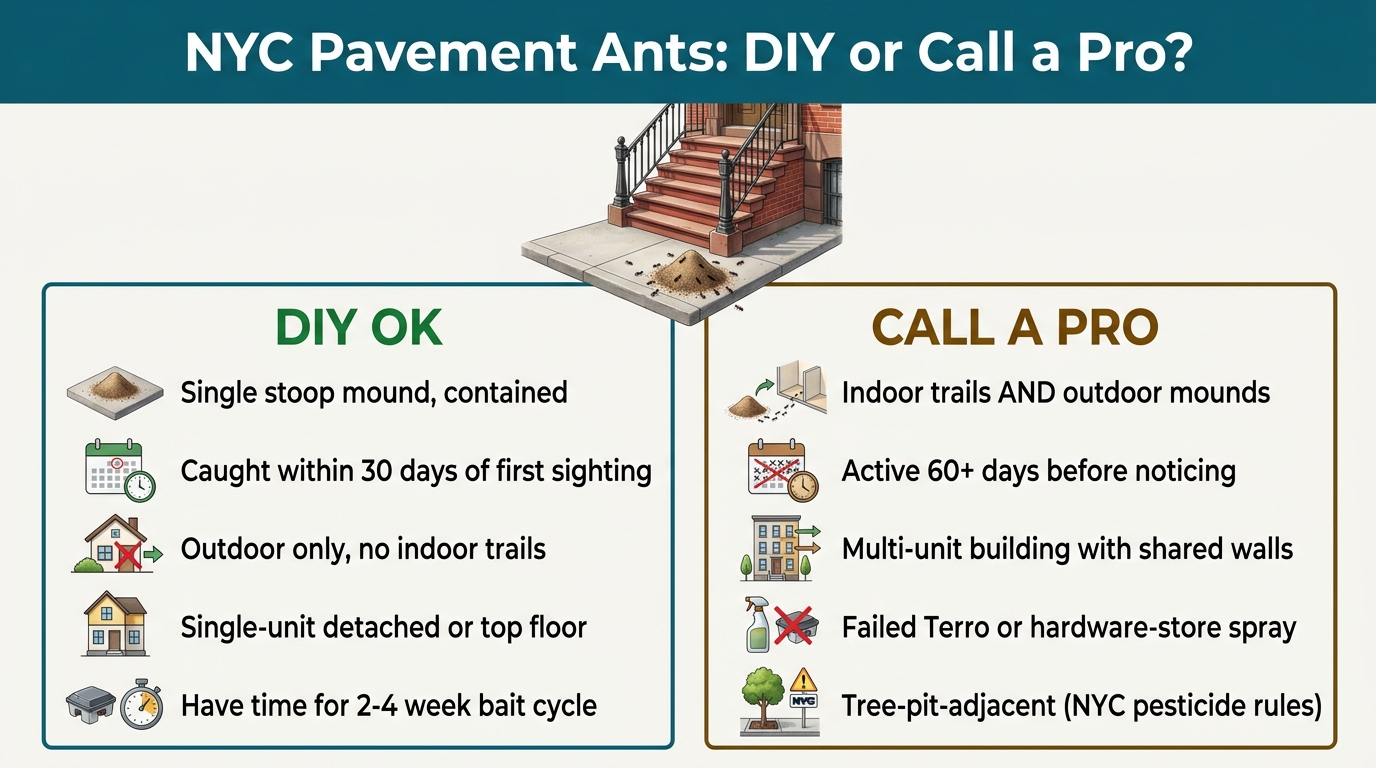
Honest answer: DIY can handle a contained pavement ant problem — say, one stoop mound caught early with no indoor foraging yet — for under $40 in bait products and a couple of weekends of patience. DIY does NOT work in these specific NYC scenarios, and trying it longer just delays the inevitable while the colony grows:
- The colony has been active for more than 60 days before you noticed it. Pavement ant colonies grow fast in summer. A trail you noticed in late June and let go until late August has likely doubled in size and may have budded a satellite colony 20 feet away.
- You have indoor trails AND outdoor mounds. Two-front infestations need coordinated indoor (gel bait + dust) and outdoor (granular bait + perimeter spray) treatment that’s hard to time correctly DIY without ant biology experience.
- Multi-unit buildings with shared walls. If your downstairs neighbor’s apartment has pavement ants too and the building isn’t coordinating a building-wide treatment, you’ll be re-treating your unit every 6 weeks indefinitely. Building-wide treatment by a licensed pest control company is the only durable fix here.
- You’ve tried Terro + a perimeter spray and the trail is still active 3 weeks later. The colony is deeper than retail bait reaches, or you’ve got a species ID problem. Don’t keep buying the same product family.
- Tree-pit-adjacent infestations. NYC tree pit pesticide rules limit what’s legal DIY. Licensed Cat 7C applicators have access to spot-treatment formulations designed for this scenario.
- Allergic to wasp/ant stings, or you have kids/pets that touch outdoor surfaces. Even though pavement ant stings are mild, you don’t want to be the household applying repeat pyrethroid sprays where kids play.
What a professional NYC pavement ant treatment actually looks like: same-day inspection during business hours, species ID by a licensed technician, a structured bait + perimeter spray protocol staged over 2 to 3 visits across 4 to 6 weeks (to match colony die-off biology), and a written guarantee window. Our team uses the products mentioned in NPMA’s pavement ant control guidance at concentrations and formulations that aren’t available OTC, including the Alpine WSG class that one r/exterminators commenter specifically called out as the right choice for pavement-ant mounds.
Who Pays for NYC Pavement Ant Treatment — You, Your Landlord, or the Building?
If you rent in NYC, this is the most important paragraph on this page. Under New York’s Warranty of Habitability (Real Property Law §235-b) and the NYC Housing Maintenance Code, landlords are legally required to maintain rental apartments free from pest infestations — including pavement ants — and to remediate them when they appear. Per the city’s pest and pesticide laws for landlords and tenants, this is non-negotiable for nearly every NYC rental.
Under NYC HMC §27-2017.1 and Local Law 55 (2018), landlords of multi-unit dwellings must address pest infestations within a defined window after a tenant complaint, typically 30 days from the date HPD issues a violation. If your landlord is unresponsive, you can call 311 to trigger an HPD inspection. Once HPD issues a violation, the landlord must remediate or face fines. Keep a written paper trail (email is best) of every complaint and the landlord’s response.
Two scenarios where the math works differently in NYC:
- Pavement ants entering from the public sidewalk or tree pit: Technically the city’s responsibility for the public-property colony, the landlord’s responsibility for sealing the building envelope that the ants exploit to get inside. Both calls can happen in parallel (311 for the tree pit, written complaint to landlord for the building gaps).
- Owner-occupied condos and co-ops: In-unit treatment is typically the unit owner’s cost; common-area treatment (lobby, basement, courtyard) falls on the building’s common-charge budget. Building-wide pavement ant treatment for a co-op is often a $1,500 to $4,000 line item the board has to approve. Get on the agenda for the next board meeting if it’s recurring.
For NYCHA residents, pest control runs through NYCHA’s own pest management program — call the NYCHA Customer Contact Center rather than booking a private pest control company. For single-family homeowners in Bayside, Whitestone, Floral Park, Forest Hills, just over the line for Long Island ant removal, or anywhere else in our service area, the cost is yours, but a well-handled pavement ant program usually pays for itself in two seasons of avoided re-infestation.
What Are Red Flags in Cheap NYC Pavement Ant Treatment Quotes?
The pavement ant market in NYC attracts a specific kind of low-bid quote because the work LOOKS simple from the outside. Here’s what we’ve learned from 26 years of getting called in to fix what other operators left behind:
Cheap-quote red flags (under $150 for an NYC pavement ant job):
- No species ID step. If the quote doesn’t mention the technician inspecting and confirming pavement ant vs odorous house ant vs Pharaoh ant (which require completely different bait protocols), they’re applying generic ant spray and hoping.
- Spray-only protocol with no bait or dust. Spraying kills foragers and leaves the queen — by August the trail is back.
- One-visit promise. Pavement ant colony die-off biology takes 2 to 4 weeks after bait pickup. A “one visit done” quote is either ineffective or planning to charge again when the ants return.
- No NYS DEC Cat 7C pesticide applicator license visible on the company website or invoice. Commercial pesticide application in NY requires state licensing. We’re licensed; many low-bidders aren’t.
- No mention of perimeter exclusion or follow-up. Eliminating the colony without sealing the entry points just means the next colony moves in by the following summer.
Inflated-quote red flags (over $1,000 for a typical NYC pavement ant job):
- Annual contract pressure for what should be a 2 to 3 visit program. A standard NYC pavement ant job is $250 to $500 for the initial treatment plus 1 to 2 follow-ups. If someone’s pitching a $1,200 annual lock-in for a single stoop infestation, walk.
- Whole-building treatment quoted without inspection of other units. For a single-apartment problem, a building-wide quote is overkill unless the inspection confirms the colony is multi-unit.
- Add-on charges for “biohazard cleaning” or “deep sanitation.” Pavement ants don’t require those — that’s bed bug or hoarding-grade language being misapplied.
A thorough free inspection from a licensed NYC pavement ant company should produce a written quote with species confirmation, scope of work, the specific product names being applied, visit schedule, and a written guarantee window. If any of that’s missing on either end of the price spectrum, get another quote.
The Bottom Line: Your NYC Pavement Ant Action Plan
If you’ve spotted pavement ants on your NYC stoop, sidewalk, or apartment kitchen this week, here’s the order to act in: (1) confirm species by checking the ID details above — pavement ants vs odorous house vs pharaoh vs carpenter all need different treatment; (2) locate the actual colony nest (under the stoop, sidewalk crack, tree pit edge, building slab penetration), not just the foraging trail; (3) deploy slow-acting bait at the trail and granular bait at the outdoor mound, then wait 2 to 4 weeks WITHOUT spraying; (4) once activity stops, perimeter-spray a pyrethroid residual around your stoop and foundation; (5) seal mortar joints, fix moisture issues, and rinse sticky takeout-container residue from outdoor bins to keep the next colony from re-establishing.
For most NYC tenants and brownstone owners, the realistic budget for a real pavement ant program looks like this: $30 to $80 in DIY bait + dust + perimeter spray if the problem is contained and caught early, $250 to $500 for a single-visit professional treatment on a moderate stoop infestation, $450 to $900 for a 2 to 3 visit program on a multi-room or multi-mound infestation, and $700 to $1,500+ for building-wide coordinated treatment for shared-wall buildings. If you rent, your landlord almost certainly owes the cost — call 311 before you reach for your wallet.
We’ve been doing ant work in NYC since 1999, and the most common mistake we see with pavement ants is spraying first and baiting second — which kills the visible workers, leaves the queen, and turns a $400 fix into a $1,200 multi-month problem. The second most common mistake is treating only the indoor trail and ignoring the sidewalk mound that’s actually feeding it. If you’d rather skip the experiment and have it handled by a team that’s run thousands of NYC pavement ant jobs, our front-office team offers free same-day inspections across all five NYC boroughs — Lisa or one of our front-office team can usually book a same-day inspection during business hours, with a 27-person team and 26 years of route experience across the brownstones, walk-ups, row homes, and apartment courtyards that make up our service area.