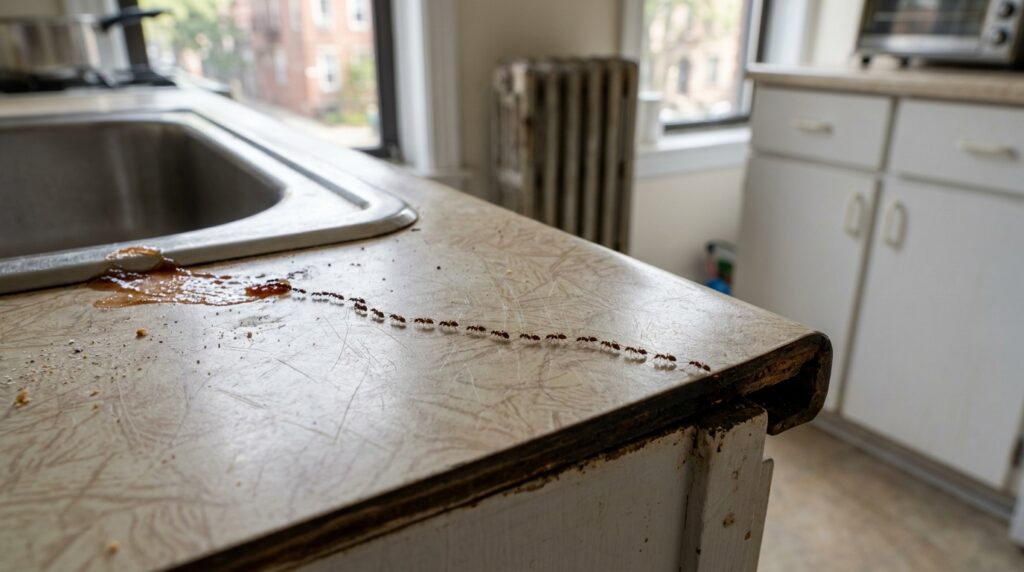
If you’ve spotted a line of tiny ants marching across your Astoria kitchen counter, found a small dirt mound at the base of your Forest Hills stoop, or noticed large black ants on the fascia of a Bayside detached home, you’re seeing one of three completely different ant species — each of which needs a totally different treatment approach. After 26 years running ant calls across every Queens neighborhood, our team has learned that Queens ant problems break down into a predictable pattern by building type: walk-up apartments get sugar ants in kitchens, attached row homes get pavement ants on stoops, and detached single-family homes get carpenter ants in fascia and decks. Misidentifying which one you have costs Queens tenants and homeowners $300 to $1,500 in wrong-treatment bills every year.
This guide walks through the most common ant species in Queens apartments and homes, where to look first by species and building type, how to tell them apart by behavior, which Queens neighborhoods have the worst recurring ant pressure, and when DIY works versus when you need a pro. If you’d rather skip the inspection and book professional ant control in Queens for a free walkthrough today, our front-office team can usually book a same-day inspection during business hours. Read on for the Queens-specific species guide.
Ants in your Queens apartment?
26+ years treating Queens ants. Species ID, targeted bait protocols, and wall-void dust for carpenter ant nests, no annual contracts, and a free inspection that's waived when you book.
What Are the Most Common Ant Species in a Queens Apartment?
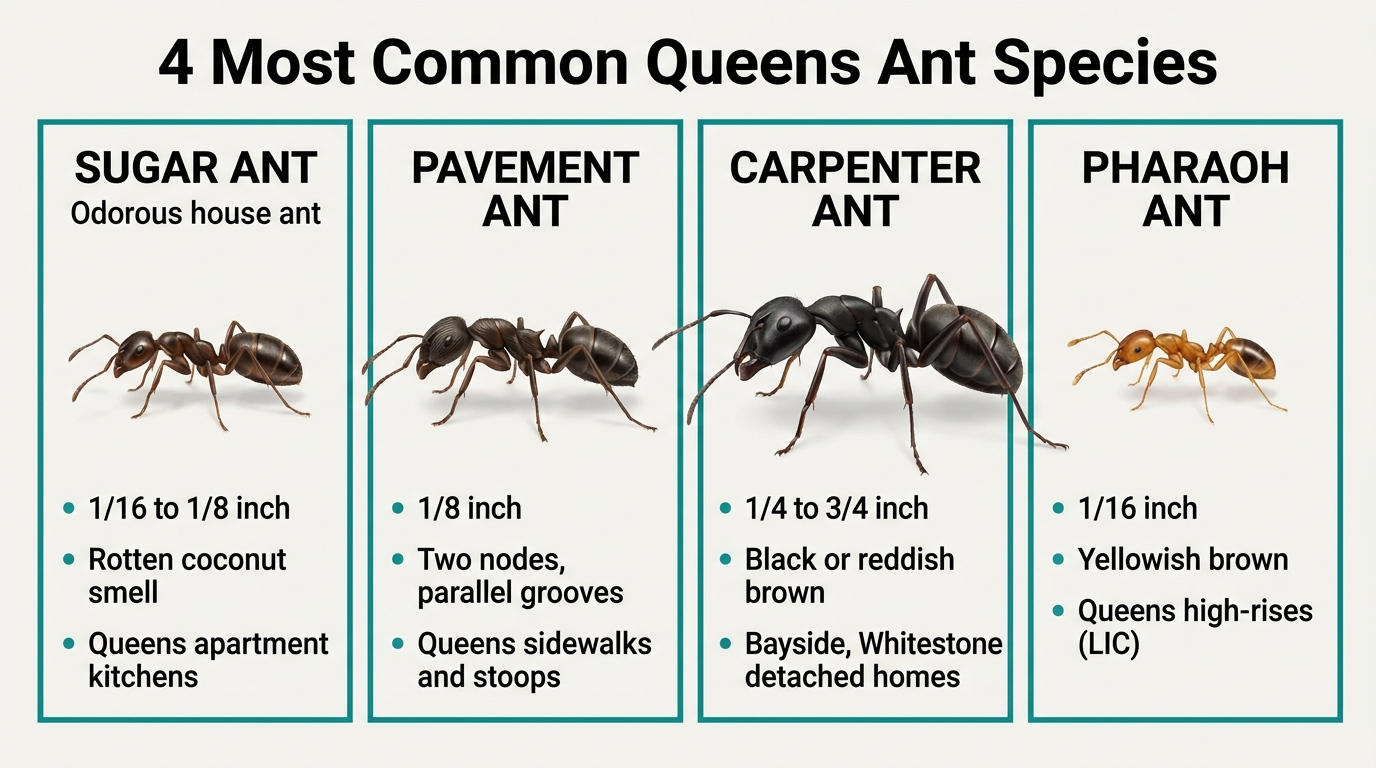
Three ant species account for over 90% of Queens calls our team runs. Each lives in different parts of Queens housing stock and needs different treatment:
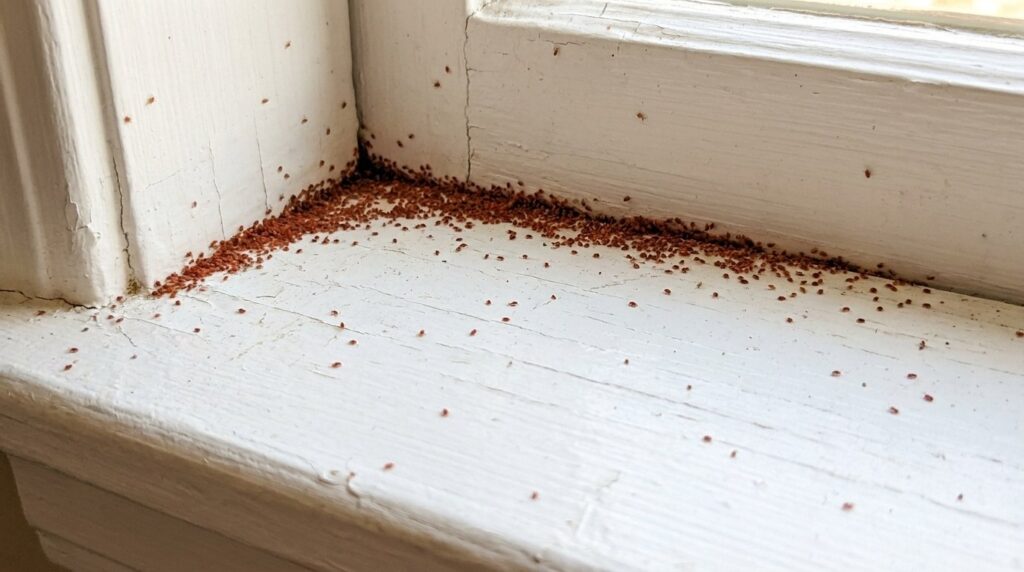
- Odorous house ant (commonly called “sugar ant” in NYC). Tiny dark brown ants 1/16 to 1/8 inch long, single hidden pedicel node, smells like rotten coconut when crushed. Dominates Queens apartment kitchens — Astoria walk-ups, Long Island City high-rises, Jackson Heights pre-war buildings. Loves sugary residue from spilled soda, fruit, takeout containers. Lives in wall voids around kitchens.
- Pavement ant. Slightly larger (1/8 inch), dark brown to nearly black, two distinct nodes between thorax and abdomen, lives in sidewalk cracks and stoop mortar joints. Common at Forest Hills row homes, Sunnyside walk-ups with bluestone stoops, and Ridgewood attached row homes. Forages 30+ feet from the colony so they show up indoors near stoop entrances and ground-floor apartment baseboards.
- Carpenter ant. The largest household ant in Queens (1/4 to 3/4 inch), black or reddish-brown, slow-moving, prefers detached homes with wooden structural elements. Dominant in Bayside, Whitestone, Floral Park, and Howard Beach detached homes. Damages fascia, deck framing, and roof structure when moisture conditions allow. NOT common in Queens apartment buildings — if you see large black ants in your apartment, they’re foraging in from a nearby tree or detached home, not nesting in your apartment.
- Pharaoh ant (less common but dangerous to misidentify). Tiny yellowish-brown ants in Queens high-rises and apartment buildings (especially Long Island City glass towers). Spraying causes catastrophic colony budding — a single spray can turn one colony into 5+ satellite colonies in a month.
- Acrobat, little black, and cornfield ants (rare). Less common Queens species. Usually outdoor or building-perimeter. Treatment similar to pavement ants.
The single most important step before treating ants in Queens is correct species identification. Our general guide to signs of an ant infestation in a NYC apartment walks through the smell test, size estimate, and behavior cues that separate species, and our comparison guide for carpenter ants vs black ants in New York is the most-read post on our site because misidentification costs people thousands every year.
Where Do You Spot Signs of Sugar Ants in Queens Apartment Kitchens?
Sugar ants (odorous house ants) are by far the most common Queens apartment ant. Here’s where our techs check first in a Queens kitchen complaint:
- Under the kitchen sink at plumbing penetrations. Wall void access + moisture from drain trap + warmth from dishwasher next door. The #1 Queens apartment sugar ant nesting site.
- Behind the stove and refrigerator. Toe-kick voids stay warm year-round. Pull each appliance and look for grease marks + trails along the wall behind.
- Inside dumbwaiter shafts (pre-war Astoria, Sunnyside, Jackson Heights). Most pre-war Queens walk-ups had dumbwaiter shafts that got sealed loosely when buildings stopped using them. These shafts host sugar ant colonies that forage into multiple apartments on the same line.
- Around radiator pipes. Pre-war Queens walk-ups have steam radiators. The gap around the pipe stays warm and is rarely sealed.
- Inside cabinet kickboards. The 1 to 2 inch cavity at the base of every wood kitchen cabinet is a sugar ant runway.
- Bathroom: under the toilet tank and inside the tub apron. Sugar ants forage to bathrooms when there’s accessible moisture. Less common than kitchen activity but worth checking.
For the complete bait-only DIY protocol that finishes sugar ant colonies in Queens kitchens in 7 to 14 days, our comprehensive NYC sugar ant guide walks through the method. Sugar ants in a single-room Queens kitchen are usually a DIY-tractable problem if caught early.
Where Do You See Signs of Pavement Ant Nests on Queens Sidewalks and Stoops?
Pavement ants nest under sidewalks, stoops, and curbs by design — Queens has thousands of miles of these surfaces, so pavement ant pressure is borough-wide. Here’s where they nest specifically:
- Stoop mortar joints (Forest Hills, Sunnyside, Ridgewood row homes). Brick and bluestone stoops with mortar that erodes over decades. The gap between two stoop treads is a textbook pavement ant nesting site.
- Sidewalk cracks and concrete joints. NYC DOT sidewalks expand and contract through 4 seasons. The longitudinal joints become colony entrances. Small excavated dirt mounds beside the joint signal a colony.
- Queens street tree pits. The soil edge where a tree pit meets the concrete is pavement ant prime real estate. Ground-floor apartments adjacent to street trees get pavement ants entering through baseboards.
- Under the building slab where pipes penetrate. Gas line, water service lateral, electrical conduit gaps coming through the slab from below.
- Behind brick retaining walls and planter beds. Queens row-home front gardens often have low brick retaining walls. Pavement ants love the thermally protected cavity behind.
- Outdoor mounds on bare soil. Detached Queens homes (Bayside, Whitestone) have backyards where pavement ants create small soil mounds at fence posts and garden bed edges.
For the complete pavement ant elimination guide including the bait + dust + perimeter spray protocol, our comprehensive NYC pavement ant DIY guide walks through the method in detail.
Where Do Signs of Carpenter Ant Damage Show Up in Queens Detached Homes?
Carpenter ants are dominant in Queens detached single-family neighborhoods (Bayside, Whitestone, Floral Park, Howard Beach, Bay Terrace, Douglaston) — and they’re rare in Queens apartment buildings unless foraging in from adjacent detached homes. Here’s where they damage Queens detached homes:
- Roof drain wood blocking and fascia. Detached Queens homes with internal roof drainage develop chronic moisture in fascia wood. Carpenter ants colonize the damp fascia.
- Deck framing and posts. Backyard decks in Bayside and Whitestone detached homes are common carpenter ant habitats. Check the deck post bases for frass piles.
- Garage and shed wood framing. Detached garages and storage sheds with moisture issues attract carpenter ants quickly.
- Sill plate and floor joist ends (basement). Where the basement floor joists meet the foundation wall — accumulated moisture from foundation seepage creates carpenter ant habitat.
- Window frame trim. Wood window frames with paint failure and water infiltration. Carpenter ants colonize the trim wood.
- Fence post bases. Wood fence posts at the soil line are common carpenter ant nesting sites.
For the complete Queens detached home carpenter ant treatment guide, our NYC carpenter ant elimination guide walks through the wall-void + perimeter bait protocol. Carpenter ant treatment is almost always a pro job for detached homes with structural damage.
How Do You Tell Queens Ant Species Apart by Behavior?
Species ID by behavior is faster and more reliable than ID by size for most Queens tenants. Here’s the behavior matrix:
| Species | Movement pattern | Location pattern | Trail behavior |
|---|---|---|---|
| Sugar ant | Fast-moving single-file lines, rapid recruitment to food | Kitchen counters, sinks, behind appliances | Persistent trails along baseboards and cabinet edges |
| Pavement ant | Moderate pace, persistent trails 30+ feet from nest | Sidewalks, stoops, ground-floor baseboards near exterior doors | Outdoor mounds visible at trail termini |
| Carpenter ant | Slow, deliberate, solitary or small groups | Fascia, decks, structural wood; rarely in apartments | No persistent trails; foragers wander |
| Pharaoh ant | Fast, branching trails that change daily | Bathrooms, kitchens, high-rises, hospitals | Multiple satellite colonies — trails change locations |
The smell test is the fastest free ID. Crush one ant on a paper towel and sniff. Sugar ants (odorous house ants) emit a distinctive rotten coconut or blue cheese odor — totally unmistakable. Pavement ants, carpenter ants, and pharaoh ants don’t have this smell. This single test confirms species ID for the majority of Queens apartment kitchen ant calls.
Ants in your Queens apartment?
26+ years treating Queens ants. Species ID, targeted bait protocols, and wall-void dust for carpenter ant nests, no annual contracts, and a free inspection that's waived when you book.
Which Queens Neighborhoods Show the Worst Signs of Ant Activity?
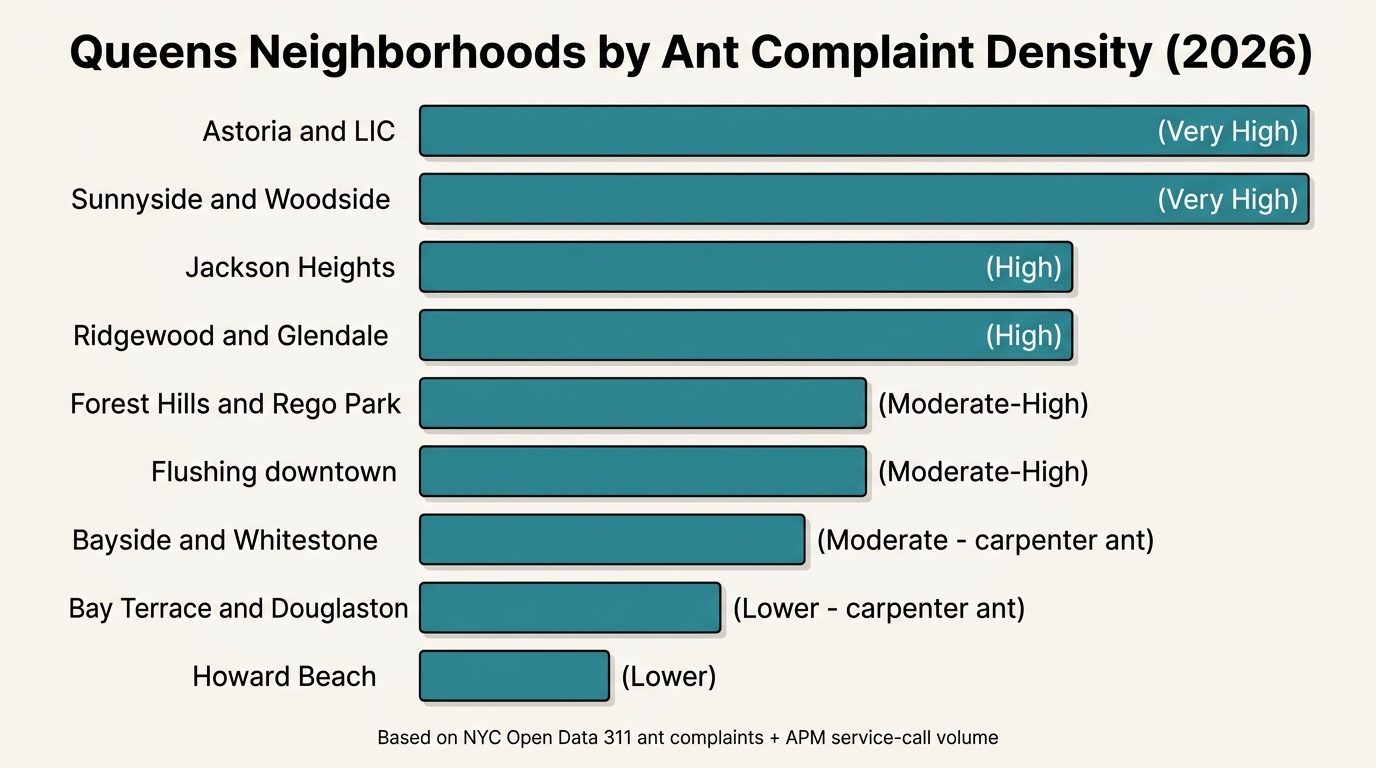
Per NYC 311 Service Request data and our 2026 service-call volume, Queens neighborhoods rank like this on residential ant complaint density:
- Astoria & Long Island City. High density of pre-war walk-ups with sealed dumbwaiter shafts + restaurant corridor along Steinway and Vernon-Jackson. Sugar ant pressure peaks in summer kitchens.
- Sunnyside & Woodside. Mature tree-lined blocks and older small apartment buildings. Stable sugar ant nesting habitat in wall voids. 7-train corridor restaurant density adds pressure.
- Jackson Heights. Dense pre-war apartment buildings with shared service alleys. Sugar ants transmit easily between buildings through shared utility risers.
- Ridgewood & Glendale. Older wood-frame attached row homes — textbook pavement ant + occasional carpenter ant habitat. Brick stoop mortar joints are pavement ant nest sites.
- Forest Hills & Rego Park. Mid-rise apartment stock with central trash chutes + tree-lined row-home corridors. Mixed sugar ant + pavement ant pressure.
- Flushing (downtown). Restaurant density along Main Street creates heavy sugar ant pressure in adjacent residential blocks.
- Bayside, Whitestone, Floral Park. Detached single-family homes with carpenter ant pressure on fascia and deck framing. Less sugar ant pressure than apartment-dense neighborhoods.
- Bay Terrace & Douglaston. Lower density, more detached homes, primarily carpenter ant pressure.
- Howard Beach & Broad Channel. Detached homes near water, occasional carpenter ant infestations driven by humidity.
If you live in any of these neighborhoods and you’re starting to see ant evidence, you’re on a typical timeline. The Queens ant pressure cycle peaks late June through August every year. Buildings with chronic ant complaints stay chronic year over year because the structural attractants (moisture, wall voids, shared utilities) don’t change.
When Are Signs of Ants in a Queens Apartment Bad Enough to Call a Pro?
DIY works for early-stage single-species Queens ant problems caught within 14 days of first sighting. Call a pro in these scenarios:
- Multiple species suspected. If you’re seeing both small fast ants AND large slow ants in the same apartment, you may have two colonies. Each needs different treatment.
- Carpenter ants confirmed in any building type. Carpenter ants need wall-void dusting + structural assessment, not retail spray. Call a pro.
- Pharaoh ants suspected (Queens high-rise). Spraying causes colony budding. Treatment is bait-only at carefully placed locations.
- Multi-unit building with confirmed adjacent-unit activity. Building-wide treatment is the only durable fix.
- You’ve tried Terro or hardware-store spray for 14+ days with no improvement. Either wrong species, wrong product, or competing food source not eliminated.
- Detached home with fascia or deck damage. Carpenter ant structural damage needs professional treatment + repair assessment.
A real professional Queens ant treatment looks like: free inspection during business hours, species ID confirmation, treatment protocol matched to species (bait for sugar/pavement, wall-void dust + bait for carpenter), 2-week follow-up to verify colony elimination, written guarantee window.
When Signs of Queens Apartment Ants Need Treatment, Who Pays — You or Your Landlord?
If you rent in Queens, your landlord almost certainly owes the cost. Under New York’s Warranty of Habitability (Real Property Law §235-b) and the NYC Housing Maintenance Code, landlords are legally required to maintain rental apartments free from pest infestations — including ants — and to remediate when they appear. Per the city’s pest and pesticide laws, this applies to nearly every Queens rental.
Under NYC HMC §27-2017.1 and Local Law 55 (2018), landlords of multi-unit dwellings must address pest infestations within a defined window after a tenant complaint, typically 30 days from the date HPD issues a violation. If your landlord drags their feet, call 311 to trigger an HPD inspection.
Two Queens-specific scenarios where the math is different:
- Owner-occupied detached homes (Bayside, Whitestone, Floral Park). Cost is yours. Carpenter ant treatment + any structural fascia or deck repair runs $400 to $3,500+ depending on scope.
- Co-op and condo buildings. Common-area ant treatment is the building’s common-charge responsibility; in-unit treatment falls on the unit owner.
For NYCHA residents in Queens (Queensbridge Houses, Astoria Houses, Ravenswood Houses, others), pest control runs through NYCHA’s own pest management program — call the NYCHA Customer Contact Center rather than booking a private exterminator.
The Bottom Line: Your Queens Ant Action Plan
If you’ve spotted ants in your Queens apartment or home: (1) confirm species using the smell test for sugar ants + the size/behavior matrix above; (2) identify whether the ant pressure is indoor kitchen (sugar ant), exterior stoop (pavement ant), or structural wood (carpenter ant); (3) for sugar ants and pavement ants caught early, DIY bait works within 7 to 14 days; (4) for carpenter ants in any setting, or any species in a multi-unit building with shared-wall activity, call a pro; (5) if you rent, document the evidence with photos and notify your landlord in writing within 7 days.
For most Queens tenants and homeowners, realistic 2026 ant treatment pricing breaks down: $15 to $80 in DIY bait + sealing supplies for contained single-species early-stage problems, $250 to $450 for a single-visit professional treatment, $450 to $900 for multi-visit programs, and $900 to $2,500+ for severe carpenter ant treatment with wall-void dusting in detached Queens homes. If you rent, your landlord owes the cost — call 311 if they’re unresponsive within 7 days.
We’ve been doing ant work across Queens since 1999, and the most common mistake we see is misidentification leading to wrong treatment — spraying sugar ants when bait would work, treating pavement ants like carpenter ants, or assuming visible large black ants in an apartment are nesting there when they’re actually foraging in from outside. The second most common mistake is letting a 2-week problem turn into a 6-month problem by waiting — Queens ant populations roughly double every 4 to 6 weeks during peak season. If you’d rather skip the experiment and have it handled by a team that’s run thousands of Queens ant jobs across Astoria walk-ups, Forest Hills row homes, and Bayside detached singles, our front-office team offers free same-day inspections — Lisa or one of our front-office team can usually book a same-day visit during business hours, and the quote you get will itemize species, treatment scope, visit schedule, and guarantee window.