If you’ve been quoted $2,500 to $4,500 for whole-apartment NYC bed bug heat treatment and your co-op board won’t approve the electrical load, your landlord won’t cover the cost, or your pre-war NYC apartment simply doesn’t have the 100+ amp electrical capacity heat treatment needs, you’re not stuck — chemical-only bed bug treatment is the right path for the majority of NYC apartments, and it works. After 26 years treating NYC bed bugs across every borough, our team has eliminated thousands of bed bug colonies with chemical-only protocols at one-third the cost of heat treatment, with the same end result. The tradeoff is timeline: chemical-only treatment takes 8 to 12 weeks across 3 visits instead of the 1-day result of heat. That’s the entire honest difference.
This guide walks through when chemical-only bed bug treatment is the right call for NYC apartments, the 3-product protocol that actually works, what to expect at each visit, how to prep your apartment, what products NYC bed bug exterminators use, and when chemical treatment should escalate to heat or combination. If you’d rather skip the research and book professional NYC bed bug treatment, our front-office team can usually book a same-day inspection during business hours. Read on for the chemical-only protocol.
Bed bugs in your NYC apartment?
26+ years treating NYC bed bugs. Crossfire residual + IGR cycles where it counts, no annual contracts, and a free inspection that's waived when you book. The chemical-only protocol works at one-third the cost of heat treatment.
When Is Chemical-Only Treatment Right for NYC Bed Bugs?
Chemical-only bed bug treatment is the right call for the majority of NYC apartments in these specific scenarios:
- Pre-war NYC apartment without 100+ amp dedicated electrical capacity. Heat treatment requires 8 to 12 industrial heaters drawing 100+ amps simultaneously for 6 to 8 hours. Most pre-war NYC apartments have 60 to 100 amp service for the entire unit. Even modern apartments often can’t accommodate the load. Chemical treatment runs on no special electrical capacity — same standard treatment kit our techs carry.
- Co-op or condo building rules that restrict heat treatment. Many NYC co-op and condo boards have explicit policies against heat treatment due to insurance, building electrical infrastructure, or proximity to other units. Chemical treatment is universally permitted.
- Budget-constrained households. Chemical-only NYC bed bug treatment runs $400 to $1,200 for a typical 1 to 2 bedroom apartment vs $2,500 to $4,500 for heat treatment. For tenants paying out of pocket while landlord disputes drag on, chemical is the more accessible path.
- Early-stage or small infestations. Chemical treatment is more cost-effective for early-stage infestations (caught within 30 to 60 days of first sighting) where the population is concentrated in 1 to 2 rooms.
- Recurring monthly maintenance (post-treatment). After initial elimination, chemical maintenance treatments at 30-day intervals are appropriate for preventing reinfestation. Heat treatment isn’t typically a maintenance option.
- Tenant in a multi-unit building where landlord won’t fund heat. If the landlord is paying for treatment, they often default to chemical treatment because it’s the cheaper option. Tenants can request heat but landlords aren’t required to provide it as long as the chemical treatment is effective.
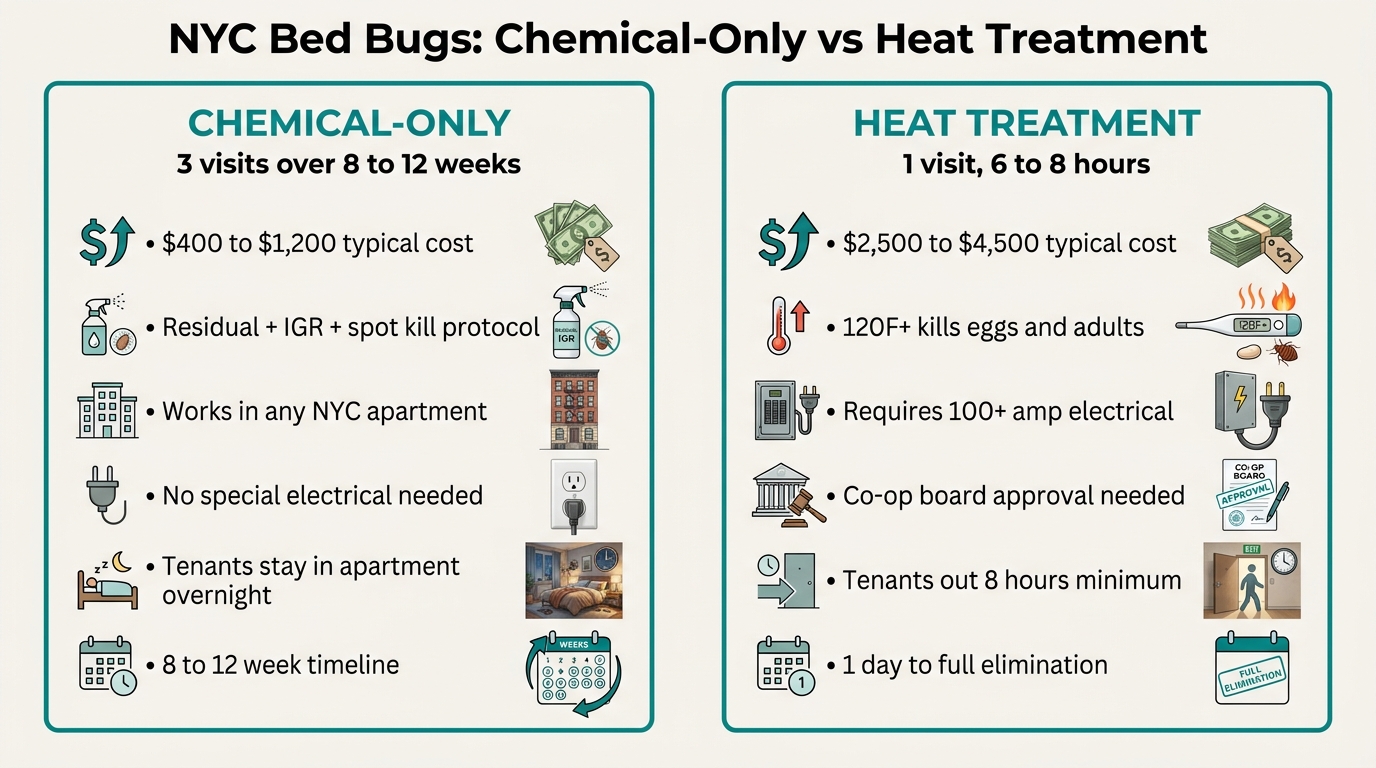
For the heat-treatment counterpart, our comprehensive guide to what temperature kills bed bugs in NYC walks through when heat IS the right call (heavily-infested whole apartments, severe books-and-clothing contamination, or speed-critical situations where 1-day elimination matters more than cost).
What’s the 3-Product Chemical Protocol for NYC Bed Bug Elimination?
Effective NYC chemical-only bed bug treatment uses three product classes applied at strategic locations. Per EPA’s bed bug management guidance for low and moderate income housing, integrated chemical treatment combining residual + IGR + contact products achieves full colony elimination at high reliability:
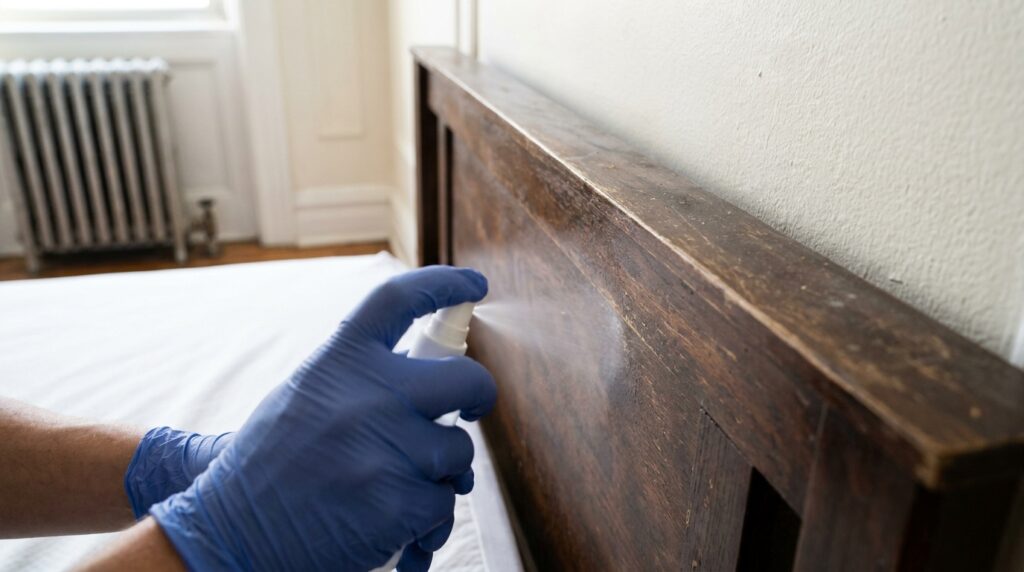
- Residual liquid product (Crossfire by MGK is APM’s primary). Applied to bed frame, headboard, baseboards, around electrical outlet covers, under mattress tufts and folds where labeled, behind picture frames, and along wall-floor edges throughout the bedroom. Crossfire contains clothianidin + metofluthrin and works on pyrethroid-resistant bed bug populations (a major NYC issue per recent academic research). The residual stays active for 30 days. Bed bugs walking through the treated zone pick up the active and die within 24 to 72 hours.
- Insect growth regulator (IGR). Applied alongside residual. IGRs don’t kill adult bed bugs — they prevent nymphs from molting to reproductive adults. This breaks the reproductive cycle so the colony can’t replace dying adults faster than they’re killed. Typical IGR active ingredients: hydroprene, methoprene. The IGR cycle is what makes chemical-only treatment finish in 8 to 12 weeks instead of 16+ weeks.
- Contact spot product (rapid knockdown for visible bugs). Applied directly to visible bed bugs during the visit. Fast-acting pyrethrins kill the bugs you can see in 30 to 60 seconds. This is for the bedside table area, the visible bed bug clusters, and the harborage seams you can identify.
- Mattress and box spring encasement (recommended add-on). Bed-bug-rated encasements ($60 to $120 per bed) seal the mattress and box spring so any bed bugs already inside die from starvation over 12 to 18 months without escaping. Encasements also prevent re-infestation of the mattress. Strongly recommended for every NYC bed bug treatment.
- Diatomaceous earth or CimeXa dust in voids (optional). For severe infestations, insecticidal dust applied to wall voids, electrical outlet cavities, and behind baseboards provides long-term residual protection. Most NYC chemical treatments include this only for confirmed wall-void infestations.
The combination of residual + IGR + spot kill + encasement, applied across 3 visits at 2-week intervals, achieves full colony elimination in 8 to 12 weeks for the majority of NYC bed bug cases. Treatment requires patience — the colony doesn’t die overnight, but it does die.
Why Does NYC Chemical Bed Bug Treatment Take 8-12 Weeks vs 1 Day for Heat?
The honest answer: heat kills every bed bug at every life stage (egg, nymph, adult) in one 6-to-8-hour treatment because temperatures above 120°F denature bed bug proteins regardless of life stage. Chemical treatment kills adults and nymphs through contact and ingestion, but doesn’t reliably kill eggs. The chemical-only timeline is dictated by the bed bug life cycle:
- Week 1-2: Initial treatment kills active adults and nymphs. Visible bed bug activity drops 80-90% in the first 2 weeks as the residual + spot product eliminates the active foraging population. Some eggs hatch into nymphs during this window.
- Week 3-4: Second visit + residual reapplication. The first wave of eggs from before initial treatment has hatched into nymphs by week 3. Second-visit treatment kills the new nymphs before they reach reproductive adulthood. IGR exposure prevents the rare survivors from reproducing.
- Week 5-6: Third visit + final verification. Any remaining eggs from initial treatment have now hatched. Third-visit treatment cleans up the residual population. Population should be at zero or near-zero by week 6 to 8.
- Week 9-12: Verification window. No additional treatment unless monitoring detects activity. If no bed bugs are seen for 4 consecutive weeks, the colony is eliminated. If activity returns, additional spot treatment.
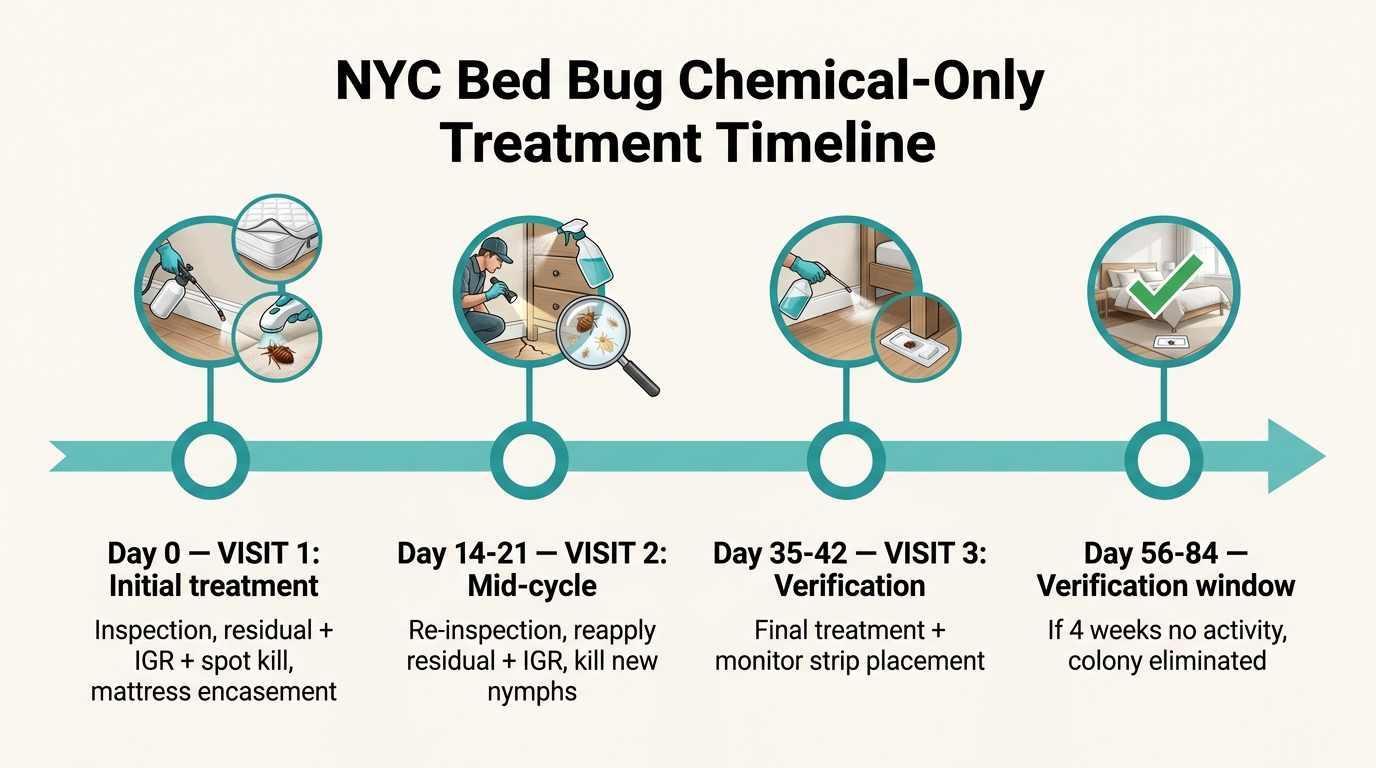
Per Penn State Extension’s bed bug management guide, the 8 to 12 week timeline reflects bed bug egg-to-adult development time (roughly 37 days under typical apartment conditions) plus a safety margin to ensure no surviving fertile females remain. Heat treatment compresses this to one day because thermal kill is total — chemical can’t replicate that timeline without something equivalent to heat exposure.
What Should You Expect at Each NYC Bed Bug Chemical Treatment Visit?
The 3-visit NYC chemical bed bug treatment protocol typically follows this schedule:
| Visit | Timing | What we do | What you do |
|---|---|---|---|
| Visit 1 (initial) | Day 0 | Full inspection, species confirmation, residual application bed frame + baseboards + electrical outlets, IGR application, spot kill of visible bugs, mattress encasement install | Apartment fully prepped (see prep section); plan to be out of apartment 4-6 hours |
| Visit 2 (mid-treatment) | Day 14-21 | Re-inspection, residual reapplication, IGR re-application, spot kill of any new visible bugs, monitor strip placement | Continue light prep (sheets washed weekly, vacuum daily); be out 2-4 hours |
| Visit 3 (verification) | Day 35-42 | Re-inspection, final residual application if any activity remains, monitor strip retrieval and analysis | Same light prep; be out 2-4 hours |
| Follow-up (if needed) | Day 56-84 | Spot treatment if monitors detect residual activity; usually not needed | Spot prep only |
Total NYC chemical bed bug treatment pricing for a typical 1 to 2 bedroom apartment is $400 to $1,200 for the full 3-visit program including mattress encasement. Larger apartments, multi-room infestations, or severe cases run $800 to $2,000.
Bed bugs in your NYC apartment?
26+ years treating NYC bed bugs. Crossfire residual + IGR cycles where it counts, no annual contracts, and a free inspection that's waived when you book. The chemical-only protocol works at one-third the cost of heat treatment.
How Do You Prep a NYC Apartment for Bed Bug Chemical Treatment?
Proper prep is what determines treatment success. Inadequate prep means the residual product can’t reach the harborage areas where bed bugs hide. Here’s the NYC apartment prep protocol:
- Wash and bag all bedding, clothes, and fabric items. Washing and drying on hot for at least 30 minutes kills all bed bug life stages. After washing, seal in clean plastic bags. Don’t return clean items to drawers or closets until treatment is complete.
- Move furniture 12 to 18 inches away from walls. Treatment requires access to baseboards. Beds, dressers, bookcases all need to be pulled away from walls.
- Empty closet floors and remove items 12 inches off ground. Closet shelving above 12 inches stays as-is; floor and lower shelves need to be cleared for baseboard access.
- Disassemble bed frame if possible. Remove the mattress and box spring from the bed frame. Stand them up against the wall in the bedroom (the treatment area). The frame should be fully accessible for residual application.
- Vacuum thoroughly with a HEPA vacuum. Vacuum the mattress, box spring, bed frame, headboard, baseboards, behind picture frames, inside electrical outlet covers (remove the covers first). Empty the vacuum bag/canister into a sealed plastic bag outside the apartment immediately.
- Remove or cover all pet food, dishes, food storage, and personal toiletries. Treatment products aren’t food-safe — kitchen items get covered or removed during application.
- Remove pets from the apartment for the day. Cats, dogs, birds, and reptiles all need to be out of the apartment for 6 to 8 hours after treatment until surfaces dry. Plan to board pets or stay at a friend’s place that day.
- Identify and report any wall-void activity. If you’ve seen bed bugs entering electrical outlet covers or wall-floor seams, document the location for the technician. Wall-void treatment requires drilling small access holes.
Skipping prep is the #1 reason chemical-only treatment fails. Tenants who don’t pull furniture away from walls, who leave clothes piled on the floor, who don’t wash bedding before treatment all end up with surviving bed bug populations that re-establish within 4 weeks. Our front-office team walks every tenant through the prep checklist before scheduling visit 1.
What Products Do NYC Bed Bug Exterminators Use in Chemical-Only Treatment?
Our product selection for NYC bed bug work:
- Crossfire (MGK). Our primary residual liquid product. Contains clothianidin + metofluthrin. Effective against pyrethroid-resistant bed bug populations. Applied to bed frame, baseboards, behind picture frames, inside electrical outlet cavities, around door and window frames. 30-day residual.
- Temprid SC (Bayer/Envu). Backup residual product for situations where Crossfire isn’t appropriate. Combines beta-cyfluthrin + imidacloprid. Used for spot applications and on baseboards in adjacent rooms.
- Suspend SC (Bayer/Envu). Pyrethroid residual for broader perimeter application in non-bed areas (closet baseboards, hallway perimeters in shared walls).
- Tempo Dust (Bayer/Envu). Insecticidal dust for wall void treatment when confirmed bed bug activity is inside walls. Applied via dust applicator into outlet cavities and drilled access points.
- CimeXa (Rockwell Labs). Silica gel desiccant dust — bed-bug-specific. Used in voids where bed bugs harbor. Long residual (months to years) but slower kill (4 to 7 days). Often combined with quick-knockdown products.
- Gentrol Aerosol (Wellmark). Hydroprene IGR for use as supplemental application in heavy-infestation areas. Disrupts bed bug nymph development.
- D-Force HPX (Whitmire). Quick-knockdown contact aerosol for visible bed bugs during the visit.
All products are NYS DEC-registered and require Cat 7A or 7C licensed applicator. Per EPA’s bed bug information clearinghouse, this product combination is the current professional standard for chemical-only treatment.
When Should NYC Bed Bug Treatment Escalate to Heat or Combination?
Chemical-only treatment works for the majority of NYC bed bug cases, but escalate to heat or combination treatment in these scenarios:
- Whole-apartment severe infestation with bed bugs in furniture across 3+ rooms. Chemical treatment requires furniture access; severe whole-apartment infestations sometimes need the speed of heat to prevent further spread.
- Books, clothing, and electronics heavily contaminated. Chemical residual doesn’t penetrate book bindings or layered clothing effectively. Heat treatment kills bed bugs inside these items in one cycle.
- Immunocompromised resident. Bed bug bites in immunocompromised people can lead to infection. Speed matters — heat treatment’s 1-day timeline is better than chemical’s 8 to 12 weeks.
- Speed-critical situations (impending move, severe stress, child in bedroom). Heat treatment finishes elimination in 1 day. If the timeline matters more than the cost differential, heat is appropriate.
- Failed chemical treatment after 12 weeks. If bed bug activity continues after a full 3-visit chemical treatment + verification window, escalate to heat or combination chemical + heat treatment.
- Confirmed pyrethroid-resistant population. Some NYC bed bug populations have documented resistance to common chemical actives. If our standard chemical protocol isn’t producing expected mortality, we switch to combination treatment.
For comprehensive cost comparison between chemical and heat treatment options in NYC, our NYC bed bug exterminator cost guide walks through the pricing math. And for early detection, our signs of bed bugs in NYC guide + NYC hotel bed bug inspection guide cover early detection patterns.
Who Pays for NYC Bed Bug Chemical Treatment — You or Your Landlord?
If you rent in NYC, your landlord owes the cost of bed bug treatment. Under New York’s Warranty of Habitability (Real Property Law §235-b) and NYC bed bug-specific regulations including the NYC Bed Bug Disclosure Act, landlords are legally required to disclose bed bug history and remediate infestations. Per the city’s bed bug page from NYC DOH, landlords must address bed bug infestations within a specific window after tenant complaint.
Under the NYC Bed Bug Disclosure Act, landlords of multi-unit dwellings must address bed bug infestations within 30 days of HPD violation issuance. Bed bugs are classified as a Class B violation in NYC (hazardous, not immediately hazardous), which means landlord response is required but not within 24 hours.
Landlord cost considerations for chemical vs heat:
- Landlords almost always default to chemical treatment because it’s cheaper. Tenants can request heat but landlords aren’t required to provide it as long as chemical treatment is effective.
- If chemical treatment fails after a full 3-visit cycle, tenant can document the failure and request landlord escalate to heat. HPD has historically backed tenants in this scenario.
- Tenant-introduced bed bugs (rare and hard to prove) may be tenant-paid under some lease provisions. The warranty of habitability is generally non-waivable, so even these clauses are often unenforceable.
- Co-op and condo owners. In-unit treatment is the unit owner’s cost. Common-area inspections and treatment are the building’s common-charge responsibility.
- NYCHA residents. Pest control runs through NYCHA’s own contracted pest management program — call the NYCHA Customer Contact Center.
One specific NYC tenant trap to watch for: some landlords try to charge for “prep” services (washing clothes, moving furniture). Prep is the tenant’s responsibility, but the landlord must provide the treatment itself. Don’t accept any landlord charge labeled “treatment” or “exterminator” — that’s the landlord’s cost.
The Bottom Line: NYC Chemical-Only Bed Bug Treatment Action Plan
If you’ve been quoted heat treatment at $2,500 to $4,500 and can’t afford it, can’t get co-op approval, or don’t have the electrical capacity: (1) request a chemical-only treatment quote — most NYC bed bug companies offer both; (2) confirm the 3-product protocol (residual + IGR + spot kill + encasement) is included; (3) commit to the 8 to 12 week timeline — chemical treatment doesn’t deliver overnight results; (4) follow the prep checklist rigorously — inadequate prep is the #1 cause of chemical treatment failure; (5) if you rent, your landlord owes the cost — call 311 if they’re unresponsive after 14 days.
For most NYC tenants and apartment owners, realistic 2026 chemical-only NYC bed bug treatment pricing breaks down: $400 to $800 for a typical 1-bedroom 3-visit program with mattress encasement, $700 to $1,200 for a 2-bedroom 3-visit program, $1,000 to $2,000 for severe multi-room infestations requiring additional spot work, plus optional $200 to $400 annual monitoring program post-treatment. Compare against heat treatment at $2,500 to $4,500 for typical 1 to 2 bedroom apartments — chemical is roughly 1/3 the cost.
We’ve been treating NYC bed bugs since 1999, and the most common mistake we see with chemical-only treatment is impatience — tenants who see bed bugs still appearing in week 2 or 3 and assume treatment isn’t working. The chemical timeline is real: 8 to 12 weeks reflects the bed bug life cycle, not treatment failure. The second most common mistake is inadequate prep — failing to pull furniture away from walls or wash all bedding before visit 1 means the residual product can’t reach the harborages where bed bugs actually live. If you’d rather skip the experiment and have it handled by a team that’s treated thousands of NYC bed bug cases, our front-office team offers free same-day inspections across all five boroughs, including bed bug treatment in the Bronx where pre-war electrical limits make the chemical-only protocol especially common. Lisa or one of our front-office team can usually book a same-day inspection, and the quote you get will itemize species confirmation, treatment protocol, visit schedule, prep checklist, and guarantee window.