Carpenter ants in your NYC walls?
26+ years on NYC carpenter ant work. Tempo Dust into wall voids, structural inspection, and exterior treatments that protect your woodwork, no annual contracts.
What Are the Most Common Ant Species New York Homeowners Confuse?
The Big Four: Ants You’ll Encounter Across NYC, Long Island, and Upstate
Black carpenter ants (Camponotus pennsylvanicus) are the largest and most feared ant species in the region, but they’re only one of several species that regularly show up in New York homes. Cornell’s IPM program lists multiple ant species that homeowners encounter across the state, including pavement ants, odorous house ants, and little black ants.
Pavement ants and odorous house ants are the species NYC apartment dwellers most frequently mistake for carpenter ants — and they’re far more common in densely built urban boroughs. If you’re dealing with ants in your apartment and need ant control in Manhattan, odds are good you’re looking at one of these smaller nuisance species rather than a true wood-destroyer.
Adding to the confusion, a European ant species (Lasius emarginatus) has quietly taken over Manhattan and become one of the most abundant ants in the city. A survey of ant species across New York City highlights just how diverse urban ant populations are, and homeowners in Brooklyn and Queens are encountering these ants regularly, with many assuming the worst when they see an unfamiliar species indoors.
Long Island’s Carpenter Ant History
Long Island residents in Nassau County have historically dealt with significant carpenter ant populations, thanks to the region’s wooded suburban landscape and abundance of mature trees. The same holds true for Suffolk County, where larger lot sizes and older homes create ideal conditions for these ants to thrive.
Local pest professionals have noted a perceived shift over the decades, with some Long Island neighborhoods seeing fewer large black carpenter ants and more small nuisance species moving in. Still, the mix of older homes, mature trees, and coastal humidity keeps Long Island firmly on the map as a carpenter ant hotspot compared to the more urban parts of the city, and our Long Island ant removal work reflects that suburban pressure.
Why Misidentification Happens So Often
Carpenter ants aren’t always black — they come in red, brown, tan, yellow, and various combinations. As the Wikipedia article on carpenter ants notes, the genus Camponotus includes over a thousand species with wide variation in color and size, which throws off homeowners who expect every carpenter ant to look the same.
A single carpenter ant colony also contains polymorphic workers ranging from large “super majors” to small “minors,” so size alone is an unreliable identification method. Many homeowners don’t realize that the small ant trailing through their Bronx or Staten Island kitchen is almost certainly not a carpenter ant — it’s far more likely a pavement ant or odorous house ant, the kind of nuisance species our Staten Island ant control calls turn up most often.
How Can You Quickly Tell Carpenter Ants Apart from Regular Black Ants?
The One-Bump Petiole Trick: Your Fastest Field ID Method
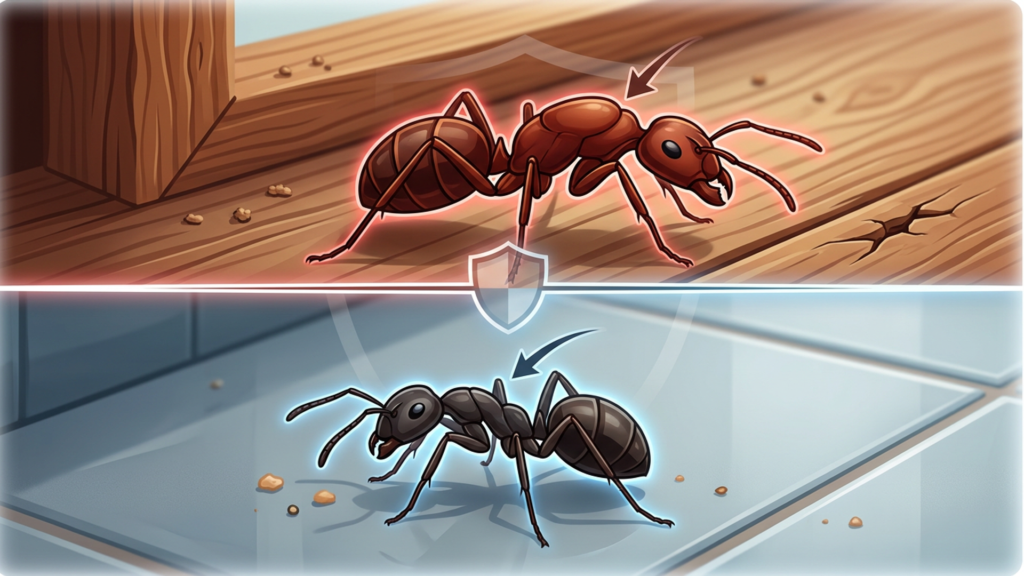
Here’s the single fastest way to identify a carpenter ant: flip it over (or use a magnifying glass) and examine the “waist” between the thorax and abdomen. Carpenter ants have a single smooth, rounded petiole segment — one bump.
Most other common New York ants, including pavement ants and odorous house ants, have two petiole segments or a distinctly different waist profile. This one feature alone can rule out carpenter ants in seconds. It’s the same method entomologists use, and once you know what to look for, you’ll never second-guess yourself again.
Size, Shape, and Body Features Side by Side
Carpenter ants are typically ¼ to ½ inch long with a smooth, evenly rounded thorax when viewed from the side — Nassau County Cooperative Extension’s guide confirms these distinguishing features. They also have a distinct heart-shaped head and elbowed antennae with 12 segments.
By comparison, little black ants are only 1/16 inch, and pavement ants measure about ⅛ inch with visible parallel lines etched on their heads. Both are dramatically smaller than carpenter ant majors. If you need a magnifying glass to see the ant clearly, it’s probably not a carpenter ant.
Behavioral Clues That Reveal the Species
Carpenter ants are primarily nocturnal foragers. If you see large ants marching along baseboards after 9 PM, that’s a strong indicator you’re dealing with carpenter ants rather than a daytime-active nuisance species.
Unlike pavement ants that form visible trailing lines to food sources during the day, carpenter ants tend to travel solo or in sparse, scattered patterns. And here’s a very common misconception worth clearing up: carpenter ants don’t eat wood. They excavate it for nesting and actually feed on sugary substances, insects, and protein sources.
How Do You Know If You Have a Carpenter Ant Infestation — and How Worried Should You Be?
Visual Signs Inside Your Home
Frass is the number-one indicator. Carpenter ant frass looks like fine sawdust or pencil shavings, often piled near baseboards, window frames, or door casings. This is distinctly different from termite frass, which appears as uniform, pellet-like granules — an important distinction if you’re also concerned about termite activity in your home.
Look for small, clean entry holes in wood surfaces. Carpenter ants create smooth, sandpapered-looking galleries that are unmistakable once you’ve seen them. Winged carpenter ants (swarmers) appearing indoors during spring — especially between March and June in New York — indicate a mature colony that has been established for at least three to five years.
The Severity Assessment: Scouts vs. Active Infestation
Seeing one or two carpenter ants per day, especially near exterior doors or windows, often means you’re seeing scouts or wanderers — not necessarily evidence of a colony inside your walls. Don’t hit the panic button just yet.
Finding 10+ ants consistently, discovering frass piles, or hearing faint rustling sounds inside walls points toward an active indoor nest that needs treatment. But here’s the reassuring part: carpenter ants are not as catastrophic as termites. They excavate already-damaged or moisture-softened wood rather than consuming sound structural lumber, so you typically have time to plan your response thoughtfully.
Seasonal Timeline of Carpenter Ant Activity in New York
Late March through May marks swarmer season as temperatures consistently hit 50°F and above — this is when most New York homeowners first notice a problem. June through August brings peak foraging season with maximum worker activity, especially during and after rainy periods.
September through November sees activity decline as colonies prepare for winter, though the colony remains alive in its galleries. Rockland County Cooperative Extension’s resource provides additional details on regional behavior patterns that are especially relevant for upstate homeowners.
What’s the Best Way to Get Rid of Carpenter Ants in New York?
Step-by-Step DIY Elimination Process
- Find the nest: Follow ant trails at night with a flashlight back to their entry point. Tap along baseboards and window frames listening for hollow sounds that indicate galleries.
- Address the moisture source: Carpenter ants are an indicator of a moisture problem. Fix leaky pipes, improve drainage, replace water-damaged wood, and improve ventilation in crawl spaces and attics.
- Apply targeted bait: TERRO liquid ant baits and Advion ant gel bait are the most consistently effective consumer products. Expect heavy feeding activity for about a week before the colony collapses.
- Treat the perimeter: Apply granular ant bait around your home’s foundation and eliminate wood-to-soil contact, mulch piled against siding, and overhanging tree branches that serve as ant highways.
New York Pesticide Regulations and Legal DIY Options
New York has stricter pesticide regulations than many states. Professional-grade products like Suspend SC and certain concentrated sprays require a licensed applicator or are restricted from consumer sale.
Over-the-counter options legally available to New York homeowners include boric acid-based baits, diatomaceous earth, TERRO liquid baits, and gel baits like Advion. Always verify that any product you purchase is approved for residential use in New York by checking NY state product registration lists before applying it.
When to Call a Professional — and What It Costs in New York
Call a licensed ant control professional if you find frass in multiple locations, suspect the colony is inside a wall void, or if DIY baiting hasn’t resolved the issue within two to three weeks. Professional carpenter ant treatment in the New York metro area typically ranges from $250–$600 for a standard treatment, with annual monitoring contracts running $400–$800 depending on property size and severity.
For ant control in New York County apartments and co-ops, building management is often legally responsible for pest treatment — check your lease before paying out of pocket.
Carpenter ants in your NYC walls?
26+ years on NYC carpenter ant work. Tempo Dust into wall voids, structural inspection, and exterior treatments that protect your woodwork, no annual contracts.
How Can You Prevent Carpenter Ants from Coming Back?
Fixing the Root Cause: Moisture Control for NY Homes
New York’s humid summers and frequent rain create ideal conditions for the moisture-damaged wood that carpenter ants target. Improving gutter drainage and grading soil away from foundations is the single most impactful prevention step you can take.
Replace any soft, water-damaged wood around windows, door frames, sill plates, and deck attachments — these are the most common nest sites in New York homes according to Rutgers’ carpenter ant fact sheet. Use a dehumidifier in basements and crawl spaces to keep relative humidity below 50%, especially in older Long Island and upstate homes without modern vapor barriers.
Yard-Wide Prevention Strategies
Remove dead stumps, fallen logs, and stacked firewood within 20 feet of your home — these are the primary outdoor nesting sites from which carpenter ants launch satellite colonies into structures. The Maine Cooperative Extension’s publication describes how parent colonies in outdoor wood sources routinely establish satellite nests inside nearby homes, making yard cleanup a critical prevention measure.
Apply a perimeter granular bait treatment each spring (April–May) before peak foraging season begins. This proactive approach is especially effective for suburban yards across Nassau and Suffolk Counties.
Long-Term Monitoring Habits
Inspect your home’s exterior each spring for new frass deposits, especially around window frames, where siding meets the foundation, and near any previous moisture damage. A carpenter ant fact sheet from Maine notes that carpenter ants prefer wood already weakened by moisture or decay, so keeping a seasonal log of when you spot activity can help pinpoint unresolved water intrusion issues.
Schedule an annual professional inspection if your home has a history of carpenter ant or termite activity, as both pests target similar moisture-compromised areas.
Still Not Sure Whether You’re Dealing with Carpenter Ants or Harmless Black Ants?
Your Quick-Reference Identification Checklist
- Check the waist: One smooth petiole bump = possible carpenter ant. Two bumps or a distinctly different profile = likely a nuisance species.
- Check the size and time: Large ants (¼ inch+) active at night are strong carpenter ant candidates. Tiny ants trailing to food during the day are almost certainly pavement or odorous house ants.
- Check for frass: Sawdust-like shavings near wood = carpenter ants actively nesting. No frass with only occasional sightings = likely scouts that wandered in from outdoors.
Your Next Steps as a New York Homeowner
If you’ve confirmed carpenter ants, start with moisture remediation and targeted baiting. Remember, this is a solvable problem and not a structural emergency on par with termites. You have time to do this right.
If you’re still uncertain about identification or the infestation seems extensive, connect with a licensed New York pest control professional who can inspect and provide a treatment plan tailored to your specific situation. Whether you’re in a Queens row house, a Brooklyn brownstone, or a Suffolk County colonial, the right combination of identification, moisture control, and targeted treatment will resolve the problem — and keep it from coming back.