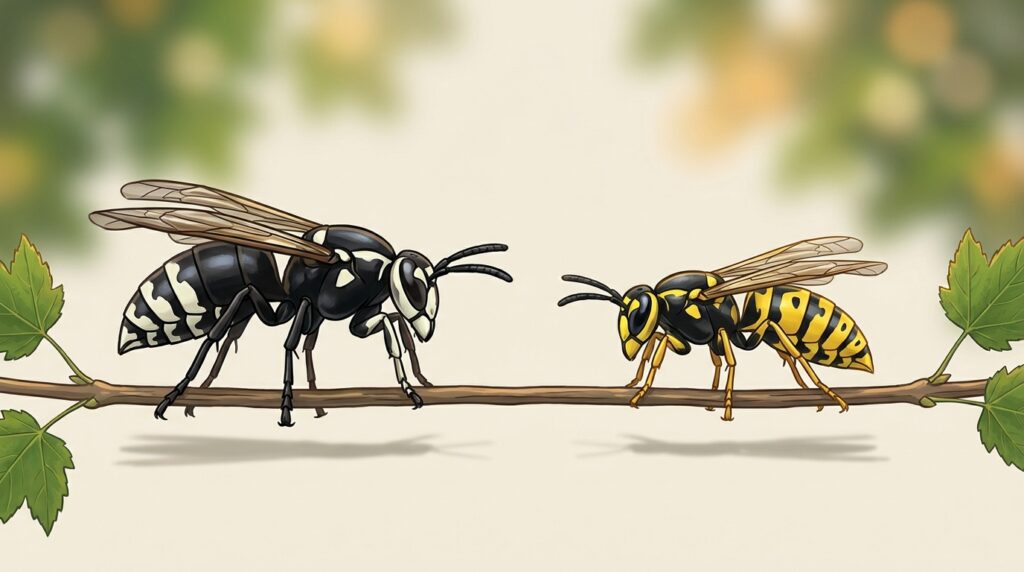
Late June walk into your backyard in Roslyn, glance up at the maple, and there it is — a gray paper football the size of a basketball, swinging from the lowest branch. Or you peel back the patio umbrella in Bayside and find a flat umbrella of cells with a dozen striped insects watching you. Or you mow over a hidden hole in the lawn in Massapequa and the air explodes with yellow-and-black bodies. We get a version of this call every week from May through September, and the first question is always the same: “Is that a hornet or a wasp?”
The honest answer matters because it changes the treatment. We’ve spent 26+ years working stinging-insect jobs across the five boroughs and Long Island, and we’ve boiled it down to four insects you actually need to recognize, plus one piece of taxonomy that sounds pedantic but saves you misdiagnosing your problem. If the nest is on your house, in your yard, or above your building’s front door, our wasp nest control team handles every species in this guide — but the first move is knowing what you’re looking at.
Wasp or hornet nest at your NYC home?
26+ years on NYC and Long Island stinging insect work. Same-day removal with the right gear for high eaves and aggressive species, no annual contracts.
Are All Hornets Actually Wasps?
This is the line every entomologist will repeat to you, and it’s worth memorizing. Hornets are wasps in the genus Vespa. That’s it. Vespa is one specific genus inside the family Vespidae, which sits inside the order Hymenoptera (with bees, ants, and sawflies). There are over 100,000 wasp species worldwide and only about 22 true hornet species — all in the northern hemisphere, none inside the Arctic Circle.
Why does this matter for a Brooklyn renter or a Hempstead homeowner? Because the most “hornet-looking” insect you’ll see in your yard, the bald-faced hornet, is not actually a hornet. It’s a yellowjacket — taxonomically Dolichovespula maculata. People (and most pest companies’ websites) keep calling it a hornet because it’s big and fierce, but the bait, the trap, and the treatment plan all need to match yellowjacket biology, not Vespa biology. We’ll get to that in a moment.
For our area, the only true hornet you’ll encounter is the European hornet (Vespa crabro), which was introduced to New York in 1840 and has been quietly living in our wall voids and hollow trees ever since. It’s brown and yellow, ¾ to 1½ inches long, and one of the few wasps that flies at night. Most of you will never meet one. The Asian giant hornet — the “murder hornet” that lit up the news in 2020 — is a West Coast invasive and is not in New York or Long Island. We tell every nervous client that when the question comes up.
Which Hornets and Wasps Will You Actually Meet in NYC and Long Island?
Here is the cast of characters our techs find on jobs from the Glendale border out to Suffolk County:
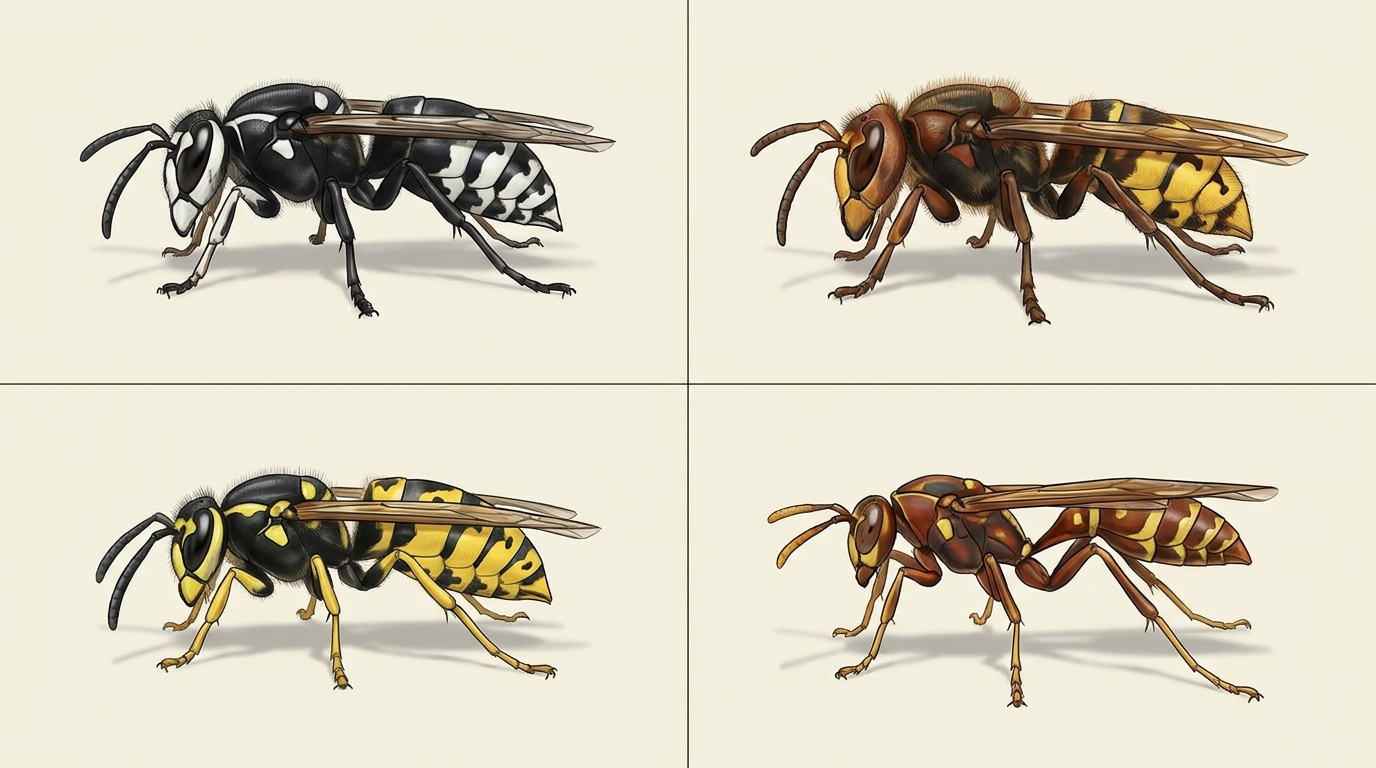
1. Bald-faced hornet (Dolichovespula maculata) — the gray football builder
Black with a striking white face and white bands on the abdomen. Workers run 5/8 to 7/8 inch (16-22 mm). Builds the giant gray paper “football” or basketball-sized aerial nests we all recognize — usually 8 to 30 feet up in a tree, on the side of a house, under a deep eave, or attached to a fire escape. Up to 800 workers per colony. Reddit users half-jokingly call them “elusive Buddhist monks” because the colony is hard to spot until the nest is huge. We see these constantly on Long Island in oak and maple trees, and on Manhattan high-rise terraces with potted trees.
2. European hornet (Vespa crabro) — the brown true hornet
Brown and yellow, ¾ to 1½ inches. Nests in hollow trees, wall voids, sheds, attics. Less aerial than the bald-faced hornet. Active at night (you might see one bumping a porch light at midnight in Forest Hills — that’s almost certainly a European hornet). Less aggressive than yellowjackets unless the nest is right next to you.
3. Yellowjackets (Vespula and Dolichovespula spp.) — the picnic raiders
Sleek, blunt, classic black-and-yellow stripes. Multiple species are common in our area:
- Eastern yellowjacket (Vespula maculifrons) — the most common in the northeast. ½ inch, anchor-shape marking on the abdomen. Builds nests in the ground or low aerial spots, with 2,000-3,000 workers by August. This is the one mowing over a yard nest releases.
- German yellowjacket (Vespula germanica) — the most aggressive species we see. Up to 5,000 workers. Loves wall voids, sheds, dumpsters, old cars. Can forage ¾ of a mile from the nest, which is why a German YJ colony in a neighbor’s shed becomes everyone’s problem.
- Aerial yellowjacket (Dolichovespula arenaria) — small gray paper nests in trees, often confused with bald-faced hornet nests but smaller (~softball, not basketball).
- Cornell IPM has documented the Southern yellowjacket (Vespula squamosa) creeping north onto Long Island in recent years, which is part of why we’re seeing more aggressive late-season activity than we did a decade ago.
4. Paper wasps (Polistes spp.) — the umbrella nest builders
Slender, long-legged, narrow waist. Legs hang down in flight (the easiest tell from a distance). Builds an open umbrella-shaped nest with a single comb of cells visible from below — no enclosing envelope. Nests under porch ceilings, deck rafters, shed eaves, and inside grills you forgot about. The native northern paper wasp (Polistes fuscatus) is fairly chill. The invasive European paper wasp (Polistes dominula) is the one we see misidentified as a yellowjacket more than any other insect — it’s striped yellow and black just like a YJ but with that paper-wasp body shape. It’s also the one that nests in shrubbery, which is dangerous when you’re hedge trimming.
How Do You Tell Hornet and Wasp Nests Apart at a Glance?
Nest shape is honestly the fastest ID once you know what to look for. Here’s our field cheat sheet:
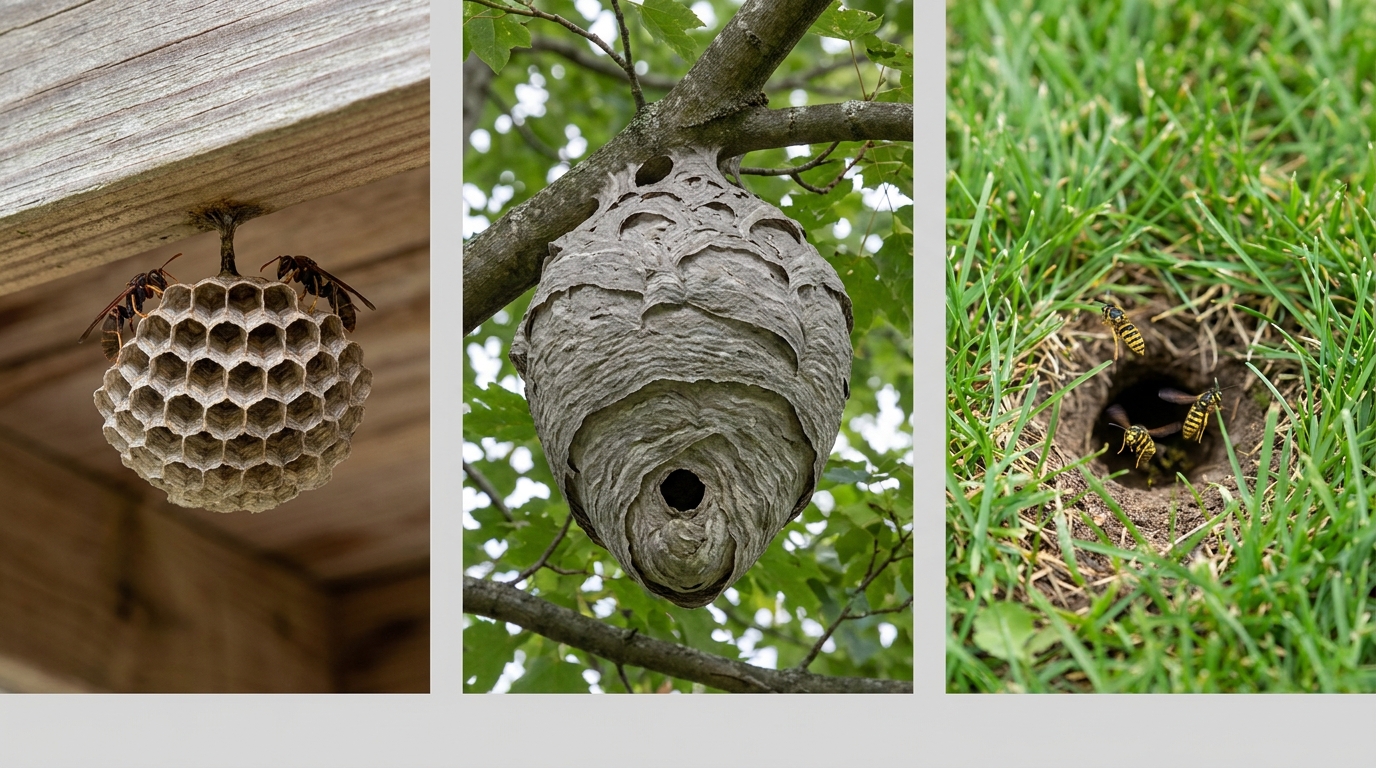
| Nest type | Shape | Location | Likely species |
|---|---|---|---|
| Gray football, basketball-sized, single hole at bottom | Closed envelope | High in tree, on building, under deep eave | Bald-faced hornet |
| Gray softball, single hole | Closed envelope | Lower tree branches, shed corner | Aerial yellowjacket |
| Hidden in ground hole or wall void, no visible nest | Closed envelope inside cavity | Lawn, foundation, shed wall | Eastern or German yellowjacket |
| Open umbrella with visible cells, hanging from a stalk | Single comb, no envelope | Under eaves, porch ceiling, deck rafter | Paper wasp (Polistes) |
| Inside a hollow tree, attic, or wall void | Hidden, often nocturnal activity around lights | Wall void, hollow tree | European hornet |
If we get a photo of the nest shape and one of the insect, we can ID it before we send a tech. Photograph the nest from a safe distance (use phone zoom, not your face).
When Are Hornets and Wasps Most Active in NYC and Long Island?
Stinging-insect season here runs roughly April through October, with peak nuisance and aggression in late August through September. We schedule treatments around this calendar:
- April-May: Mated queens emerge from overwintering, pick nest sites, and start small colonies (a queen alone with a few cells). This is the cheapest, safest treatment window because the queen can be killed before the colony exists. Pheromone traps deployed now reduce summer yellowjacket pressure by 50%+ — we set them on commercial properties in Long Island City and Maspeth in the second half of April.
- June-July: Workers are out, nests are growing, but most colonies are still small. Most homeowners notice activity but no aggression yet. Best window for proactive nest removal before the colony gets to full strength.
- August-September: Peak. Colonies hit maximum size (5,000 German YJ workers in a wall void is not unusual). New queens and drones hatch and stop eating insect protein — they want carbohydrates, which is why this is when wasps invade your barbecue, fight you for soda, and sting you for being near a trash can. Aggression is at its highest because the colony is defending its annual peak. Most of our calls happen in this window.
- October: Cold nights collapse colonies. Only mated queens survive, and they overwinter in protected spots — under loose bark, in wall voids, behind shutters. The nest itself is abandoned and won’t be reused (which is good news for tearing it down once frost hits, and bad news because next spring’s queens will start fresh nests in similar spots).
If you have a recurring problem in the same yard year after year, it’s almost always because the queens are overwintering on your property. We do exterior treatments in late October and again in early April to break that cycle.
Wasp or hornet nest at your NYC home?
26+ years on NYC and Long Island stinging insect work. Same-day removal with the right gear for high eaves and aggressive species, no annual contracts.
How Bad Is a Hornet or Wasp Sting, Really?
Most people overestimate sting risk and underestimate allergy risk. Justin Schmidt, the entomologist who literally let himself be stung by every venomous insect he could find to build the Schmidt Sting Pain Index, rates almost every wasp and hornet sting in our area as a 2 out of 4 on the pain scale. That hurts, but it’s far below the tarantula hawk and bullet ant. The European hornet is closer to a low 3 because of its size.
What matters more than raw pain is how many stings and your allergy profile. A single sting from a paper wasp is annoying. Thirty stings from an angry German yellowjacket colony defending a wall void is a hospital trip. The real danger is anaphylaxis — and the signs come on fast:
- Difficulty breathing or swallowing
- Swelling of the face, lips, or throat
- Hives anywhere on the body
- Dizziness, weak or rapid pulse
- Nausea or sudden full-body itching
If you see any of these after a sting, call 911 immediately. Don’t drive yourself to an ER. If you’re known to be allergic, carry an epinephrine auto-injector and use it at the first sign. For non-allergic stings, wash with soap and water, apply ice for 20 minutes, take an antihistamine, and watch the site for spreading redness over the next 48 hours.
When you can absolutely leave a nest alone:
- Paper wasp umbrella under the eave of a remote shed, no foot traffic within 10 feet
- Bald-faced hornet nest 30 feet up a tree at the back of a wooded Suffolk lot
- Any nest in a place where nobody — kids, pets, lawn crews — will go before October
When you should call us:
- Any nest within 10 feet of a doorway, deck, balcony, or play area
- Any ground yellowjacket nest in an active lawn or near a pool
- Any nest you suspect is in a wall void (sound is a giveaway — scratching, buzzing inside the wall)
- Any nest above 8 feet that needs ladder work
- Any nest at all if anyone in the household has a known sting allergy
- Any nest on the exterior of a multi-unit building (under NYC housing code HMC § 27-2017, your landlord is obligated to address pest hazards including stinging insects on the building exterior)
Why Is DIY Hornet and Wasp Removal in Long Island Yards So Risky?
Every August our phones light up with the same call. Someone in Massapequa, Roslyn, Sands Point, or Old Westbury saw the gray football in their tree, grabbed a can of Spectracide off the truck at Home Depot, climbed an extension ladder at dusk, and got chased back into the house with seven stings. Sometimes it’s a kid who walked too close. Sometimes it’s the dog.
Here is what actually happens when you spray a bald-faced hornet nest at home:
- The aerosol jet only reaches 15-20 feet at best, and the spray cone is wide, so half the chemical drifts. If the nest is higher than your ladder reach, you’re spraying air.
- Bald-faced hornets are alarm-pheromone wired. The first 50 you hit release scent that pulls every other worker out of the nest. You now have 200-800 angry insects in the air around you.
- Ladders + panic = falls. We’ve seen ER reports from this exact scenario every August on Long Island. The sting itself is rarely the worst injury.
- Even if you “kill” the visible nest, surviving workers and the queen often relocate. In two weeks you have a new colony 40 feet away.
Our team does this work daily with proper PPE, ladder safety equipment, and treatments that knock down the entire colony before alarm pheromones can spread. Our specialty is the high aerial work and wall void treatments that DIY can’t safely reach — that’s part of why we get wasp control calls from across Long Island every week. If you have a confirmed bald-faced hornet nest above 8 feet or a yellowjacket colony in your siding, please don’t climb the ladder. Call us.
What Should You Do About a Hornet or Wasp Nest Right Now?
If you’re staring at a nest while reading this, here’s our short list in order:
- Don’t swat or spray anything yet. Step back to at least 20 feet.
- Photograph from a distance — nest shape, location, and one insect if you can zoom in. A coin or familiar object in frame helps with scale.
- Identify using the table above. Most likely it’s bald-faced hornet, paper wasp, or yellowjacket.
- Decide leave-alone vs treat based on the foot-traffic and allergy criteria above.
- Call your super or landlord in writing if it’s on a multi-unit building exterior — under HMC § 27-2017 they’re obligated to address it.
- Call our wasp and hornet control team if the nest is in a high-traffic location, above 8 feet, in a wall void, or anywhere near someone with a sting allergy. Same-day inspections are standard from May through October across NYC and Long Island.
- For nests on city property (street trees, parks), file a 311 complaint — NYC Parks and DPW handle those.
For a deeper look at NYC pest patterns by season, our water bugs in NYC guide covers the cockroach side of summer, and our signs of mice in NYC guide handles the rodent side. If you’re seeing flying insects in spring and aren’t sure whether it’s a wasp swarm or termite swarm (it really matters), our flying termites in NYC post walks through the difference.
Key Takeaways
- All hornets are wasps; not all wasps are hornets. The only true hornet in NY is the European hornet (Vespa crabro). The “bald-faced hornet” is taxonomically a yellowjacket.
- Four insects do almost all the damage in our area: bald-faced hornet (gray football nests), yellowjackets (ground or wall void nests, picnic raiders), paper wasps (open umbrella nests under eaves), and the rare European hornet (wall voids, nocturnal).
- Nest shape is the fastest ID. Photograph it from 20 feet away and check the table above.
- Peak aggression is late August through September. Best treatment window is April through May when queens are alone or colonies are tiny.
- Most NE wasp stings rank Schmidt 2/4. Real risk is anaphylaxis and multiple stings — call 911 for breathing difficulty, throat swelling, or hives.
- DIY hornet removal in Long Island yards is the mistake we see most. Aerosol can + extension ladder + alarm pheromones = ER trip.
- Multi-unit building exterior nests are your landlord’s responsibility under HMC § 27-2017.
If you’re seeing a nest, hearing buzzing in a wall, or watching wasps zigzag around your back deck and you’re not sure how to handle it, our team can identify the species, locate the nest entry, and put together a treatment that fits your property. We’ve worked NYC and Long Island stinging-insect jobs for 26 years and have removed everything from a paper-wasp umbrella under a Park Slope brownstone stoop to a 2-foot bald-faced hornet football wedged into the gable of a Sands Point estate. Get a free quote and we’ll follow up the same day.