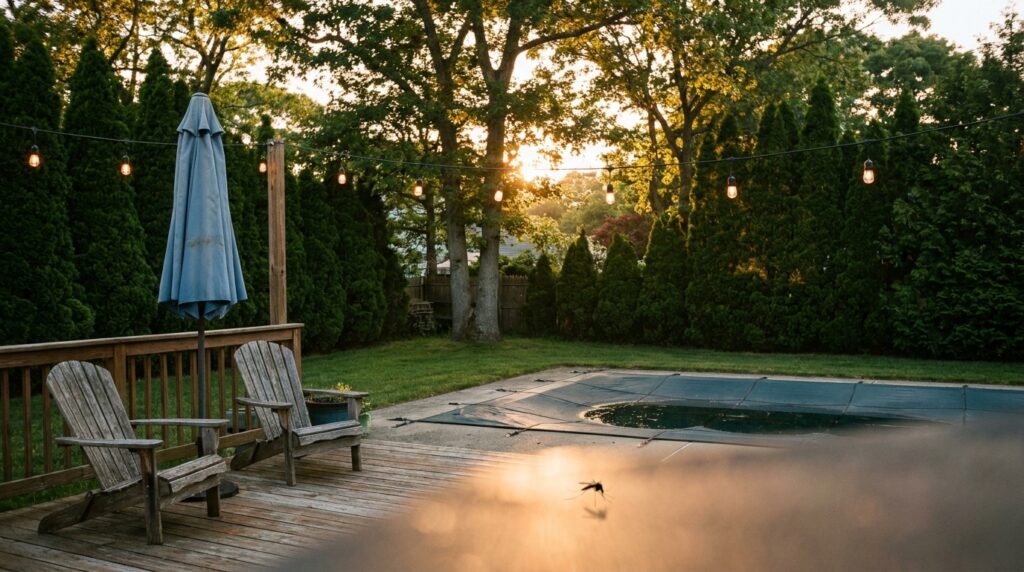
Every year on Long Island, mosquito season seems to sneak up on us — one warm April afternoon, the patio doors are open, and by the time we’ve finished our first iced coffee outside, somebody’s already swatting. After 26 years of treating Nassau and Suffolk yards, our team has learned that the mosquitoes never really arrive on the calendar date homeowners expect. They arrive on the temperature curve. This guide walks through what we’re seeing for the 2026 season — when biting actually begins, where Long Island mosquitoes breed in your yard, what diseases they’re carrying this year, and how the Suffolk County and Nassau County control programs differ. If you’d rather hand the whole problem off, we offer professional mosquito control on Long Island, but most of what we cover here you can act on yourself before the season hits its peak.
Mosquitoes ruining your NYC backyard?
26+ years on NYC and Long Island mosquito work. Ecovia MT plant-based yard treatments that are kid-friendly and pet-friendly, no annual contracts.
When Does Mosquito Season Start on Long Island in 2026?
Long Island mosquito eggs hatch when daytime temperatures hold steady around 50 degrees Fahrenheit. In a typical year, that threshold lands sometime between mid-March and the first week of April, and it’s been arriving earlier as our springs have warmed. We’ve already had a few 50-degree stretches in 2026, and the first homeowner calls about backyard mosquitoes usually come in within ten days of that kind of weather window.
What makes Long Island a little different from upstate is that mosquito eggs from the previous fall can survive our coastal winters in protected spots — pool covers, clogged gutters, plant saucers, even moist mulch beds. So the moment things warm up, you’re not waiting for fresh adults to arrive from somewhere else. You’re getting hatch-out from eggs that have been sitting on your property since October. By the time you notice the first bite, the yard population has usually been building quietly for two or three weeks.
The practical takeaway: if you wait for that first bite to start treatment, you’re already a month behind.
Why Are Long Island Mosquitoes Worse Now Than Before?
Long-time Long Island residents tell us the same thing on every other yard call — “the mosquitoes are worse than they used to be.” That’s not just nostalgia. We’ve seen a real shift in which species dominate Nassau and Suffolk yards over the last decade.
Historically, the Northern house mosquito (Culex pipiens) was the main player out here, and Culex mostly bites at dusk and dawn. You could plan a barbecue around it. Now the dominant biting species in many Long Island neighborhoods is the Asian tiger mosquito (Aedes albopictus), an invasive species that the Cornell Cooperative Extension confirms has established itself in downstate New York. Tiger mosquitoes are aggressive, painful biters — and crucially, they bite during the day. The “no mosquitoes until sunset” expectation that older Long Islanders grew up with no longer holds.
We hear this from homeowners constantly, and it shows up on r/longisland threads almost weekly: “Tiger mosquitoes are all that we have here now. The sons of bitches come out during the day too! We had an agreement!” The agreement broke. If you’re planning yard activities this summer, plan for biting any time the temperature is above 70.
Which Mosquito Species Bite You on Long Island?
Three groups of mosquitoes account for nearly every bite our team encounters across Nassau and Suffolk yards. Knowing which species is biting you matters, because they breed in different places, they’re active at different times of day, and they carry different diseases.
- Northern house mosquito (Culex pipiens) — small, brown, dusk-and-dawn biter. Breeds in stagnant pools of water with organic debris (think: that birdbath you forgot to scrub). The primary West Nile virus vector in our area. Stays within roughly 300 feet of its breeding site, so if you’ve got Culex in your yard, the source is on your property or your neighbor’s.
- Asian tiger mosquito (Aedes albopictus) — black with white stripes on the legs, day-active, very aggressive. Needs only a quarter-inch of water in a container to complete its life cycle, which is why bottle caps, plant saucers, and forgotten kid toys are such reliable breeding sources. Cornell IPM associates Aedes with Eastern Equine Encephalitis and Zika in addition to nuisance biting.
- Salt marsh mosquito (Aedes sollicitans) — found in coastal areas, especially South Shore Suffolk, the bay-side of Nassau, and the Suffolk barrier beaches. These mosquitoes breed in tidal marshes that flood and recede, and the females will fly several miles inland from breeding sites. So even if your yard in Lindenhurst or Massapequa has zero standing water, you can still get hammered after a high tide.
A small number of Anopheles mosquitoes also live on Long Island. They’re the species that can transmit malaria globally, but as ABC7’s Eyewitness News reported, Suffolk County hasn’t seen locally acquired malaria since 1999, and the surveillance lab has not flagged any since.
When Are Long Island Mosquitoes Most Active Each Week of the Season?
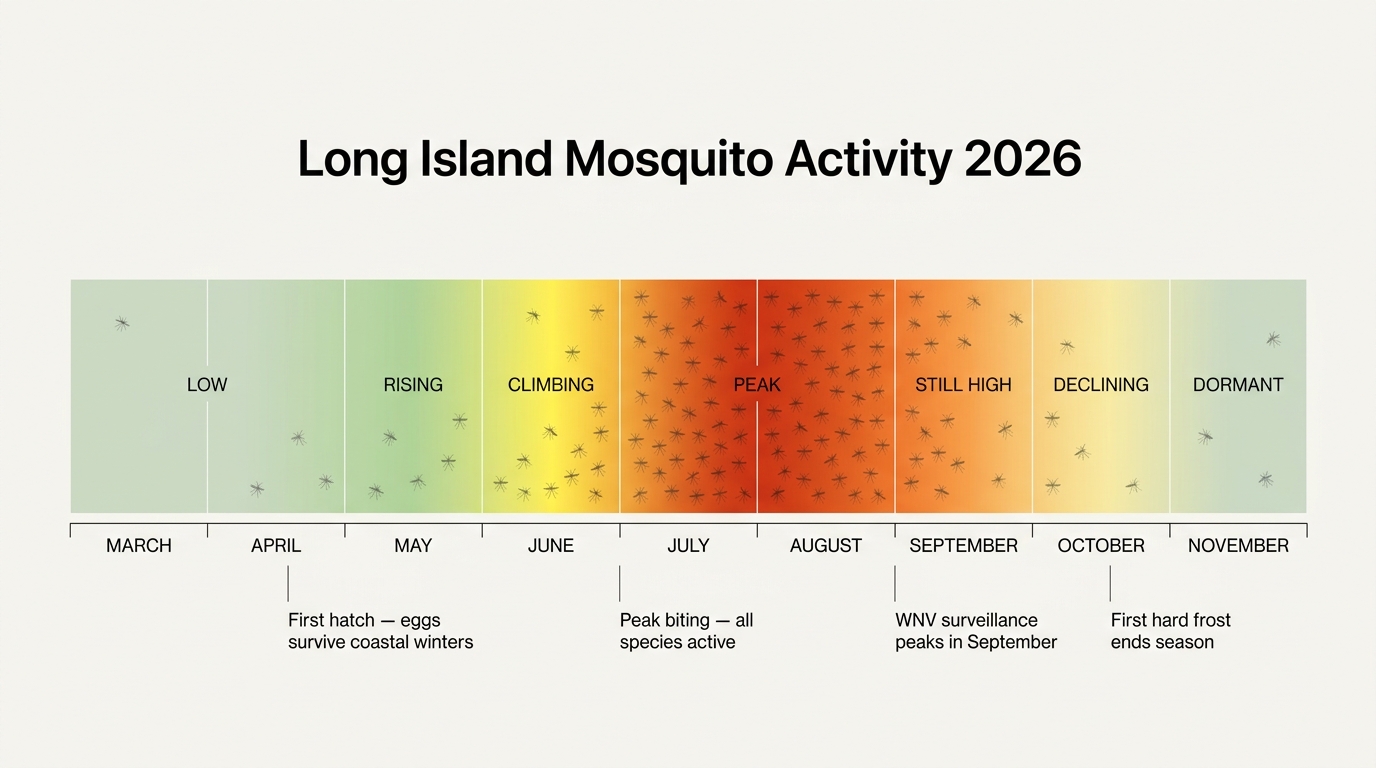
Here’s the activity calendar we work with internally for scheduling Long Island mosquito treatments. Use it as a planning tool — peak weeks are when the population is exponentially compounding, and missing those is what allows infestations to take over a yard.
| Period | Activity Level | What’s Happening on Your Yard |
|---|---|---|
| Mid-March to early April | Low — early hatch | Overwintered Culex eggs hatching in protected pockets |
| Mid-April to late May | Building | First-generation adults emerge; tiger mosquito eggs hatch as soil warms |
| Early to mid-June | Rising sharply | All three species active; Aedes daytime biting begins in earnest |
| Mid-June through August | PEAK | All species at maximum population; this is the worst stretch |
| September | High but declining | Still considered a peak month for West Nile virus surveillance |
| October | Tail-off | Active until first hard frost — typically late October on the South Shore |
| November onward | Dormant | Females laying overwintering eggs; population winds down |
We tell homeowners across Long Island that if they want to enjoy their backyard on summer weekends, the time to schedule mosquito service is April or May — not the first week of July when the kids start getting bit at the pool. By July, you’re playing catch-up against a population that has already gone through three or four breeding cycles.
If you’re tracking pest patterns more broadly, our calendar for spider season on Long Island overlaps the back half of mosquito season — late summer is when both peak together, which is part of why August and September yard calls hit our schedule hardest.
Where Do Mosquitoes Breed in Nassau and Suffolk Yards?
The single most important thing we want every Long Island homeowner to internalize is this: mosquitoes don’t fly in from somewhere else and ruin your barbecue. They breed in your yard, your neighbor’s yard, and the strip of overgrown property half a block away. A Culex pipiens stays within 300 feet of where it hatched. Tiger mosquitoes need a quarter-inch of water. So eliminating breeding water on your property cuts your bite count dramatically — usually by half or more.
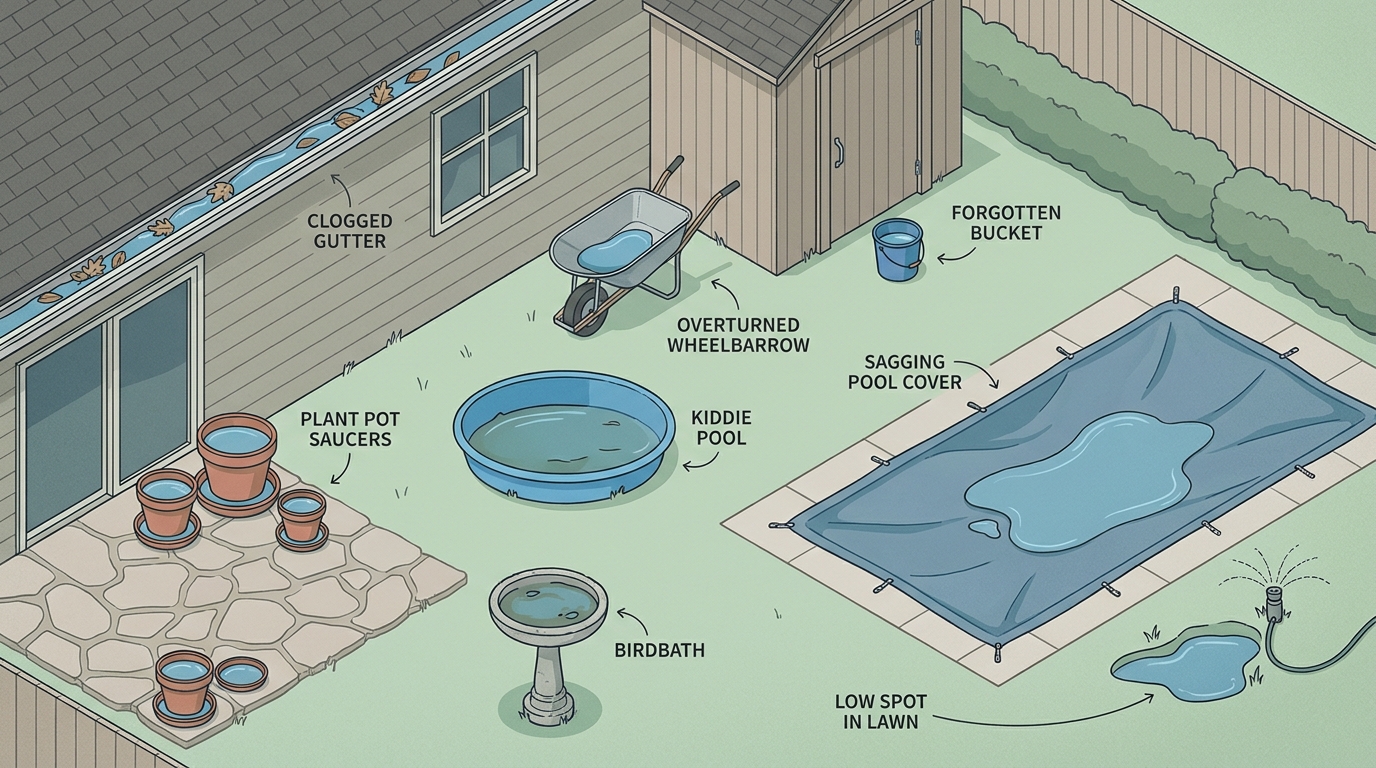
Here’s a comprehensive Long Island yard audit, including the sources nobody on the SERP-top-10 mosquito blogs talks about:
- Clogged rain gutters — number-one underdiscussed source. Leaves trap water in the bottom of the trough. Cornell IPM warns that clogged gutters can produce huge mosquito populations on their own.
- Pool covers — water pools on top of vinyl covers, especially over the winter and shoulder seasons. Prop them up to drain or pump off after every rain.
- Birdbaths — refresh every two to three days, and scrub the sides (mosquito eggs glue to the walls, not just the water).
- Kid pools, sandbox toys, dog dishes, watering cans — anything left out collecting rain. Empty after every storm.
- Plant saucers — drainage saucers under potted plants are a top tiger mosquito breeding site on patios and decks.
- Sprinkler and irrigation runoff — Long Island Reddit threads mention this constantly, but no commercial mosquito blog covers it. Over-watered lawns leave puddles around sprinkler heads and along the edges of beds. Walk your yard the morning after a sprinkler cycle and you’ll find them.
- Basement floor drains — homeowners on r/longisland describe putting mosquito dunks down basement drains to suppress larvae in the trap water. We’ve confirmed it; it’s a real source in older Long Island homes with French drains or sump pits.
- Vegetable and tomato gardens — the foliage holds moisture, the soil stays damp, and gardeners often water in the evening. Tomato cages are a favorite tiger mosquito hangout.
- Salt marsh adjacency (South Shore) — if you’re in Massapequa, Lindenhurst, Bay Shore, Sayville, Patchogue, or any waterfront town, the salt marsh mosquito will reach you regardless of yard hygiene. You’re not doing anything wrong. You’ll need active treatment because the breeding source is regional, not local.
- The neighbor’s untreated pool or abandoned property — the single biggest source you can’t fix yourself. Long Island Reddit users routinely call Nassau Public Works mosquito control at 516-571-6900 or the Nassau County Department of Health to report standing water at vacant properties. In Suffolk, you submit a mosquito control request directly to the Division of Vector Control.
For the breeding sources you can’t dump (ornamental ponds, French drains, persistent low spots), Cornell IPM specifically recommends Bti products containing Bacillus thuringiensis israelensis — sold to homeowners as Mosquito Dunks. They’re a bacterial larvicide that kills mosquito larvae in water without harming fish, pets, or people.
When we run a Long Island yard inspection, this audit is the first thing we do. Half of our Hicksville pest control jobs for mosquito issues end up being a gutter problem, a pool cover problem, and a low spot at the corner of the lot, all at once.
Mosquitoes ruining your NYC backyard?
26+ years on NYC and Long Island mosquito work. Ecovia MT plant-based yard treatments that are kid-friendly and pet-friendly, no annual contracts.
What Diseases Do Long Island Mosquitoes Carry in 2026?
Most mosquito bites on Long Island leave you with nothing worse than an itchy welt, but a small percentage of mosquitoes here carry serious viral diseases. The most relevant ones for Nassau and Suffolk County in 2026 are West Nile virus, Eastern Equine Encephalitis, and now (as of late 2025) chikungunya. The numbers below come from the Suffolk County Department of Health Services Arthropod-Borne Disease Laboratory, which monitors approximately 50 surveillance sites weekly.
West Nile virus on Long Island
West Nile virus (WNV) was first identified in New York State in 1999 and has been the most common mosquito-borne disease in our area ever since. It’s spread primarily by Culex mosquitoes, which is why backyard breeding control matters so much.
According to New York State Department of Health guidance, about 1 in 150 people infected with WNV develop severe disease that affects the brain or spinal cord. Most infected people have no symptoms at all. Symptoms, when they appear, show up 3 to 14 days after the bite. People over 50 and under 15 are at the greatest risk of serious illness.
Suffolk County’s surveillance data shows the year-to-year volatility homeowners should plan for:
| Year | Suffolk Mosquito Samples Positive for WNV | Suffolk Human Cases |
|---|---|---|
| 2025 | 147 | 5 |
| 2024 | 235 (5-year high) | 21 |
| 2023 | 99 | 5 |
| 2022 | 96 | 11 |
| 2021 | 111 | 8 |
The 2024 surveillance season was the most active Suffolk has seen since 2010. Newsday reported in September 2024 that Suffolk had 197 positive samples and Nassau had 56 by mid-September of that year. Whether 2026 returns to a 2024-style peak or stays closer to 2025 levels depends largely on summer rainfall and temperature — both of which we can’t predict, which is exactly why we recommend planning for the higher end.
Eastern Equine Encephalitis (EEE) on Long Island
EEE, sometimes called “Triple E,” is rarer than West Nile but far more dangerous when it does occur. The CDC lists EEE as one of the most severe mosquito-transmitted diseases in the United States, with approximately 33% mortality and significant neurological damage in most survivors.
NYS DOH reports that 12 New Yorkers have been diagnosed with EEE between 1971 and 2024, and seven of them died. There has never been an identified human EEE case in Suffolk County itself, though Suffolk had one EEE-positive mosquito sample in 2024 and nine positives in 2019. Risk is highest from late July through September. EEE is mostly carried by Aedes mosquitoes from wooded, swampy areas — meaning the Pine Barrens corridor in central and eastern Suffolk is an environment to take seriously.
Chikungunya — a 2025 Long Island first
In September 2025, the New York Times reported the first locally acquired chikungunya case in the United States in years, in a Nassau County resident. Chikungunya is normally a tropical disease spread by Aedes mosquitoes — the same group that includes our tiger mosquito. While one case doesn’t make a trend, public health officials are watching closely, and we’re flagging it because Long Island’s expanding tiger mosquito population creates the conditions for further imports to take hold.
What you should actually do with this information
Don’t panic about every mosquito bite. The base-rate risk of severe illness for any given bite is very low. Do, however, take the standard precautions seriously during peak weeks: dump standing water, use repellent, and call your provider quickly if a bite is followed within two weeks by fever, headache, neck stiffness, or unusual confusion. Horses are especially vulnerable to both EEE and WNV, and the New York State Department of Health emphasizes that horse owners should vaccinate in early spring for summertime protection.
How Does the Suffolk County Vector Control Spray Program Work?
Suffolk County runs the largest vector control program in the New York metro area, and most homeowners we talk to don’t realize how active it is. The Suffolk County Department of Public Works Division of Vector Control operates under New York State Public Health Law Article 15, Sections 1500–1502, and its operational window each year runs May 1 through October 31.
What that means in practice for Suffolk residents:
- The Division applies adulticide insecticides — Anvil 10-10 ULV, Duet ULV, and Evergreen ULV (5-25) — by truck-mounted ULV (ultra-low volume) sprayers, helicopter, and occasionally fixed-wing aircraft over salt marsh areas
- The Division also applies larvicides to standing water and known breeding sites — products like Altosid, Aquabac, FourStar Briquets, VectoBac, and VectoLex (which is Bti-based, the same active ingredient in homeowner Mosquito Dunks)
- The schedule is published daily and updated based on weekly surveillance trap data and disease-positive sample locations
- The Spraying Information Hotline is 631-852-4939, and the main Division line is 631-852-4270
If you don’t want adult mosquito control applied to your property, Suffolk has a “No Spray Law Registry” you can enroll in. We’re not anti-spray — for many of our Suffolk County mosquito treatment program clients, county spraying is a useful background layer beneath our targeted yard treatment — but residents have the right to opt out.
If you spot a heavy mosquito problem on your property or a neighbor’s, you can submit a formal mosquito control request through the Suffolk Vector Control website, and a technician will inspect.
What Should Nassau County Residents Know About Local Mosquito Control?
Nassau County’s program is structured differently than Suffolk’s, and it’s genuinely confusing for residents who move from one county to the other. Where Suffolk consolidates everything under DPW Vector Control, Nassau routes mosquito issues through two agencies:
- Nassau County Department of Health: 516-227-9697 — for disease surveillance and general public health questions
- Nassau County Department of Public Works mosquito line: 516-571-6900 — for spraying, complaints, and standing water at abandoned properties
- 311 — for vacant pool reports, abandoned property water hazards, and other municipal issues
Nassau also runs surveillance trapping (the September 2024 Newsday report cited 56 Nassau positive samples) but the program operates at a smaller scale than Suffolk’s. Practically, this means Nassau residents lean more on private treatment for in-yard control, while Suffolk residents can layer county adulticide spraying on top of private treatment.
For our team across Nassau County — the pest control work we do across Nassau County leans heavily on yard-perimeter treatment because most homeowners don’t have a neighborhood-level public spray program backing them up. Towns like the year-round Roslyn pest plan area, Manhasset, Great Neck, and the rest of the affluent North Shore see less county aerial work than the South Shore salt marsh towns, so the burden of yard control sits more on the homeowner.
When Should You Start Mosquito Treatment on Your Long Island Yard?
The honest answer: April. Maybe early May at the latest.
We hear it constantly — “I’ll wait until I see them.” That’s the most common mistake homeowners make. By the time mosquitoes are biting at your barbecue, the population has already cycled through two or three generations, and treatment becomes reactive instead of preventive. A consistent treatment program that begins before peak season holds the population at a fraction of what it would otherwise be, all summer long.
For our yard mosquito service, we use a barrier treatment approach that targets resting mosquitoes on the underside of leaves, in shrub beds, along fence lines, and in shaded spots where they hide between feedings. We also include larvicide treatment of standing water sources you can’t drain — French drains, ornamental ponds, sump pits. We use products like Rockwell Labs’ Ecovia MT, an eco-friendly formulation that we treat as our default for yards with kids, pets, and pollinator-friendly gardens. It’s family and pet-friendly, and we’re explicit with clients about what’s going down and why.
A typical Long Island mosquito treatment program runs from April through October with treatments every 21 to 28 days. For homeowners who only need event-specific protection (a graduation party, a backyard wedding), we also do one-time treatments timed 24 to 72 hours before the event. We offer same-day service during business hours, which matters more in mosquito season than for most other pest categories — heat and rain shift mosquito populations on a 48-hour cycle.
If you’re trying to budget the season, our breakdown of seasonal NYC pest cost expectations covers the framework we use for both NYC and Long Island residential pricing. Most Long Island mosquito programs land in the $400–$900 range for the full season depending on yard size and treatment frequency.
How Can You Reduce Mosquito Bites Around Your Long Island Home Right Now?
Even if you don’t hire a service, there’s a solid DIY playbook that cuts your bite count dramatically. Most of this comes from the CDC’s preventing mosquito bites guidance, the Cornell Cooperative Extension, and a decade of what we’ve watched actually work in Long Island yards.
1. Eliminate breeding water weekly. Walk your yard every Sunday morning during the season and dump anything holding water. This is 60% of the battle.
2. Use Bti for water you can’t drain. Mosquito Dunks (the blue ring-shaped tablets sold at any hardware store) drop into ornamental ponds, sump pits, French drains, and even basement floor drains. Bti targets larvae and is harmless to fish and pets. Cornell IPM endorses it for homeowner use.
3. Use EPA-registered repellents that actually work. The CDC recommends DEET (lower concentrations are fine for kids — you don’t need 100% strength), picaridin (20% formulations are very popular on Long Island and don’t have DEET’s plastic-melting reputation), oil of lemon eucalyptus, and IR3535. Permethrin can be sprayed on clothing only — never on skin — and it kills mosquitoes and ticks on contact.
4. Note the bifenthrin caveat. New York State restricts bifenthrin for residential use, so the popular Bifen IT product line that mosquito enthusiasts use in other states is not legally available here. Don’t try to source it from out of state — use approved alternatives or call a licensed exterminator.
5. Adjust your old dusk/dawn rule. That advice was written for Culex pipiens. Tiger mosquitoes ignore it and bite all day. Long sleeves and repellent are useful any time you’re outside in shaded yard spots between June and September.
6. Fix your screens. Window and door screens take a beating over a Long Island winter. Patch holes and check that storm doors close fully. Mosquitoes that get inside your house at dusk follow you all night.
7. Coordinate with neighbors. Cornell IPM notes that neighborhood-level coordination is one of the most effective mosquito control strategies, and it’s worked well in Mid-Atlantic communities. If everyone on your block dumps standing water on the same morning, the population crash is dramatic. We’ve watched it happen on cul-de-sac calls.
Long Island Mosquito Season 2026 At a Glance
Long Island mosquito season starts when temperatures hit a steady 50°F — typically late March or early April — and runs through the first hard frost in late October. Peak biting weeks are mid-June through August, with September a continued danger period for West Nile virus. The dominant species in your yard has shifted toward the Asian tiger mosquito, which bites during the day and breaks the old “dusk and dawn” rule. Suffolk County runs an active spray program with daily-updated schedules and a 631-852-4939 hotline; Nassau routes through DOH (516-227-9697) and Public Works (516-571-6900). Most yard infestations trace back to clogged gutters, pool covers, plant saucers, sprinkler runoff, and the occasional neighbor’s untreated pool — all fixable, mostly by you, with a Sunday-morning yard walk and Mosquito Dunks for the water you can’t dump.
If you’ve already done the audit and the bites are still bad — or if you’d rather skip the audit and have someone do it for you — give our office a call. We’ve been treating Long Island yards since 1999, we know the difference between a Massapequa salt-marsh problem and a Roslyn pool-cover problem, and we offer same-day service during business hours. Get a quote any time at (718) 418-8986 and we’ll walk through what your yard actually needs this season.