
If you woke up to a tiny black grain on your kitchen counter or heard scratching above your bathroom ceiling at 3 a.m., the first question is the same one every NYC tenant asks: is it a rat or a mouse? The answer changes everything — the bait you buy, the holes you seal, the conversation you have with your super, and whether you need professional rodent control in NYC or a $4 snap trap from the hardware store.
Here is the honest news from what we see across pre-war buildings, brownstones, walk-ups, and high-rises in the five boroughs and Long Island: it is almost certainly a mouse. Rats are common on NYC sidewalks, in basements, and in commercial spaces, but they are uncommon inside individual apartments above the first floor. Mice, on the other hand, are everywhere. This guide gives you the signs we use to confirm which one you have, what to photograph for your landlord, and what actually works to make them stop coming back.
Rats or mice in your NYC apartment?
26+ years on NYC rodent work. We identify the species, find the entry points, and seal them clean, no annual contracts, free inspection.
How Can You Tell If You Have a Rat or a Mouse in Your NYC Apartment?
We’ve found the fastest way to tell them apart is size, then tail, then ears. A house mouse in your apartment is roughly the size of a candy bar — about 3 to 4 inches of body plus a thin tail of equal length, and it weighs less than an ounce. A Norway rat, the species you see darting between trash bags on your street, is the size of a small baked potato — 9 to 11 inches of body, plus a thick scaly tail, and weighing up to a pound.
Beyond size, the giveaway is proportion. A mouse has a triangular pointed nose and oversized ears that look almost too big for its head. A rat has a blunt snout, smaller ears that sit close to its head, and beady eyes. Mouse fur is soft and uniform; rat fur is coarse, often greasy, and sometimes leaves visible smudges on baseboards.
| Quick tell | Mouse | Rat |
|---|---|---|
| Body length | 3-4 inches | 9-11 inches |
| Weight | Less than 1 ounce | Up to 1 pound |
| Nose | Sharp, triangular | Blunt, broad |
| Ears | Large, floppy | Small, close to head |
| Tail | Thin, hairy, body-length | Thick, scaly, hairless |
| Hole needed | 1/4 inch (size of a dime) | 1/2 inch (size of a quarter) |
| Behavior | Curious, bold, easy to trap | Cautious, neophobic, avoids new objects |
If you only ever see signs and never see the animal itself, look at hole size in your walls and the gnaw marks on your food packaging. A clean dime-sized hole in drywall behind your fridge is mouse work. A torn quarter-sized hole through a closet baseboard with rough edges is a rat. We cover the rest of the evidence below.
How Do You Tell Mouse Droppings From Rat Droppings?
Droppings are the single most reliable identifier — and they are usually the first sign you see. A mouse leaves 40 to 100 droppings per day. A rat leaves 40 to 50. The shape, size, and pattern are completely different.
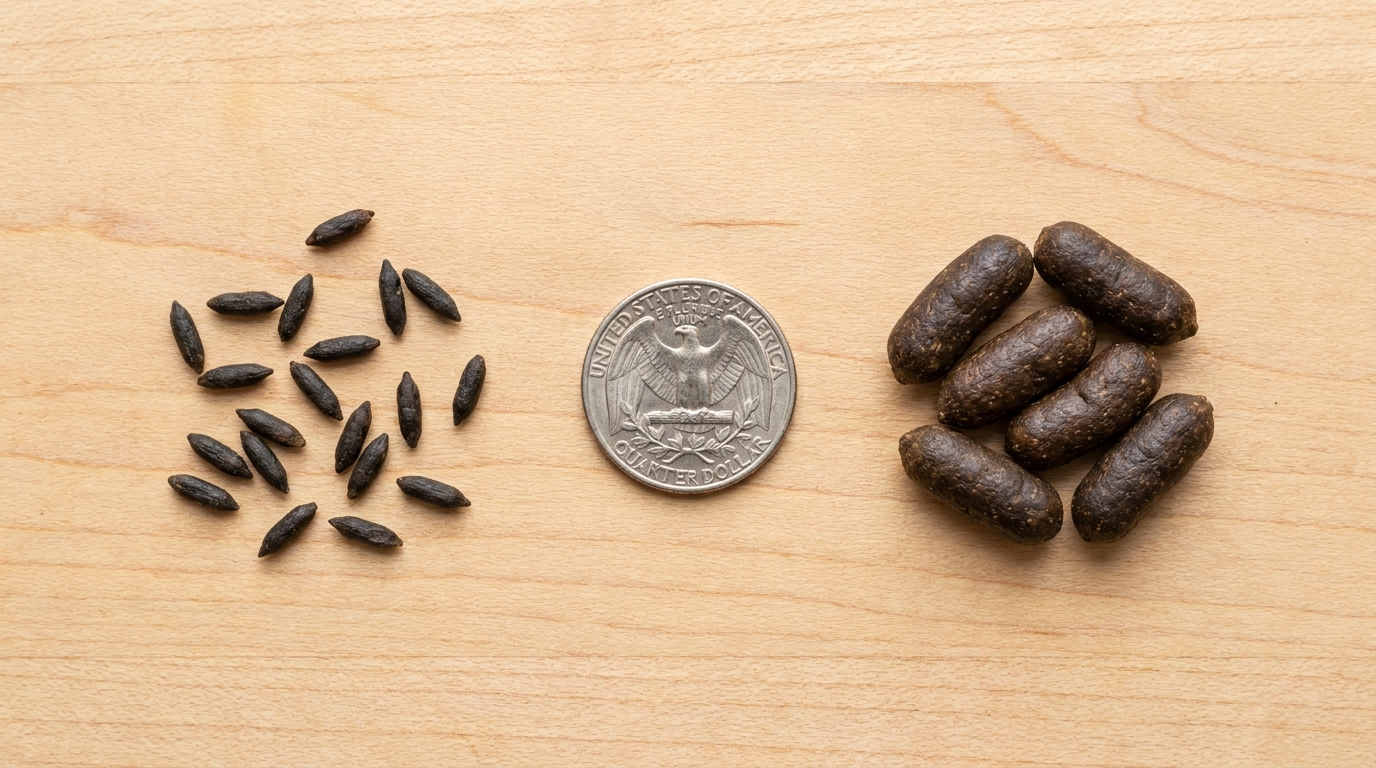
Mouse droppings are small (about 1/4 inch, the size of a black grain of rice), pointed at one or both ends, and scattered randomly. You will find them on counters, in silverware drawers, behind the toaster, and along the perimeter of the kitchen floor. Mice scatter their droppings as a pheromone trail — they use the scent to communicate with other mice, which is why you find them all over.
Rat droppings are 1/2 to 3/4 inch long, capsule-shaped, and clustered in one spot. Norway rat droppings have blunt ends and look like dark olive pits. Roof rat droppings are slimmer with pointed ends, and we see Norway droppings far more often than roof rat droppings in NYC apartments. Rats deliberately defecate in the same hidden corner — behind the hot water heater, deep in a closet, near a burrow entry — because they instinctively hide droppings from predators. If you find one large pile of pellets in a discrete, hidden spot, that is rats. If you find tiny dark grains scattered everywhere, that is mice.
Fresh vs. old droppings matter for knowing whether the infestation is active. Fresh droppings are dark, shiny, and soft — if you press one with a paper towel, it gives slightly. Old droppings are dull gray-brown, hard, and crumble when you touch them. If droppings are fresh and you smell ammonia, the population is active and growing.
Rodenticide droppings are a useful tell we always look for and that almost no other guide mentions. If you see green, blue, or pink droppings, the rodents are actively eating bait and the treatment is working. If your super put out bait stations and the droppings are still dark, the rodents are not taking it, and you need a different bait or trap strategy.
When you photograph droppings to show your super or to file with 311, include a coin in the frame for scale. A penny next to a 1/4 inch grain is unambiguous mouse evidence; the same penny next to a 3/4 inch capsule is unambiguous rat.
Where Are You Most Likely to Find Rat or Mouse Evidence in Your Apartment?
The signs are not random. Mice take consistent travel paths along walls, baseboards, and behind furniture, and they nest in warm dark places near food. Based on what our technicians find in NYC apartments week after week (plus real tenant kill logs — yes, some renters keep them), the most common places to find droppings, gnaw marks, or trapped mice are:
- Behind the refrigerator (warm motor + crumbs underneath)
- Inside the stove insulation (preferred nesting site)
- Under the sink (pipe penetrations + occasional water)
- Between a couch and a bookcase
- Under a chest of drawers in the bedroom
- Inside lower kitchen cabinets and pantry shelves
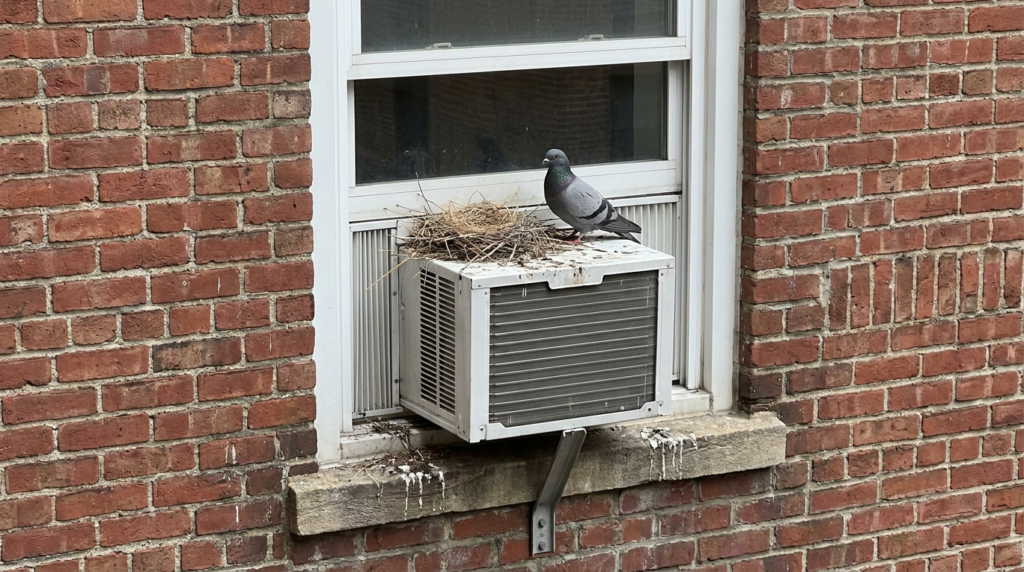
- Under or behind a window AC unit
- Along the inside seam of the apartment door (gap under the door)
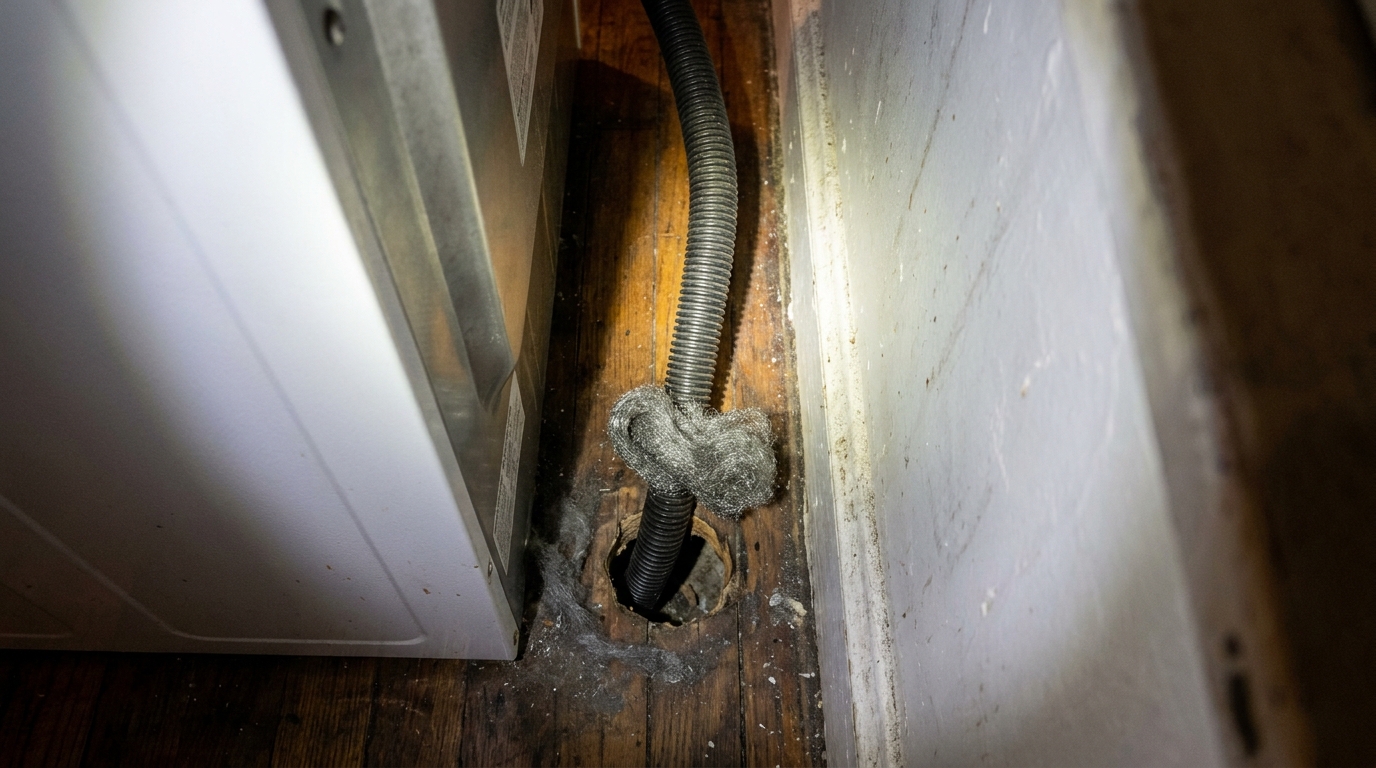
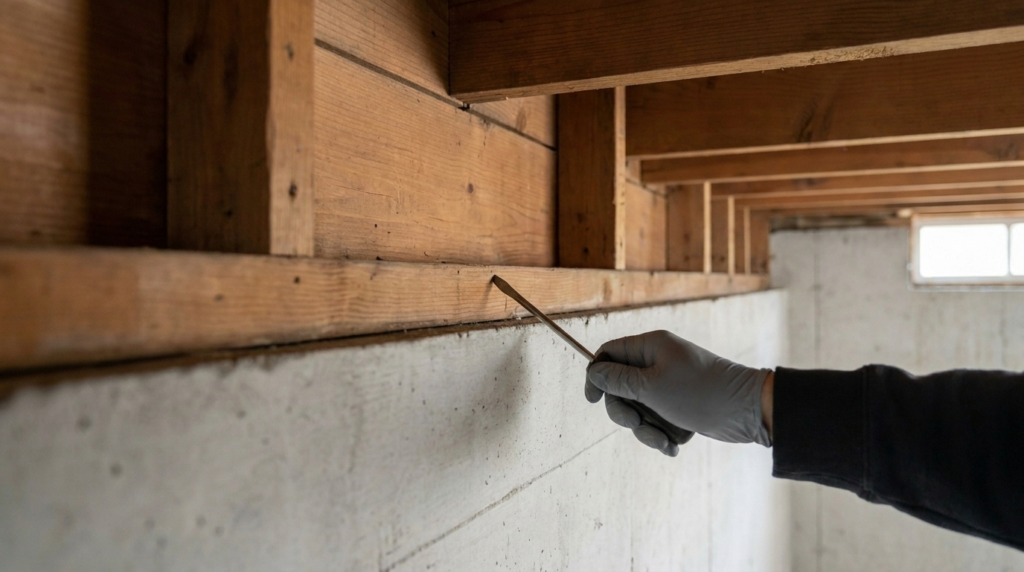
The single most overlooked entry point we find in NYC apartments is the gap behind your stove or oven. When supers replace an old appliance, the new model often sits 2 to 3 inches forward of the gas hookup, leaving a wide gap that connects directly to the wall void. Mice and the occasional rat travel up the gas pipe from the basement straight into your kitchen. We have lost count of the infestations we have traced back to this one gap. If your stove was replaced recently, look behind it with a flashlight — and if the gap is wider than your finger, get steel wool stuffed into every visible hole around the pipe.
Other entry points unique to older NYC buildings: settling cracks around radiator pipes, plaster wall gaps near outlets, intercom buzzer system openings, dishwasher water lines, and elevator shafts that act as vertical highways between floors. In a Brooklyn brownstone, shared walls between units and the front-stoop crawl space are recurring problems we treat constantly.
What Rat or Mouse Damage Should You Show Your Super or Landlord?
Beyond droppings, four kinds of damage are worth photographing for both your super and any 311 complaint:
- Gnaw holes. A mouse hole is small, clean-cut, and roughly dime-sized. A rat hole is quarter-sized or larger with rough, torn edges. Look at the bottom of door frames, the base of plaster walls, and any wood molding.
- Tooth marks on packaging or wires. Rat tooth marks are distinct grooves about 1/8 inch long. Mouse marks are fine, scratchy nibbles. Chewed wires near radiators or behind appliances are a fire hazard and one of the strongest pieces of evidence to show a landlord — under NYC housing code, this elevates a pest complaint to an immediate-action issue.
- Rub marks and grease trails. Rats have oily fur and leave dark smudges along walls where they run the same route nightly. Smear a fresh rub mark with your finger — if it transfers, the path is active. Mice rarely leave rub marks visible to the eye.
- Nests. Mice shred paper, fabric, and stove insulation into soft beds. If you pull out the bottom drawer of your stove and find shredded insulation in a clump, that is a confirmed mouse nest.
We tell every client to document everything with photos, the date, and the location. Under NYC housing code (HMC § 27-2017 and § 27-2018), landlords are obligated to provide pest-free conditions, and your written notice plus a 311 complaint creates the paper trail that gets HPD inspectors involved if your landlord stalls.
Rats or mice in your NYC apartment?
26+ years on NYC rodent work. We identify the species, find the entry points, and seal them clean, no annual contracts, free inspection.
Why Does Misidentifying Rats vs Mice Cost You Weeks of Wasted Treatment?
This is the part nobody tells you, but we see it in the field every week: rat treatment and mouse treatment are not interchangeable. If you assume rat and put out rat bait when you actually have mice, the bait is sized wrong and the entry points you seal are too large. If you assume mouse and put out snap traps for what is actually a rat, the traps are not strong enough and the rat will spring them without dying.
Two specific mistakes we see constantly are worth flagging:
- Never use bait inside walls or above a ceiling for rats. Rat bait works through delayed-onset anticoagulants — the rat eats, then dies one to four days later, often inside the void where it nested. A dead rat in your wall cavity smells like ammonia and decomposition for two to six weeks, and there is no way to remove it without opening drywall. For an indoor rat, snap traps with peanut butter or a professional rat removal service are the right answer.
- Pesticide sprays do nothing to mice. We hear this from new clients almost every week — a landlord sent the building’s pest control vendor to spray for mice. Sprays kill insects, not mammals. If your super’s solution is a bottle of spray, push back politely and ask for snap traps, bait stations, and gap sealing instead.
It is also worth knowing that rats and mice rarely share territory. Rats outcompete mice and will drive them out or kill them. If you have rats, you almost certainly do not have mice, and vice versa. So when our team confirms rat droppings during an inspection, we stop hunting for mouse signs and focus all the treatment on rat exclusion.
Which NYC Building Types Have the Highest Rat and Mouse Risk?
In our 27 years serving NYC and Long Island, we have found that building age, floor, and infrastructure are far better predictors of rodent activity than tenant cleanliness. Pre-war buildings (anything built before 1940) with plaster walls, settled foundations, and original plumbing are dramatically more prone to mice than new construction with sealed utility penetrations. Ground-floor and basement apartments face the highest risk regardless of borough.
NYC has actively responded to its rat problem with the NYC Rat Mitigation Zones program and the appointment of a Director of Rodent Mitigation (the Rat Czar) in 2023. As of 2024, the Department of Sanitation requires sealed waste containers for all residential buildings, replacing the old plastic bags piled at the curb that fed the city’s rat population for decades. We are seeing these rules reduce street-level rat populations, but the lag for indoor improvements is significant.
Specific NYC factors we want every tenant to know:
- Brooklyn brownstones in Bed-Stuy, Crown Heights, Flatbush, and East New York have historically generated the most 311 rodent complaints in the borough.
- Manhattan high-rises above the 5th floor see far less rodent activity than low-floor walk-ups, but doorman buildings still transmit rodents vertically through elevator shafts and trash chutes.
- Queens and the Bronx have higher activity around tree-lined residential streets where roof rats nest in canopy.
- Long Island suburbs see seasonal mouse migration indoors every fall as temperatures drop, which is why we handle so much Long Island rat and mouse removal in Nassau and Suffolk.
- Hurricane Ida-style flooding events displace rats out of the sewer system and into ground-floor apartments — a recent surge of first-time rat reports from longtime NYC tenants tracks closely to flash flood events we have responded to.
If your building is older than 1940 and you are on a floor below the 5th, you are in the high-risk pool, and persistent activity usually requires building-wide treatment, not single-unit traps.
What Rat and Mouse Diseases Should NYC Renters Actually Worry About?
Both rats and mice carry pathogens that pose real health risks, especially during cleanup. The main concerns:
- Hantavirus pulmonary syndrome (HPS). Spread by inhaling aerosolized particles from mouse droppings, urine, or nesting material. Deer mice are the primary carriers, but house mice can also transmit. Hantavirus is rare in NYC but serious — fatality rates are high once symptoms develop.
- Leptospirosis. Spread through rat urine, often via contaminated puddles or moist surfaces. Causes flu-like symptoms and, in severe cases, organ damage. NYC has documented cases each year, mostly traced to rat-heavy street environments.
- Salmonellosis and E. coli. Both rats and mice contaminate food and food-prep surfaces with droppings, urine, and saliva. Anything stored in unsealed packaging that has been near droppings should be discarded.
- Rat-bite fever. Rare in residential settings but possible from rat saliva, droppings, or actual bites.
- Asthma triggers. Mouse droppings and urine are documented allergens that trigger and worsen asthma in children — a significant issue in NYC apartment buildings with chronic infestations.
The cleanup rule we drill into every client: never sweep or vacuum dry rodent droppings. Sweeping aerosolizes hantavirus particles and can cause inhalation exposure. Spray droppings with a bleach solution (1.5 cups bleach per gallon of hot water), let them soak for 10 to 20 minutes, and wipe up with damp paper towels. Wear a mask, gloves, and eye protection. Bag and seal the waste before throwing it out. The CDC guidance on hantavirus cleanup is the authoritative protocol we follow on every job.
What Should You Do About Rats or Mice in Your Apartment Right Now?
If you have just confirmed signs of rodent activity in your apartment, work this list in order:
- Identify using droppings, hole size, and gnaw marks. If it is a mouse, snap traps and sealing will likely solve it. If it is a rat, jump straight to step 6.
- Document with photos. Include a coin for scale on droppings, and date every photo.
- Notify your super or landlord in writing (email or text creates a paper trail). Cite NYC housing code and request action within 24 hours.
- Seal entry points with steel wool packed into gaps and expanding foam over the steel wool. Pay special attention to under your sink, behind the stove, around radiator pipes, and the gap under your apartment door.
- Set traps — Victor or D-Con snap traps with peanut butter as bait, placed against walls along travel paths, not in the open. Sticky traps under appliances catch the mice your snap traps miss. Use covered bait stations only if you have no kids or pets.
- Call professional rodent control if you confirm rats indoors, if mouse activity persists after two weeks of trapping, or if you live in a multi-unit building where the source is clearly a neighbor or shared wall. We provide comprehensive rodent removal across NYC and Long Island, including same-day inspections, building-wide treatment coordination, and exclusion work that a hardware store visit cannot match.
- File a 311 complaint if your landlord ignores written notice for more than five business days. HPD inspectors have authority to fine landlords for unaddressed pest complaints under HMC violations.
For a deeper look at confirming a mouse infestation, our guide to signs of mice in NYC apartments walks through the seven most common indicators in pre-war buildings. If you suspect cockroaches at the same time (which we see often), our water bugs in NYC guide covers identification and treatment.
Key Takeaways
- It is almost always a mouse, not a rat. We see rats inside individual apartments above the first floor only rarely; mice are everywhere.
- Mouse droppings = 1/4 inch grains of rice, scattered. Rat droppings = 1/2 to 3/4 inch capsules, clustered.
- The gap behind your stove is the entry point most NYC tenants miss — and the one we find first on most inspections.
- Photograph droppings with a coin for scale, and document gnaw marks for your super and 311.
- Pesticide sprays do nothing to rodents — push back if your landlord tries that. Snap traps with peanut butter and gap sealing with steel wool are what we recommend and use ourselves.
- Never use rat bait inside walls — the smell is unbearable for weeks.
- File a 311 complaint if your landlord stalls. HMC § 27-2017 makes pest-free conditions a legal obligation.
If you are seeing droppings, hearing scratching, or finding gnaw marks and are not sure how serious the infestation is, we can identify the species, find the entry points, and put together a treatment plan that fits your building. Our team has worked NYC and Long Island rodent jobs for 27 years and has seen every variation — get a free quote and we will follow up the same day.