If you live in Brooklyn long enough, you will eventually share your kitchen with a roach. Whether that visit becomes a one-off or a full-blown infestation depends almost entirely on three things: the species, your building’s bones, and what your neighbors are doing on the other side of the wall. Our team at Advanced Pest Management has been treating Brooklyn apartments for 26+ years — brownstones in Bed-Stuy, walk-ups in Bushwick, garden apartments off Ocean Parkway, new-construction high-rises near Atlantic Yards — and the patterns are remarkably consistent. If you’re trying to figure out whether what you saw last night was a fluke or the start of a real problem, you’re in the right place. For a complete walk-through of professional treatment options, our cockroach control service for Brooklyn apartments covers the entire process from inspection to follow-up; this guide is the diagnostic primer to read first.
In the next ten minutes you’ll learn which Brooklyn neighborhoods rank highest in NYC’s official cockroach surveys, how to ID the bug you saw without a magnifying glass, why “Advion gel from Amazon” works for some readers and fails completely for others, and what your landlord legally owes you. We’ve pulled together NYC.gov data, Cornell IPM and Rutgers research, and the unfiltered tenant experience from r/Brooklyn so you can make the right call before this turns into a lease-breaking situation.
Cockroaches in your NYC kitchen?
26+ years treating NYC roaches. Gel baits and crack-and-crevice work that actually finishes the colony, no annual contracts, and a free inspection.
Which Brooklyn Neighborhoods Are the Cockroach Hot Zones?
Brooklyn isn’t one cockroach problem — it’s at least a dozen. The NYC Department of Health’s Environment & Health Data Portal publishes adult-reported cockroach data by neighborhood, and the spread inside Brooklyn alone is enormous. Williamsburg-Bushwick sits at 43.6%, while Bensonhurst-Bay Ridge sits at 20.5%. That is the difference between roughly one in two adults seeing a roach inside the home in the past 30 days versus one in five.
Here’s what the borough’s official heat map looks like:
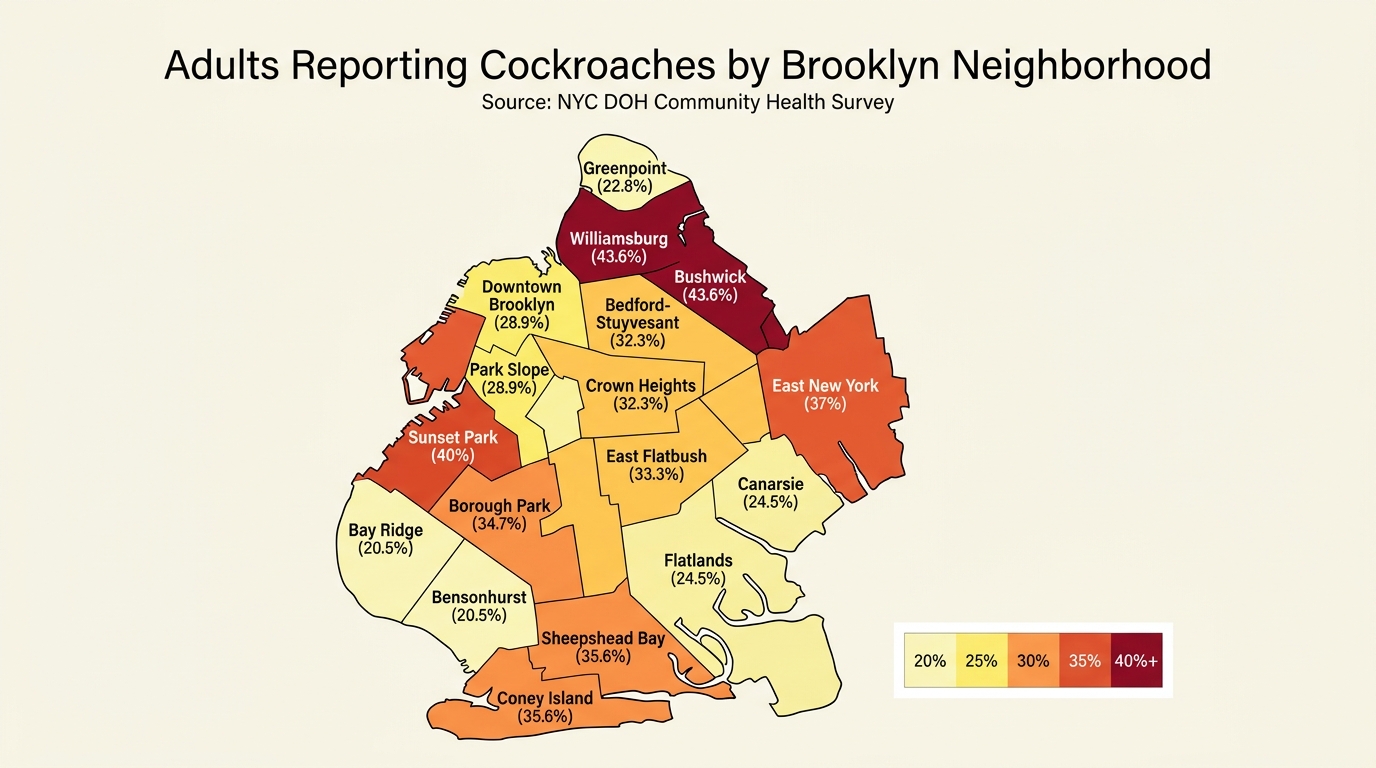
A few patterns jump out. The dense, older, mixed-residential-and-commercial corridors — Williamsburg-Bushwick, Sunset Park, East New York, Coney Island-Sheepshead Bay, Borough Park, East Flatbush, Bed-Stuy-Crown Heights — all sit above 30%. The lower-density, more suburban edges of the borough — Bay Ridge, Bensonhurst, Greenpoint — drop into the low 20s. Brooklyn-wide, 32.5% of adults reported cockroaches in their home, which is meaningfully higher than Manhattan (28.0%) or Queens (26.3%) and only beaten in NYC by the Bronx (35.1%).
In our experience, where you live in Brooklyn predicts which species you’re going to see and how aggressive the treatment plan needs to be. We’ve worked accounts in every one of these UHF zones, and the takeaway is unromantic: roaches in Brooklyn track building stock and shared infrastructure more than they track any one tenant’s housekeeping. If you’re in Williamsburg, Bushwick, Sunset Park, or East NY, you are starting from a much harder baseline than someone in Bay Ridge — and that’s not your fault.
Which Roach Did You Actually See: German Cockroach or American Cockroach in Brooklyn?
About 80% of the calls we take from Brooklyn tenants are German cockroaches. Most of the rest are American cockroaches that crawled in through a basement drain or a sewer access. Telling them apart in five seconds saves you from buying the wrong product and treating the wrong rooms.
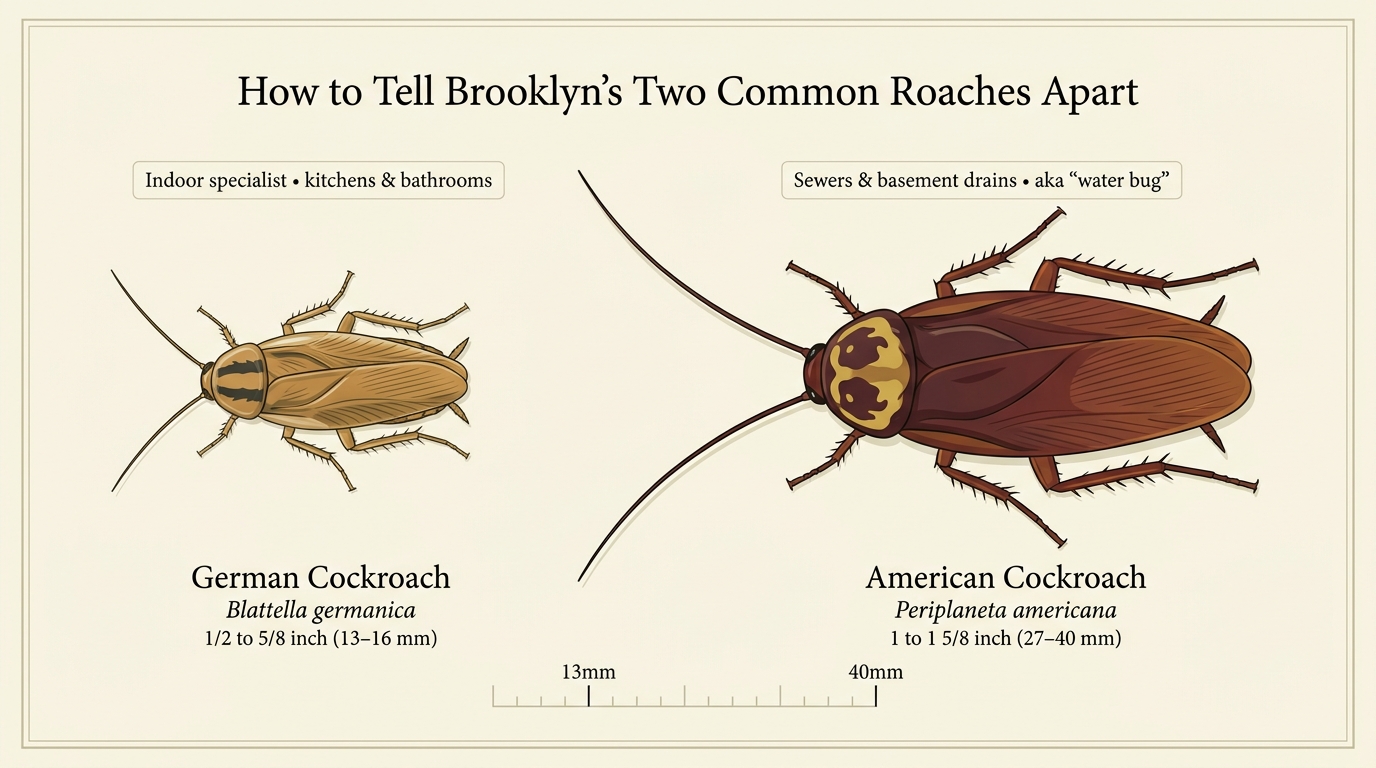
The German cockroach (Blattella germanica) is small — 13 to 16 mm, about the size of a kidney bean — light tan, with two thin parallel dark stripes running from front to back on the pronotum (the shield right behind the head). According to Cornell’s Integrated Pest Management program, this is “the most common cockroach pest” and the one most associated with kitchens, bathrooms, and apartment-to-apartment spread. If you saw a small light-brown roach scuttle behind your stove or under the dishwasher, that’s a German.
The American cockroach (Periplaneta americana) is the giant, reddish-brown, two-inch insect Brooklynites politely call a “water bug.” It comes up through plumbing, basement drains, sewer access, and elevator shafts. Rutgers Cooperative Extension notes American cockroaches “can move into buildings on the inside of waste pipes.” A single American in a top-floor apartment after a heavy rain is not the same situation as repeated German sightings in the kitchen.
Why misidentification matters: the bait, dust, exclusion strategy, and treatment locations are completely different. German cockroaches need apartment-interior bait placements, IGRs, and shared-wall void treatment. American cockroaches need basement, drain, and exterior-perimeter work. Spraying for one when you have the other wastes time and can make the actual problem worse.
Why Do Brooklyn Brownstones, Prewar Walk-Ups, and Garden Apartments Get So Many Roaches?
The building you live in matters more than how often you sweep. Our team has treated brownstones in Park Slope, four-story walk-ups in Sunset Park, garden apartments in Ditmas Park, NYCHA developments in East NY, and brand-new luxury towers in Downtown Brooklyn. The infestation patterns are completely different in each.
Brownstones (Bed-Stuy, Crown Heights, Park Slope, Cobble Hill, Fort Greene): Old wood floors with gaps, original plaster walls with hairline cracks, gas pipes penetrating walls behind stoves, and shared brick walls between adjacent townhouses. One r/Brooklyn tenant put it perfectly: “I moved to an apartment in a brownstone (older building) that doesn’t have a regular exterminator and have experienced the gambit of pests… I see a German Roach in sporadic bursts.” Brownstones rarely have a building-wide pest contract because they’re owner-occupied or small-landlord, so any infestation in one floor leaks straight up or down.
Prewar walk-ups (Bushwick, Williamsburg, Sunset Park, Greenpoint): Trash chutes (often originally incinerator chutes), wet basements, ground-floor commercial tenants, and shared electrical conduit between units. Roaches use the chute and the conduit as elevators. Reddit threads are full of tenants who clean obsessively but still see roaches because the building itself is the source — “my place was clean and roach-booby-trapped/poisoned and it meant nothing cus the building was infested and my neighbors were gross.”
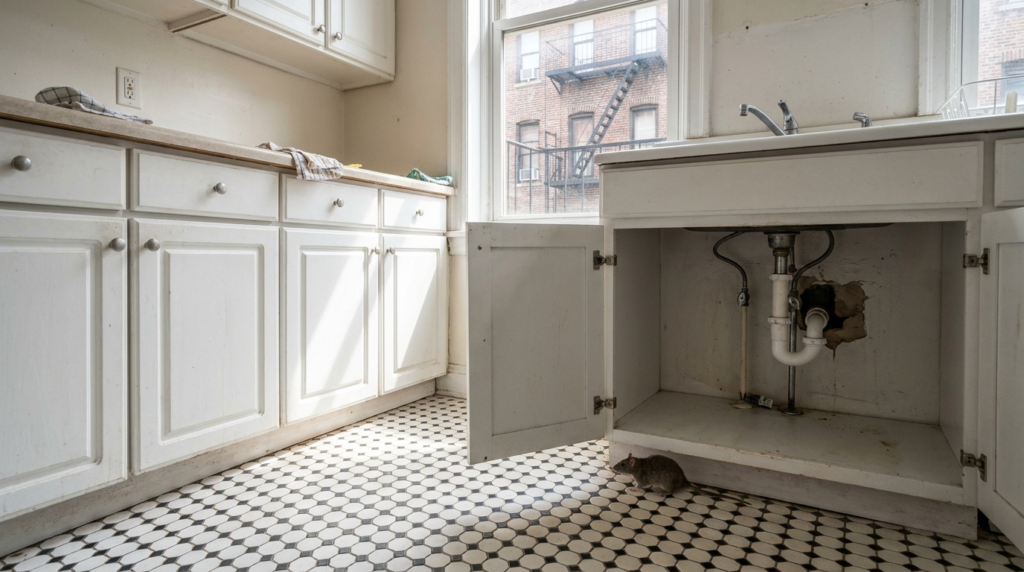
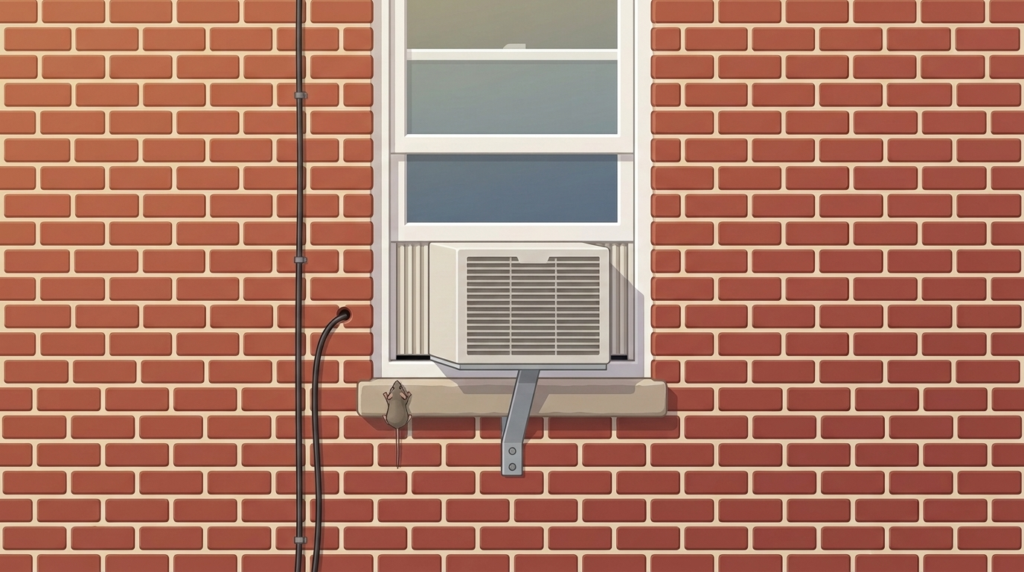
Garden apartments (Ditmas Park, Midwood, Sheepshead Bay): Shared crawl spaces, exterior wall penetrations for window AC units, and slab-on-grade floors that put kitchens within six inches of soil. American cockroaches dominate here.
NYCHA developments and large managed buildings: Building-wide monthly extermination is required, but the NYCHA pest control program has been transitioning to integrated pest management. If your building uses a contractor that sprays pyrethroids without baiting, treatment can actually push roaches deeper into wall voids and into adjacent units.
New construction (Downtown Brooklyn, Williamsburg waterfront, Atlantic Yards): Far fewer shared-wall transmission paths and modern slab-and-stud construction. Reddit consensus matches what we see on jobs: “Never encountered any cockroaches in ‘luxury’ apartment or condo — not even a single one.” When new buildings do have a problem, it’s almost always a single unit traced to a delivery box, a used appliance, or a personal item brought in from an infested previous home.
What Are the Earliest Signs of a Cockroach Problem in a Brooklyn Apartment?
In our 26+ years working Brooklyn kitchens, the early signs are almost always there for two to four weeks before the tenant calls. Catching them early is the difference between a $300 one-time treatment and a multi-month elimination project.
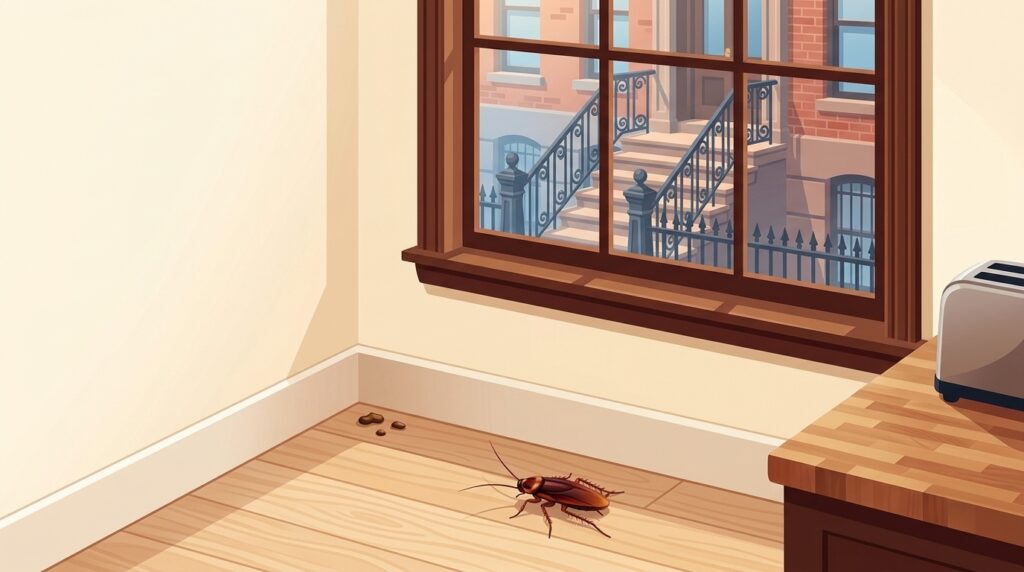
The droppings. German cockroach droppings look like coarsely ground black pepper or coffee grounds. They show up in the corners of kitchen drawers, on top of high cabinets where dust collects, behind the toaster, inside the cutlery drawer, and along the channel where the under-cabinet meets the wall. Don’t confuse them with mouse droppings, which are larger, more pill-shaped, and look more like uncooked rice. If you’re not sure what you’re looking at, our deeper seven signs of cockroaches in NYC apartments guide has detailed photo-style descriptions of each.
The smell. A heavy German cockroach population gives off a distinct musty, oily odor — almost like wet cardboard mixed with old sneakers. The pheromone is what they use to communicate with each other. If you walk into your kitchen at night and the air smells “wrong” but you can’t name what’s wrong, that’s often it.
The egg cases (oothecae). German cockroach egg cases are tan, elongate, about 8 mm long, and the female actually carries hers around attached to her abdomen until just before they hatch. Each ootheca holds about 40 eggs. Finding empty translucent casings means a generation has already hatched and is hiding in your walls. Rutgers entomologist Changlu Wang notes that 80% of an active German cockroach population is nymphs, not adults — which means by the time you’ve seen one adult, you have 4-5 hidden ones for every visible one.
The smear marks. Roaches leave dark, irregular grease tracks where the wall meets the ceiling and along baseboards. They run the same paths every night.
The tolerance benchmark. A common question we hear: how many sightings is “normal” in a Brooklyn apartment? The honest answer from our techs and from the broader r/Brooklyn community: zero per week is the only acceptable target. Manhattanites sometimes joke “one big roach a year is acceptable,” but for German cockroaches specifically, even a single confirmed sighting in an apartment without a regular maintenance program means you have a hidden colony. Cornell IPM states bluntly: “All roach problems start small, but roaches reproduce rapidly, so early intervention is highly recommended.”
Cockroaches in your NYC kitchen?
26+ years treating NYC roaches. Gel baits and crack-and-crevice work that actually finishes the colony, no annual contracts, and a free inspection.
What Does a Heavy Cockroach Infestation in a Brooklyn Apartment Smell, Sound, and Look Like?
Once you cross from “occasional sighting” into “active infestation,” the experience changes. We’ve walked into Brooklyn kitchens where the cabinet under the sink genuinely moves when you shine a flashlight in. Here’s what tenants describe before they call us:
- Daytime sightings. Roaches are nocturnal. If you’re seeing them in the kitchen at 2 PM, the population has outgrown its nighttime hiding spaces.
- Roaches inside the refrigerator gasket. The motor compartment behind the fridge runs warm, has condensation moisture, and traps food crumbs. It is the single most consistent hot spot in Brooklyn German cockroach jobs.
- Egg cases on the underside of the kitchen drawer. When you pull a drawer out and find tan grain-of-rice-shaped capsules glued to the bottom, you’re looking at the next generation.
- The “moving wall.” You flip on the kitchen light and a dozen small bodies scurry into shadows. If they’re visible while the lights are on, you have hundreds you don’t see.
- Allergic reactions or worsening asthma. Cornell IPM cites that proteins in cockroach feces cause sustained allergic reactions including chronic asthma. NYC.gov directly links borough-level cockroach prevalence to asthma rates.
We also want to name the part nobody on commercial pest sites talks about: the mental health toll. We’ve taken calls from tenants who haven’t slept in their bedroom in weeks, who eat all their meals out of the apartment, who are mid-lease-break because of one infested kitchen. One Brooklyn tenant on Reddit wrote, “I lasted a year there somehow when I was averaging 1-2 roaches/week… it wasn’t til I finally snapped, broke my lease and moved that I realized how genuinely stressed out I was in my own apartment.” If that sounds like you, the situation is solvable — it just usually takes building-wide coordination and a pro, not another trip to the hardware store.
Why Does DIY Roach Treatment Keep Failing in Your Brooklyn Apartment?
The number one reason DIY fails in Brooklyn is shared walls. The number two reason is product choice. The number three reason is treatment scope.
Shared walls. German cockroaches use the gap where the gas pipe enters your wall behind the stove, the channel around the radiator pipe, the void behind the medicine cabinet, and the conduit around electrical outlets to move between apartments. You can keep a spotless kitchen, bait the daylights out of every corner, and still see new roaches every week — because they’re not living in your unit, they’re commuting in from your neighbor’s. Rutgers documents this directly: “This pest occurs more often in apartment buildings due to the building structural features that allow cockroaches to spread between units through common utilities, shared common walls, and hallways.”
Pyrethroid sprays from the hardware store. “Raid” and similar over-the-counter aerosols are pyrethroids. Pyrethroids are repellent — they don’t kill the colony, they push survivors deeper into the wall voids, and worse, they can contaminate any bait you’ve put down so the surviving roaches won’t eat it. NYC DOH explicitly warns against foggers, bombs, and certain illegal pesticides like Tres Pasitos, Chinese Roach Chalk, and Tempo for residential consumer use. Foggers don’t reach the harborage anyway — they kill what’s exposed and leave the colony intact.
Pesticide resistance. University of California Riverside research published in 2022 showed that German cockroach populations in some U.S. cities have evolved resistance to five common over-the-counter pesticides. Even abamectin, the one the resistant populations still died from, can develop resistance in roughly two generations — about a year. The take: spraying the same product month after month makes the next generation harder to kill.
Treatment scope. Most DIY treatments hit the kitchen and stop there. We’ve inspected Brooklyn apartments where the kitchen was getting heavy bait but the bathroom was untreated, and the colony had relocated to the under-sink void in the bathroom. Cornell IPM is explicit: cockroach management is “best achieved through an integrated pest management approach that uses multiple tactics.”
What actually works. The current professional protocol — and the one our techs have been refining on Brooklyn jobs for two-plus decades — is non-repellent insecticide + bait + insect growth regulator + mechanical removal + exclusion. Applied to harborage areas, the under-sink void, behind appliances, the dishwasher cavity, and any shared-wall pipe penetration. We use Bayer Tempo Dust in wall voids, gel baits in cabinet hinges and door corners, and IGRs to disrupt the breeding cycle so the population can’t replace itself faster than we can kill it. For severe cases in Brooklyn brownstones we also do wall-void drilling and dusting where chronic shared-wall transmission is the root cause.
When Is Bait Enough and When Do You Need Wall-Void Treatment for Brooklyn Roaches?
Bait alone works in a clean, well-sealed unit with a fresh, isolated infestation — for example, a German cockroach colony that hitchhiked in on a delivery box and hasn’t yet spread into the wall voids. The Reddit consensus on Advion gel and Maxforce reflects this reality: when conditions are right, gel bait can wipe out a small colony in a few weeks.
Bait alone fails when:
- The infestation has been active long enough for the colony to disperse into shared wall voids
- A neighboring unit is also infested (which is the rule, not the exception, in Brooklyn prewar buildings)
- You have egg cases hatching in inaccessible locations (behind built-in cabinets, inside subfloor cavities, behind tile)
- The building has trash chute pressure (former incinerator chutes are roach highways)
- A ground-floor commercial tenant — restaurant, deli, bodega — is sustaining a population that pushes upstairs
For all of those scenarios, a real solution requires a tech with the tools and license to drill, dust, treat at the source, and coordinate with the building. The Rutgers fact sheet recommends 10 to 30 grams of bait per typical one-bedroom apartment with follow-up every 2 to 4 weeks until no cockroaches appear in monitors for a full month. Most consumer Advion syringes hold 30 grams total. Doing this correctly across cabinets, appliances, voids, and shared walls — and then monitoring with sticky traps for four straight weeks — is what separates a real outcome from a temporary lull. Our comprehensive cockroach control program is built around this protocol and includes the monitoring follow-ups.
What Are Your Tenant Rights When Your Brooklyn Landlord Won’t Treat the Roaches?
You have more rights than most tenants realize. Here’s the short version.
The Warranty of Habitability is established under New York Real Property Law § 235-b, and NYC Housing Maintenance Code § 27-2017.1 specifically requires the owner to keep the premises free from pests. Translation: your landlord is legally required to address a cockroach infestation. They cannot tell you to handle it yourself.
Document in writing. Email your landlord or property manager describing what you’ve seen, the date, and where. Keep photos. This starts the clock and creates a paper trail. Verbal complaints don’t count.
Escalate via 311. If your landlord doesn’t act within a reasonable window — generally 7 to 14 days for serious infestations — file a complaint through NYC 311’s residential pest complaint portal. This triggers an inspection by the Department of Housing Preservation and Development (HPD). HPD violations are a serious matter for landlords; they often produce action where direct requests didn’t.
Local Law 55 specifically requires building owners to address conditions that lead to pest infestations and asthma triggers, and to use Integrated Pest Management methods. This is a higher bar than just “spray something.”
Don’t let your landlord blame you. The single most common dodge in Brooklyn is “your apartment must be dirty.” The data, the science, and our own job notes all say the same thing: cockroach prevalence in Brooklyn correlates with building maintenance and shared infrastructure, not with individual housekeeping. A meticulously clean apartment in an infested prewar building will still have roaches until the building is treated.
Free home assessments for asthma triggers. If you or your child has been diagnosed with persistent moderate or severe asthma and you live in rental housing with cockroaches or mice, the NYC Health Department’s Healthy Neighborhoods Program offers a free home assessment. Worth knowing if asthma is part of the picture.
Why Does Whole-Building Treatment Matter More Than Individual-Unit Treatment for Brooklyn Roaches?
This is the conversation that ends most Brooklyn cockroach problems. If you live in a building larger than four units and you have a German cockroach infestation, the only durable solution is whole-line or whole-building treatment. Anything less treats the symptom, not the source.
Reddit captured the arc perfectly in one of the threads our team reviewed for this guide. A tenant in a Brooklyn brownstone documented a year of trying everything DIY, then their landlord finally hired a monthly exterminator and treated all the units in the building. Update: “I have been getting DMs regarding this still and just wanted to update that my landlord actually did end up springing for a regular exterminator to come once a month. The exterminator told me that apparently my neighbors have been leaving food out, etc. and may not have been completely honest about pests that they were seeing but everyone will be getting treated.” That’s the actual fix — coordination, building-wide treatment, and honest neighbor cooperation.
For co-op buildings, this almost always means going to the board. For rental buildings, it means escalating with management or HPD. Our team has done dozens of building-wide Brooklyn jobs where we treat every unit on a riser in one day, dust shared wall voids, treat the basement and trash chute, and follow up at 2 and 4 weeks. The first time, the building absorbs the cost; on monthly maintenance afterward, the per-unit cost is small. We also handle the specialized garbage chute treatments (fogging plus dusting) that prewar Brooklyn buildings with former incinerator chutes almost always need. These are the kinds of jobs where one-unit-only treatment simply cannot succeed.
If you’re in a single-family townhouse or you own a small Brooklyn building, the same logic still applies — treat it as a whole, not unit by unit, and use a service area program rather than emergency-only one-offs. Our Brooklyn-wide pest control program is designed for exactly these multi-unit and small-landlord situations.
What About American Cockroaches and “Water Bugs” in Brooklyn Basements?
A separate situation worth its own conversation. American cockroaches in Brooklyn are mostly basement, drain, and sewer-associated. They show up in ground-floor apartments after heavy rain, in basement laundry rooms year-round, and occasionally on upper floors when they ride up through plumbing chases. If you’re seeing one large reddish-brown roach a few times a year in a ground-floor unit after a storm, that’s typical and treatable with drain treatment and exterior-perimeter exclusion.
If you’re seeing them indoors regularly — multiple sightings a week — there’s a steady source: a wet basement, a broken drain trap, a sewer line vent, or a building-wide moisture problem. Our companion guide on water bugs in NYC apartments breaks down the difference between American cockroaches and the actual aquatic “water bug” species (Belostomatidae), which most New Yorkers never actually encounter despite using the term constantly. The treatment plan for a real American cockroach problem is exterior- and basement-focused; the treatment plan for German cockroaches is interior and apartment-focused. They are not interchangeable.
Cockroaches in your NYC kitchen?
26+ years treating NYC roaches. Gel baits and crack-and-crevice work that actually finishes the colony, no annual contracts, and a free inspection.
When Should You Call a Brooklyn Pest Control Company Instead of Trying Another DIY Round?
Honest answer: as soon as you know you have a German cockroach problem and you live in any building with shared walls. The math is brutal. A female German cockroach produces 5 to 8 oothecae over her 140- to 280-day lifespan, with about 40 eggs per ootheca. That’s 200 to 320 offspring per female. The full life cycle is about 100 days. If you wait three months, you can go from 5 visible roaches to several hundred hidden ones.
Call us — or any reputable licensed Brooklyn exterminator — when:
- You’ve seen multiple German cockroaches in one week, in any apartment building
- You’ve found egg cases (oothecae) anywhere in the apartment
- Your building’s monthly contractor is spraying but the problem isn’t getting better (they’re likely using repellent products and missing harborage)
- You smell the musty pheromone odor in the kitchen or bathroom
- You’re in a brownstone, prewar walk-up, or any building over 50 years old
- You have asthma or a child with asthma in the home
- You’re about to sign a lease in a building with online reviews mentioning roaches
The Brooklyn buildings we treat most often are concentrated in exactly the neighborhoods the NYC DOH map flagged: Williamsburg, Bushwick, Sunset Park, East New York, Bed-Stuy, Crown Heights, Borough Park, Coney Island, Sheepshead Bay, East Flatbush. If you live in any of those zones and you have shared walls, the prior probability that DIY alone will solve a real infestation is low. We’d rather you catch it at five sightings than at fifty.
Quick Recap
If you take three things from this guide:
- Brooklyn cockroach risk tracks neighborhood and building stock. Williamsburg-Bushwick, Sunset Park, and East NY sit above 35% adult-reported prevalence; Bay Ridge and Greenpoint are far lower. Your building matters more than your housekeeping.
- German cockroaches in apartments are a building problem, not just an apartment problem. Bait alone rarely ends an infestation when the colony has spread through shared walls. Whole-line or whole-building treatment combined with non-repellent insecticide, IGRs, and exclusion is what actually works.
- You have legal rights. Document in writing, escalate via 311, and don’t let a landlord blame your housekeeping for what is structurally a building maintenance issue.
If the signs in your apartment match what we’ve described — droppings in cabinet corners, daytime sightings, egg cases, the musty smell — getting a professional inspection sooner saves time, money, and stress. We’ve been doing this in every Brooklyn neighborhood since 1999, and we’d rather help you stop a small problem early than rebuild after a year of DIY frustration. You can reach our team for a free estimate any time, and same-day service across all five boroughs is the standard, not the exception.