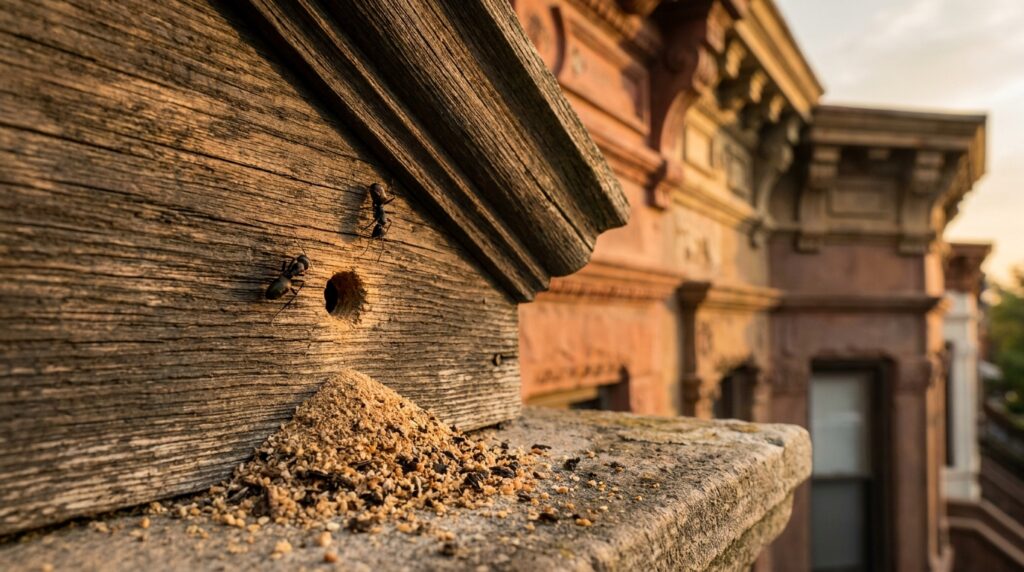
If you’ve found small piles of what looks like sawdust mixed with insect parts on the floor beneath a Brooklyn brownstone roof drain, heard faint rustling inside the cornice of a Manhattan brownstone bay window at night, or noticed soft hollow-sounding wood in the fascia of your Park Slope home, you may be looking at carpenter ant damage — and you need to act on it in the next 30 to 60 days before structural repair becomes the bigger bill. After 26 years inspecting NYC brownstones for carpenter ant activity, our team has learned that brownstone-specific moisture patterns (parapet flashing failures, roof drain leaks, cornice water infiltration) are the dominant driver of carpenter ant colonization in pre-war Brooklyn and Manhattan housing stock. Catching it early turns a $400 spot treatment into a single-visit fix; missing it for 18 months turns it into $8,000 of fascia and cornice rebuild work plus $1,200 treatment.
This guide walks through what carpenter ant damage actually looks like in NYC brownstone wood specifically, how to tell it apart from termite damage and water damage, where to inspect first in a typical brownstone, when damage is structural vs cosmetic, and what your NYC brownstone owner or co-op resident options are. If you’d rather skip the inspection and book professional NYC carpenter ant control for a free brownstone walkthrough, our front-office team can usually book a same-day inspection during business hours. Read on for the brownstone-specific diagnostic.
Carpenter ants in your NYC brownstone?
26+ years inspecting NYC brownstones. Cornice and parapet damage diagnostics, wall-void Tempo Dust application, and the 4-week colony elimination cycle, no annual contracts, and a free inspection that's waived when you book.
What Does Carpenter Ant Damage Look Like in an NYC Brownstone?
Carpenter ants don’t eat wood the way termites do. Per Penn State Extension’s carpenter ant biology guide, they excavate wood to create galleries (tunnels and nesting chambers) and push the excavated material out as frass. The wood damage looks fundamentally different from termite damage:
- Smooth, sandpaper-clean galleries. Carpenter ant galleries inside the wood are clean, smooth-walled, often following the grain. You can see this when you break a piece of suspected damaged wood — galleries look almost machined, not rough or muddy.
- Frass piles below entry points. Frass is a mix of wood shavings + dead insect parts + ant debris. It looks like coarse sawdust with small black grain-like specks (the ant parts) mixed in. Find frass piles on the floor below a fascia board, cornice bracket, or window pediment — there’s a gallery above.
- Hollow-sounding wood. Tap suspected damaged wood with a screwdriver handle. Carpenter-ant-damaged wood sounds hollow and dull. Solid healthy wood sounds firm and thuds.
- Visible exit holes. Small round holes about 1/8 inch in diameter, sometimes in a line along a wood grain. Excavated material falls through these holes as the colony pushes debris out.
- Rustling noise at night. Established colonies in brownstone fascia or cornice wood can be heard rustling at 9 to 11 p.m. when the colony is most active. Press your ear against the wall below a suspected nest — faint scratching is the carpenter ants.
- Large black or reddish-brown ants 1/4 to 3/4 inch long. NYC carpenter ants (Camponotus pennsylvanicus) are the largest household ant in our service area. Adult workers are big, slow-moving, and often spotted along trails on exterior fascia or interior baseboards adjacent to nesting wood. Per Cornell IPM’s carpenter ant research, the visible workers are 10% to 15% of the colony at most — the rest are inside the nest.
One important note: just seeing a single large black ant doesn’t mean you have a colony. Foraging workers travel up to 100 yards from the nest. The presence of frass + hollow wood + multiple workers concentrated in one area is the diagnostic combination that confirms an established nest. For broader context on species ID, our comparison guide for carpenter ants vs black ants in New York is the most-read post on our site for a reason — misidentification at the homeowner level costs people thousands of dollars in wrong-treatment bills every year.
How Do You Tell Carpenter Ant Damage from Termite Damage in NYC Brownstone Wood?
Brownstone owners frequently confuse the two, and the consequences of misdiagnosis are significant. Here’s how to tell them apart:
| Diagnostic feature | Carpenter ants | Subterranean termites |
|---|---|---|
| Wood gallery surface | Smooth, sandpaper-clean walls; follows grain | Rough, muddy interior with soil deposits; cross-grain damage |
| Frass present | YES — coarse sawdust + insect parts visible | NO frass; termites pack mud into damaged areas |
| Mud tubes | NO | YES — quarter-inch mud tubes climbing foundation walls |
| Visible workers | Large 1/4 to 3/4 inch black or reddish-brown ants | Rarely visible; termites stay enclosed |
| Swarmers | Late summer (August-September), winged carpenter ant reproductives | Spring (March-April), winged termite reproductives |
| Damage location | Wet/decayed wood, fascia, cornices, roof drains | Soil-contact wood, sill plates, basement framing |
| Treatment cost (NYC brownstone) | $400 to $1,200 spot + $1,500-$3,000 if structural | $2,500 to $6,000 whole-structure |
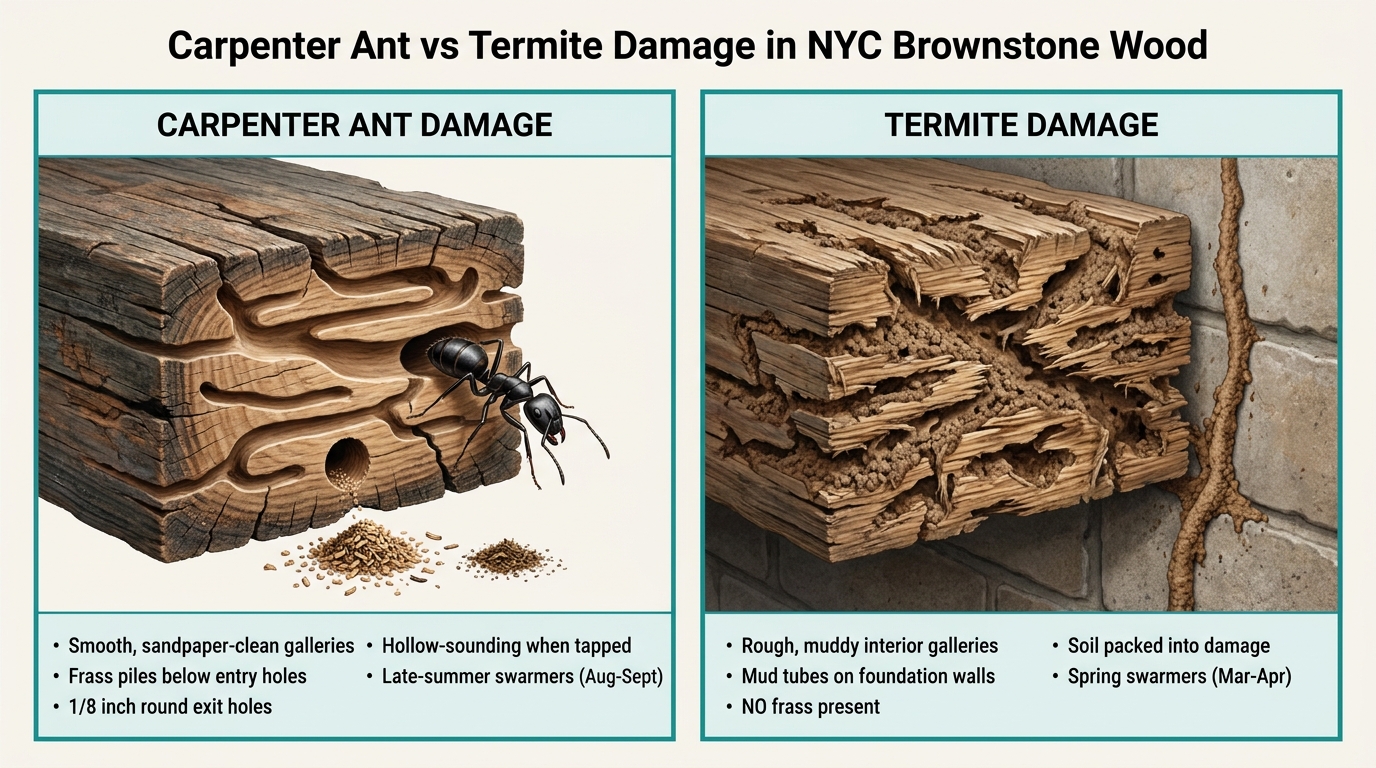
The single most diagnostic difference: carpenter ants leave frass piles; termites do not. If you find sawdust-like material below suspected damaged wood, it’s almost certainly carpenter ants. If the wood is damaged but no frass is present and you see mud tubes on the foundation, it’s almost certainly termites. For comprehensive termite identification, our guide to signs of termites in NYC covers the species in depth, and our flying termites in NYC guide walks through swarmer identification.
Where Should You Check First for Signs of Carpenter Ants in a NYC Brownstone?
Brownstone-specific carpenter ant inspection follows a predictable pattern based on where moisture accumulates. Here’s the inspection sequence our techs use:
- Roof drain wood blocking and fascia behind the gutter. NYC brownstone roofs have built-in drain scuppers and internal drain lines. Decades of water leakage around drain wood blocking creates the ideal carpenter ant nesting substrate. Look at the fascia board immediately behind any internal roof drain.
- Parapet wall cornice and crown molding. Pre-war brownstone parapets have terracotta or stone caps with decorative wood cornice work behind them. Failed parapet flashing lets water saturate the cornice wood. Carpenter ants colonize this wood within 5 to 10 years of any flashing failure.
- Bay window pediments and second-floor projecting cornices. Decorative wood pediments and projecting cornices on the second and third floors of brownstones are constantly exposed to weather. Look for frass piles on the windowsill below the pediment.
- Mansard roof framing (some Park Slope and Manhattan brownstones). Mansard-style roof framing has dormer wood that’s notoriously hard to keep dry. Carpenter ants colonize the framing around dormer windows.
- Basement sill plates and floor joist ends. Where the basement floor joists meet the foundation wall, accumulated moisture from foundation seepage creates carpenter ant habitat. Inspect the sill plate (the horizontal wood beam at the top of the foundation wall) for frass and gallery damage.
- Deck posts and back-garden trim wood. Brownstone backyard decks, posts, and pergola structures are common carpenter ant habitats. Inspect the base of any wooden post in the backyard.
- Around chimney flashing (brownstones with active fireplaces). Failed chimney flashing on the roof creates a chronically damp wood zone where chimneys penetrate the roof framing. Carpenter ant nests in this zone are common.
- Interior baseboards on rooms adjacent to roof or parapet leaks. Top-floor apartments or top-floor rooms in single-family brownstones with any history of roof leaks should be inspected at the baseboards and behind crown molding.
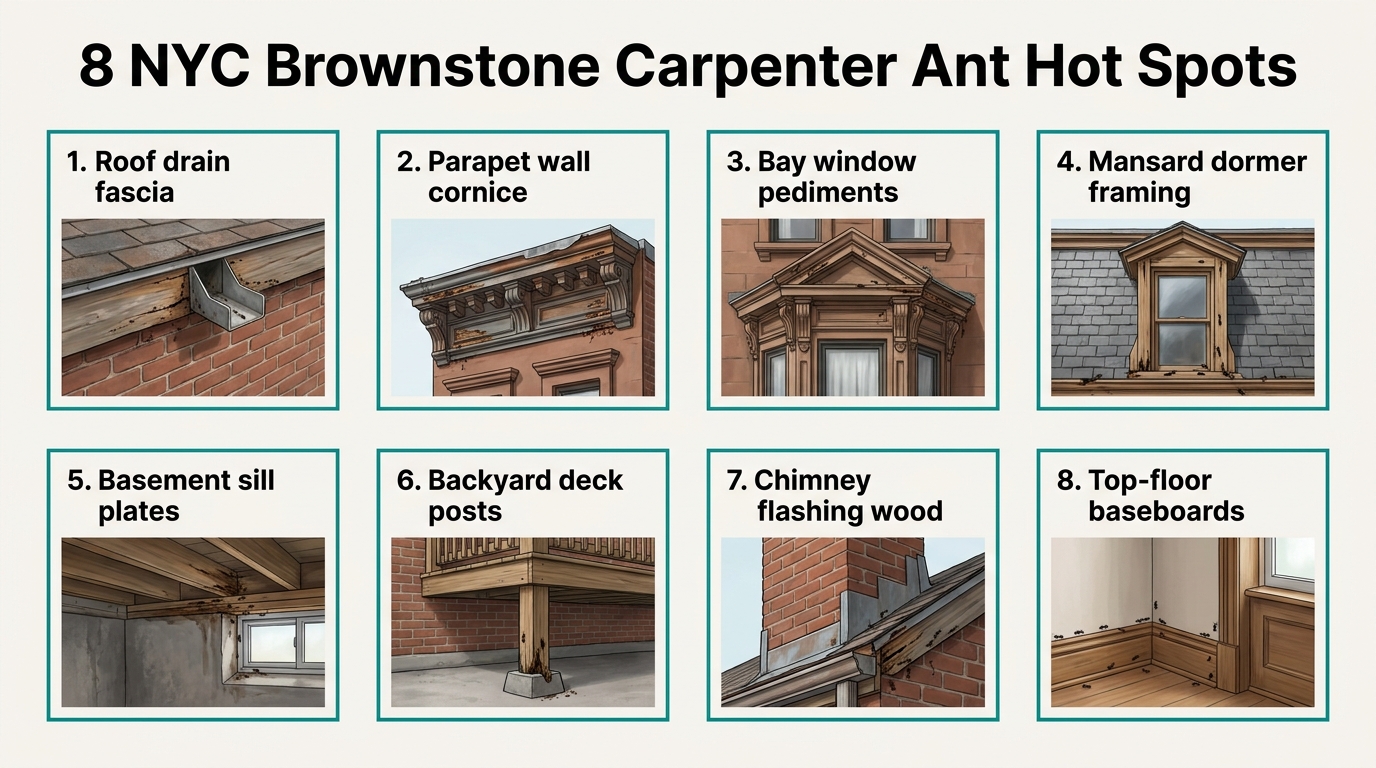
The key inspection principle: follow the water. Carpenter ants in NYC brownstones colonize moisture-damaged wood specifically. Dry, sound wood is rarely colonized. If you find the moisture source, you find the colony.
When Is NYC Brownstone Carpenter Ant Damage Structural vs Cosmetic?
This is the most important diagnostic question for brownstone owners. Cosmetic damage can wait; structural damage cannot. Here’s how we classify it:
Cosmetic damage (no immediate structural risk):
- Small gallery in a single decorative cornice bracket or pediment — the structural load of the cornice doesn’t depend on the bracket integrity.
- Frass piles below a fascia board that’s screwed onto sound underlying framing.
- Gallery damage in trim wood adjacent to (but not in) a load-bearing structural member.
- Damage in deck framing where the deck is non-essential to building structure.
Structural damage (immediate treatment required, possible repair required):
- Gallery damage in floor joists, ceiling joists, or roof rafters. These carry building load. Compromised joists need engineering assessment.
- Gallery damage in basement sill plates — the sill plate is what the entire floor system rests on. Damage here is a code-relevant structural defect.
- Gallery damage in load-bearing wall framing, especially the studs at brownstone party walls or in rear-extension framing.
- Gallery damage in roof framing around the cornice that connects to the structural roof system.
- Gallery damage in stair stringers — the stair structural members. Stair failure is a serious injury risk.
For brownstone owners, the diagnostic step is: identify the damaged wood + identify whether it’s load-bearing + measure the extent of the gallery. Per EPA integrated pest management guidance, treatment alone doesn’t repair structural damage — you need both treatment (kill the colony) and structural assessment (determine if repair is needed). For significant structural damage, we coordinate with brownstone restoration contractors who specialize in cornice and fascia rebuild.
Carpenter ants in your NYC brownstone?
26+ years inspecting NYC brownstones. Cornice and parapet damage diagnostics, wall-void Tempo Dust application, and the 4-week colony elimination cycle, no annual contracts, and a free inspection that's waived when you book.
Why Are NYC Brownstone Roof Drains and Parapets Hot Spots for Signs of Carpenter Ants?
NYC brownstone construction has structural features that make it more carpenter-ant-prone than any other residential building type in our service area:
Internal roof drainage. Pre-war brownstones drain rainwater through internal drain lines that run from a roof scupper down through interior walls to the basement. Decades of small leaks around drain connections soak surrounding wood framing. The longer the building has been standing, the more accumulated moisture damage exists. By the time a brownstone is 80 to 120 years old, internal drain leaks have created multiple potential carpenter ant nesting sites.
Parapet wall infrastructure. Brownstone parapets (the low walls extending above the roof line) cap with terracotta or stone elements bedded in mortar with metal flashing underneath. Flashing fails over time. Water penetrates the wood framing behind the parapet. Carpenter ants colonize the saturated wood within 5 to 10 years of any flashing failure.
Cornice and pediment construction. Decorative brownstone cornices are typically built around wood framing covered by sheet metal or terracotta. The wood is enclosed but rarely waterproofed. Cornice leaks are common and create exactly the moisture conditions carpenter ants prefer.
Rear extension wood framing. Most NYC brownstones have a rear extension (the part of the building that projects into the backyard). Rear extensions are often built with less robust framing than the main house and accumulate moisture damage from inadequate roofing or gutter design.
Mahogany and old oak. The original wood used in pre-war brownstone construction is often mahogany or old-growth oak that’s still structurally sound after 100+ years. Carpenter ants prefer this kind of dense wood when it’s moisture-damaged — and the colonies in brownstone framing can be 10 to 20 years old by the time they’re discovered.
How Bad Do Signs of NYC Brownstone Carpenter Ant Damage Get Before Repair Is Needed?
The worst NYC brownstone carpenter ant cases we’ve documented:
- 10-year colonies in cornice framing. By the time the homeowner notices frass piles, the colony has been active for a decade and excavated 4 to 8 feet of horizontal cornice gallery. Treatment is straightforward; the cornice rebuild is $8,000 to $20,000.
- Multiple satellite colonies throughout brownstone. Per Penn State research, carpenter ant colonies establish satellite nests in different parts of the structure. A single main colony can have 3 to 5 satellite nests in different cornice positions, joist ends, and roof framing locations. Treatment requires finding and treating every nest.
- Adjacent-brownstone transmission. Carpenter ant colonies establish satellite nests across party walls into adjacent brownstones. Treating one brownstone without coordinating with the neighbor leaves the colony alive on the other side.
- Structural fascia and joist damage. In severe cases, carpenter ant gallery damage has extended into floor joist ends and structural fascia, requiring partial joist replacement at $4,000 to $12,000 per damaged section.
- Repeat infestation cycles. Brownstones with poor roof drainage and chronic moisture issues see carpenter ant re-infestation every 5 to 10 years even after successful treatment. The structural fix (roofing, flashing, drainage) is the only way to break the cycle.
This is why our quotes for confirmed NYC brownstone carpenter ant infestations often start at $1,200 to $2,500 — finding all the satellite nests requires thorough inspection, and treatment that doesn’t address every nest fails. Our comprehensive guide to getting rid of carpenter ants in NYC walks through the elimination cycle in detail.
When Are Signs of NYC Brownstone Carpenter Ant Damage Bad Enough to Call a Pro?
Honest answer: DIY rarely works for confirmed NYC brownstone carpenter ant infestations because the colonies are typically in inaccessible wall voids, cornice framing, or roof structure. Call a pro in these scenarios:
- Confirmed frass + hollow wood combination. The diagnostic combination means an established colony you can’t reach with retail products.
- Damage in any structural member. Floor joists, sill plates, roof rafters require professional treatment + possible structural assessment.
- Damage above ladder height or behind cornices. Treatment requires interior access (often through finished apartments above) or roof access. Beyond DIY scope.
- Multiple satellite nests suspected. Finding all the nests requires thorough inspection. Single-spot DIY treatment leaves the main colony alive.
- Brownstone you want to maintain for resale. Carpenter ant damage history affects resale value if not properly documented and remediated. Professional treatment + documentation is the right path.
- Co-op or condo building requiring coordination. Multi-unit buildings need building-wide treatment, sometimes board approval, and adjacent-unit coordination.
A real professional NYC brownstone carpenter ant treatment looks like: thorough exterior + interior inspection identifying all nest locations, wall-void drilling and Tempo Dust application to inaccessible nests, perimeter bait stations for foraging workers, 4-week monitoring cycle, written guarantee window, structural damage assessment with referral to brownstone restoration contractor if needed. APM specializes in wall-void drilling and Tempo Dust application for hidden brownstone nests — most general pest control operators skip this and rely on perimeter spray, which doesn’t reach the actual colony.
When Signs of NYC Brownstone Carpenter Ants Show Up, Who Pays — Owner, Tenant, or Co-op?
Brownstone carpenter ant treatment cost responsibility depends on building structure:
- Single-family owner-occupied brownstone. Cost is yours. The structural value the treatment protects is worth every dollar.
- Owner-occupied with rental income (3-family configuration). Cost is the owner’s; this is a structural pest issue, not a tenant comfort issue.
- Co-op brownstone (multi-unit). Common-area carpenter ant treatment (exterior, cornice, parapet, roof framing) is the building’s responsibility funded by common charges. In-unit treatment for damage discovered in an individual apartment is typically the unit owner’s cost. Bylaws determine specifics.
- Tenant in a rented brownstone apartment. Carpenter ant treatment is the landlord’s responsibility under the Warranty of Habitability. Per the city’s pest and pesticide laws, landlords must address structural pest issues.
- Cooperative resale or refinance. Significant carpenter ant damage discovered during a sale or refinance triggers disclosure requirements and may require board approval for treatment funding. The board typically approves treatment because the alternative (visible structural damage) affects building value.
One specific NYC brownstone dynamic worth knowing: carpenter ant damage discovered during a home inspection prior to sale almost always triggers either a price reduction or seller-paid treatment requirement. A $1,200 treatment + $500 inspection report is much smaller than the $5,000 to $15,000 price reduction a buyer typically demands for documented active carpenter ant damage. If you’re planning to sell a brownstone with visible cornice frass piles, treat first, document the treatment, and disclose the history rather than letting the buyer discover it.
The Bottom Line: NYC Brownstone Carpenter Ant Action Plan
If you’ve found frass piles, hollow-sounding wood, or carpenter ants in your NYC brownstone: (1) inspect the suspected damage area thoroughly — frass + hollow wood + visible workers is the diagnostic combination; (2) identify whether the damaged wood is structural or cosmetic; (3) trace the moisture source that created the damp wood (carpenter ants don’t colonize dry wood) — usually a roof drain, parapet flashing, or cornice leak; (4) book a professional inspection within 30 days, sooner if any damage looks structural; (5) plan for both treatment + structural repair budgets, not just treatment.
For most NYC brownstone owners, realistic 2026 carpenter ant treatment pricing breaks down: $400 to $800 for a single localized spot treatment caught early in cosmetic wood, $1,200 to $2,500 for thorough multi-nest treatment with wall-void dusting on a typical brownstone, $2,500 to $5,000 for severe whole-brownstone treatment with multiple satellite nests, and $8,000 to $20,000+ for cornice or fascia structural rebuild work (separate from treatment, billed by brownstone restoration contractor). Roof and flashing repair to address the moisture source is typically an additional $3,000 to $15,000 depending on scope.
We’ve been inspecting NYC brownstones since 1999, and the most common mistake we see is owners treating the visible workers with retail spray, ignoring the frass piles, and discovering 18 months later that the cornice or fascia they thought was solid has gallery damage extending 6 to 10 feet. The second most common mistake is treating without addressing the moisture source — which makes re-infestation within 3 to 5 years almost guaranteed. If you’d rather skip the experiment and have it diagnosed by a team that’s inspected hundreds of NYC brownstones, our front-office team offers free same-day brownstone inspections across Brooklyn and Manhattan — Lisa or one of our front-office team can usually book a same-day visit, and the assessment you get will document active nest locations, structural vs cosmetic damage classification, treatment scope, and structural repair referrals if needed.