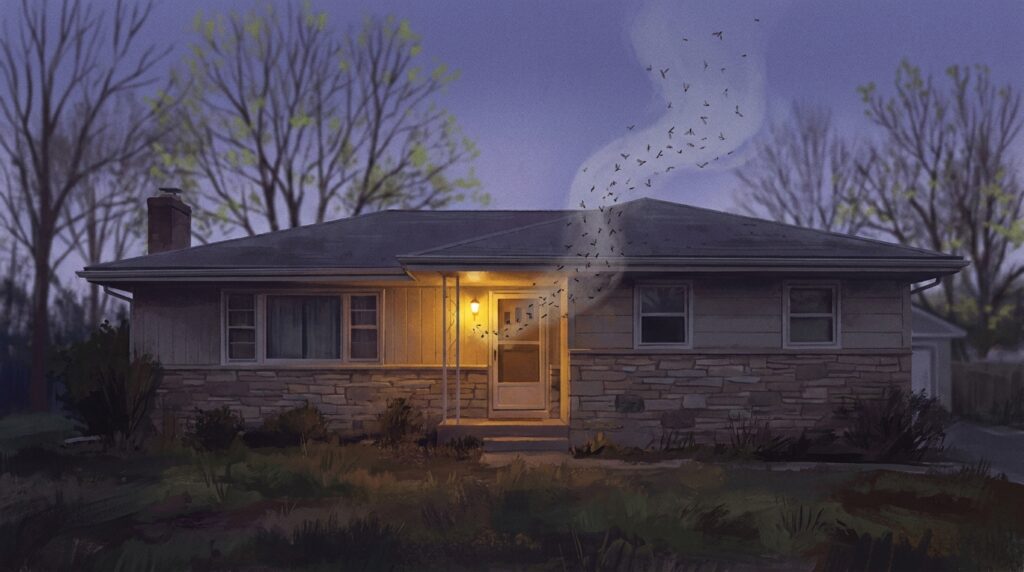
Every spring on Long Island and across Queens, a familiar pattern repeats itself. A homeowner walks into the kitchen on a warm humid morning and finds dozens of small dark winged insects on the windowsill, the stove, the sliding glass door — or worse, hundreds of them swirling toward the porch light. That single moment is how most subterranean termite infestations on Long Island get diagnosed each year. We’ve been running professional termite treatment across Long Island and Queens since 1999, and our team has watched this season unfold the same way every spring for 26 years. The colony was there for 3 to 5 years before you saw it. The swarm is just when it finally announced itself.
This guide walks through how 2026’s swarm season is shaping up across Nassau, Suffolk, and Queens, what the swarmers are telling you, the 24-hour action plan we recommend, and why subterranean termites in our region need foundation-level treatment.
Termite swarmers around your foundation?
26+ years on NYC and Long Island termite work. NY Category 7C licensed, 100% results guarantee, and free inspections that catch swarms before damage spreads.
When Does Termite Swarm Season Start on Long Island & Queens in 2026?
Eastern subterranean termites — Reticulitermes flavipes — are the only species producing significant swarms across Long Island and Queens. Their swarm window opens in late March, peaks in April, and tapers off through May, with the occasional outlier swarm into early June if spring runs cold. Cornell Cooperative Extension of Nassau County’s homeowner’s guide to eastern subterranean termites documents the same March-through-June window for our region.
What we’ve seen on the ground in 2026 lines up. Spring weather has been a typical Northeast roller coaster — warm 60s one week, freezing the next, with heavy rain between mid-March and mid-April. That cold-warm-rain cycle is exactly the trigger subterranean termites wait for. First indoor-swarmer calls in Queens landed around March 22nd. Nassau picked up a week later, Suffolk a week behind Nassau as soil temperatures rose moving east. We expect peak activity through mid-May.
If you haven’t seen a swarm yet, that doesn’t mean your property is clear. A given colony only swarms once a year, and one quietly feeding under your basement might choose a date a week from now or a week from never. Spring is when you look for evidence, not when you wait for it.
What Triggers Termite Swarmers to Emerge in Queens & Long Island?
A subterranean colony has to be at least 3 to 5 years old, large enough to support several thousand workers and soldiers, and mature enough to divert energy into the winged reproductive caste. NC State Extension’s biology and behavior reference for eastern subterranean termites notes that a queen produces 5,000 to 10,000 eggs per year and a mature colony can contain hundreds of thousands of members. A swarm event is the visible sign of a colony that has been working below your foundation for years.
Once a colony is mature, the actual emergence trigger is environmental. Three conditions in combination push the swarmers to the surface:
- Soil temperature in the high 50s to mid-60s. The frost has to be out of the upper soil layer.
- A recent significant rain event that saturates the soil and softens the surface, letting workers carve emergence holes.
- A warm sunny day following the rain — typically 65°F or warmer. The combination of warm air and saturated soil is the signal.
That’s why spring swarms so often happen in the late morning of the first warm day after a rainy weekend. Swarmers are drawn to light, so you find them at windows, sliding glass doors, light fixtures, and under the porch overhang. After a brief mating flight they drop their wings, pair off, and try to dig back into the soil — though almost all die in the attempt. The pile of discarded translucent wings on your windowsill is often the only physical evidence left when you walk in.
How Do You Tell a Termite Swarmer From a Flying Ant in Your NY Home?
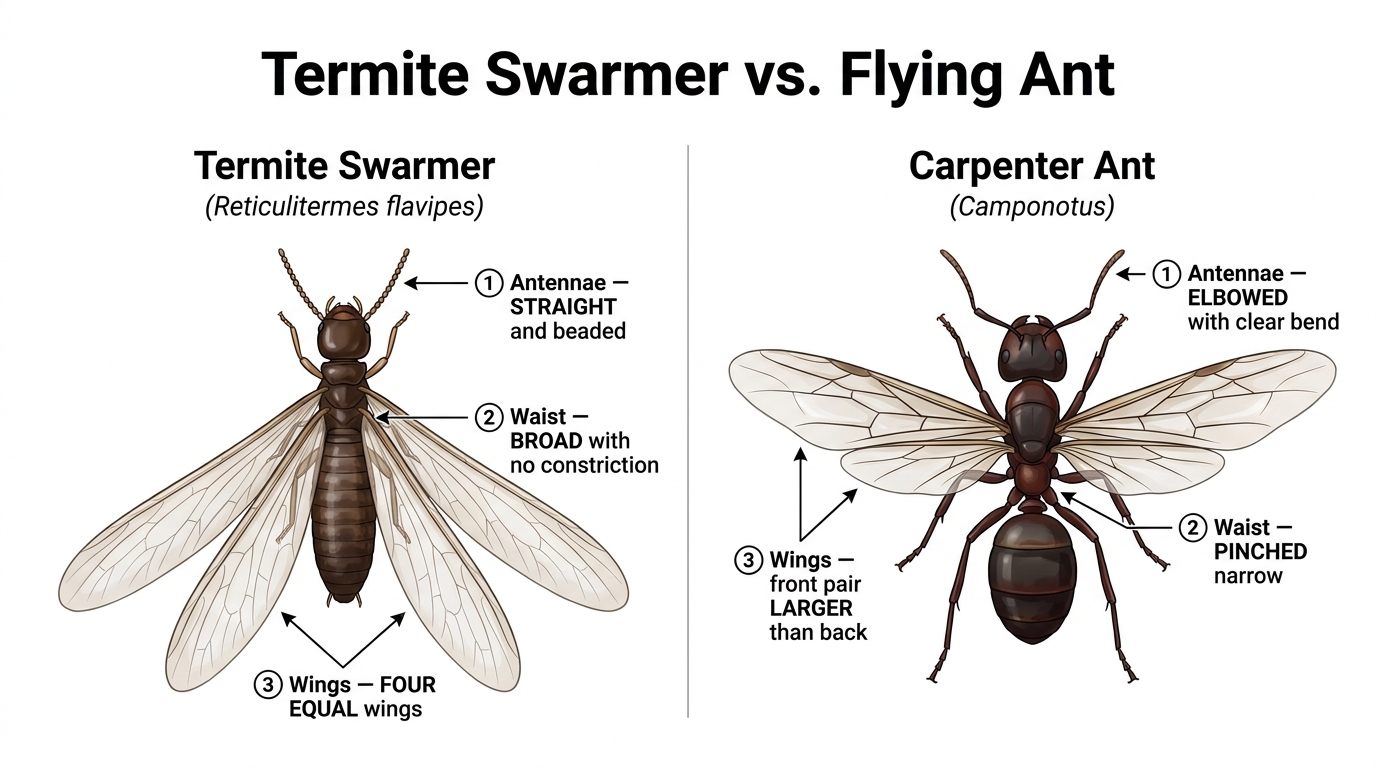
This is the most common ID mistake homeowners make in spring. Flying carpenter ants and pavement ants also swarm in spring, and at first glance the two insects look nearly identical. Misidentification matters because the treatment plans are completely different. We cover the full visual workup in our complete swarmer-vs-flying-ant identification guide; the three differences you can check in 30 seconds:
- Antennae: Termite swarmers have straight, beaded antennae. Carpenter ant swarmers have a sharply elbowed antenna with a clear bend in the middle.
- Waist: Termites have a broad, thick waist with no constriction — the body looks like one long piece. Carpenter ants have an obvious pinched, wasp-like waist.
- Wings: Termites have four wings of equal length that extend well past the abdomen. Ants have a longer front pair and a shorter rear pair.
If you can’t tell from looking — at 7 a.m. on a kitchen counter it can be genuinely hard — collect 5 to 10 specimens in a sealed plastic bag, including any shed wings. A licensed termite professional can identify the species in under a minute.
Termite swarmers around your foundation?
26+ years on NYC and Long Island termite work. NY Category 7C licensed, 100% results guarantee, and free inspections that catch swarms before damage spreads.
What Are the Inspection Signs of Subterranean Termites in Long Island Basements?
Swarmers are the alarm bell, but the actual evidence lives in the basement, the crawl space, and along the foundation. We’ve inspected hundreds of Long Island and Queens homes, and the same five signs come up again and again — usually in finished basements where the homeowner has no idea what’s happening behind the drywall.
- Mud tubes. Subterranean termites can’t survive in open air, so they build pencil-thick mud tubes from the soil up to the wood they’re feeding on. Look along the inside of foundation walls, on basement support posts, on sill plates, and around plumbing penetrations. Even a single tube the width of a pencil confirms an active colony (see the photo below).
- Hollow-sounding or soft wood. Tap suspect wood with the handle of a screwdriver. Termite-eaten wood sounds hollow and gives way under firm pressure. The most common targets in Long Island homes are basement door frames, window frames at grade level, and the bottom plates of exterior walls.
- Discarded wings. Piles of small translucent wings on windowsills, in light fixtures, in spider webs, or near baseboards. Swarmers shed their wings within minutes of emerging.
- Frass and tack-strip damage. A common Long Island scenario: a homeowner pulls up old basement carpet and finds the wooden tack strips at the wall edges have been completely eaten through. Tack strips are softwood in direct contact with concrete and damp carpet — the perfect first meal.
- Cedar paneling damage in finished basements. A lot of mid-century Long Island homes have cedar or knotty-pine paneling installed against concrete walls or framed off concrete with untreated furring strips. We’ve found active colonies hidden behind that paneling more times than we can count.
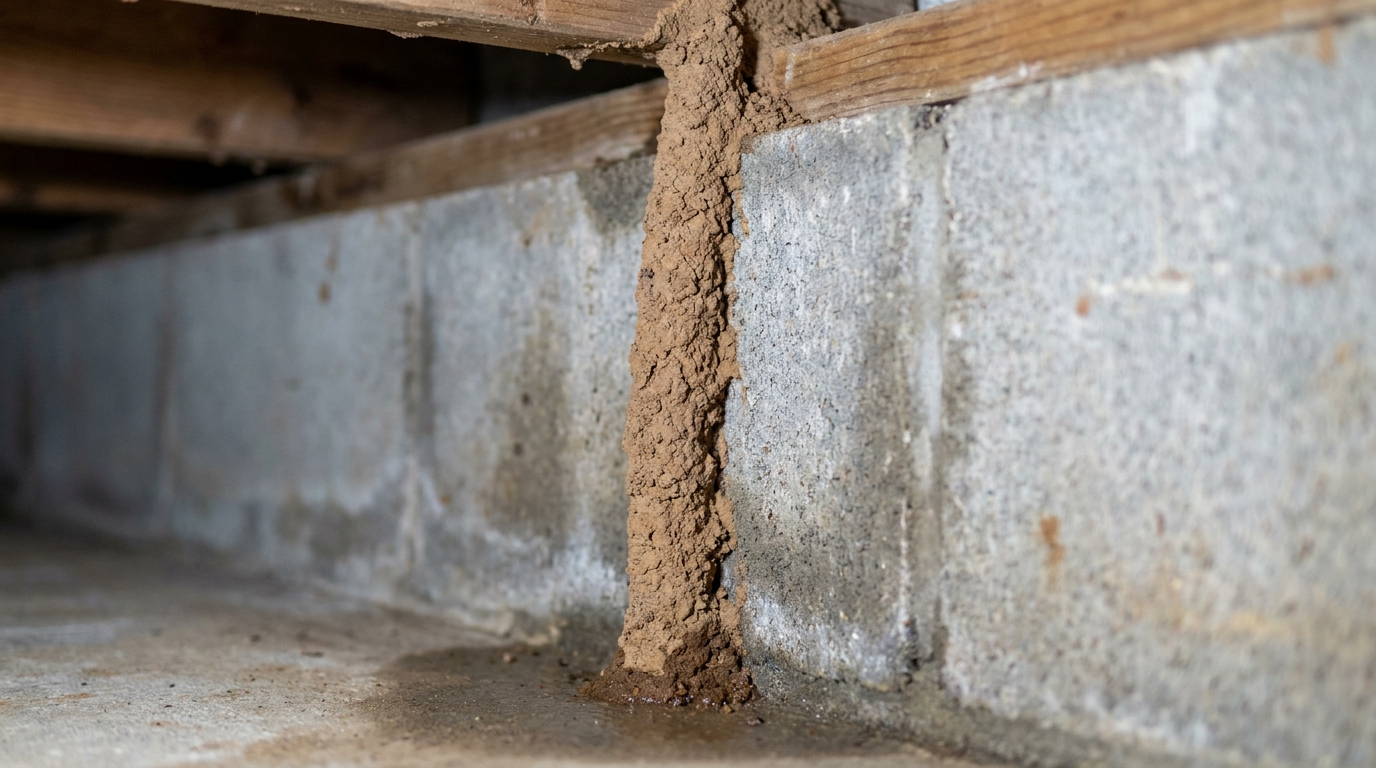
One pattern we see constantly: a homeowner buys a Long Island house, the pre-purchase termite inspection comes back clean, and 6 to 18 months later they tear out basement carpet or paneling for a renovation and discover an active colony with mud tubes running up the foundation. Pre-purchase inspections frequently miss what’s hidden behind finished surfaces — there’s no way to inspect a wall that’s been drywalled over. If you bought a home with a finished basement in the last few years, treat the area behind the walls as unknown rather than clear.
Why Does Indoor Termite Swarming Mean an Active Long Island Colony?
This is the most important fact to internalize. Subterranean swarmers don’t travel far from their parent colony — typically 100 to 300 feet at most, and most never make it more than 30 feet on their own. So when you find swarmers inside, the colony is either under your foundation, inside your walls, or directly adjacent to your structure. There’s no scenario where indoor swarmers came from a colony three blocks away.
A colony only starts producing swarmers after 3 to 5 years of feeding. The USDA Forest Service’s subterranean termites homeowner’s guide notes that 60,000 workers can consume more than two linear feet of standard 2×4 lumber in a year — and a mature Long Island colony can run hundreds of thousands of workers. Years of that adds up to real structural damage even when visible signs look minor.
One more thing Long Island homeowners often miss: colonies almost always come in clusters. Properties in termite-active soil typically host two to six separate colonies per acre, because swarmers from different colonies seek out mates from outside their own genetic line. If your neighbor had a swarm last year and you didn’t, you’re almost certainly hosting a separate colony foraging under your property too. We see this every spring in Massapequa, Levittown, Bethpage, Glendale, Forest Hills, and Ridgewood.
What Is the 24-Hour Action Plan When You Find Termite Swarmers?
If you walk in and find a fresh swarm or a pile of shed wings, here’s what we recommend in the first 24 hours.
Do:
- Collect 5 to 10 intact specimens in a sealed plastic bag, including any shed wings.
- Photograph the scene — wide shot, then close-ups of the insects and any mud tubes within 10 feet.
- Note the exact location, time of day, and weather.
- Check basement walls, floor joists, and foundation walls inside and out for mud tubes.
- Tap surrounding wood with a screwdriver handle — hollow or soft means active feeding.
- Vacuum the visible swarmers and seal the vacuum bag as additional evidence.
- Call a licensed termite professional for a same-day or next-day inspection.
Don’t:
- Don’t spray aerosol insecticide. It kills only the visible swarmers and does nothing to the colony of tens or hundreds of thousands of workers underneath. It also destroys the specimens needed for ID.
- Don’t buy DIY hardware-store termite stakes and assume you’re done. Spectracide and similar products aren’t engineered to eliminate a mature colony feeding on your structure. We get the call six months later when the damage didn’t stop.
- Don’t tear into the wall. Disturbing a gallery drives workers deeper and makes the colony harder to track.
- Don’t assume the swarm “going away” means the problem went away. A swarm lasts hours. The colony lives on for years.
Why Do Subterranean Termites in Queens & Long Island Need Foundation Treatment?
Effective treatment of Reticulitermes flavipes requires reaching the colony in the soil — not just killing the workers you can see. Two professional approaches work, and both target the foundation.
Liquid soil barrier treatment. The standard approach for single-family homes is a fipronil-based termiticide (Termidor SC) applied as a continuous chemical barrier in the soil around the foundation perimeter. Workers passing through pick up the active ingredient and carry it back to the colony. Colonies typically collapse over a few weeks to months. For slab foundations — common in post-war Long Island ranches in Levittown, Hicksville, and Wantagh — treatment also requires drilling small holes through the slab so termiticide can be injected under the concrete itself. Pre-war Queens homes with full basements get the perimeter trench plus injection at expansion joints and plumbing penetrations.
As our guide to what NYC pest control actually costs details, this benefits from a licensed crew with the right equipment. New York State pesticide regulations enforced by the NYS DEC restrict who can apply termiticides — homeowners can’t legally apply professional-grade products themselves.
Bait station systems. The other proven approach is an in-ground bait system (Sentricon is the most widely used) installed in a perimeter pattern. Stations contain wood treated with a slow-acting insect growth regulator like hexaflumuron. Foragers find the bait, recruit other workers, and carry the active ingredient back to the queen and the brood. Bait systems are particularly valuable where soil treatment isn’t feasible — properties with high water tables or wells nearby. Colony elimination typically runs 90 days to several months.
We frequently combine the two — perimeter liquid plus targeted bait stations — when an inspection turns up multiple active colonies. Our subterranean termite specialists on Long Island handle Nassau and Suffolk, while the Queens termite control team covers everything from Long Island City and Maspeth out through Forest Hills, Glendale, Ridgewood, and the Queens-Nassau border.
How Much Does Termite Treatment Cost on Long Island & in Queens?
Pricing varies with home size, foundation type, severity, and treatment approach. Ballpark numbers across our service area in 2026:
- Termite inspection: $100 to $300 for a stand-alone inspection. Many companies — including ours — credit the fee toward treatment if you move forward.
- Liquid barrier treatment: $1,500 to $5,000+ for a single-family home depending on perimeter footage, foundation type, and whether the slab needs drilling. Pre-war Queens homes with complex foundations run higher than newer ranches.
- Bait station system: $1,500 to $4,000 initial, plus an annual monitoring contract ($300 to $500/yr).
- Annual renewal warranty: Industry standard is about 10% of original treatment cost per year.
The math is simple: catching a colony in its first or second year of feeding almost always costs a fraction of what it costs to address an undiagnosed colony that’s been chewing for 8 or 10 years. Spring swarm season is the cheapest window of your termite story — if you act on it.
How Do You Prevent Termites Long-Term After This Season’s Swarm?
Once active infestation is treated, long-term prevention is moisture management plus structural exclusion. Subterranean termites are biologically obligated to stay near soil moisture, so anything that reduces moisture around your foundation makes your home a less attractive target. Penn State Extension’s eastern subterranean termites publication spells out the full checklist:
- Fix any plumbing leak in the basement, crawl space, or first floor immediately. A slow leak under a sink is enough moisture to sustain a satellite colony.
- Run a dehumidifier in the basement during humid months. Long Island summers push basement humidity past 70% — target 50% or below.
- Make sure gutters and downspouts carry water at least 5 feet from the foundation.
- Eliminate wood-to-soil contact. No lattice, deck post, fence post, or porch step should rest directly on dirt.
- Pull mulch back from the foundation by 12 to 18 inches; replace with gravel along the foundation strip.
- Seal foundation cracks with a durable sealant — termites travel through cracks as narrow as 1/16 inch.
- Schedule an annual termite inspection. An hour with a licensed inspector each spring is the cheapest insurance policy on a property in our region.
For finished basements, any future renovation is the right moment to inspect what’s behind the drywall. If you’re pulling down old paneling or replacing carpet, call us for a quick inspection while the framing is exposed. It’s the only time you can see what’s actually happening between the foundation and the finished surface.
The Bottom Line on Long Island & Queens Termite Swarm Season
Termite swarm season runs late March through May across Long Island and Queens, with peak activity in April. Indoor swarmers always mean an active colony — usually one that’s been feeding for years before it announced itself. The 24-hour action plan is to collect specimens, document the scene, look for mud tubes, and call a licensed termite professional rather than reaching for an aerosol can or hardware-store stakes. Effective treatment requires reaching the colony through the soil — with perimeter liquid barrier, bait stations, or both.
If you’ve found swarmers, shed wings, mud tubes, or damaged wood this spring, our team can have a licensed inspector at your property quickly. Call us at (718) 418-8986 or request a free estimate for termite swarm season inspection and treatment across Nassau, Suffolk, and Queens. The colony is not going to stop on its own.