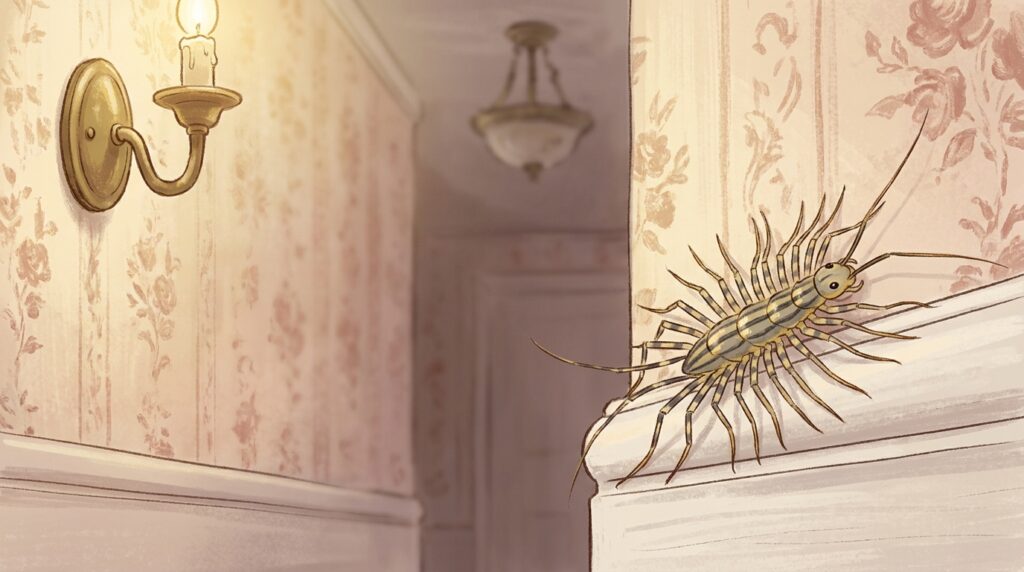
It is a strange thing for a 27-year-old NYC pest control company to publish a guide telling you NOT to call us. But the house centipede is a strange creature, and the New York City apartment is a strange ecosystem, and after 26 years of inspecting pre-war buildings from Astoria to Brooklyn Heights, we have come to believe one quiet truth: in nine out of ten cases, the house centipede skittering across your bathroom tile is doing more for you than any can of spray ever will. The real pest is the one the centipede is hunting — and that is usually a roach. If you actually want a roach problem solved, our professional cockroach control service in NYC is the right call. The centipede on your wall is probably not.
We know how this sounds coming from us. We have built our business on showing up at apartments where pests have made life miserable, and we are not in the habit of telling people to look the other way. But house centipedes are a special case, and the longer you live in a New York City apartment, the more you start to understand why the entomology subreddits, the NYC subreddits, and even the Hacker News crowd all converge on the same advice: leave them alone. Here is the full case, the biology, the building science, and the rare exceptions where we do think you should pick up the phone.
House centipedes in your NYC apartment?
26+ years on NYC pest work. Centipedes mean prey insects, and we treat the underlying roach or silverfish problem driving the activity, no annual contracts.
What Are NYC House Centipedes, Really?
The creature you are looking at is Scutigera coleoptrata, the common house centipede. It originated in the Mediterranean and arrived in New York City sometime in the 19th century — by 1896, the U.S. Department of Agriculture’s Division of Entomology was already describing it as common in New York. So if it feels like the house centipede has been part of NYC apartment life forever, that is roughly true. Generations of New Yorkers have screamed and stomped and spritzed, and the house centipede has just kept doing its job.
The body of an adult house centipede is only about an inch to an inch and a half long. The illusion of being three or four inches long comes from its 15 pairs of long, banded, antennae-like legs and its two long sensory antennae at the front. The body is yellowish-gray with three thin dark stripes running along its back. The hind legs of an adult female are nearly as long as her body, which is part of why the creature looks so unsettling on a white tile wall at midnight. According to Penn State Extension’s house centipede fact sheet, this exact morphology is what allows the centipede to be such an effective indoor predator — it can run in any direction at startling speed, including up walls and across ceilings.
We have inspected hundreds of NYC apartments where the centipede has been mistaken for something far worse — a small water bug, a baby roach, a strange spider. It is none of those things. It is a generalist predator that is genuinely on your side, even if its appearance is doing it no favors at all.
Why Do House Centipedes Live in NYC Apartments?
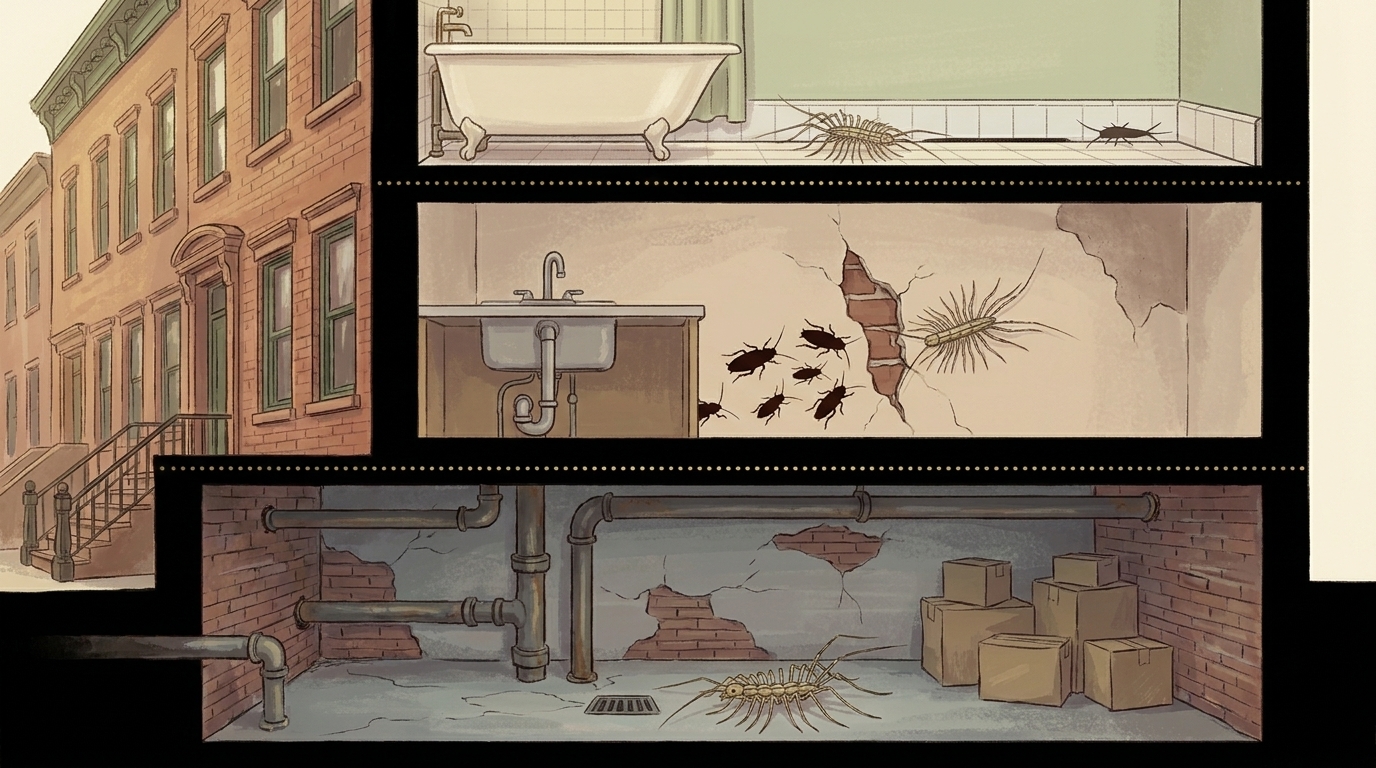
NYC apartments are essentially purpose-built house centipede habitat. The species needs three things to thrive — humidity, darkness during the day, and a steady supply of prey insects — and the average pre-war Brooklyn or Queens building delivers all three in abundance.
The humidity comes from old cast-iron plumbing, basement laundry rooms, bathroom radiators, and the simple fact that a 100-year-old building leaks heat and moisture in ways no modern construction does. Centipedes have respiratory openings called spiracles that they cannot close, which means they have to live somewhere damp or they desiccate and die. A pre-war basement is essentially a five-star centipede resort.
The darkness comes from wall voids, behind baseboards, under tubs, inside utility chases, and in the gaps around radiator pipes that pass through plaster. House centipedes are nocturnal, so when you flip on the bathroom light at 2 a.m. and one freezes on the wall, you are catching it on its way back to its hiding place after a night of hunting.
And the prey — the prey is the whole reason it is there in the first place. NYC apartment buildings are crawling with the small arthropods house centipedes love to eat. Roach nymphs in the kitchen wall void. Silverfish in the bathroom baseboard. Tiny ants foraging across a counter. Carpet beetle larvae in a closet. Bed bugs in a bedroom. Without those food sources, a house centipede would not bother. With them, it sets up shop and stays for years — these creatures live three to seven years and start breeding in their third year, according to peer-reviewed biology.
What Do House Centipedes Actually Eat in NYC?
This is the part where the story turns. Because everything we have just told you about why house centipedes are in your apartment is also a complete answer to what is on the menu — and that menu is brutal for the actual pests you are worried about.
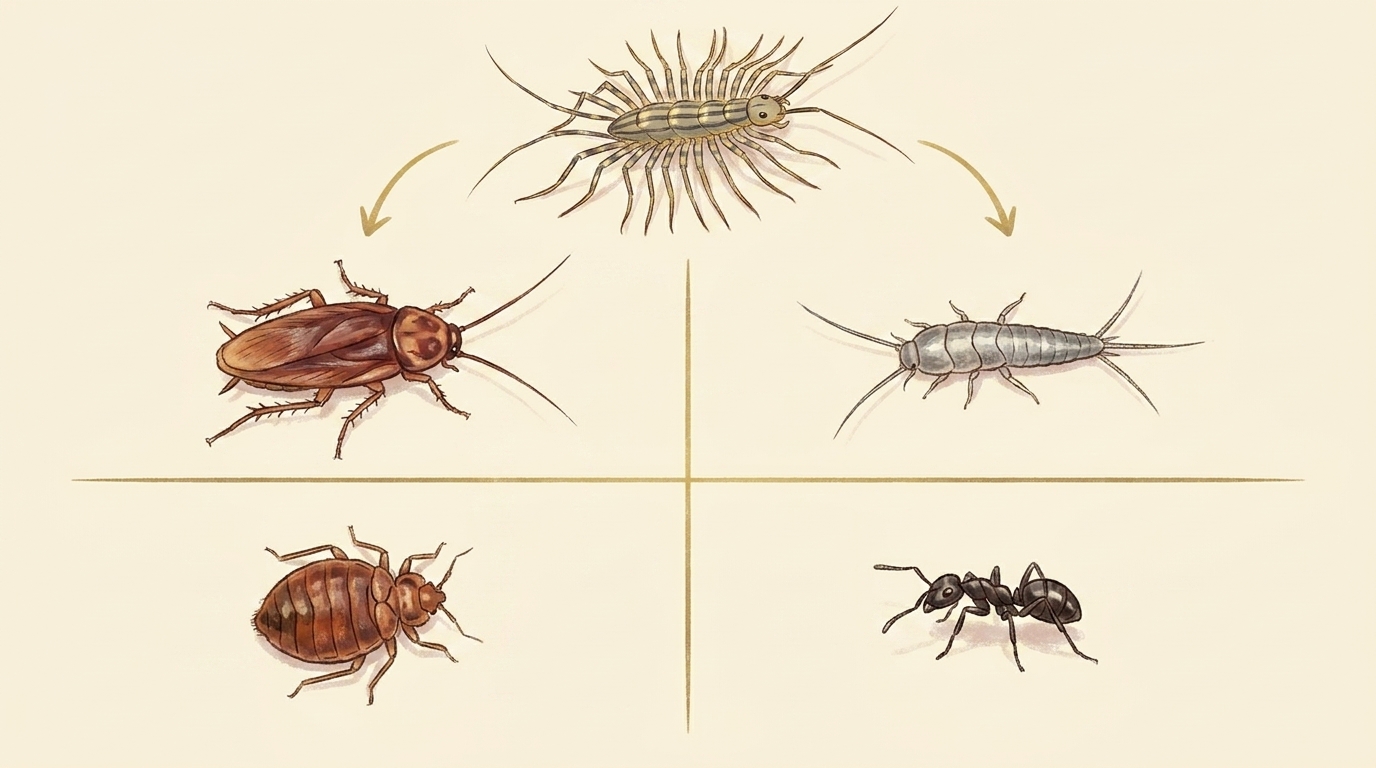
A single house centipede will hunt and eat:
- Cockroach nymphs — the small, soft, pre-adult roaches that grow into the adults you see scuttling across your stove. A centipede can take down several in a night.
- Silverfish and firebrats — the silver, carrot-shaped creatures that live behind your bathroom baseboard and in your closet. We see them constantly in NYC apartments, and centipedes love them.
- Bed bugs — yes, really. Bed bugs are on the menu, and there are documented Hacker News and Reddit accounts of NYC tenants whose bed bug problems mysteriously resolved while a centipede population thrived. We are not suggesting you import centipedes as a bed bug strategy, but the prey relationship is real.
- Ants — small house ants, foraging trails in the kitchen, the occasional carpenter scout. There is a frequently-shared Reddit story of a person whose bathroom ant problem disappeared within 48 hours of a single house centipede taking up residence.
- Spiders, flies, moths, earwigs, and carpet beetle larvae — basically anything small enough to subdue.
The hunting technique is unusually sophisticated for an arthropod. The centipede uses a “lassoing” motion with its rear legs to wrap up prey, then administers venom through its forcipules — modified front pincer-like legs, not its mouth — and either eats the prey on the spot or beats it into submission with its legs first. For dangerous prey like wasps, the scientific literature on Scutigera coleoptrata describes a sting-and-retreat strategy where the centipede stings, pulls back, waits for the venom to take effect, and then returns to feed.
This is the entire reason our team has come to respect the species. We have watched, on countless inspections, an apartment with one or two visible centipedes turn out to have a manageable, slowly-being-handled roach situation in the wall void. We have also seen apartments with zero centipedes turn out to have explosive roach problems. The correlation is not random. It is biology.
Are House Centipedes in NYC Apartments Dangerous?
For practical purposes — no. Not to you, not to your kids, not to your pets.
The forcipules can technically deliver venom, but the venom is calibrated for prey that weighs a fraction of a gram. Even in the rare event that a cornered centipede attempts to sting a human, the Missouri Department of Conservation field guide describes the result as “generally no worse than a bee sting” — localized pain, mild swelling, no lasting effects. The forcipules are also small enough that they have difficulty penetrating human skin in the first place. And these creatures are not aggressive; they will flee from any contact, every time, unless they are physically grabbed or stepped on barefoot.
They do not damage your apartment. They do not chew wood, eat fabric, contaminate food, or carry the diseases that roaches carry. They do not nest in walls the way ants and bed bugs do. They produce no webbing. They make no sound. They do not swarm. A house centipede is — biologically — about as harmless as an apartment guest can possibly be.
The Connecticut Agricultural Experiment Station’s official fact sheet on the species is even more direct, stating that “using pesticides to eradicate house centipedes is not recommended.” That is a state-government entomology lab telling homeowners to put down the spray. Coming from a science-based agency that exists specifically to advise on insect management, that is about as strong an endorsement of tolerance as you will ever read.
The one caveat we want to flag: a small percentage of people have allergic reactions to insect venom in general, and a sting from any arthropod — bee, wasp, centipede — can produce a more serious response in someone allergic. If that describes you or someone in your home, that is the rare scenario where we would say the centipede should be removed. For everyone else, the math is overwhelmingly in the centipede’s favor.
House centipedes in your NYC apartment?
26+ years on NYC pest work. Centipedes mean prey insects, and we treat the underlying roach or silverfish problem driving the activity, no annual contracts.
What Does a House Centipede in Your NYC Apartment Tell You About Other Pests?
This is where we, as a pest control company, finally have something useful to add — because this is the conversation our office staff actually has with NYC tenants who call about centipedes. The centipede itself is rarely the problem. The centipede is a symptom.
When we see a house centipede population establishing itself in a NYC apartment, our team’s first question is always the same: what is it eating? Because something is. Centipedes are not living in your apartment for the architecture. They are there because the prey is there. Per Penn State Extension’s guidance, “if house centipedes are seen frequently, this indicates that some prey arthropod is in abundance, and may signify a greater problem than the presence of the centipedes.”
Translated into the realities of NYC pre-war housing stock, here is what a recurring centipede sighting often means:
- A centipede in a Brooklyn brownstone basement or first-floor apartment is most often hunting cockroaches and silverfish. The centipede is the late-stage symptom of a building-wide roach situation that the super has not addressed. We have written separately on the seven signs of a NYC cockroach infestation — if any of those signs are familiar, the centipede is doing what it can, but a building-wide treatment is what the situation actually needs.
- A centipede in a Manhattan high-rise bathroom is more often hunting silverfish and the occasional small roach in the wall void. The bathroom is humid; the wall voids are connected vertically to other units. This is the pattern we see most often in older Upper West Side and Upper East Side buildings.
- A centipede in a Queens or Long Island City rental is frequently hunting roaches that came up from a shared garbage chute or a poorly-maintained basement. This is also where we sometimes see centipedes appear in the same apartments as small water-bug-style roaches — and we have a separate guide on what New Yorkers actually mean when they say “water bug” that helps untangle that confusion.
- A centipede in any apartment with a chronic ant trail or visible silverfish is, in our experience, hunting exactly what you would expect. The ant or silverfish problem is the actionable issue. The centipede will diminish on its own once its food supply does.
If the only “pest” you have ever seen in your apartment is the centipede itself, that is genuinely good news — it means your other pest pressure is low enough that the centipede is the only visible animal. If you also have roaches, bed bugs, ants, or silverfish, the centipede is helping, but it cannot do the whole job alone.
When Should You Actually Call NYC Pest Control About Centipedes?
There are real exceptions to the “leave them alone” rule. We are not going to pretend otherwise. After 26 years across the five boroughs and Long Island, here is when we believe a professional call is genuinely the right answer.
You are seeing centipedes daily, or in groups of more than two or three at a time. A few centipedes in a building is normal and beneficial. A surge — a dozen, two dozen, or visible juveniles — usually points to either a major prey infestation in the wall voids or a moisture problem in a basement or crawl space. Either of those is worth a real diagnosis from a technician.
Someone in the home has a documented insect-venom allergy. As we noted above, this is the one health-based reason we would actively recommend exclusion and removal rather than tolerance.
You also have visible signs of the prey species. If you are seeing centipedes AND seeing roaches, bed bugs, or active ant trails, the centipede is not the issue — the underlying infestation is. That is when our year-round residential pest service plans and our roach and rodent treatments earn their keep, because no centipede can outrun a building-wide German cockroach problem on its own.
You have persistent dampness in a basement, crawl space, bathroom, or laundry room. Per the YouTube channel Crawl Space Ninja’s well-watched video on the subject, centipede surges almost always trace back to a moisture problem. We can identify and treat the pest pressure; you may also need a contractor to address the underlying water source.
The sighting is in a rental and your super or landlord is unresponsive. Under NYC Housing Maintenance Code, landlords are required to provide pest-free conditions, and a documented infestation is a valid 311/HPD complaint. A documented professional inspection report can support that complaint.
In all other cases — the occasional centipede, the late-night bathroom appearance, the one running across the hallway floor, the one your cat tries to play with — our honest professional advice is to leave it alone. Or, if you genuinely cannot stand it, scoop it onto a piece of paper and put it outside. Apartment Therapy has a nice phrase for this: catch and release. The centipede continues its job; you do not have to share a tile floor with it; everyone wins.
How Do You Get Rid of House Centipedes in a NYC Apartment Without Killing Them?
If you have decided that even the contrarian biology argument is not going to overcome your visceral reaction — and many otherwise rational New Yorkers feel exactly that way — here is the right way to discourage house centipedes from your apartment without resorting to spray.
Reduce the food supply. This is the single most effective long-term strategy. If there is nothing for the centipede to eat, the centipede leaves. Address roaches, silverfish, and ants properly — through traps, exclusion, and targeted professional treatment if necessary — and the centipede population follows the prey out. This is the strategy our technicians actually recommend on the phone when someone calls about centipedes.
Reduce the humidity. Run a dehumidifier in basements, laundry rooms, and persistently damp bathrooms. Fix any leaking pipes promptly, including under-sink leaks that you might otherwise tolerate. Use the bathroom exhaust fan during and after showers. Centipedes need moisture to survive; without it, they cannot establish themselves indoors.
Seal entry points. Cover floor drains in basements with fine mesh; many centipedes enter through dry floor drains connected to disused sumps. Caulk gaps around radiator pipes, baseboards, and the perimeter of sump pump covers. Replace deteriorating weatherstripping around exterior doors and basement windows. The same sealing work that excludes centipedes also excludes the prey insects that brought them, so you get a double benefit.
Skip the spray cans. Aerosol residual sprays and hardware-store dust treatments are widely available, but they are blunt instruments — they kill the centipede without addressing the prey infestation that drew it in, and they introduce chemical residues to your living space for marginal benefit. We use targeted, family and pet-friendly products on professional jobs because the situation calls for them; for a casual apartment centipede, the cost-benefit just is not there.
Use catch-and-release for the squeamish. A wide-mouth jar and a piece of card stock will let you scoop a centipede off a wall and walk it down to the sidewalk. The centipede will be back at hunting in a courtyard or basement somewhere else within the hour. You will feel less like you have sentenced a useful predator to death by Reebok.
How Do House Centipedes Compare to NYC Water Bugs and Other Apartment Pests?
This question comes up constantly when we are on the phone with new customers, because the silhouettes of NYC apartment pests blur together at 2 a.m.
A house centipede is not a water bug. A water bug, as most New Yorkers use the term, is actually one of several large cockroach species — most commonly the American cockroach or the smoky brown cockroach. Cockroaches are flat, oval, six-legged, and reddish-brown to dark brown, with two short antennae and no protruding long legs. House centipedes, by contrast, have 30 long thin banded legs spread out on either side of the body, two extremely long antennae, and a fast scuttling motion that is unmistakable once you have seen it.
A house centipede is not a silverfish. Silverfish are silver-gray, carrot-shaped, six-legged, and have three thin tail filaments at the rear. They wriggle slowly. Centipedes scuttle blindingly fast. Silverfish are also a centipede prey item, so seeing both in the same apartment is a clear signal of what is going on.
A house centipede is not a millipede. Millipedes are slow, segmented, dark, and roll up when disturbed. They have many short legs but they tuck close to the body and the millipede looks tubular. Centipedes look feathery — long legs splayed out at angles. Millipedes are detritivores; centipedes are predators. If you have millipedes, that is a different (also mostly benign) conversation.
A house centipede is not a small spider, although the speed and the legginess can briefly fool the eye. Spiders have eight legs in distinct pairs and a clearly two-segmented body. Centipedes have many more legs in a long row along a single elongated body.
If you are seeing one of these other species and want a deeper read, our seven-signs cockroach guide above walks through the full cockroach lineup, and our NYC water bug explainer covers what New Yorkers most often mean when they use that word.
What Should NYC Renters Know About House Centipede Rights and Building Coordination?
If you live in a NYC apartment, the housing-code conversation around house centipedes is meaningfully different from the conversation around roaches or bed bugs.
Centipedes themselves are not a violation. NYC HPD, 311, and the Department of Health do not classify house centipedes as a public-health pest, because they pose no measurable health risk and do not damage the structure. A landlord cannot be cited for the presence of centipedes in the way they can be cited for cockroaches or bed bugs. So if you call 311 specifically about a centipede, you may be told that the issue does not rise to a code violation.
But — and this is the important nuance — the prey species the centipede is hunting absolutely IS a code issue. Cockroach infestations, bed bug infestations, and rodent infestations all carry actionable obligations under NYC Housing Maintenance Code. If you are seeing centipedes regularly, and you are also seeing the prey species, the right complaint to file is about the prey, not the centipede. The landlord’s obligation kicks in around what the centipede is eating, not around the centipede itself.
In multi-unit buildings, a single tenant’s centipede issue is rarely a single-tenant issue. The centipedes likely move through wall voids, plumbing chases, and elevator shafts between units. If you are seeing a recurring problem and your neighbors are also seeing one, a building-wide treatment is more effective than a single-unit visit — and that is the conversation to have with the super or board first. Renters in tenant-dense areas like our service zone for Brooklyn pest control see this dynamic constantly: one apartment calls, the building is the actual unit of treatment.
In the brownstones and walk-ups of Brooklyn, Queens, and Bronx, the situation is often even more straightforward: the building’s basement is the source, and a basement-level treatment combined with humidity control resolves what feels like a unit-level problem.
Key Takeaways
The house centipede in your NYC apartment is, statistically, doing more for you than against you. It is harmless to humans, harmless to pets, harmless to the building, and actively eating the cockroaches, silverfish, ants, and bed bugs you do not want to share a lease with. After more than two decades of inspecting NYC apartments, our team has come to view it as one of the few pieces of free, all-natural pest control that the city actually delivers. The right response to a single nighttime sighting is, in most cases, a quiet thank-you and a turn of the light switch.
The exceptions are real but narrow: daily sightings in groups, a documented insect-venom allergy in the home, visible signs of the prey species, persistent moisture problems, or a non-responsive landlord. Those situations are when our team at Advanced Pest Management is the right call — not for the centipede, but for what brought the centipede in. We have served NYC and Long Island since 1999 with same-day service across all five boroughs, and our office can usually have a technician at a Brooklyn, Queens, Manhattan, Bronx, or Staten Island apartment within hours when an actual infestation is at stake. If that is what you are dealing with, please call us. If it is just one centipede on the wall at midnight, please put down the shoe.