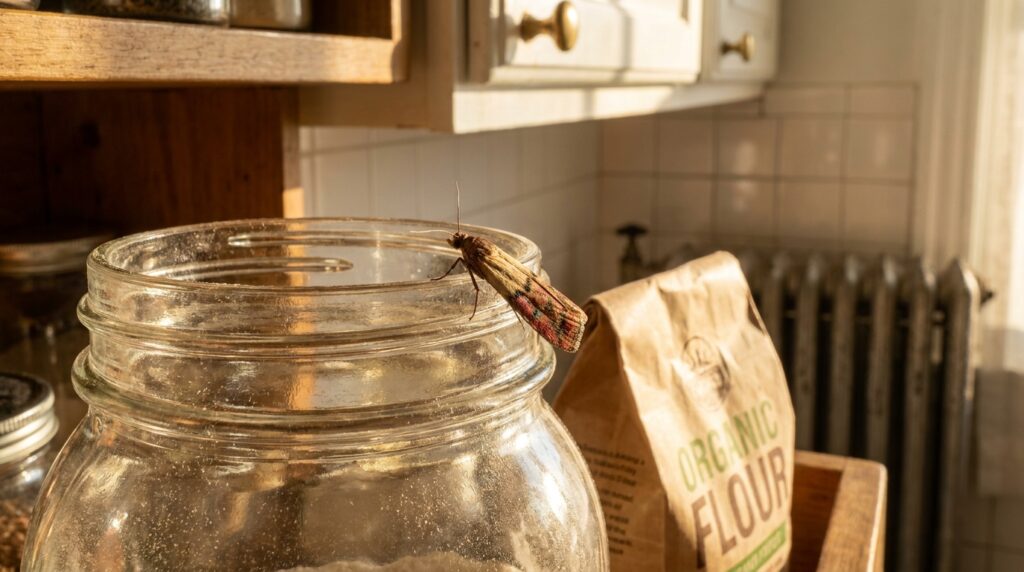
You opened the cabinet for the flour, and a small tan moth fluttered out. Two days later you killed seven. By the end of the week you have torn the kitchen apart, and you still cannot find where they are coming from.
We’ve been treating Indian meal moths in NYC apartments since 1999, and the same scenario walks through our phone every spring. The frustrating part is that almost none of the advice ranking on Google was written for a 600-square-foot Queens or Brooklyn apartment with a window AC unit, a radiator that runs hot all winter, and shared walls with three neighbors. We wrote this guide to fix that. If you operate a restaurant, deli, or food-handling business, our professional pest control for NYC restaurants and food-handling facility pest management programs run on a different protocol that we’ll cover near the end. Everyone else, read on.
Pantry moths in your NYC kitchen?
26+ years on NYC stored-product pest work. We find the source, treat wall voids and cabinet seams, and follow up so the cycle does not restart, no annual contracts.
Why Are Pantry Moths So Common in NYC Apartment Kitchens?
The short answer is that almost everything about a typical NYC apartment helps Indian meal moths thrive. The longer answer comes down to how we shop, how old our buildings are, and how warm our kitchens run from October through April.
Small NYC Kitchens Force Bulk Groceries Into Strange Storage Spots
Back in 2009, the real estate publication Brick Underground named this the “Costco effect” after entomologist Gil Bloom told them that “people used to buy things in smaller containers, and now they have a huge bag of flour or box of cereal sitting in the pantry and they don’t realize that it’s become infested.” Seventeen years later, with delivery apps making bulk grain orders one-tap easy, the problem has only gotten worse. NYC apartment kitchens were never designed for 20-pound bags of rice, and dry goods routinely migrate into bedroom closets, hall closets, and the shelf above a radiator. Every one of those non-kitchen storage spots becomes a potential infestation site the moment you bring home an infested package.
Apartment Heat Accelerates the Indian Meal Moth Lifecycle
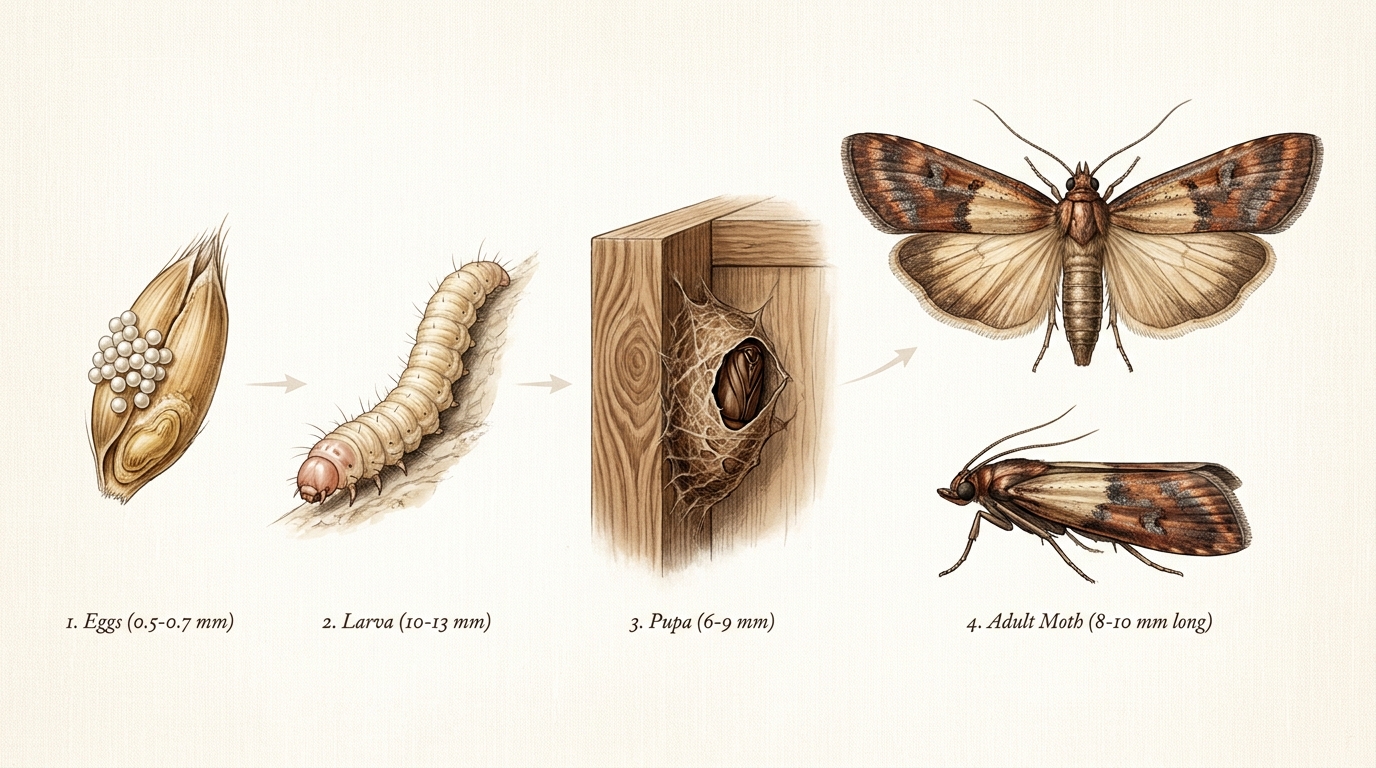
Cornell’s Integrated Pest Management program reports that Indian meal moth larvae develop in 13 to 288 days depending on temperature and food supply. The warmer the room, the faster the lifecycle. NYC apartments run hot all winter — building radiators routinely push our customers’ kitchens into the mid-70s in January, and that pushes generations toward the fast end of Cornell’s range. We’ve cleared apartments where a single infested bag of bird seed produced four overlapping moth generations in less than five months. The USDA’s Agricultural Research Service notes that a mature female can lay up to 300 eggs that begin to hatch within 14 days, so generations stack quickly.
Older NYC Buildings Give Moth Larvae Hundreds of Hiding Places
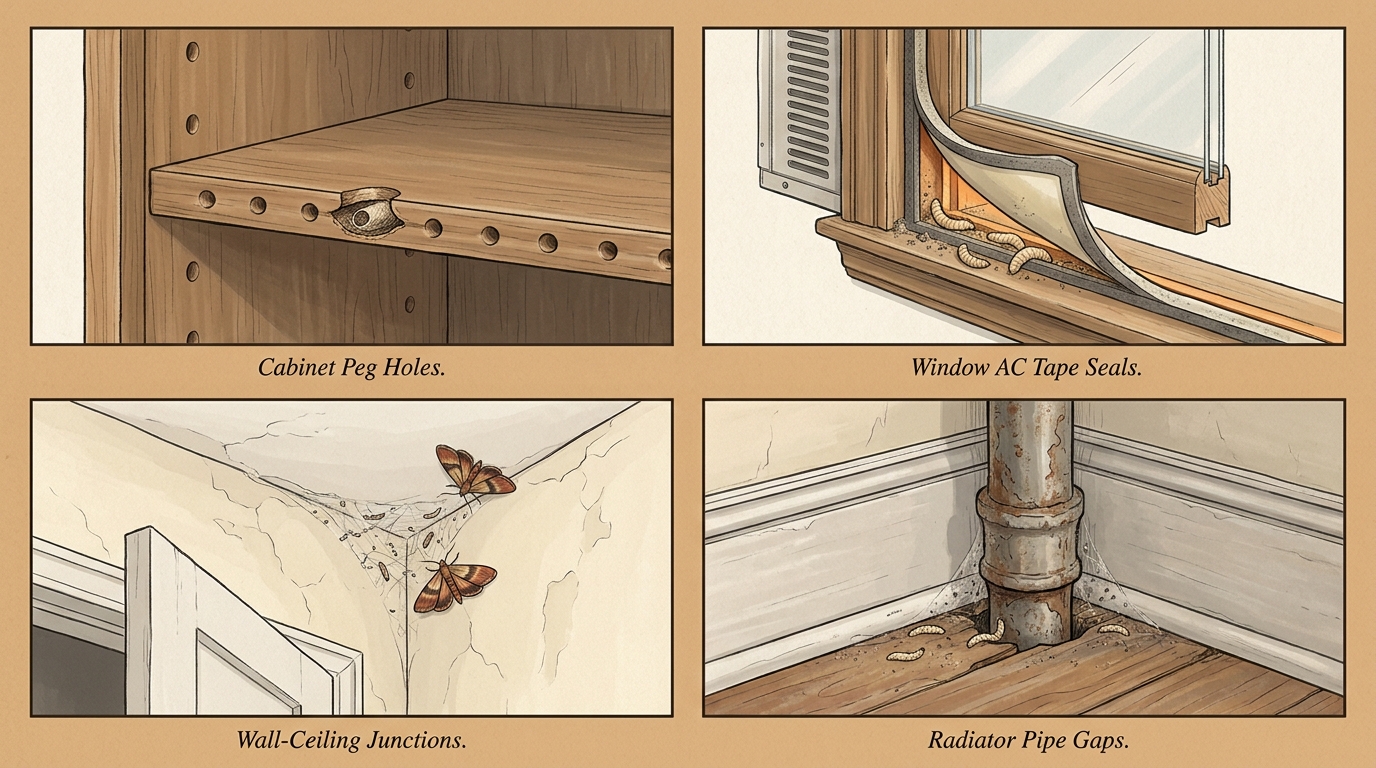
Pre-war brownstones, mid-century co-ops, and tenement walk-ups all share a feature that modern suburban kitchens do not: countless little gaps. Cabinets settle and pull away from plaster. Baseboards never seal flush. Cabinet shelves have peg holes drilled every two inches. Window air conditioner units sit on foam-and-tape gaskets that warm up in winter. Radiator pipes punch through floors with no escutcheon. When Indian meal moth larvae mature, they leave food entirely to find a sheltered spot to spin a cocoon, and our pre-war housing stock gives them more of those sheltered spots than almost any other type of building in America.
What Do NYC Pantry Moths Actually Look Like?
Before you treat anything, confirm what you have. Three different small pests get confused on NYC neighborhood Facebook groups every week, and the treatments are completely different.
The Indian Meal Moth Is the NYC Culprit Almost Every Time
Cornell IPM describes the adult Indian meal moth (Plodia interpunctella) as 3/8 to 1/2 inch long — about the size of a cooked grain of rice — with wings that look brown with a wide tan stripe when folded over the back, and a striking copper or bronze tip when the wings are open. The adult lives only one to two weeks, doesn’t bite, doesn’t sting, and isn’t attracted to your blood or your skin. It’s only here to mate, lay eggs, and die. The mature larvae are cream-colored caterpillars about half an inch long, often with a tinge of pink or green from whatever they’ve been feeding on.
Look for Webbing, Tiny Caterpillars, and Bronze-Tipped Wings
The National Pesticide Information Center confirms that larvae spin a web as they move and leave behind silken threads — webbing or clumped grain inside an unopened package is diagnostic. We’ve found infestations where the only outward sign in the cabinet was a bag of cornmeal that looked like it had cobwebs inside. The University of Minnesota Extension’s pantry pest identification guide is a useful reference if you want to inspect a suspect package before throwing it out — pour the contents onto a cookie sheet and look for caterpillars and silk.
Don’t Confuse Pantry Moths With Clothes Moths or Carpet Beetles
This is the single most common mistake we see on the phone. Pantry moths eat stored food. Clothes moths eat wool, fur, silk, and feathers in closets. Carpet beetles aren’t moths at all — they’re small striped beetles whose larvae eat natural fibers and shed pet hair. We have NYC tenants call us in October convinced they have pantry moths, and our tech walks in to find clothes moths in a hall closet full of vintage wool coats. If the moths are small and tan with copper-tipped wings and you’re seeing them near food, think pantry moths. If you’re finding holes in wool sweaters or slim case-shaped cocoons in dresser drawers, think clothes moths. If you’re seeing small striped beetles near rugs or upholstery, think carpet beetles.
Where Do Pantry Moths Come From in an NYC Apartment?
Almost never the answer most people expect. Pantry moths do not show up because your kitchen is dirty. They almost always arrive inside something you brought home from the store.
The Grocery Store Is the Starting Point, Not Your Cleanliness
USDA researchers point out that the Indian meal moth is one of the top twelve moth species intercepted at U.S. ports, and infestations regularly slip past inspection into commodity grain shipments. By the time a 5-pound bag of flour reaches a Brooklyn supermarket shelf, it may already have eggs on the outside of the inner liner. NPIC notes that larvae can chew straight through plastic bags and thin cardboard, so even unopened packages are at risk. We’ve found infestations starting in unopened name-brand cereal boxes pulled fresh from a Trader Joe’s bag.
Pet Food, Bird Seed, Spices, and Dried Décor Are the Overlooked Carriers
Dog kibble, cat food, parrot seed, whole pecans, dried chili pods, fall door wreaths, dried-flower centerpieces, old turmeric, even chicken bouillon — we’ve found Indian meal moth larvae in every one of these products inside NYC apartments. A pest pro on Reddit reported finding eggs and larvae throughout an unopened bag of fresh shelled pecans. One Manhattan customer was certain she didn’t have moths until we found a six-foot ficus tree in her living room with adult moths actively congregating on the leaves. Check every dry food and dried-plant product you own, not just the obvious “pantry” items.
In Multi-Unit NYC Buildings, Moths Migrate Between Apartments
This is the angle nearly every other article skips, and it matters more in NYC than almost anywhere else in the country. Mature larvae can survive for weeks without food and crawl dozens of feet to find a pupation site. In multi-unit buildings, our techs have traced active infestations to neighboring units, hallway carpet, shared elevator-shaft chases, basement utility rooms, and the foyer of a building’s bird-seed-storing super. One Reddit poster on a 13th-floor condo discovered the source of her recurring infestation was the carpeted hallway ceiling shared with the entire floor — not anywhere inside her unit. A Brooklyn renter we talked with last summer suspected — correctly — that the radiator riser shared with the apartment below was the entry point.
How Do You Find the Source of a Pantry Moth Infestation in an NYC Kitchen?
Finding the source is the entire game. Until you’ve found and removed it, every other step is just cleanup that buys you a week.
Check Cabinet Peg Holes and Wall-Ceiling Junctions for Moth Cocoons
Cornell IPM specifies that mature larvae often pupate at wall-ceiling junctions and inside cracks and crevices. The Reddit pest control community has a much more specific tip we’ve validated on dozens of jobs: check the small round holes drilled into the inside of every kitchen cabinet — the holes that hold adjustable shelf pegs. One Reddit commenter described finding moth cocoons in every single peg hole of his kitchen cabinets. Grab a flashlight and a thin nail, and inspect every peg hole in every cabinet. Cocoons look like tiny yellow-tan silk sacs, sometimes with a darker pupa visible inside. Then look at the corner where each cabinet meets the wall, the ceiling above each cabinet, and the underside of every shelf.
Inspect Non-Kitchen Zones — Closets, Window AC Seals, and Houseplants
The Queens 6th-floor thread that has dominated Google for “pantry moths NYC” since 2023 contains an update from the original poster after a year of frustration: she found moth larvae stuck under the foam-and-tape gasket that sealed her bedroom window AC unit. That is a uniquely NYC discovery, and we’ve replicated it on customer jobs. The seal around a window AC is warm, dark, and protected — and in Queens, Brooklyn, and Manhattan walk-ups, those AC units stay in place year-round. So do hall closets with no food in them. So does the gap behind a radiator cover, the soil of a houseplant that’s been sitting in the corner for two years, and the inside of a long-forgotten bag of pet food on a fire escape. Set a single sticky pheromone trap in each non-kitchen room for two weeks and see where the population is densest. We’ve found 20 moths in a hall closet that hadn’t held food in a decade.
Use Pheromone Traps for Detection, Not Eradication
Here is where most online advice goes off the rails. Cornell IPM is explicit that pheromone traps alone will not eliminate an infestation, and in dense multi-unit NYC buildings the traps can actively make the problem worse. A condo owner on Reddit whose building had a hallway-ceiling infestation specifically warned other readers to remove their pheromone traps because “their pheromones are detectable from crazy distances” and the traps were drawing male moths in from outside her unit. We tell customers to use the traps for two weeks to map hot spots, then take them down and focus the rest of the work on physically removing the source.
Pantry moths in your NYC kitchen?
26+ years on NYC stored-product pest work. We find the source, treat wall voids and cabinet seams, and follow up so the cycle does not restart, no annual contracts.
How Do You Get Rid of Pantry Moths in an NYC Kitchen for Good?
Once you’ve found the source, elimination is mostly mechanical. No spray will do this for you, and one piece of YouTube advice that gets millions of views is actively dangerous near food.
Throw Out Every Infested Dry Good, Then Freeze the Survivors at 0°F for a Week
Bag every infested item — webbing, larvae, cocoons, even a single adult resting inside a package — and walk it down to the outdoor trash the same day. Not the bin under the sink. NPIC’s freezing protocol kills all life stages at 0°F for seven days, and a typical NYC apartment freezer runs at or below 0°F. Confirm yours with a $5 freezer thermometer. UMN Extension recommends 0°F for at least four days, but for thicker packages we tell customers to go a full week. After freezing, transfer survivors into glass or rigid plastic — larvae cannot chew through either material, but UMN warns that they can chew through Ziploc bags if they’re motivated.
Vacuum Every Crevice, Then Wash With Soapy Water — Never Spray Pesticide Near Food
Cornell IPM is unambiguous: pesticide sprays should never be used in the pantry, in cabinets, or around food items. The most-watched pantry moth video on YouTube, by a pest tech with hundreds of thousands of views, recommends doing exactly that — spraying pyrethroid aerosols inside the pantry. Don’t. Residue transfers from the cabinet liner to a flour bag to a slice of bread to your kid’s mouth, and there is no friendly pesticide aerosol for surfaces that will touch food. Use a vacuum with a crevice attachment on every peg hole, every shelf seam, and every corner. Then wash all surfaces with hot soapy water. Empty the vacuum canister directly into your outdoor trash the moment you’re done — captured larvae can crawl back out otherwise. UMN notes that adult Indian meal moths may keep flying for up to three weeks after the source has been removed, so don’t panic if you see a few stragglers.
Seal the Cracks That Let Moths Travel Between Rooms or Units
The original Queens 6th-floor poster’s August 2025 update credited her improvement to “sealing tons of cracks along the floor and walls a few months ago.” That step — silicone-caulking the gaps where cabinets meet the wall, where baseboards meet the floor, around window AC tape, around radiator pipe penetrations, and under door thresholds — is the difference between a clear apartment and one that reinfests every six weeks. The same principle is why our piece on why clean NYC kitchens still get cockroach infestations emphasizes exclusion work over chemicals. NYC’s architecture rewards apartments where the gaps are sealed.
Can Pantry Moths Spread Between NYC Apartments?
Yes, and our customers in Brooklyn co-ops, Queens condos, and Manhattan walk-ups have more legal recourse than they often realize.
Yes — Through Shared Walls, Hallway Ceilings, and Under-Door Gaps
Field reports we hear regularly involve infestations originating in hallway ceilings, neighboring units, basement utility closets, or building-wide bird-seed and pet-food storage. Because mature larvae can survive without food and crawl long distances to pupate, a single infested unit in a 50-unit Brooklyn co-op can seed moths into half a dozen apartments over a single warm season. If your moths are appearing right at the apartment door threshold or in the foyer closet by the entry, the source may be entirely outside your unit. Shared kitchen plumbing and risers are a parallel issue — we cover the same multi-unit dynamic in our piece on drain flies in NYC apartments.
NYC’s Housing Maintenance Code Makes Landlords Responsible
The NYC Department of Housing Preservation and Development’s code enforcement page lists pests as one of nine conditions that an HPD inspector will write a violation for on every inspection. The Housing Maintenance Code (HMC §§ 27-2017 through 27-2018) requires landlords of multiple-dwelling buildings to keep them free of pests. If you’ve documented a recurring problem in your apartment that you’ve traced to common areas — the basement, the hallway, a neighboring unit a landlord has access to — the responsibility to remediate is the landlord’s, not yours. Document everything: dates, photos of trapped moths, photos of cocoons in cabinet peg holes, written notice to the management company.
When to Escalate to 311 or the NYC Department of Health
If your landlord won’t act, file a written 311 complaint with dates and photos, and request an HPD inspection. For severe persistent cases, especially cases involving common-area food storage or a landlord who refuses to inspect neighboring units, contact the NYC Department of Health and Mental Hygiene. Building-wide treatment is often the only thing that stops a true cross-unit pantry moth problem, and an HPD violation on the building’s record is the lever that gets that treatment scheduled.
When Should You Call a Pantry Moth Exterminator in NYC?
Most NYC apartment infestations respond to thorough mechanical work and a freezer. A meaningful minority do not.
Signs Your DIY Pantry Moth Approach Is Not Working
You’ve thrown out every infested dry good, vacuumed every peg hole, frozen the rest, sealed cabinets to plaster with caulk, and you’re still finding fresh adults two months later. Or the moths are clearly migrating in from common areas you can’t legally treat. Or you keep birds, reptiles, or small mammals whose specialty food can’t simply be replaced. Or you live in a co-op where multiple units have reported moths and the building won’t fund a coordinated treatment. These are the cases where a licensed technician earns the cost of the call.
What a Professional NYC Pest Control Inspection Looks For
When our techs walk into a pantry moth job in Brooklyn, Queens, or Manhattan, we work the source list — not the food list. We check the inside of every cabinet peg hole with a flashlight and a probe. We pull out the under-cabinet kick plate. We inspect the back of the radiator cover, the foam tape around every window AC unit, the corners of every closet, the top of every door frame, the underside of dropped ceilings if the building has them, and any neighboring common area we have access to. We lay out a temporary monitoring grid of pheromone traps to confirm the population’s center, then physically remove the source and seal the architectural gaps that let it return. We use family and pet-friendly products throughout, and the work usually happens in one or two visits. We’ve been doing this work in NYC since 1999.
Why NYC Restaurants and Food Businesses Need a Different Pantry Moth Protocol
If you operate a restaurant, café, deli, bodega, bakery, ghost kitchen, or grocery, an Indian meal moth sighting isn’t a household inconvenience — it’s a Department of Health letter-grade risk. Our NYC commercial pest control program for restaurants includes documented inspection logs, sticky-trap monitoring grids, IPM-compliant sanitation protocols, and the kind of paperwork DOH inspectors expect to see. For food manufacturers, packers, and distributors handling stored grain at scale, our stored-product pest control for food processing facilities adds structural exclusion, supply-chain entry-point inspection, and ongoing IPM for the full slate of stored-product pests, of which Indian meal moth is the most common. We work with restaurants across all five boroughs, and the call before a violation is always cheaper than the call after one.
The Bottom Line on Pantry Moths in NYC Kitchens
Pantry moths in NYC apartments are not a cleanliness problem. They’re a logistics problem — a story about bulk groceries we never had room for, kitchens that run too hot in winter, buildings full of architectural gaps, and the inevitability of any one of those things meeting an infested bag of bird seed from the supermarket. Find the source, freeze what you can save, vacuum the rest, caulk the cracks, and skip the pantry sprays. If you’ve done all of that and you’re still seeing moths, or you’re running a business where one moth is one too many, call a New York pest control team that knows what to look for inside your specific kind of building. We’re at (718) 418-8986 for a free estimate.