If you woke up with three bites in a neat little row and Googled “how much does bed bug treatment cost,” you’ve probably seen quotes ranging from $300 to $9,000 — and most of them feel like they were generated by a calculator with no idea what a Brooklyn brownstone or a Murray Hill walk-up actually looks like. After 26 years quoting bed bug jobs across all five NYC boroughs and out into Nassau and Suffolk, our team has learned that the gap between the average national cost articles and what New Yorkers actually pay for a real, durable bed bug job is wider than for almost any other pest in our service catalog.
This guide breaks down what NYC bed bug exterminator cost looks like in 2026 — by treatment method, infestation severity, building type, and number of visits. We’ll walk through what should be on a real itemized quote, what’s hidden in the fine print of cheap quotes, who legally pays for treatment if you rent, and how to avoid the two most expensive mistakes we see every week. If you’d rather skip the research and book professional bed bug treatment in NYC for a free estimate today, our front-office team can usually book a same-day inspection. But if you want to walk into that conversation knowing exactly what your apartment should cost — read on.
Bed bugs in your NYC apartment?
26+ years treating NYC bed bugs. Crossfire residual where it counts, no annual contracts, and a free inspection that's waived when you book.
What Does a NYC Bed Bug Exterminator Cost on Average?
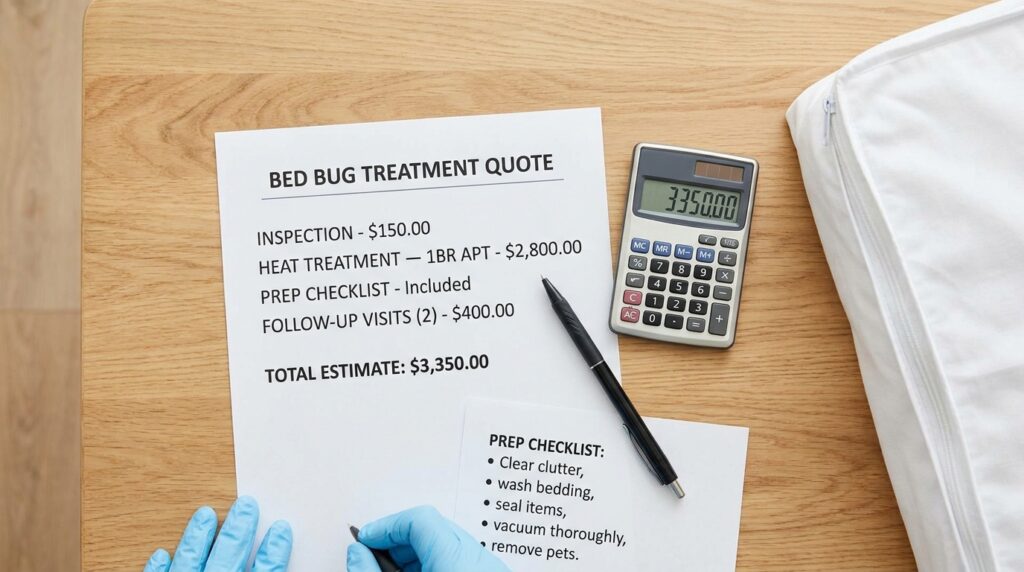
For a typical NYC apartment with a confirmed bed bug problem, real 2026 pricing looks like this: $500–$1,500 for a single-room or small chemical treatment, $1,500–$3,500 for a 1-bedroom heat treatment, and $2,500–$6,000+ for whole-apartment or multi-bedroom work that includes both heat and chemical follow-up. A standalone inspection runs $75–$200 and is usually waived if you book the work.
Those ranges are 30–50% higher than what national cost calculators predict, and there’s a reason. Angi’s 2026 New York City pest control data puts the city-specific bed bug treatment range at $1,500–$6,000, with the city’s pest control prices running roughly 50% above national averages. That’s not because NYC exterminators are gouging — it’s because NYC bed bug jobs are structurally more complicated than the national average. Pre-war wall voids, multi-unit transmission paths, sprinkler-system coordination, and elevator-shaft logistics all add labor and equipment time that suburban single-family jobs don’t have.
We’ve seen the cheap end of the market too — there are operators in NYC who will quote you $300 to “spray the bedroom.” That number is real, but the result usually isn’t. A single chemical pass without follow-up visits, mattress encasements, or wall-void treatment doesn’t end an infestation; it pauses it. The question worth asking isn’t “what’s the cheapest quote I can get?” — it’s “what’s the all-in cost to actually make this stop, including the follow-up visits I’m going to need anyway?”
Why Is Bed Bug Treatment More Expensive Than Roach or Mouse Extermination?
Bed bug work costs more than almost any other residential pest treatment, and after thousands of jobs we’ve narrowed it down to four reasons. The first is biology. Bed bugs lay eggs that no chemical on the market reliably kills on contact — eggs hatch on a 6-to-10-day cycle, which means a single visit that wipes out every visible adult will see new bugs walking around within two weeks. That’s why almost every legitimate bed bug treatment is structured as a 2-to-4-visit program over 4-to-8 weeks, not a one-and-done service.
The second reason is prep and labor time. A typical roach job for our team takes about 45 minutes inside an apartment. A real bed bug job — including a thorough visual inspection, mattress and box-spring inspection, baseboard and outlet treatment, and follow-up scheduling — runs 2 to 4 hours minimum. Heat treatment days run 6 to 8 hours with two to three technicians on-site continuously, monitoring temperature sensors and repositioning equipment to eliminate cold spots. That’s a substantial labor bill before chemicals and equipment are even factored in.
The third is resistance. According to Penn State Extension’s bed bug management research, over 90% of US bed bug populations now carry genetic resistance to the pyrethroid pesticides that most consumer products and older professional sprays rely on. That means the cheap chemicals don’t work anymore — modern bed bug control requires neonicotinoid-based products like Crossfire (which we use across our NYC bed bug program) and biopesticides like Aprehend, both of which cost the exterminator significantly more per job.
The fourth, and the one most pricing articles miss, is multi-unit risk in NYC. When we treat one apartment in a 6-unit walk-up and the neighbor on the other side of a shared wall doesn’t treat, the bugs simply walk back through the wall void within weeks. A real NYC bed bug job often includes adjacent-unit inspection, building-wide coordination conversations with landlords or supers, and dust treatment of common-wall outlets — all things a suburban single-family job doesn’t need.
If you’re not 100% sure you have bed bugs at all, our walkthrough on the telltale signs of bed bugs in a NYC apartment covers the bites, fecal staining, shed skins, and live-bug evidence to confirm before you spend a dime on treatment. Misidentification is one of the most expensive mistakes we see — paying for a bed bug job when the actual problem is carpet beetles or fleas.
What’s Actually Included in a Bed Bug Treatment Quote?
A real bed bug extermination quote should have at least six distinct line items, even if it’s bundled into one flat fee. When a quote shows up as just “$X for bed bug treatment” with no breakdown, that’s almost always a sign you’re being quoted for an underbuilt job that won’t finish the problem. Here’s what we include in every NYC bed bug treatment, and what to look for in any quote you’re comparing:
- Visual inspection and confirmation — Before any chemical or heat goes in, our technicians walk every room of the unit, check mattress seams, box springs, bed frames, baseboards, outlet plates, picture frames, and crown molding for live bugs, eggs, fecal staining, and shed skins. Standalone inspection fee is $75–$200 in NYC, almost always waived if you book the treatment.
- Treatment method selection and product choice — Decision between chemical (Crossfire, Aprehend), heat, steam, or combo, based on building type, severity, and presence of children/pets/sensitive occupants. Real quotes name the specific products.
- Initial treatment application — Chemical baseboard banding, outlet plate dusting (we use silica-gel desiccants in wall voids), mattress and box-spring treatment with EPA-registered bed bug pesticides, or heat treatment with monitored temperature equipment held at 130°F+ for 4–8 hours.
- Mattress encasements and interceptor cups — High-quality bed-bug-proof encasements run $30–$60 per mattress; ClimbUp interceptors under bed legs run $15–$30 for a four-pack. Reputable companies bundle these into the job; cheaper outfits charge for them separately or skip them entirely.
- Follow-up visits — Bed bug eggs hatch 6–10 days after treatment, so you need at least one follow-up at the 2-week mark, often a second at the 4-week mark. A real bed bug program includes 2–3 follow-up visits in the initial price. Cheap quotes charge $150–$300 per follow-up.
- Guarantee window — A real bed bug job comes with at least a 30-day guarantee, often 60–90 days for our chemical programs. Treatment-and-warranty packages on serious jobs run up to a year. Vague language like “standard guarantee applies” with no number on the invoice is a red flag.
A real example from a Reddit thread that mirrors what we typically quote on a Brooklyn brownstone single-bedroom: $1,200 for liquid + aerosol + dust application with a 3-month guarantee, validated by working pest professionals as a fair NYC-style chemical job. That’s the kind of itemization a serious quote should look like. If you’re getting a one-line $400 number with no detail, you’re going to be calling someone else in 6 weeks.
How Do Bed Bug Costs Differ Between Heat Treatment and Chemical Treatment?
This is the question that drives most of the sticker shock on NYC bed bug quotes, because the gap between the two methods can be enormous — and the marketing around heat treatment often skips the parts you really need to know.
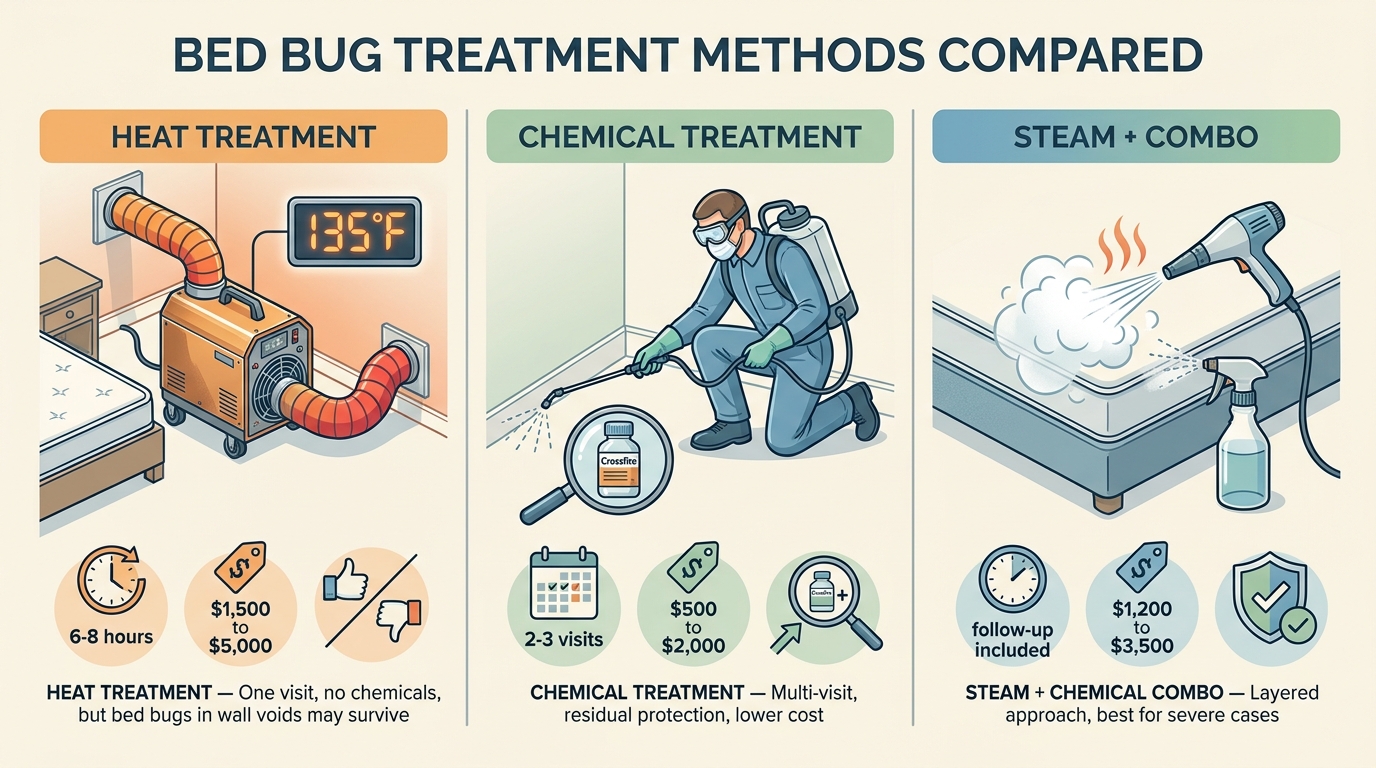
Chemical treatment runs $500–$2,000 for a typical NYC apartment, requires 2–3 visits over 4–6 weeks, and uses modern non-repellent products like Crossfire (a neonicotinoid + pyrethroid + PBO synergist). Bugs cross treated baseboards, outlet rims, and bed frames without sensing the chemical, pick it up on their bodies, and die within hours. New bugs that hatch from eggs over the following weeks cross the same residual and die the same way. The advantage: residual protection lasts weeks after the technician leaves. The disadvantage: it takes longer to fully clear a unit (typically 3–6 weeks).
Heat treatment runs $1,500–$5,000 for a typical 1-bedroom NYC apartment and $2,500–$9,000+ for whole-home jobs in single-family or multi-bedroom apartments. The pricing is largely a function of square footage — most NYC operators charge $2.00–$3.50 per square foot for heat alone, before prep work and any required sprinkler-system coordination. Equipment runs as much as $154,000 for the high-end electric systems we and other established NYC operators use, and a single heat day requires 2–3 technicians on-site for 6–8 hours holding the unit at 130–135°F. The advantage: one visit kills all life stages including eggs. The disadvantage — and the part most heat-treatment marketing leaves out — is that bed bugs hiding in wall voids, behind insulation, or just beyond the heat zone often survive. According to research from Virginia Tech’s bed bug program and the EPA’s pesticides for bed bug control guidance, the air at the center of a treated room can hit 134°F while baseboards against an exterior wall hit only 102°F — well below the lethal threshold. That’s why most reputable NYC operators (us included) follow a heat treatment with a residual chemical application, which is what pushes whole-home pricing into the $3,000–$6,000 range.
Steam and combo treatments ($1,200–$3,500) are increasingly the standard for severe or repeat infestations. Handheld steamers at 160°F+ kill bugs and eggs on contact in mattress seams, sofa cushions, and curtain folds where chemicals can’t legally be applied. Layered with chemical residual, this is what we recommend for most established multi-room NYC infestations.
The honest answer to “heat or chemical?” depends on three things: how spread out the bugs are, how many wall voids and exterior walls are in play, and your tolerance for a multi-week treatment timeline versus one big day with a 5-figure bill. For a single-bedroom problem caught early, chemical wins on price and effectiveness. For a whole-apartment problem in a brownstone with established harborage, combo treatment is usually the only thing that finishes the job. Either way, our deep-dive on what temperature actually kills bed bugs walks through the thermal physics so you can ask better questions of any quote you’re comparing.
Bed bugs in your NYC apartment?
26+ years treating NYC bed bugs. Crossfire residual where it counts, no annual contracts, and a free inspection that's waived when you book.
How Does Infestation Severity Change the NYC Bed Bug Treatment Cost?
Severity is the second biggest cost driver after treatment method, and most homeowners and tenants underestimate where their problem sits on the severity ladder. Here’s how our team and most legitimate NYC operators tier bed bug jobs:
| Severity | What it looks like | Typical NYC cost range |
|---|---|---|
| Mild | A handful of bugs in a single room, no visible nesting evidence, problem caught within 30 days of first bite | $500–$1,200 |
| Moderate | Live bugs and fecal staining in 2–3 rooms, evidence of nesting in mattress or box spring, problem 30–90 days old | $1,500–$3,000 |
| Severe | Visible bugs day and night, multiple rooms with nesting, wall-void harborage, pets/family also bitten | $3,000–$6,000+ |
| Whole-building or multi-unit | Multiple apartments affected, common-wall transmission, building-wide coordination required | $5,000–$15,000+ (varies dramatically by unit count) |
Three things almost always push a job from “moderate” to “severe” in NYC: the infestation has been active for more than 90 days before someone called (bed bugs reproduce on a 5-eggs-per-day cycle, so 90 days of inaction can mean hundreds of bugs hiding in wall voids), a neighboring unit also has bugs that the building hasn’t addressed, or the apartment has heavy clutter that prevents thorough inspection and treatment of every harborage zone. We’ve quoted Brooklyn apartments where the tenant called within a week of first bites and the job was a clean $800 chemical program, and we’ve quoted Manhattan high-rises where the same tenant could have had the same outcome but waited 6 months — and the job became a $4,500 combo treatment with two follow-ups.
What NYC-Specific Factors Drive Bed Bug Exterminator Cost Up?
NYC bed bug pricing isn’t priced like Long Island bed bug treatment, and it’s certainly not priced like the national average. A few city-specific realities push our quotes — and every legitimate competitor’s quotes — above what online cost calculators predict:
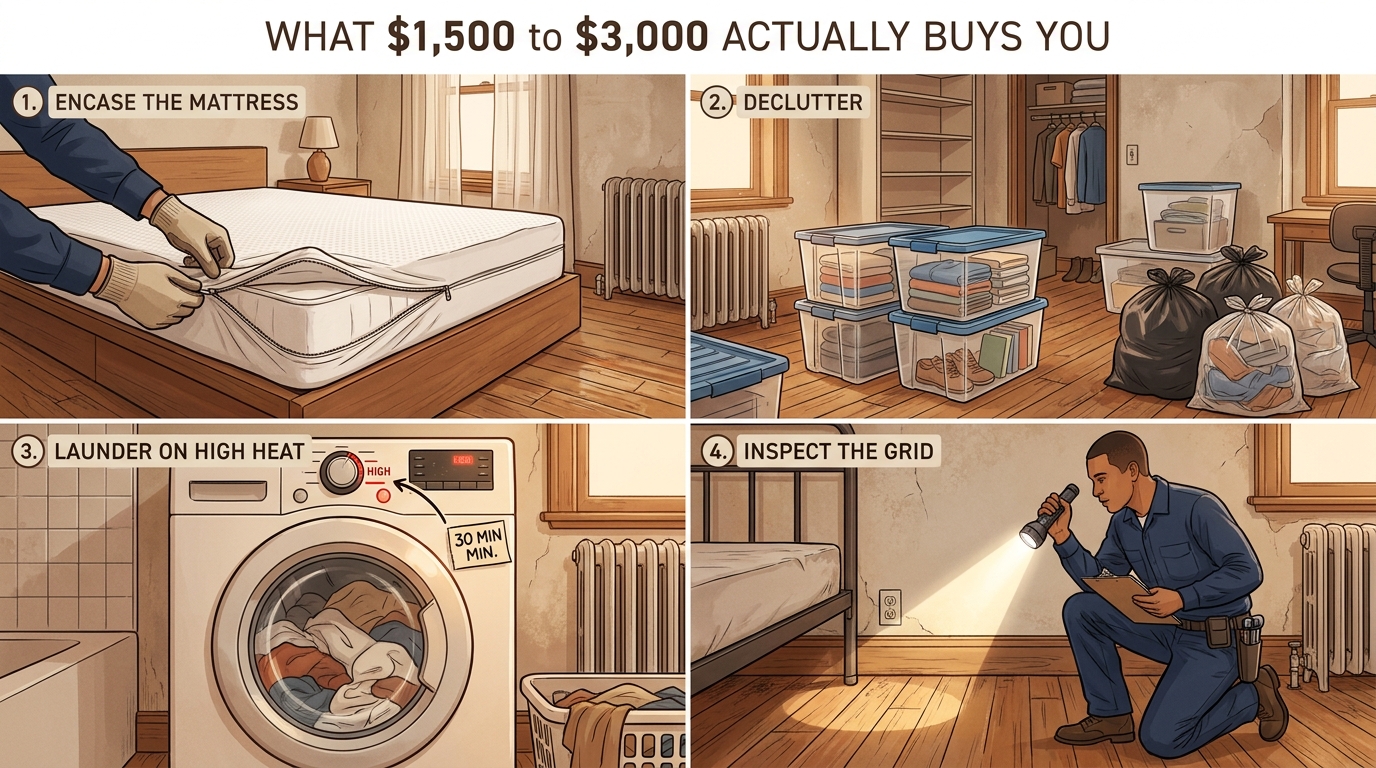
Pre-war wall voids and plaster walls. A 1920s Brooklyn brownstone or a Manhattan walk-up has plaster walls, decades of accumulated openings around radiators, gas pipes, and elevator shafts, and wall cavities filled with dense old insulation. Bed bugs use these as highways between units and as harborage zones that are physically protected from heat treatment. Any serious treatment in this kind of building includes outlet-plate dusting with silica-gel products and crack-and-crevice band treatment along baseboards — equipment and labor time that adds to the base price.
Sprinkler systems in newer apartment buildings. Many post-2000 NYC apartment buildings have sprinkler systems that automatically trigger above 135°F. Heat treatment in these buildings requires coordinating with a fire-sprinkler company to put the system into temporary standby mode, which is a separate $300–$800 line item in addition to the bed bug job. This is one of the biggest reasons heat treatment in newer NYC high-rises runs $1,000–$2,000 more than a comparable suburban job.
Multi-unit coordination. When one apartment in a 6-unit walk-up treats and the others don’t, the bugs just shift to a neighboring unit. We’ve watched tenants spend $1,800 on three rounds of treatment that fail because the source was the unit downstairs. The NY State Department of Health’s bed bug guidance explicitly recommends building-wide Integrated Pest Management for exactly this reason, and a serious treatment plan in a multi-family building includes adjacent-unit inspection at minimum.
Elevator-shaft and common-wall transmission. In NYC high-rises, bed bugs travel vertically through elevator shafts and electrical conduits between units on different floors. Treating just your unit when the building has an active outbreak elsewhere is a recipe for re-infestation within 60–90 days. Real quotes for high-rise jobs often include common-area treatment as a recommendation for the building.
Borough-specific factors. Bed bug calls in Brooklyn skew toward brownstone wall-void work and multi-unit walk-ups; calls in Manhattan skew toward high-rise sprinkler coordination and tighter prep windows around doorman buildings; calls out in Long Island (Nassau and Suffolk) skew toward single-family whole-home heat treatment with simpler logistics but larger square footage. The pricing reflects the structural complexity of the work each location actually requires.
Should You Pay for One-Time Treatment, a Multi-Visit Plan, or Whole-Building Coordination?
We get asked this constantly, and the honest answer depends on how confident you are about the source and how spread the bugs are. Here’s the math we walk our customers through:
| Plan type | Typical NYC pricing | Best for |
|---|---|---|
| One-time chemical (small scope) | $500–$1,200 | Single-bedroom infestations caught within 30 days, no neighbor involvement, no kids/pets concerns |
| Multi-visit chemical program (2–3 visits) | $1,500–$3,000 | Moderate infestations across multiple rooms, established harborage, follow-ups bundled in price |
| Single-day heat treatment | $1,500–$5,000 | Whole-apartment problems in low-rise buildings without sprinklers, occupants who can’t tolerate residual chemical, shorter timeline preference |
| Combo heat + chemical | $3,000–$6,000+ | Severe whole-apartment or multi-room jobs, brownstones with wall-void harborage, repeat infestations |
| Building-wide coordinated treatment | $5,000–$25,000+ | Multi-unit landlord-paid jobs covering 4+ apartments, common areas, hallways |
For most one-bedroom NYC tenants who caught the problem early, our recommendation is the multi-visit chemical program — it’s the lowest all-in price that actually finishes the job. For brownstones, multi-room infestations, or anywhere the bugs have been active for more than 90 days, combo treatment is usually the only path that doesn’t end in a callback. Avoid the “one-time spray” $400–$600 quotes unless the inspector has confirmed mild scope; the math almost always works out worse than paying $1,200 once for a real program.
For a broader view of pricing across all NYC pest categories — roaches, rodents, ants, mosquitoes — see our comprehensive guide to NYC pest control pricing. This bed-bug-specific post is the deep dive; the general guide covers the rest.
Who Pays for NYC Bed Bug Treatment — You or Your Landlord?
If you rent in NYC, this is by far the most important question on this page, and the answer is almost always: your landlord pays, not you. Under New York’s Warranty of Habitability (Real Property Law §235-b), the NYC Housing Maintenance Code, and the NYC Bedbug Disclosure Law (HMC §27-2018.1), landlords are legally required to maintain rental apartments free from bed bug infestations and to remediate them when they occur. This applies to nearly every rental apartment in NYC, including co-ops where the building rents the unit out, and most condos.
The Bedbug Disclosure Law also requires landlords to provide every new tenant with a one-year history of bed bug infestations in the building before signing a vacancy lease. This is the official Form DBB-N from NYS Homes and Community Renewal — if your landlord didn’t give it to you when you signed, that’s already a violation. As of 2024, NYC’s Local Law 69 also requires landlords to notify tenants of any bed bug infestation in the building within 72 hours of confirmation, and you can verify your building’s full history at the HPD Online portal before you sign anything.
We see two specific tenant traps regularly. The first is the lease-clause waiver — some NYC landlords insert language into leases like “Tenant agrees to be responsible for any and all costs associated with the diagnosis and eradication of bed bugs.” We’ve seen tenants on Reddit panic over this kind of clause; the answer from every housing attorney we’ve spoken with is the same — those clauses are unenforceable under NY law because the warranty of habitability cannot be waived by contract. Sign the lease if everything else is acceptable, and the landlord still owes the cost of treatment if bed bugs appear.
The second trap is the “you brought them” framing. Landlords sometimes try to charge tenants by claiming the bugs were tenant-introduced. This is almost never legally provable, and our team coaches anxious tenants through the 311 complaint process so they don’t end up paying out of pocket for what’s structurally a building-level problem. Once 311 triggers an HPD inspection and a violation is issued, the landlord typically has 30 days to remediate, which gets the work done at landlord cost regardless of who claims to have brought the bugs in.
For NYCHA residents, pest control runs through NYCHA’s own program — call the NYCHA Customer Contact Center rather than booking a private exterminator. For owner-occupied co-ops and condos, the cost typically falls on the building’s common-charge budget for common-area treatment and on the unit owner for in-unit work, though specifics vary by bylaws. If you own a one-family home or are a landlord yourself, the cost is yours — but a well-handled bed bug job usually pays for itself in avoided HPD violations, reduced tenant turnover, and protected property value. The EPA’s bed bug control guidance and Penn State Extension’s IPM resources are both useful for owners who want to understand what the work actually involves.
What Are Red Flags in Cheap (or Inflated) NYC Bed Bug Quotes?
Both ends of the price spectrum have warning signs. Here’s what we’ve learned from 26 years of getting called in to fix what other companies left behind:
Cheap-quote red flags (under $400 for a real bed bug job):
- The quote includes only baseboard spraying with no inspection, no encasements, no interceptor cups, and no follow-up visits. That’s not bed bug control — that’s a chemical pass that resets the clock for 4 weeks.
- The company won’t name the specific products. Modern bed bug work uses specific neonicotinoid combos (Crossfire), biopesticides (Aprehend), and silica-gel desiccants (CimeXa). If the quote just says “EPA-approved spray,” ask which one. Pyrethroid-only products are now ineffective against most NYC populations.
- No NYS DEC pesticide applicator license number on the invoice or the company’s website. New York requires licensing for any commercial pesticide application; reputable companies put this prominently. You can verify on the NYS DEC’s pesticide applicator registry if you have any doubt.
- “30-day guarantee” with no clarity on what triggers a free retreatment. For real bed bug work, look for at least 60–90 days, with explicit language about what counts as covered (new bug sightings within the warranty window, not just “evidence”).
Inflated-quote red flags (north of $5,000 for a typical 1-bedroom apartment):
- Heat-only quotes for a small infestation. If a single-bedroom apartment with mild scope is being quoted at $4,000+ for heat alone, the company is likely upselling on equipment time you don’t need. Chemical programs at half the cost typically work just as well at that scope.
- High-pressure tactics or same-day pressure to sign. National chains like Orkin and Terminix are routinely quoted on Reddit at 2–3x the price of local NYC operators for the same scope of work — one Reddit user shared a $2,500 Orkin quote for a 1,100-square-foot townhome that other commenters pegged at $1,200 for a comparable local job.
- Conditional-warranty fine print that voids your guarantee if a guest visited or you traveled. These clauses exist specifically to minimize callback obligations on the company’s side. A reputable bed bug company offers an unconditional 60–90 day warranty.
- Bundled long-term contracts (12+ months) with cancellation penalties. Reputable NYC bed bug companies offer the initial treatment package and then optional monthly or quarterly recurring service — never a forced lock-in.
The bottom line on red flags: a thorough free inspection from a licensed local NYC company should produce a written quote with the six line items we listed above, a clear scope of work, and a written guarantee window. If any of that’s missing on either end of the price spectrum, get another quote. For more on identifying a legitimate operator, the Texas A&M Extension’s How to Select a Bed Bug Control Provider guide is useful even outside Texas — the criteria translate directly to NYC.
Bed bugs in your NYC apartment?
26+ years treating NYC bed bugs. Crossfire residual where it counts, no annual contracts, and a free inspection that's waived when you book.
The Bottom Line: What to Budget for Bed Bug Treatment in NYC
For most NYC tenants and homeowners, the realistic 2026 budget for serious bed bug work breaks down like this: $500–$1,500 for a single-room or small apartment chemical program with 2–3 follow-ups, $1,500–$3,500 for a 1-bedroom heat treatment, and $3,000–$6,000+ for whole-apartment combo treatment in larger units, brownstones, or anywhere with established multi-room harborage. If you rent, your landlord almost certainly owes the cost — call 311 before you reach for your wallet, and verify your building’s history at HPD Online before you panic.
We’ve been doing bed bug work in NYC since 1999, and the most common mistake we see is paying twice — once for a too-cheap one-room spray that didn’t include encasements, follow-ups, or wall-void treatment, then again 6 weeks later when the bugs are back in force. Pay once for a real program from a licensed local company, get the inspection done thoroughly, and budget for the full follow-up sequence within the guarantee window. That’s how NYC bed bug costs actually pencil out.
If you’re staring at suspicious bites or live bugs right now and want a real number for your specific apartment, our team offers free bed bug inspections across all five boroughs and out to Nassau and Suffolk — same-day service during business hours, with 27 technicians who’ve worked everything from Bed-Stuy brownstones to Long Island City lofts. Lisa or one of our front-office team can typically get you a same-day inspection scheduled, and the quote you get will itemize exactly what’s included, what the timeline looks like, and what the guarantee covers — so you can compare it apples-to-apples against anyone else.