By late June, yellow jackets in NYC have established their colonies, and by August they’re aggressive — defending nests with the kind of repeated stinging behavior that turns a backyard cookout into an ER visit. If you’ve spotted yellow-and-black wasps streaming in and out of a single point on your fence, eaves, soffit, or even a hole in the ground, you have a yellow jacket nest, and how you handle the next 48 hours determines whether this becomes a $0 DIY win or a $400 emergency pro call. After 26 years removing wasp and hornet nests across every NYC borough, our team has narrowed yellow jacket removal down to a clear decision tree — and the answer of “DIY or pro” depends almost entirely on where the nest is and how big it is.
This guide walks through how to identify a yellow jacket nest, where they typically build in NYC yards and patios, the 3 DIY methods that actually work for small nests, when the nest is too big or too risky to handle yourself, and how to keep yellow jackets away from your backyard or rooftop for the rest of the summer. If your nest is bigger than a softball or located somewhere you can’t reach safely, skip the DIY and book professional wasp nest removal in NYC — our front-office team typically gets you a same-day quote. But if it’s a small early-season nest in an accessible spot, you may be able to handle this yourself.
Yellow jackets swarming your NYC yard?
26+ years removing NYC wasp and hornet nests. Same-day service in summer, no annual contracts, and a free yard inspection that's waived when you book.
How Do You Spot Yellow Jackets You Need to Get Rid Of vs Other NYC Wasps?
Yellow jackets (Vespula and Dolichovespula species) are the wasps most NYC homeowners reflexively call “bees” — they’re not. Bees are fuzzy, slow, and only sting once. Yellow jackets are smooth, fast, aggressive, and can sting repeatedly. Correct identification matters because the treatment approach for honeybees (call a beekeeper, never spray) is the opposite of the treatment approach for yellow jackets (treat the nest after dark with confidence, they’re not protected).
Here’s how to distinguish yellow jackets from the other stinging insects common in NYC yards and patios:
- Yellow jacket: 1/2-inch long, smooth (not fuzzy), bright yellow and black bands. Aggressive defenders. Nests in ground holes, wall voids, hollow logs, and inside fence-post hollows. By August, hundreds to low thousands of workers.
- Bald-faced hornet (technically a yellow jacket relative): 3/4 to 1 inch, black with white face and markings. Builds the iconic gray football-shaped paper nest hanging from trees, eaves, and soffits. Extremely aggressive within ~10 feet of nest.
- European hornet: 1 to 1.5 inches (largest NYC stinging insect), brown and yellow. Nests in tree hollows, attics, wall voids. Less aggressive than yellow jackets unless provoked.
- Paper wasp: 3/4 inch, slender body with dangling legs in flight, brown with yellow markings. Builds the open-celled umbrella-shaped paper nests you see on eaves and porch ceilings. Generally less aggressive.
- Honeybee: 1/2 inch, golden-brown, FUZZY (this is the key tell), slower flight. Beneficial pollinator. Never spray honeybees — call a local beekeeper or NYC’s Honey Bee Lab if you have a swarm.
Our detailed hornets vs wasps field guide for NYC and Long Island covers the species ID in more depth with photos, and our guide on identifying a wasp nest in NYC walks through how to confirm what you’re looking at before you decide on a treatment approach.
Where Do You Find Yellow Jacket Nests to Get Rid Of in NYC Yards, Patios & Fire Escapes?
Yellow jackets are opportunistic nesters — they’ll build wherever they find a protected cavity with a single entry point. After thousands of NYC yellow jacket calls, our techs have learned to check the same places first depending on the property type:
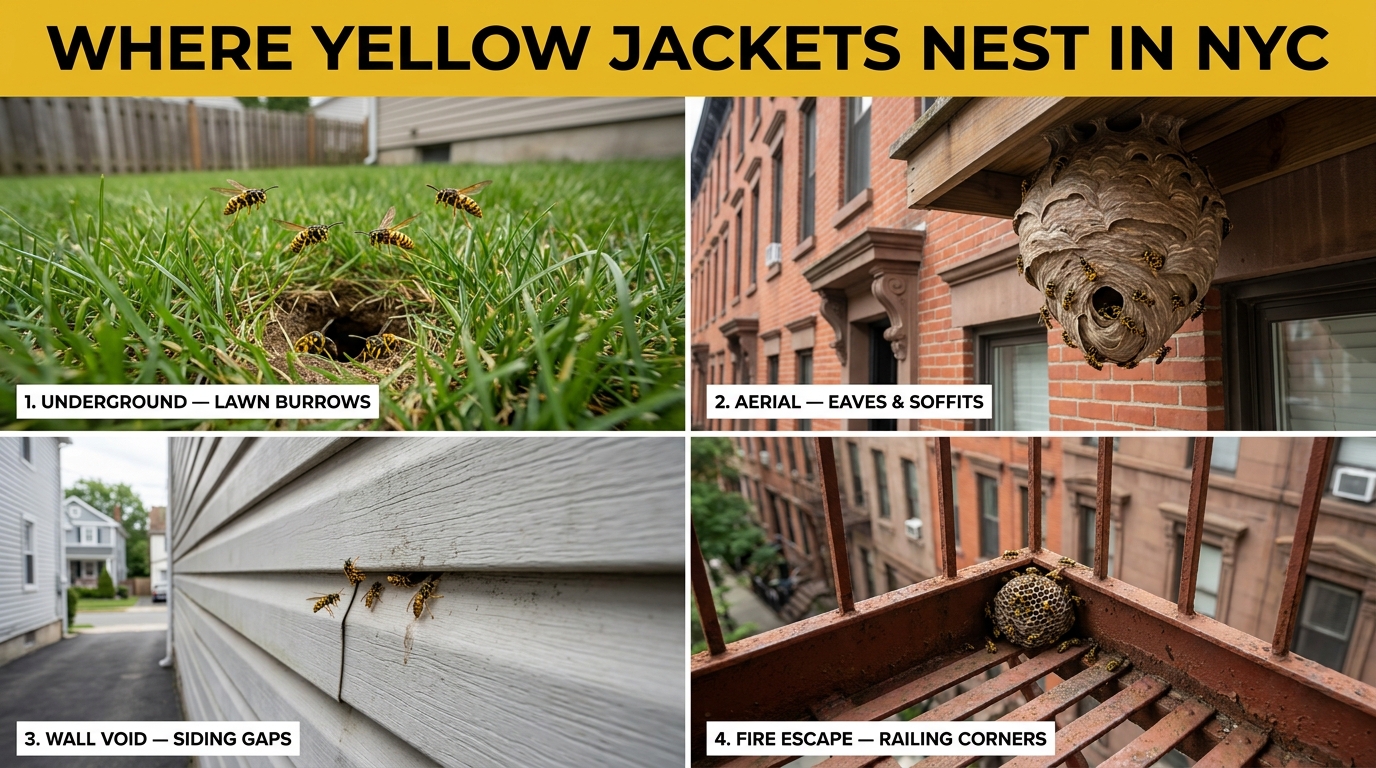
Backyards (Brooklyn brownstones, Queens row homes, Bronx detached houses): Underground nests in old rodent burrows, abandoned chipmunk holes, and gaps between paver stones are the most common. Look for a steady stream of yellow jackets entering and exiting a single small hole in the lawn or near the foundation. Aerial nests in dense shrubs (yew, boxwood, juniper) are the second most common — typically 1–3 feet off the ground inside the shrub.
Eaves, soffits, and fascia boards: Bald-faced hornets and yellow jackets build aerial paper nests hanging from soffits and eaves, especially on the shaded north-facing side of the house. By August these can be the size of a basketball. Check the eave line carefully from the ground with binoculars before approaching.
Wall voids and behind siding: The most dangerous yellow jacket location — they enter through a tiny gap in siding or trim and build inside the wall cavity. You’ll see workers entering and exiting a small entry point on the house exterior, but the nest itself is hidden. NEVER seal the entry point without killing the nest first — trapped yellow jackets will chew through interior drywall.
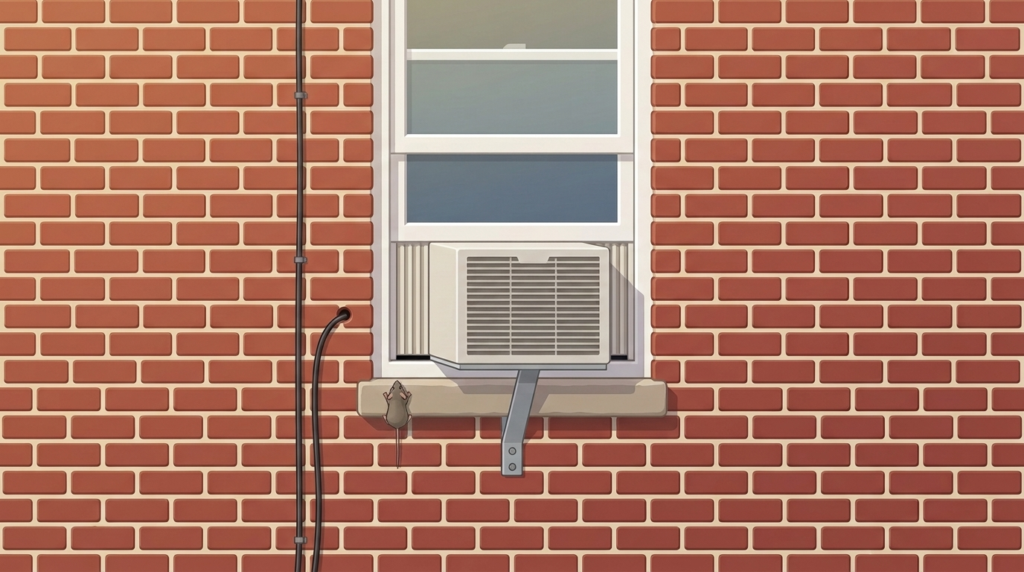
NYC apartment balconies and fire escapes: Paper wasps and small yellow jacket colonies will build under balcony railings, in the corners of fire-escape grating, behind air-conditioner units, and inside the hollow metal posts of fire-escape ladders. These are smaller colonies (usually paper wasps, not yellow jackets) but more dangerous because you can’t easily retreat from a stinging swarm on a fire escape.
Manhattan and Brooklyn rooftops: Tar-and-gravel roof corners, parapet wall cavities, behind rooftop HVAC equipment, and inside chimney cap gaps. Treatment here often requires ladder access and is rarely DIY-appropriate.
Detached garage and shed corners: Yellow jackets love the upper corners of garages, sheds, and detached storage structures — protected from rain, easy entry through gable vents or gaps under the roofline.
How Do You Find a Yellow Jacket Nest to Get Rid Of in Your NYC Yard Before You Stumble Into One?
If you’re seeing yellow jackets in your yard but haven’t located the nest yet, the safest approach is to watch their flight pattern in the morning (8–10 a.m.) when they’re most active and predictable. Yellow jackets fly in straight lines back to the nest — what entomologists call “beelining.” Stand still, watch the flight direction, and walk in the direction they’re heading. Within 50–100 feet you’ll see the entry point.
Three Queens-, Brooklyn-, and Bronx-specific tips that have saved our customers from accidental stings:
- Look at the ground first. Underground yellow jacket nests are responsible for the majority of accidental stinging incidents in NYC backyards because lawn mowers and string trimmers don’t see the entry hole until it’s too late. Walk the perimeter of your yard slowly before you mow.
- Check the underside of your deck or patio table. Yellow jackets will build small early-season nests inside the hollow legs of patio furniture and under deck railings — easy to miss until you’re sitting at the table.
- Listen for buzzing at dusk. When yellow jackets return to the nest at sunset, you can sometimes hear the buzzing through walls or floorboards if the nest is in a wall void or under a deck. This is the easiest time to locate a hidden nest.
If you find an active nest with significant traffic (10+ workers per minute entering and exiting), the colony is probably 200+ workers. Below 5 workers per minute, you likely have an early-season nest of 30–80 workers that’s much more DIY-tractable.
How Do You Get Rid of a Small NYC Yellow Jacket Nest Yourself?
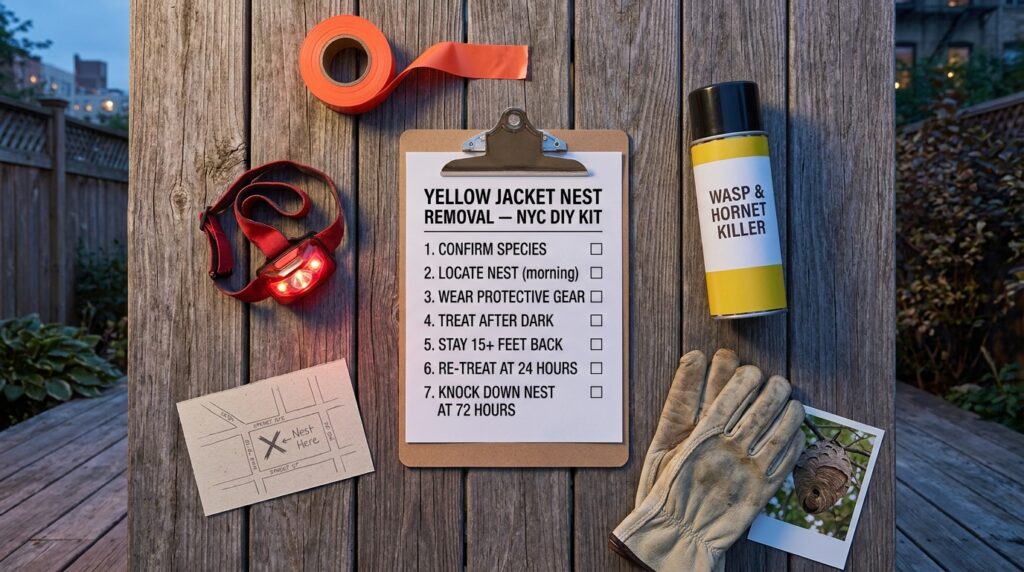
For an early-season aerial nest the size of a baseball or smaller, in an accessible location (not in a wall void, not above eye level, not on a fire escape), the DIY approach can work. Here’s the protocol that’s worked for our customers across NYC backyards:
Timing matters more than product. Treat after dark (10 p.m. or later) or before dawn (5 a.m. or earlier) — yellow jackets return to the nest at night, are sluggish in the dark, and most of the colony will be inside the nest when you treat. Daytime treatment kills the workers outside the nest and leaves the colony intact to defend.
Equipment: Wear thick long-sleeve clothing tucked into gloves and pants tucked into boots. A bee/wasp veil over your head is ideal but a heavy hooded sweatshirt works. Stand at least 10 feet from the nest. Use a wasp spray that shoots a stream 15–20 feet (not a fogger) — Spectracide PRO or Raid Wasp & Hornet Killer are the most accessible retail options. Per the EPA’s guidance on insect repellents and pesticides, follow the label exactly — overspray doesn’t help and may damage paint or siding.
The 4-step DIY method:
- Locate the nest entry during daylight and mark it (a piece of bright tape on the wall, a stake in the lawn near a ground nest) so you can find it in the dark. Don’t approach the nest during daylight.
- Return at 10 p.m. or later with a red headlamp or red-filtered flashlight (yellow jackets are far less responsive to red light than white light). White light wakes them up; red light lets you see without triggering defensive behavior.
- Spray a 5–10 second continuous stream directly into the nest entry from 15–20 feet away. Stay upwind. Empty roughly half the can on the nest entry, then back away calmly — do not run, as fast movement triggers chase behavior even at night.
- Re-treat 24 hours later at the same time. Check the entry the next morning — if you see no activity for 48 hours, the colony is dead. Knock down the aerial nest after 72 hours of no activity, or fill the ground hole with sand and seal it.
If you can’t get within 20 feet of the nest, can’t see the entry clearly, or are allergic to bee/wasp stings, DO NOT attempt DIY treatment. Yellow jackets will pursue a perceived threat for up to 100 yards.
When Is an NYC Yellow Jacket Nest Too Big or Too Dangerous for DIY?
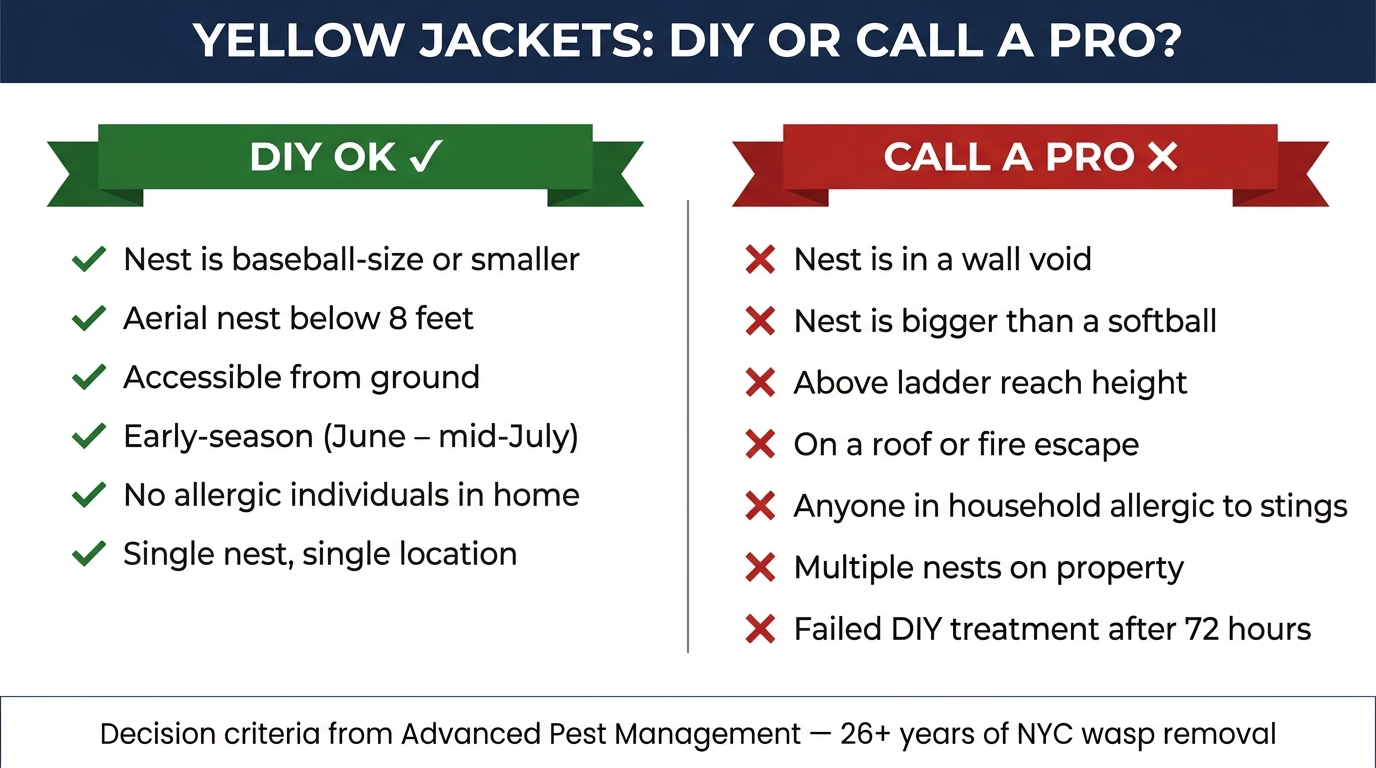
Five scenarios where you should skip DIY and call a pro:
- The nest is in a wall void. Spraying the entry point will kill some workers, but the colony will simply chew through interior drywall looking for a new exit. We’ve responded to NYC homes where DIY-treated wall-void nests resulted in dozens of yellow jackets emerging through bedroom electrical outlets.
- The nest is bigger than a softball. Late-season nests (August onward) can have 1,000+ workers. Retail wasp spray doesn’t have the volume to kill a colony that size in one application, and the survivors will be aggressive for days.
- The nest is above ladder-reach height or on a roof. Spraying upward at a nest above your head means the spray (and dead/dying yellow jackets) falls back down on you. Ladder work near a nest is significantly more dangerous than ground-level treatment.
- Anyone in your household is allergic to stings. Even a single sting can trigger an anaphylactic reaction in allergic individuals. Per CDC guidance on insect sting allergies, allergic households should not attempt DIY wasp treatment.
- You can’t approach the nest safely. Nests on fire escapes, in narrow alley spaces between buildings, or near outdoor stairs where you’d have to retreat through the nest’s flight path are all pro-only situations.
Professional yellow jacket nest removal in NYC typically runs $200–$400 for a single nest in an accessible location, $400–$700 for wall-void or ladder-access work, and $600–$1,200+ for multiple nests or complex commercial properties. Same-day service is standard during peak season for any borough.
Yellow jackets swarming your NYC yard?
26+ years removing NYC wasp and hornet nests. Same-day service in summer, no annual contracts, and a free yard inspection that's waived when you book.
What NYC-Specific Yellow Jacket Hazards Should You Know Before You Try to Get Rid of a Nest?
Yellow jackets in NYC come with a few city-specific risks that aren’t in the national how-to guides:
Outdoor restaurant dining and food vendors. Yellow jackets become heavily attracted to sugary drinks and protein-based foods by late summer (their natural insect prey runs low, so they shift to scavenging). Outdoor dining sheds, food trucks, and stoop hangouts are all yellow jacket magnets in August and September. Cover drinks, keep food covered until you eat, and check soda cans before sipping — there are several confirmed NYC ER visits each year from people who drank a yellow jacket inside a can.
NYC schoolyards and playgrounds. Yellow jackets nesting in playground equipment, under park benches, and in the wood-chip ground cover are a real risk during late-summer recess and after-school hours. Reportable to 311 for public-property treatment by NYC Parks Pest Management.
Fire-escape exits. A yellow jacket nest blocking a fire-escape exit is a code violation in NYC. If you discover one, document it and report to your building management immediately. If management doesn’t act within 48 hours, this is reportable to HPD via 311.
Compost bins and outdoor garbage. Brooklyn and Queens backyards with compost setups attract yellow jackets in late summer. Keep compost covered and rinse recycling containers; yellow jackets investigating the smell of beer/soda residue on cans will linger and build small satellite nests nearby.
Backyard pools. Yellow jackets are attracted to water, especially in late summer drought conditions. Pool decks, pool floats stored on the ground, and pool toys left in damp grass are all common nest discovery spots.
How Do You Stop Yellow Jackets From Coming Back to Your NYC Patio or Backyard?
Prevention is much easier (and cheaper) than removal. Five things you can do this week to make your NYC yard or patio less attractive to yellow jackets:
- Fill abandoned rodent burrows in your lawn. Yellow jackets exploit existing holes — they don’t dig their own. Fill any hole you see in your lawn or near the foundation with dirt or sand.
- Inspect and seal entry points on the house. Walk the perimeter of your house once in late May and once in late June, looking for gaps around the gas meter, dryer vent, AC line set, and any siding gaps. Caulk holes the size of a pencil or larger. Per Cornell IPM’s stinging insect guidance, structural exclusion is the highest-leverage prevention move.
- Don’t leave sweet drinks or food uncovered outdoors after July 4th. Yellow jackets pivot from insect prey to sugar scavenging in mid-to-late summer. Cover drinks (especially cans), keep food covered, and clean up immediately after outdoor meals.
- Hang a fake “wasp nest” decoy. Yellow jackets are territorial — they won’t build within 100–200 feet of an existing colony. A simple paper-bag decoy hung from your patio in early May can deter colonies from establishing on your property. Effectiveness varies but it’s a $5 experiment that sometimes works.
- Maintain shrubs and trees. Dense overgrown shrubs (especially boxwood, yew, juniper) are textbook yellow jacket nesting sites. Annual spring pruning to keep shrubs open and airy makes them less attractive.
Trapping is widely sold but rarely effective for nest elimination — yellow jacket traps catch foraging workers but don’t impact the colony’s reproductive capacity. They’re useful for reducing the “annoyance count” of yellow jackets around a single outdoor dining area for a few weeks; they’re not a substitute for nest removal.
When Should You Call an NYC Pro vs Try Another DIY Yellow Jacket Pass?
Honest answer: if your first DIY treatment didn’t work (you still see active yellow jackets returning to the same entry 72 hours later), the nest is bigger than you thought, your spray didn’t penetrate the nest cavity deep enough, or you’re dealing with a wall-void colony that’s now alerted and defensive. Trying a second DIY pass on a colony that’s already been hit once is significantly more dangerous than the first attempt because the workers are aggressive and the colony has had time to mobilize defenders.
Call a pro instead in these cases:
- Failed DIY treatment after 48–72 hours
- Nest discovered after first DIY pass to be larger than the visible entry suggested
- Wall-void or attic nest of any size
- Aerial nest above 8 feet (ladder territory)
- Allergic individual in the household
- Multiple nests on the same property
- Commercial property or rental where liability matters
NYC professional wasp removal is fast — most jobs are 30–60 minutes on-site once we arrive, single-treatment kills with same-night follow-up if needed, and includes nest removal so you don’t have to deal with the dead nest yourself. Most NYC pros (us included) offer free re-treatment if the original nest isn’t fully eliminated within 7 days.
The Bottom Line: Your NYC Yellow Jacket Action Plan
If you’ve spotted yellow jackets in your NYC yard or patio this week, here’s the order to act: (1) confirm species by checking against the ID list above — yellow jackets vs honeybees vs paper wasps need different responses, (2) locate the nest by watching morning flight patterns, (3) assess size and location against the DIY-vs-pro criteria, (4) if DIY is appropriate, treat after dark with a wasp-spray stream from 15+ feet away and re-treat at 24 hours, and (5) if any DIY criteria fail, skip the experiment and call a pro — yellow jacket stings escalate fast and a wall-void nest discovered after a failed DIY pass is much more dangerous than the original problem.
The biggest mistake we see every August is homeowners who attempted DIY in late July, didn’t fully eliminate the colony, and then call us for an emergency removal in mid-August when the colony has tripled in size and defenders are aggressive. Catching yellow jackets in June or early July — when colonies are small and DIY-tractable — is the single highest-leverage move for the rest of your summer.
If you’d rather skip the DIY experiment and have it handled today, our team offers same-day yellow jacket and wasp removal across all five NYC boroughs, with a 27-person team, 26 years of route experience, and a single-treatment guarantee that includes nest removal and 7-day free re-treatment if anything survives. Lisa or one of our front-office team can usually book a same-day inspection during peak season, and the quote you get itemizes whether the nest needs single-spray treatment, wall-void dust application, or aerial-nest extraction.