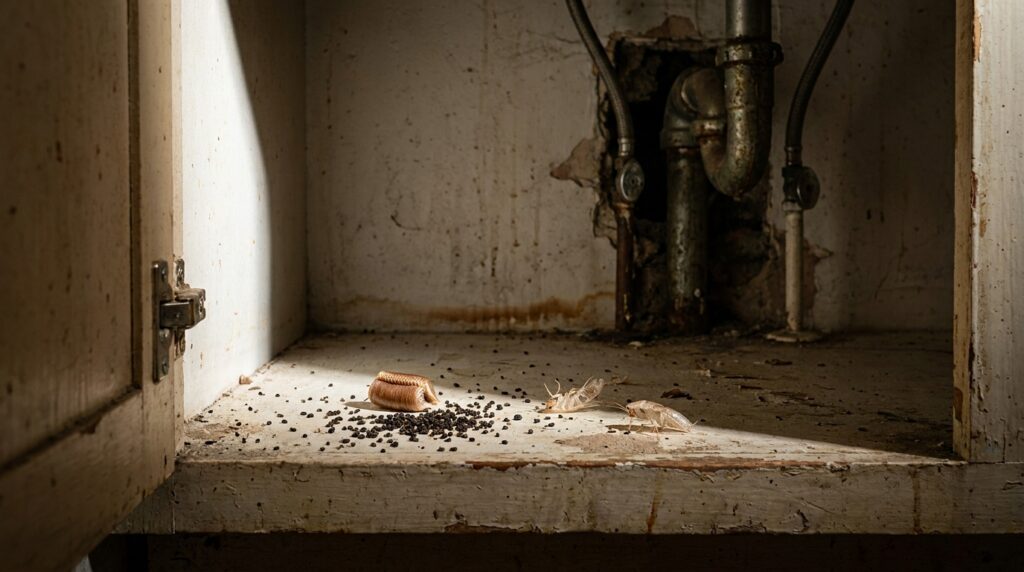
If you’ve spotted a roach scurry across your Bronx kitchen floor at 2 a.m., found small black grain-like droppings under your sink, or smelled a musty oily odor that wasn’t there a week ago, you’re not crazy and you’re not alone — you’re seeing the early signs of a cockroach infestation that’s about to get exponentially worse if you don’t act in the next 7 to 14 days. After 26 years running cockroach jobs across every NYC borough, our team has learned that Bronx cockroach calls follow a specific pattern: pre-war walk-up infrastructure, shared-wall transmission, and tenant under-reporting that lets a 2-roach problem become a 200-roach problem in 60 days. The Bronx had over 22,000 311 cockroach complaints in 2024 alone per NYC Open Data — second-highest borough on a per-capita basis after Brooklyn.
This guide walks through the 8 specific signs of a roach infestation in a Bronx apartment, which Bronx neighborhoods have the worst recurring cockroach pressure, where to look first in pre-war walk-ups specifically, and what your tenant rights are when the landlord drags their feet. If you’d rather skip the inspection and book professional cockroach control in the Bronx for a free walkthrough today, our front-office team can usually book a same-day inspection. But if you want to know exactly what you’re dealing with before that conversation, read on.
Roaches in your Bronx apartment?
26+ years treating Bronx roaches. Gel bait, wall-void dust, and IGR cycles that finish the colony, not just the visible ones, no annual contracts, and a free inspection that's waived when you book.
What Are the First Signs of Roaches in a Bronx Apartment?
Most Bronx tenants don’t realize they have roaches until they actually see one running across the floor — by which point the colony is established and the population is in the hundreds. The earlier signs show up days or weeks before the first sighting, and catching them at this stage turns a $300 single-visit treatment into a $50 DIY fix. Here are the 8 signs our techs check first:
- Droppings that look like coffee grounds or black grains of rice. German cockroach droppings are small (about 1 mm), dark, and concentrated near nesting areas — inside cabinet corners, behind the stove, under the sink, along the baseboard. Per Oregon State University’s National Pesticide Information Center, fresh droppings are dark and shiny; old droppings are gray and crumbly. Find a fresh dropping = active roach in the last 24 to 48 hours.
- Musty oily odor. An established cockroach population in a Bronx apartment produces a distinctive musty, slightly damp, greasy smell. Most tenants describe it as “stale” or “off” or “like something rotting somewhere.” If you walk into your Bronx apartment after being away for a few days and notice the smell, the colony is established.
- Egg cases (oothecae). Tan to dark brown, purse-shaped, about 8 mm long, containing 30 to 48 eggs. Female German cockroaches carry the case until just before hatching and deposit them in crevices — inside cabinet hinges, behind kitchen drawers, in the bottom of the dishwasher gasket. Finding even one egg case means a breeding population.
- Shed exoskeletons. Roaches molt 5 to 6 times before becoming adults. The cast skins look like translucent brown shell fragments scattered near harborage. Concentrated shed skins (10+ in a small area) = active growing population.
- Smear marks. Roaches walking along the same paths leave brown greasy smears where their bodies rub against walls and baseboards. Look along the bottom 2 inches of walls in the kitchen and bathroom.
- Daytime sightings. Cockroaches are nocturnal. Seeing one during the day signals population pressure has exceeded harborage capacity — the colony is overcrowded. This is a severe-tier red flag in Bronx apartments.
- Scratching or rustling in walls at night. Established wall-void colonies make audible noise in pre-war Bronx walk-ups with plaster walls. Place your ear against an interior kitchen wall at 11 p.m. — if you hear faint scratching, you have a wall-void nest.
- Dead roaches in unexpected places. Dead roaches in light fixtures, on windowsills, or in the bathtub indicate active foraging stress (water-seeking, light disorientation). Multiple dead roaches per week without DIY treatment = thriving population that’s overgrowing its food supply.
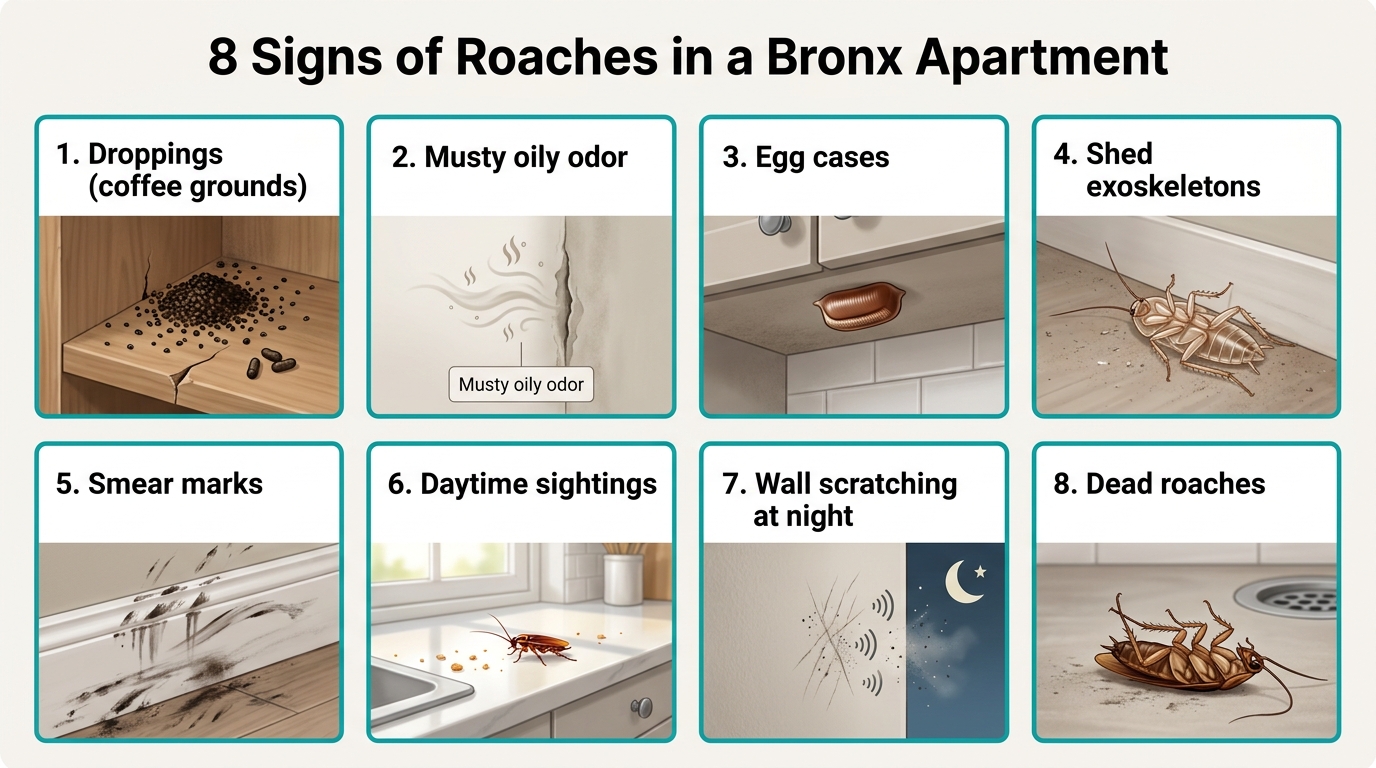
If you’ve found 3 or more of these signs in a Bronx apartment, you have an active infestation that needs treatment within 14 days — not “let’s wait and see.” German cockroach populations roughly double every 4 to 6 weeks per Rutgers NJAES research. Waiting turns a $300 fix into a $1,500 multi-visit program.
Which Bronx Neighborhoods Show the Worst Signs of Cockroach Activity?
Per NYC 311 Service Request data (publicly searchable at NYC Open Data), cockroach complaint density varies dramatically across the Bronx. The neighborhoods that consistently rank highest in cockroach complaints per resident in our service area:
- Fordham + University Heights. Dense pre-war walk-ups around the Fordham Road commercial corridor, strong restaurant density along Fordham Plaza and the Grand Concourse. Heavy German cockroach pressure in 4 to 6 story walk-ups.
- Belmont (Arthur Ave + Crotona). Italian restaurant corridor on Arthur Avenue creates building-adjacent commercial pressure. Pre-war walk-ups built 1920s to 1940s have shared dumbwaiter shafts that connect to ground-floor restaurants.
- Mott Haven + Hunts Point. Industrial-adjacent residential, older housing stock, food distribution warehouse proximity (Hunts Point Food Distribution Center) creates background cockroach pressure that radiates into nearby residential blocks.
- Tremont + Mt Hope. Older multi-family buildings with shared infrastructure and high tenant density. Per our service-call data, this corridor has the highest German cockroach call volume in the borough.
- Concourse Village. Aging mid-rise apartment buildings with central trash chutes and shared utility risers. American cockroaches (water bugs) dominate the basement and chute room pressure here, with German cockroaches in lower-floor apartments adjacent to chutes.
- Bedford Park + Norwood. Heavily multi-family with a mix of pre-war and post-war buildings. Cockroach pressure varies by individual building infrastructure — buildings with chronic complaints stay chronic.
- Jerome Park + Riverdale (mixed). Lower density and more single-family homes mean lower cockroach pressure on the whole, but pockets of older apartment buildings have steady call volume.
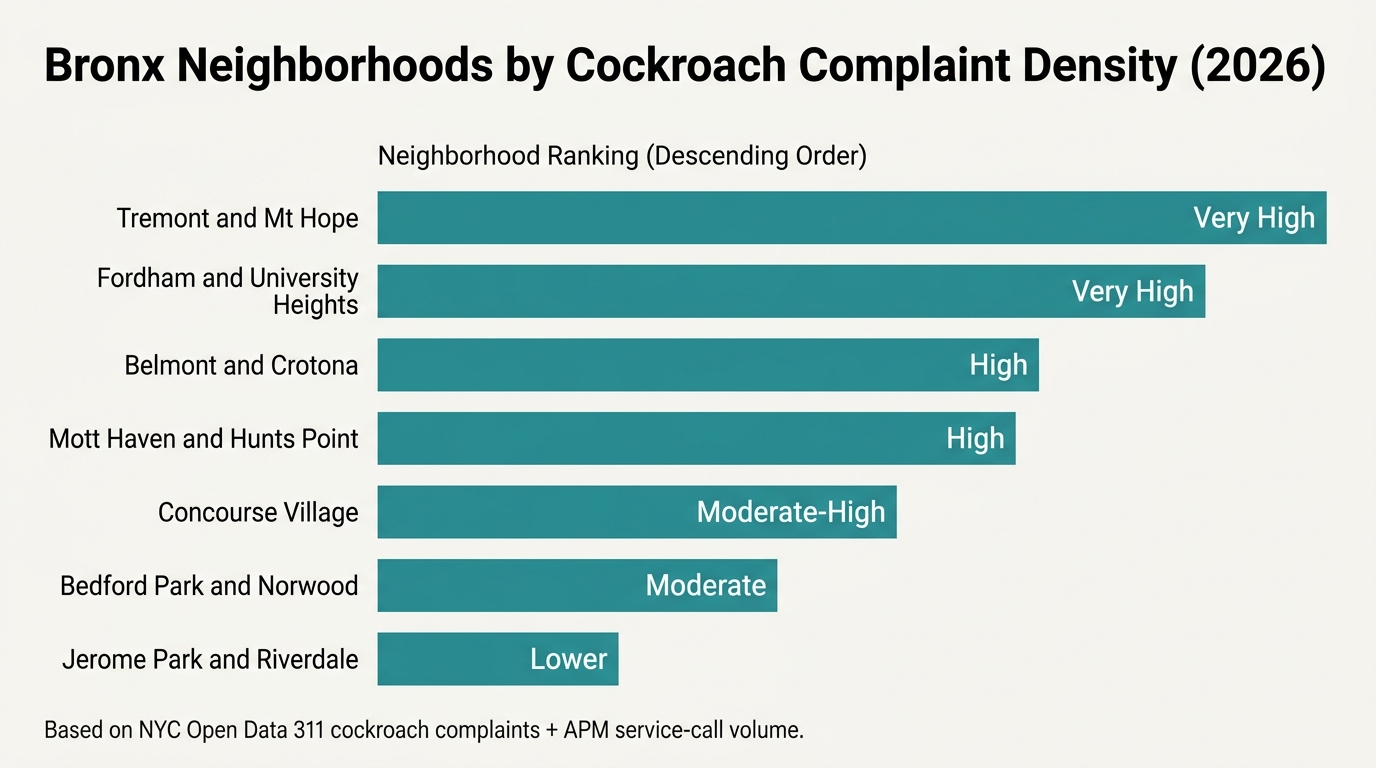
If you live in any of these neighborhoods and you’re starting to see roach signs, you’re not unlucky — you’re on a typical timeline. Many Bronx cockroach calls we run come from buildings where the same apartment has had cockroach activity in 3+ prior tenancies. The building structure invites them; tenant turnover just changes who notices. Our comparison guide for cockroach signs in Brooklyn apartments covers the borough next-door pattern; the Bronx-specific dynamics below are different.
Where Do You Spot the Earliest Signs of Roaches in a Pre-War Bronx Walk-Up?
Bronx pre-war walk-ups (1920s to 1940s construction) have a specific set of cockroach harborages that newer construction doesn’t share. After thousands of Bronx cockroach calls, our techs check the same locations first depending on building type:
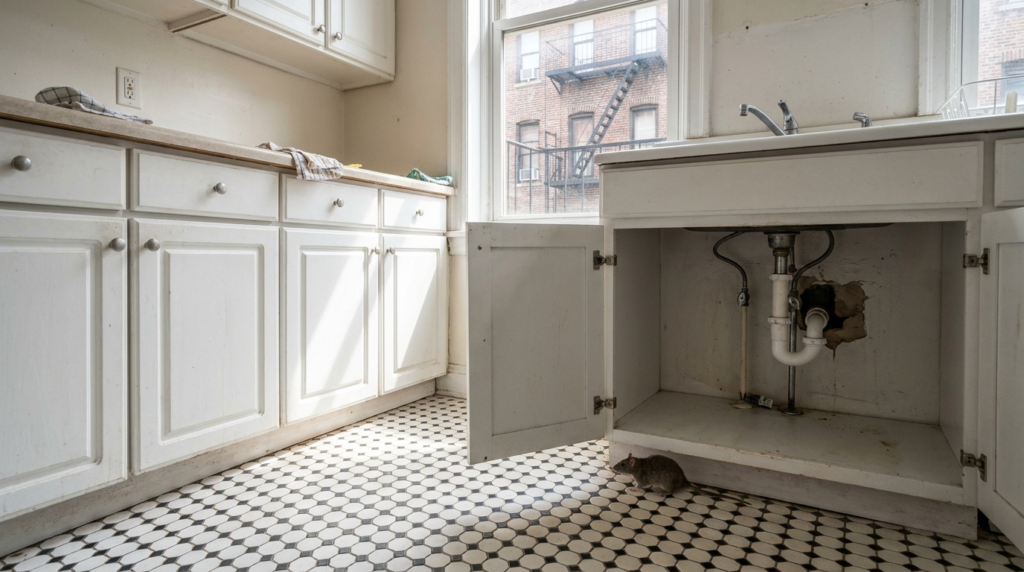
- Under the kitchen sink at plumbing penetrations. The drain pipe + supply line entry point through the wall under the sink is the #1 Bronx pre-war walk-up cockroach harborage. Plaster wall + 100-year-old plumbing gaps + moisture from the drain trap + warmth from the dishwasher = textbook German cockroach nesting site.
- Behind the stove and refrigerator. The toe-kick void under both appliances stays warm year-round and the wall behind has electrical gas penetrations. Pull each appliance out and look for grease marks, droppings, or visible foraging trails.
- Inside dumbwaiter shafts (most pre-war Bronx walk-ups). Pre-war walk-ups had dumbwaiter shafts running floor to floor. When dumbwaiters were retired in the 1960s, most were sealed at each floor with thin plywood or sheet metal. These sealed shafts are highways for German cockroaches between apartments on the same line. If your apartment’s kitchen has a small recessed wall cavity (sometimes covered by a panel near the floor), you have a former dumbwaiter shaft and possibly a nest inside.
- Around radiator pipes and steam riser penetrations. Pre-war Bronx walk-ups have steam radiators with cast-iron pipes that come up through the floor. The gap around the pipe is rarely sealed and stays warm. Cockroaches love this spot.
- Cabinet hinges and drawer slides. Wood cabinet hinges with screw holes, cabinet drawer slide mechanisms, and the hollow space behind the cabinet kickboard are all classic German cockroach harborage in pre-war Bronx kitchens.
- Inside the wall void around the breaker panel and electrical outlets. Wall penetrations for electrical work create gaps. Sealed only with paper-thin gasket on the outlet cover. Cockroaches enter the wall void from these openings and nest in the cavity.
- Bathroom: behind the toilet tank and inside the tub apron. Constant moisture + warmth + protected harborage. Look behind the toilet tank where the supply line enters the wall, and inside the access panel of any built-in bathtub.
- Trash chute room (if your building has one). Multi-unit Bronx buildings 5+ stories with shared garbage chutes will have a chute room on each floor or in the basement. American cockroaches (water bugs) nest in chute rooms and radiate out into lower-floor apartments. If your building has a chute, ALL apartments above it are getting some level of pressure.
Knowing which building type you’re in tells us — and you — where the colony came from before we even open a cabinet door. If you’ve called and described the wrong location pattern, the inspection takes 3x longer than it should.
Why Are Signs of Roaches Worse in Bronx Apartments Than Manhattan High-Rises?
This is the most common question we get from Bronx tenants who used to live in Manhattan and are surprised by their first cockroach encounter. The answer comes down to building age, building height, and shared infrastructure:
Manhattan high-rises (especially post-1990 construction) are typically built to tighter envelopes — sealed concrete floor decks between units, mechanical ventilation rather than gravity ducts, fewer construction-era gaps for cockroaches to exploit. Cockroach pressure in a 40-story Midtown tower concentrates on the ground floor (loading dock, package room, restaurant tenants) and basement; floors above the 5th or 6th are usually cockroach-free unless the building has a chronic chute problem.
The Bronx, by contrast, has a much higher concentration of pre-war wood-frame and brick walk-ups (2 to 6 stories), which are exactly the building type German cockroaches find easiest to colonize. Wood-frame construction has wall voids cockroaches can run through; pre-war brick walk-ups have floor joist gaps, sealed dumbwaiter shafts, and shared steam riser cavities that connect apartments vertically. Per Rutgers research on German cockroach biology, these structural features are the dominant reason cockroach infestations are more common in apartment buildings than detached homes.
Add restaurant density along Bronx commercial corridors (Fordham Road, Arthur Avenue, Grand Concourse, East Tremont Avenue, 161st Street near Yankee Stadium), and you have the perfect cockroach ecosystem: cheap food source + abundant nesting habitat. Manhattan’s same-density restaurant corridors are usually adjacent to newer construction or commercial-only zoning; the Bronx’s are adjacent to dense residential. Same restaurants per acre, totally different cockroach pressure depending on what’s next door.
Roaches in your Bronx apartment?
26+ years treating Bronx roaches. Gel bait, wall-void dust, and IGR cycles that finish the colony, not just the visible ones, no annual contracts, and a free inspection that's waived when you book.
What’s the Difference Between Signs of German vs American Cockroaches in the Bronx?
The two species New Yorkers actually encounter behave totally differently and need totally different treatment. Understanding which one you have determines the right next step. In the Bronx specifically, German cockroaches dominate apartment kitchens and bathrooms, while American cockroaches (water bugs) dominate basements, chute rooms, and ground-floor units:
- German cockroach (Blattella germanica). Light brown, about 1/2 inch long, two dark parallel stripes on the thorax (the back behind the head). Reproduces explosively — a single female produces 4 to 8 egg capsules with up to 48 eggs each in a 20 to 30 week lifespan, per Penn State Extension. Lives in kitchens and bathrooms. Hides in cabinet hinges, under sinks, behind appliances. This is by far the most common Bronx apartment cockroach.
- American cockroach (Periplaneta americana), also called “water bug” in NYC. Large reddish-brown, 1.5 inches long, can fly short distances. Lives in basements, laundry rooms, drains, garbage chute rooms, and building common areas. Slower reproduction than German cockroaches but more disturbing to encounter because of size. Our deep guide to water bugs in NYC is the most-read post on our site for a reason — water bug ID confusion costs Bronx tenants thousands of dollars in wrong-treatment bills.
- Oriental cockroach. Shiny dark brown, about 1 inch long, slow movers. Live in cool damp basements, around drain pipes, in crawl spaces. Less common in Bronx walk-up kitchens but show up in basement laundry rooms.
- Brown-banded cockroach. Less common in the Bronx. Prefers warm dry locations — bedrooms, electronics, picture frames. If you find these, they’re usually in a single room rather than throughout the apartment.
The treatment approach for each is completely different. German cockroaches need professional gel bait + IGR + wall-void dust over 4 to 8 weeks. American cockroaches in a basement need targeted drain treatment + perimeter baiting and often resolve in a single visit. Confusing one for the other costs Bronx tenants $300 to $1,500 in wrong-product treatment that doesn’t work. Our general guide to signs of cockroaches in NYC apartments walks through species ID in more depth.
How Bad Do the Signs of Cockroach Pressure Get in Pre-War Bronx Buildings?
Pre-war Bronx walk-ups have the highest baseline cockroach pressure of any residential building type in our service area, and it’s not close. After thousands of Bronx jobs, here’s what we typically see when we inspect a 5- to 6-story walk-up with a recent cockroach complaint:
- The complaining apartment usually has 100 to 500+ cockroaches across kitchen, bathroom, and wall voids by the time the tenant calls a pro. That’s because the visible sightings only start once the population has exceeded harborage capacity.
- 2 to 4 adjacent apartments on the same line are typically also infested via shared wall voids, sealed dumbwaiter shafts, and plumbing risers — even when those neighbors haven’t reported anything. Real elimination requires building-wide coordination.
- The building basement and chute room (if applicable) are infested. Even in walk-ups without trash chutes, the building basement often hosts an American cockroach colony that radiates pressure up through utility chases.
- Roof bulkhead trash collection rooms (top floor) often host nests too. Tenants don’t think about this, but the small enclosed room near the roof access where trash gets temporarily stored is a perfect harborage.
- Restaurant-adjacent buildings have permanent background pressure. A Bronx walk-up that shares a wall or sidewalk with a ground-floor restaurant will never be fully cockroach-free without commercial-grade building-wide treatment plus restaurant cooperation.
This is why our Bronx cockroach quotes for confirmed multi-unit pre-war walk-up infestations often start at $1,500 and run up to $5,000 to $15,000 for building-wide coordinated treatment. Single-unit treatment in a multi-unit infested building is fighting upstream — the cockroaches come back from the neighbor’s wall void within 6 weeks every time.
When Are Signs of a Bronx Cockroach Infestation Bad Enough to Call a Pro?
Honest answer: DIY can handle a single-roach early-stage problem caught within a week of first evidence, in an apartment with no shared-wall activity. Per our comprehensive NYC cockroach exterminator cost guide, the realistic DIY budget for a contained early-stage problem is $30 to $80 in bait + sealing supplies.
DIY does NOT work in these Bronx-specific scenarios — call a pro instead:
- Pre-war walk-up with shared-wall activity confirmed. If neighbors or the super has mentioned cockroaches anywhere in the building, you’re sharing one colony spread across multiple units. Building-wide treatment is the only durable fix.
- Daytime sightings. A single daytime sighting means population pressure has exceeded harborage capacity. The colony is in the high hundreds at minimum. DIY won’t catch up.
- You’ve tried Terro or hardware-store spray for 14+ days with no improvement. Per Illinois Extension’s October 2024 academic review, retail pyrethroid sprays produce under 20% mortality on wild German cockroach populations under realistic exposure. The colony is rebuilding faster than you can spray.
- Restaurant-adjacent Bronx apartment. Buildings adjacent to commercial restaurants have ongoing background pressure that requires coordinated treatment with the commercial space.
- Allergic individual or asthmatic in the household. Per Penn State research, cockroach excrement and shed skins contain allergens that trigger asthma attacks. Households with asthmatic kids should not attempt DIY — get the cockroaches eliminated quickly and professionally.
- Sub-tenant or roommate situations where you can’t access the whole apartment. DIY requires access to every cabinet, behind every appliance, under every sink. If you can’t get full access, hire a pro who can.
A real professional Bronx cockroach treatment looks like this: same-day inspection during business hours, species ID by a licensed technician (NYS DEC Cat 7A or 7C), structured gel bait + IGR + wall-void dust protocol staged over 2 to 3 visits across 4 to 8 weeks, written guarantee window. Our team specializes in wall-void drilling and Tempo Dust application plus garbage chute fogging — two specialized treatments most of our competitors skip but that finish the colony in pre-war Bronx buildings.
When Bronx Cockroach Signs Turn Into a Treatment Job, Who Pays — You or Your Landlord?
If you rent in the Bronx, this is by far the most important paragraph on this page, and the answer is almost always: your landlord pays, not you. Under New York’s Warranty of Habitability (Real Property Law §235-b) and the NYC Housing Maintenance Code, landlords are legally required to maintain rental apartments free from pest infestations — including cockroaches — and to remediate them when they appear. Per the city’s pest and pesticide laws for landlords and tenants, this is non-negotiable for nearly every Bronx rental.
Under NYC HMC §27-2017.1 and Local Law 55 (2018), landlords of multi-unit dwellings must address pest infestations within a defined window after a tenant complaint, typically 30 days from the date HPD issues a violation. Cockroach infestations are classified as Class C violations (immediately hazardous) in NYC, which means landlords must respond within 24 hours of HPD issuing the violation — significantly faster than the 30-day window for less severe pest issues.
The escalation path that consistently works in Bronx walk-ups:
- Notify the landlord or super in writing. Email is best — creates a paper trail. Photograph droppings, sightings, and any visible damage with timestamps. Notify within 7 days of first sighting.
- Call NYC 311 if the landlord doesn’t respond within 7 days. File a “Residential Pest Complaint” — cockroaches specifically. Per the NYC311 residential pest complaint guide, this triggers an HPD inspection within 24 to 72 hours in active complaints.
- HPD inspects and issues a violation if cockroaches are confirmed. The Class C classification kicks in the 24-hour landlord response requirement.
- Verify the building’s violation history at the HPD Online portal — if your Bronx building has 10+ open violations, that’s leverage in any landlord conversation.
- For severe ongoing violations, file an HP Action in housing court. Tenant rights organizations like Met Council on Housing or Legal Services NYC can help with the filing if the landlord remains unresponsive.
One Bronx-specific trap to watch for: some small landlords (owners of 3 to 4 family Bronx walk-ups) try to argue cockroaches are “your fault” because of food storage or hygiene. The warranty of habitability is non-waivable under NY law and German cockroaches in a multi-unit building are almost always a structural source (wall voids, neighboring units, shared chutes). Document the situation early with photos, notify in writing within 7 days of first sighting — you’re protected.
For NYCHA residents, pest control runs through NYCHA’s own contracted pest management program — call the NYCHA Customer Contact Center rather than booking a private exterminator. NYCHA’s treatment cadence varies dramatically by development; supplement with documentation and 311 escalation if response is slow.
The Bottom Line: Your Bronx Cockroach Action Plan
If you’ve worked through this guide and found 3 or more signs of an active cockroach infestation in your Bronx apartment, here’s the order to act: (1) document the evidence with photos before notifying anyone — date-stamped photos strengthen every subsequent step; (2) notify your landlord or super in writing within 7 days of first sighting; (3) if the building doesn’t respond within 7 days, file a 311 residential pest complaint to trigger HPD inspection; (4) call a licensed Bronx pest control company for a free inspection — even if the landlord will ultimately pay, getting an expert opinion in writing strengthens your position with HPD; (5) cover the basics yourself: clean kitchen counters nightly, store dry goods in sealed containers, rinse takeout containers before tossing, fix any plumbing leaks.
Most early-stage Bronx cockroach problems we see are populations of 50 to 200 roaches active for under 60 days — a $400 to $900 professional 2-visit program ends the problem. Wait 6 months and that same problem becomes a $1,500 to $3,000 multi-room job with wall-void dusting because the population has bred, expanded territory, and likely transmitted to adjacent apartments via shared walls.
If you’re staring at roaches under your kitchen sink in Fordham, Belmont, Tremont, Mott Haven, or anywhere else in the Bronx right now, our team offers free same-day cockroach inspections across all five NYC boroughs — a 27-person team, 26 years of route experience across pre-war walk-ups, post-war mid-rises, and detached homes, and a wall-void dusting and chute-treatment approach that actually closes the problem rather than just spraying what you can see. Lisa or one of our front-office team can usually book a same-day inspection, and the quote you get will itemize species ID, scope of work, the specific products being applied, visit schedule, and guarantee window so you can compare it apples-to-apples against anyone else.