If you spotted termite swarmers (winged reproductives) flying near a window in your Brooklyn brownstone this past April or May, found small mud tubes running up the foundation of your Queens row home, or discovered hollow-sounding wood in the basement framing of your Bronx single-family — you have a termite problem, and it’s expensive, but it’s nowhere near as expensive as ignoring it for another year. After 26 years running termite treatments across every NYC borough, our team has learned that the gap between a $1,500 spot treatment and a $25,000 structural repair bill comes down to one thing: how long the colony was active before you treated it. NYC termite treatment costs land above national averages because of foundation type, building age, and access dynamics — but treatment is always cheaper than damage.
This guide breaks down what NYC termite treatment actually costs in 2026 by species (subterranean vs Formosan), foundation type (slab vs basement vs deep brownstone), and treatment method (liquid soil treatment vs bait stations vs combination). We’ll walk through what should be on a real quote, why NYC-specific building infrastructure adds cost, who pays in co-op and landlord situations, and the red flags. If you’d rather skip the research and book professional NYC termite treatment for a free inspection, our front-office team can usually book a same-week inspection. Read on if you want a real number.
Termite swarmers around your NYC foundation?
26+ years treating NYC termites. Liquid soil treatment, Sentricon bait stations, and brownstone foundation drilling that actually eliminates the colony, no annual contracts, and a free inspection that's waived when you book.
What Does NYC Termite Treatment Cost on Average in 2026?
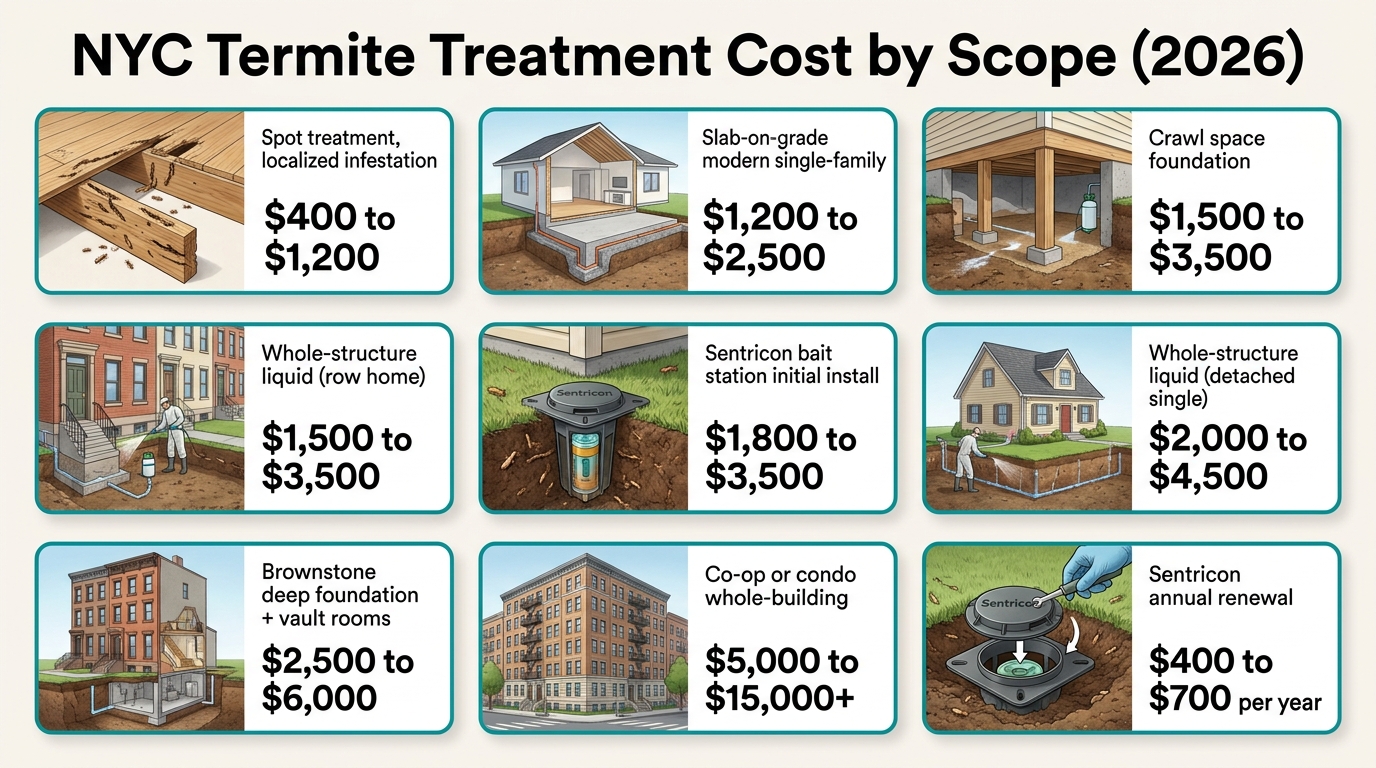
For most NYC termite treatment jobs we quote in 2026, real pricing breaks down by scope: $400 to $1,200 for spot treatment on a single localized infestation caught early (one area of damage, limited foundation exposure), $1,500 to $4,500 for whole-structure liquid soil treatment on a typical NYC row home or detached single-family, $1,800 to $3,500 initial plus $400 to $700 annual renewal for Sentricon bait station programs, $2,500 to $6,000 for brownstone deep-foundation treatment requiring multi-day work and basement access, and $5,000 to $15,000+ for multi-family or commercial building-wide treatment. A standalone termite inspection runs $200 to $400 — usually waived when you book treatment. Annual renewal under our standard guarantee structure runs $300 to $500.
National cost averages run lower because they’re built on suburban single-family work. Angi’s 2026 termite treatment data puts the typical range at $375 to $1,500 with a national average of $560 for liquid treatment. Our NYC quotes run above those averages because NYC foundations (deep brownstone footings, slab-on-grade in modern construction, mixed basement-slab in row homes) all require different access methods, often more drilling, and sometimes interior access through finished spaces that suburban single-family work skips entirely.
Here’s how NYC termite treatment quotes typically shake out by scope:
| Scope | Typical NYC cost | Notes |
|---|---|---|
| Spot treatment, single localized infestation | $400 to $1,200 | Limited foundation exposure, caught early |
| Whole-structure liquid soil treatment (row home) | $1,500 to $3,500 | Standard 1,500-2,500 sq ft attached row home |
| Whole-structure liquid (detached single-family) | $2,000 to $4,500 | Larger perimeter, exposed foundation |
| Sentricon bait station program (initial install) | $1,800 to $3,500 | 10-15 stations around perimeter |
| Sentricon annual renewal + monitoring | $400 to $700/year | Ongoing colony elimination + guarantee |
| Brownstone deep-foundation treatment | $2,500 to $6,000 | Multi-day, basement + cellar + sidewalk vault access |
| Co-op or condo whole-building | $5,000 to $15,000+ | Multi-unit, common-charge funded |
| Commercial building treatment | $3,500 to $25,000+ | Depends on footprint and structure age |
| Annual inspection + guarantee renewal | $200 to $400 | Standard maintenance after initial treatment |
The single biggest cost variable is treatment method — liquid soil treatment is a one-time upfront cost with optional annual renewal, while bait station programs are lower upfront but include mandatory annual fees. Over a 5-year horizon, the two methods land within $500 of each other for typical NYC properties. Choose based on the building structure (bait stations don’t work well around brownstone vault sidewalks; liquid treatment is hard in row homes with shared walls), not just initial price.
Why Is Termite Treatment So Expensive in NYC Compared to the Suburbs?
NYC termite treatment pricing runs above national averages for four structural reasons:
Foundation depth and complexity. NYC brownstones, row homes, and pre-war buildings often have foundations 6 to 10 feet deep with vault rooms (the underground spaces beneath the sidewalk where coal was stored historically), basement extensions, and decades of stone-and-mortar foundation repairs. Treating subterranean termites in this kind of foundation requires drilling through concrete floors, accessing vault rooms from interior, and applying termiticide to multiple discrete zones — significantly more labor than a suburban slab-on-grade.
Building access dynamics. Brownstone basements often have finished apartments. Row homes share walls with neighbors. Multi-family buildings require landlord and tenant coordination. Treatment that takes 1 to 2 days in a detached suburban home can stretch to 3 to 5 days in NYC because of access scheduling.
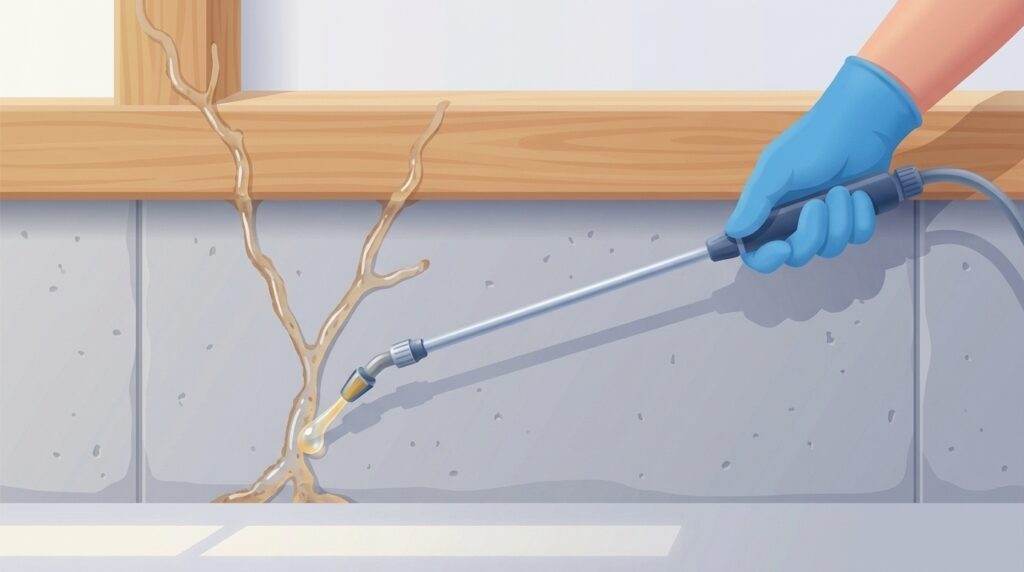
Drilling and patch-repair labor. Liquid soil treatment around a brownstone perimeter requires drilling 12-inch-deep holes through sidewalk concrete every 12 to 18 inches, injecting termiticide, then patching the drill holes. Sidewalk drilling alone adds 4 to 8 hours of labor and material on a typical brownstone perimeter.
Post-swarmer-season surge pricing. NYC termite swarmer season peaks late March through April. Homeowners who saw swarmers in spring now researching cost are competing for technician time during the heaviest treatment season. Pricing is roughly flat year-round but availability tightens dramatically in late spring and early summer.
For broader context on the species ID step, our guide to flying termites in NYC walks through the swarmer ID step and our guide to signs of termites in NYC covers structural evidence patterns.
What’s Actually Included in a Real NYC Termite Treatment Quote?
A real termite treatment quote should itemize at least six things. Here’s what we include:
- WDI inspection (wood-destroying insect). Before any treatment, a licensed inspector documents the structure, identifies species, marks active mud tubes, probes wood for hollow spots, and produces a written report. NYS pesticide applicators (Cat 7B) are licensed to issue WDI reports that satisfy mortgage and real estate disclosure requirements. Inspection runs $200 to $400 standalone; usually waived when treatment is booked.
- Species and colony location confirmation. Subterranean termites (the dominant NYC species) live in soil and tunnel up to wood; Formosan subterranean termites (less common but reported in NY) are more aggressive; drywood termites (rare in NYC, more common in southern states) require fumigation. Treatment differs dramatically by species.
- Treatment method selection. Liquid soil treatment with Termidor or Premise (creates a chemical barrier in the soil around the foundation), bait station program with Sentricon or Advance TBS (colonies feed on bait and carry slow-acting growth regulator back to the colony), or combination approach for complex structures. Per Penn State Extension’s subterranean termite guide, both approaches achieve full colony elimination when applied correctly.
- Drilling and access scope. Itemize the perimeter linear footage requiring drilling, interior slab penetrations needed, and any sidewalk vault or cellar access. This drives a significant portion of total labor cost.
- Guarantee window. Standard NYC termite treatment includes a 1-year guarantee with annual renewal option ($300 to $500/year typical). Renewal keeps the guarantee active for re-treatment at no charge if termites return. Without renewal, the guarantee expires after the first year.
- Follow-up monitoring schedule. Bait station programs include quarterly station inspection; liquid treatment programs typically include annual inspection. The schedule should be in writing.
If your termite job is part of a real estate transaction (NYC sale, refinance, or co-op board approval), let us know during the inspection — we can issue the NPMA-33 WDI report format that title companies and lenders require.
How Do Subterranean vs Formosan Termite Treatment Costs Differ in NYC?
Species ID is the second biggest cost driver after foundation type. NYC has primarily two termite species to know about:
| Species | NYC prevalence | Treatment approach | Typical NYC cost range |
|---|---|---|---|
| Eastern Subterranean (Reticulitermes flavipes) | By far the most common NYC species. Lives in soil, tunnels up to wood through mud tubes. | Liquid soil treatment OR Sentricon bait station | $1,500 to $4,500 program |
| Formosan Subterranean (Coptotermes formosanus) | Rarely if ever found locally. More aggressive, larger colonies, faster damage. | Liquid + bait combination, often requires interior treatment too | $3,000 to $8,000+ program |
| Drywood Termites | Rare in NYC. More common in southern states. Don’t need soil contact. | Fumigation (whole-house tenting) or spot treatment | $1,500 to $9,000 depending on scope |
The most common NYC mistake is treating Eastern Subterranean termites with the wrong product or method. Spot treatment of a single mud tube without addressing the broader foundation perimeter leaves the colony intact. Per EPA’s safe pest control guidance, modern termiticides like Termidor (fipronil) and Premise (imidacloprid) are non-repellent — termites don’t avoid the treated zone, they walk through it and carry the active ingredient back to the colony. That’s why a partial-perimeter treatment fails: termites just enter through the untreated section.
For a deeper look at NYC termite identification, our flying termites in NYC guide walks through swarmer ID (the most common way New Yorkers first discover termites), and our termite swarm season guide for Long Island and Queens covers the spring timing pattern.
How Does NYC Foundation Type Change Termite Treatment Cost?
Foundation type is the single biggest NYC-specific cost driver. Here’s how it plays out:
- Slab-on-grade (modern post-1990 construction). Cheapest tier. Concrete slab with no basement. Treatment is perimeter drilling + injection. $1,200 to $2,500 typical.
- Crawl space foundation (some Queens detached homes, parts of Staten Island). Staten Island termite control often runs into this foundation type. Moderate tier. Access through crawl space hatch, treat sill plates + soil. $1,500 to $3,500 typical.
- Finished basement (most NYC row homes and small detached). Mid-to-high tier. Treat exterior perimeter + interior slab drilling around finished basement walls. $1,800 to $4,000 typical.
- Brownstone with vault rooms + deep foundation. Highest tier. Multi-day work: exterior perimeter, sidewalk vault interior access (often through cellar from interior), sub-cellar treatment if applicable. $2,500 to $6,000+ typical.
- Co-op or apartment building with multiple foundation penetrations. Building-wide budget. Cellar access, common-area treatment, sometimes individual unit treatment for visible damage. $5,000 to $15,000+ typical.
- Commercial restaurant or food-service property. Premium tier per DOH compliance + after-hours scheduling. $3,500 to $25,000+ depending on footprint.
Brownstone homeowners should expect to pay 50 to 100% more than the suburban national average for an equivalent infestation scope, and it’s worth every dollar — the structural value of a $2 million Park Slope or Brooklyn Heights brownstone makes Brooklyn termite treatment a rounding error compared to the $25,000 to $100,000 structural repair bill that a deferred subterranean termite infestation can produce over 3 to 5 years.
Termite swarmers around your NYC foundation?
26+ years treating NYC termites. Liquid soil treatment, Sentricon bait stations, and brownstone foundation drilling that actually eliminates the colony, no annual contracts, and a free inspection that's waived when you book.
What NYC-Specific Factors Drive Termite Treatment Cost Up?
A few NYC-specific realities consistently push termite quotes above the national average:
Sidewalk vault treatment. Brownstones, row homes, and many pre-war commercial buildings have sidewalk vault rooms — underground spaces beneath the sidewalk that were originally used for coal delivery. These vaults sit beneath the public sidewalk and are typically accessed through the building cellar via a steel hatch or doorway. Termite treatment in vault rooms requires interior access, sometimes coordination with adjacent buildings for shared walls, and product selection compatible with damp underground conditions. Vault treatment alone adds $400 to $1,500 to a brownstone job.
Sidewalk drilling and patch-repair. Liquid termiticide treatment around the foundation perimeter requires drilling through sidewalk concrete and patching after injection. NYC DOT sidewalk repair standards mean the patches need to meet city specs. We handle this in-house at most jobs; some operators subcontract the concrete patch work at additional cost.
Co-op and condo board approval cycles. Multi-family building termite treatment typically requires board approval. Boards meet monthly or quarterly. A termite job we could complete in 2 weeks stretches to 6 to 12 weeks when board approval scheduling is the rate-limiting step.
Shared-wall row home treatment dynamics. Row home termite treatment that doesn’t include adjacent units is fighting upstream — the colony often spans multiple units via shared foundation walls. Either coordinate with neighbors for combined treatment (significantly reduces per-unit cost) or accept that your unit treatment may need to be re-applied if the neighbor stays untreated.
NYC DOB permits for major drilling work. Drilling more than 12 inches into building structural elements may require NYC Department of Buildings permits depending on the building type. Most termite treatment falls below this threshold, but commercial and multi-family work can trigger permit requirements that add $200 to $800.
Should NYC Termite Treatment Be a One-Time Cost or Annual?
Honest answer: termites are not a one-and-done pest. Even after successful initial treatment, NYC properties remain at low-but-real ongoing termite pressure because soil contact and moisture conditions don’t change. Here’s how the math works:
| Plan type | Typical NYC cost | Best for | Honest tradeoff |
|---|---|---|---|
| One-time treatment without renewal | $1,500 to $4,500 upfront | Property sale, mortgage requirement, single infestation | 1-year guarantee expires; re-infestation in 3-5 years requires full re-treatment |
| Liquid treatment + annual renewal | $1,500-$4,500 + $300-$500/year | Long-term owner-occupiers, brownstone owners | Keeps guarantee active indefinitely; re-treatment at no charge if termites return |
| Sentricon bait station program | $1,800-$3,500 initial + $400-$700/year | Properties where liquid treatment is hard (heavy landscaping, vault complexity) | Lower upfront, mandatory annual fee, colony elimination through bait |
| Annual inspection-only program | $200-$400/year | Properties without active termites but high risk (brownstone in active block, history of nearby infestations) | Catches new infestations early; doesn’t include guarantee |
| Commercial building-wide annual contract | $1,500-$5,000+/year | Co-ops, condos, commercial properties | Bundled inspection + treatment + guarantee |
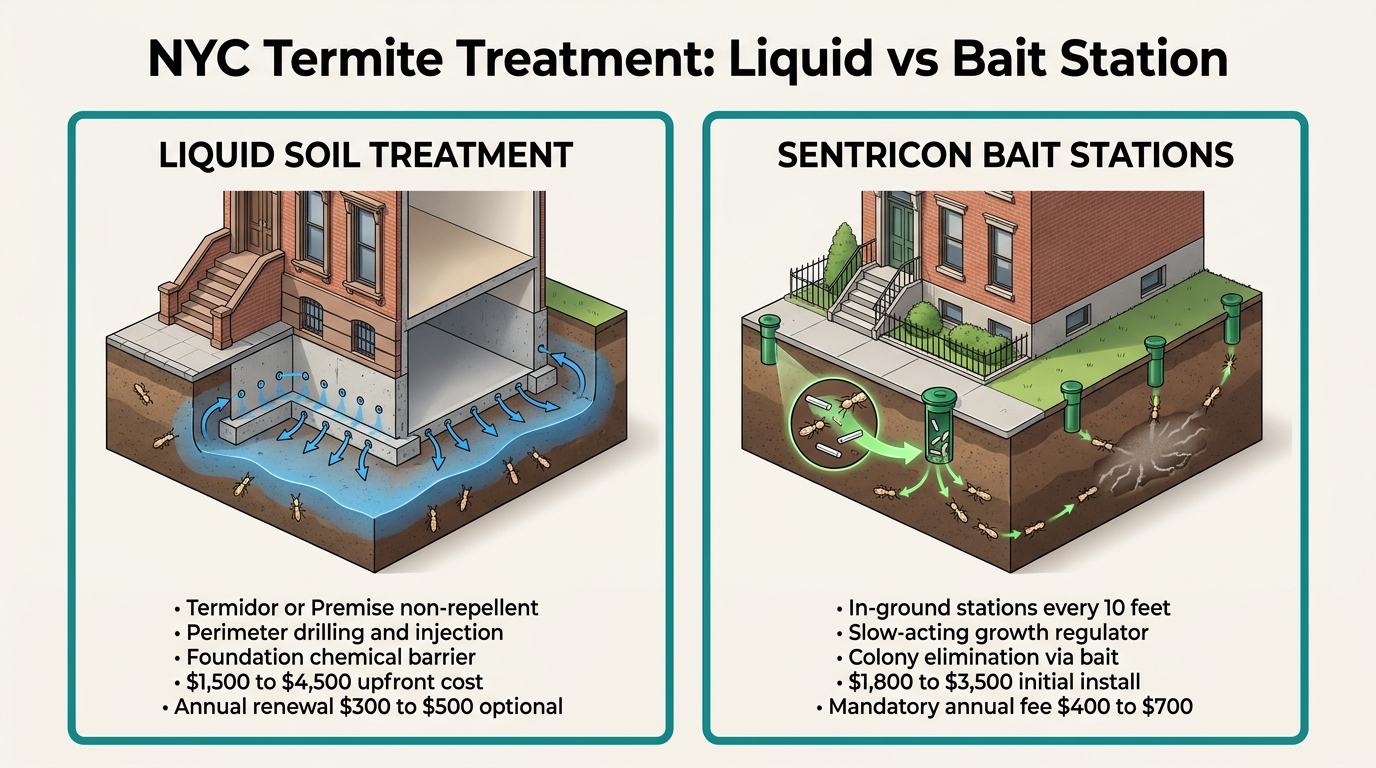
For most NYC owner-occupied homeowners (brownstones, row homes, detached singles), our recommendation is liquid treatment + annual renewal — the upfront cost is the biggest line item, but the annual renewal at $300 to $500 buys peace of mind and keeps the guarantee active. For properties where liquid treatment is structurally hard, Sentricon bait station programs work well and have comparable 5-year economics.
Who Pays for NYC Termite Treatment — Homeowner, Co-op Board, or Landlord?
Termite treatment in NYC is structurally different from cockroach or rodent treatment because termites damage the building itself, not just tenant comfort. The cost question depends on building type:
- Single-family owner-occupied (Bronx, Queens, Staten Island, parts of Brooklyn). Cost is yours. The structural repair value the treatment protects makes it worth every dollar.
- Brownstone owner-occupied (Brooklyn, Manhattan). Cost is yours, often with significant brownstone-specific premium, and a termite exterminator in Manhattan will price the vault and deep-foundation work accordingly. Talk to your insurance about whether your homeowners policy covers any portion of damage discovery costs.
- Co-op apartment building. Common-area termite treatment (foundation, basement, common walls) is the building’s responsibility funded by common charges. In-unit treatment for damage discovered in an individual apartment is typically the unit owner’s cost, though board policies vary.
- Condo building. Similar to co-op — common elements are building responsibility, in-unit elements are unit owner. Bylaws determine the specifics.
- Multi-family rental (3+ units, including 3-4 family Bronx walk-ups). Landlord responsibility under the Warranty of Habitability — termites threaten habitability of the structure. Per the city’s pest and pesticide laws, landlords must address structural pest issues.
- Single-family rental. Depends on the lease. Most leases assign the landlord responsibility for structural pest issues including termites; tenants are responsible for cosmetic and incidental pest issues.
For NYCHA developments, termite treatment runs through NYCHA’s contracted pest management program — tenant complaints route through the NYCHA Customer Contact Center.
One specific NYC dynamic worth knowing: many NYC mortgage refinancing and home equity loan applications require a current WDI (wood-destroying insect) report. The cost of the WDI inspection ($200 to $400) is typically borne by the homeowner as part of the refinancing process. If termites are found during the inspection, treatment may be required before the loan closes.
The Bottom Line: NYC Termite Treatment Cost in 2026
If you saw termite swarmers around your NYC property this past spring or found mud tubes on your foundation: (1) get a professional WDI inspection within 30 days — colonies grow continuously and damage compounds; (2) confirm species and infestation scope before any treatment commitment; (3) for liquid treatment, expect $1,500 to $4,500 upfront for a typical row home or detached single; (4) for bait station programs, expect $1,800 to $3,500 initial + $400 to $700 annual; (5) for brownstones, budget $2,500 to $6,000+ because of vault and deep-foundation work; (6) take the annual renewal — termite re-pressure is real, the guarantee is worth it.
For most NYC homeowners, realistic 2026 termite treatment pricing breaks down as: $1,500 to $4,500 for liquid soil treatment on a typical row home or detached single-family, $1,800 to $3,500 initial + annual renewal for Sentricon bait station programs, $2,500 to $6,000+ for brownstones with vault rooms and deep foundations, and $5,000 to $15,000+ for multi-family co-op or condo whole-building work. If you’re in the middle of a property sale or refinance, the WDI inspection alone is $200 to $400 standalone.
We’ve been doing NYC termite work since 1999, and the most common mistake we see is homeowners ignoring spring swarmer activity and discovering significant structural damage 18 to 36 months later when the floor joist they thought was solid turns out to be hollow. A $3,000 timely treatment becomes a $30,000 structural repair plus $3,000 treatment. The second most common mistake is buying the cheapest spot treatment without addressing the colony — which kills foragers in one area while the colony continues to expand elsewhere. If you’d rather skip the experiment and have it handled by a team that’s treated thousands of NYC brownstones, row homes, and apartment buildings, our front-office team offers free same-week inspections across all five NYC boroughs — Lisa or one of our front-office team can usually get an inspection scheduled within 3 to 7 days, and the WDI report you get will document species, infestation scope, treatment scope, product selection, and guarantee window so you can compare it apples-to-apples against anyone else.