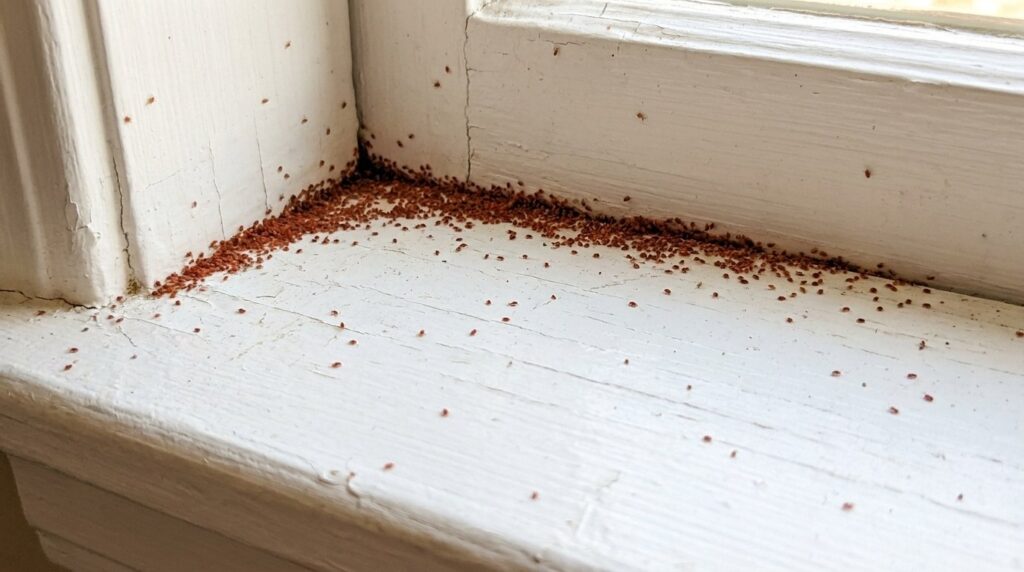
You raise the blind on a sunny window and the sill is moving. Hundreds of rusty red specks, each one smaller than a pinhead, drifting slowly across the paint. Press one with a fingertip and it leaves a mark behind.
Those are clover mites, and every spring they send more calls to our Long Island pest control team than anything else people find on a windowsill. The reassuring part first: clover mites do not bite people or pets, spread no disease, and do no damage to your house, its furnishings or your food. Every mite you see indoors wandered in from outside by mistake and will dry out and die there on its own.
The less comforting part: you cannot vacuum your way out of this, because nothing is living in your walls. The mites are in the turf on the sunny side of your foundation, and they keep coming while that turf runs up to the wall. Learning how to get rid of clover mites on Long Island is mostly about the strip of ground between your lawn and your siding — the part almost every article skips.
Tiny red mites on your Long Island windowsills?
We treat the foundation band where clover mites cross from the lawn and seal the window and siding joints they come through. Month to month, no annual lock-in, and we waive the inspection fee when you have the work done.
How Do You Get Rid of Clover Mites on Long Island Windowsills?
Vacuum them. Do not wipe them, and do not spray an interior sill. The crevice tool, run along the joint where the sash meets the sill, lifts them off the paint without breaking one — and not breaking them is the whole trick. The University of Kentucky’s entomology department recommends the crevice tool for this job and pairs it with a rule we repeat on every call: indoor mite removal stays non-chemical, and insecticides do not belong on kitchen counters. Cornell’s New York State IPM Program adds the step people forget — get the vacuum bag out of the house, so survivors do not walk back out into another room.
Then confirm what you have, because two very different pests get reported as tiny red bugs. Clover mites (Bryobia praetiosa) are not insects. They are mites: eight-legged arthropods related to spiders and ticks, and Iowa State University Extension puts an adult at about 1/64 inch. The giveaway is the front pair of legs, roughly twice as long as the others and held out ahead of the body like antennae. Colorado State’s extension service calls them “walking dust specks.”
Chiggers are the other answer to tiny red bugs, and that confusion is why people ask. Chiggers bite; clover mites cannot. They are plant feeders living on sap from clover, grasses and herbs. If something is genuinely biting you, it is not clover mites, and the bite question belongs with ticks and Lyme risk on Long Island, not here.
How Do You Remove Clover Mites Without Staining Long Island Paint?
Clover mites picked up a folk name somewhere along the way: blood bugs. On one forum thread the label pulled a dozen upvotes, and it is easy to see why — squash one on a white sill and you get a red smear that looks like exactly that.
It is not blood. Cornell’s New York State IPM Program states it flatly: the red is a pigment, not mite blood. The University of Kentucky says the same and explains why — clover mites are not blood feeders at all, so the red stain is the mite’s own body pigment. There is nothing to disinfect, but the pigment behaves like a dye, and Iowa State calls the mark durable: stubborn enough that you do not want it worked into a painted sill.
Which means the instinct that does the damage is the obvious one. People find a moving sill and they wipe it. Dragging a cloth along the windowsill crushes every mite in its path and works pigment into the paint in a single pass. By the time we get a call about this, the sill often has both problems on it: live mites in the joint, and a set of rusty streaks where someone already tried to help.
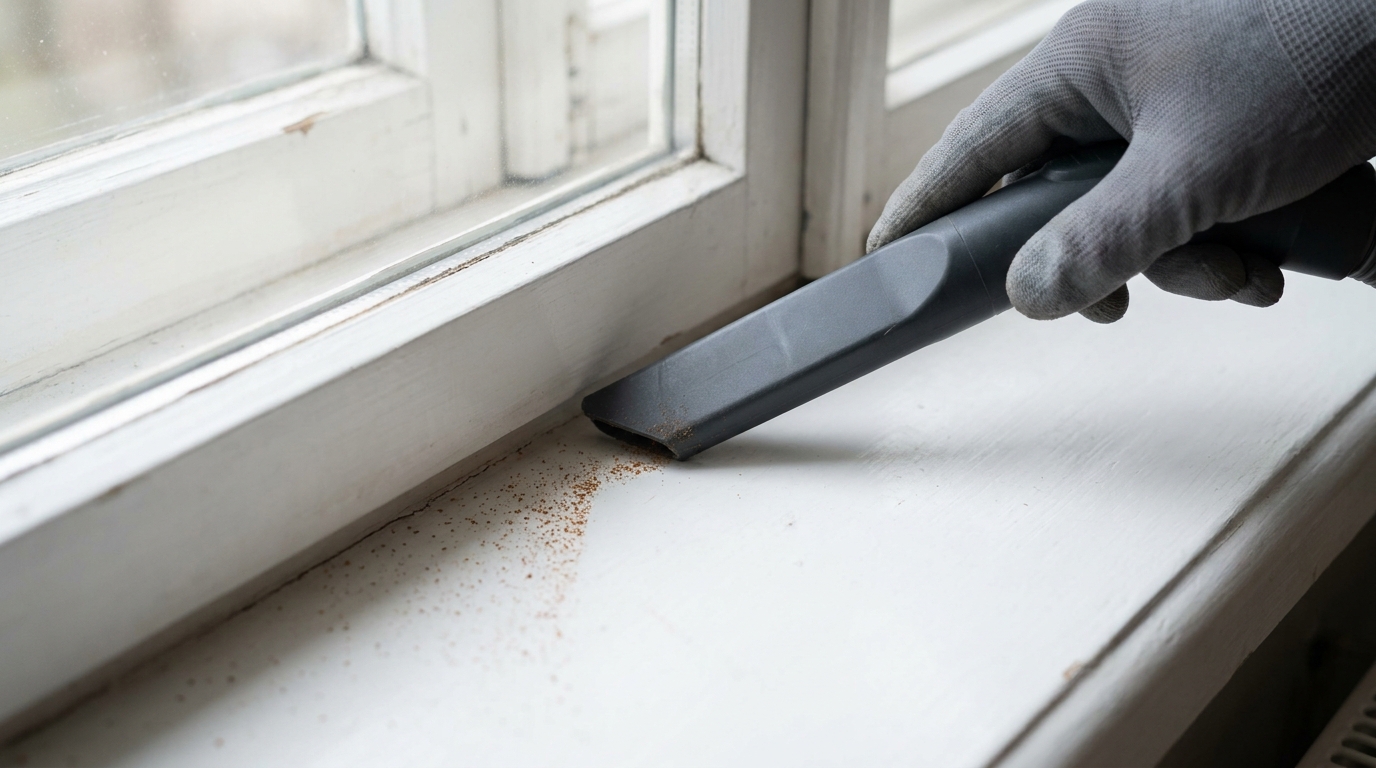
So work the sill with suction, not pressure: light contact along the joint and the corners where they collect, and along the outside sill and the siding seam below if they are massing there too. Outdoors a vacuum still beats a hose, which pushes them into the joints instead of removing them. If a stain is already there and the mites are gone, treat it as a dye mark on paint and keep expectations realistic on flat interior finishes.
How Do You Treat the Long Island Lawn Strip Clover Mites Cross?
This is where control actually happens. Clover mites cross from turf to wall on foot, at ground level. Take the turf away from the wall and you take away the bridge.
Cornell’s New York State IPM Program — the New York authority here — recommends a vegetation-free zone of 18 to 36 inches (PDF) around a building’s perimeter to cut the number of mites getting inside. Purdue, Iowa State and the University of Minnesota Extension each put the band at 18 to 24 inches. Penn State goes as narrow as 6 inches; Colorado State out to about three feet. Eighteen inches is the floor nobody argues with, so that is what we work to: at least 18 inches of plant-free ground wherever the lawn touches your foundation.
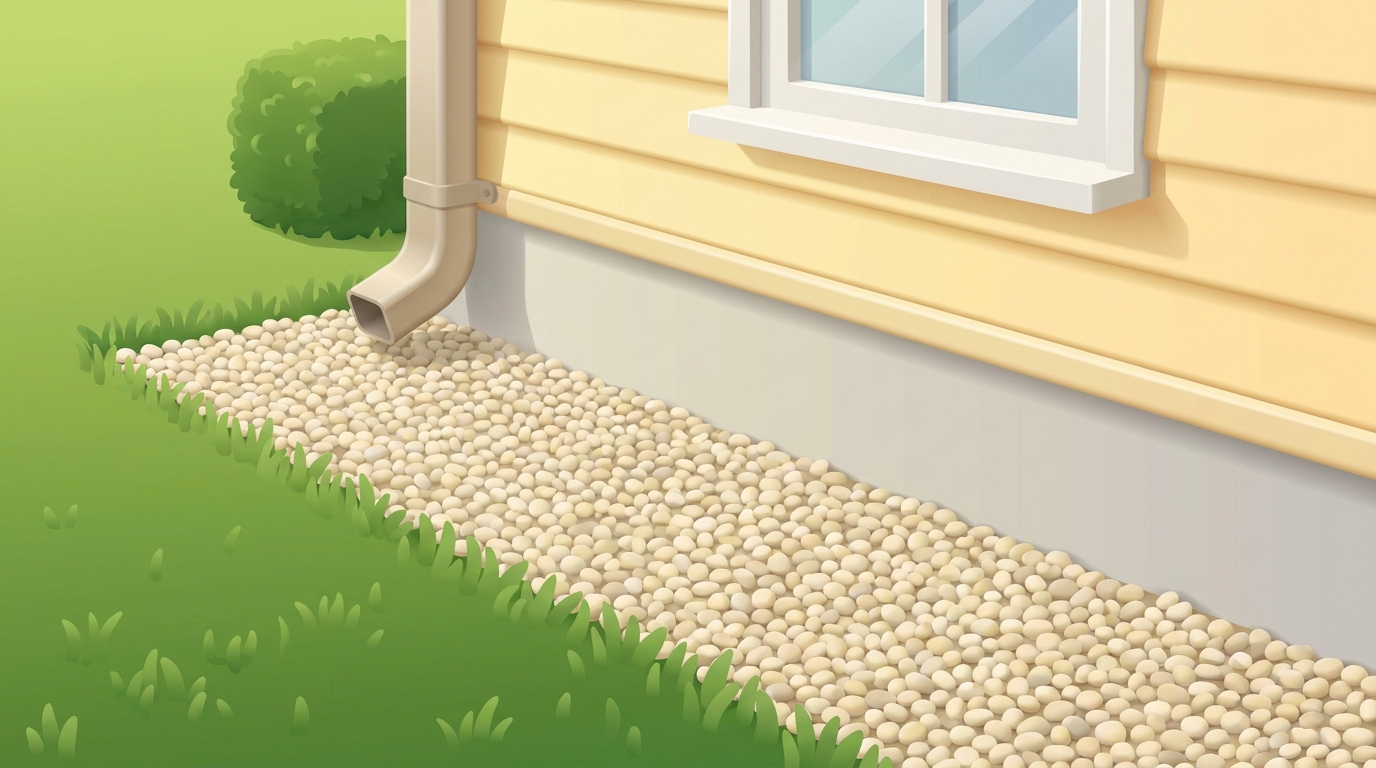
What goes in that band is genuinely contested, and any article that says gravel solves it is skipping the argument. Cornell recommends maintaining the zone with pea gravel, masonry or crushed stone, partly because stone avoids the moisture problems of mulch or grass sitting against a structure, and Purdue also puts pea gravel first. But Minnesota says landscape rock is not enough of a deterrent on its own and prefers clean bare soil, and Iowa State goes further: the bare strip is not always successful, because mites will migrate over wood chips and rock mulches.
Our read, after doing this on a lot of houses: the band works because it removes host plants, not because gravel is a wall. It reduces the crossing; it does not guarantee zero. One homeowner who had already put a two-foot grass-free barrier around their entire house wrote that the mites simply set up shop under their siding instead.
Two details make it work harder. If you keep plantings in that zone, Minnesota’s guidance is to space them far enough apart that mites cannot bridge across the foliage. And aim at the right walls: Colorado State notes they almost always enter on the sun-exposed south and west sides, so on most Nassau County lots this is a one- or two-wall job, not four.
One Long Island homeowner described the mites massed along their patio and siding, staying within about 16 inches of the wall — one yard, not data, but a good picture of why the band is the width it is. If you would rather treat the strip than rebuild it, Kentucky’s soap spray of 2 tablespoons of liquid dish soap per gallon of water kills the mites it hits and leaves no residual.
Why Do Fertilized Long Island Lawns Need Extra Clover Mite Control?
This is the half of the problem almost nobody connects to the other half.
Clover mites feed on plant sap, and the lusher the turf, the larger the population it supports. Five separate extension services make that link. Cornell ties clover mite populations to over-fertilized and over-watered lawns and prescribes the fix in one line: manage for a healthy lawn rather than a lush one. Kentucky says they are especially abundant in the heavy, succulent growth of well-fertilized lawns and tells homeowners to avoid overfertilizing. Iowa State reports the same, while noting the mites do no apparent harm to the turfgrass itself. Purdue Extension names both conditions together: new lawns being established, and well-fertilized grass close to foundation walls. Penn State is the most cautious of the five, saying only that the rise in clover mite activity may be related in some way to increased use of lawn fertilizer.
Read that carefully, because it is easy to overstate. What the literature describes is a standing condition, not a countdown. No source says a wave arrives a set number of days after you fertilize, and neither do we — the mites respond to what the turf is like, not to the date on the bag. Nitrogen drives that growth in most lawn fertilizer, so a heavy feeding program on the foundation-side strip works against you all season, not for a week.
The version we hear most, and the one with the most people behind it, is new turf. Purdue and UConn’s Home and Garden Education Center both single out newly established lawns as the highest-risk case, and in homeowner forums it is the most repeated origin story on the topic — five different people in separate threads traced their problem to a new construction build, a new sod install or a fresh seed-and-feed. That maps onto Long Island, where a re-sodded lot or a recent build is common enough that “we just redid the lawn” often answers the question before we ask it.
We are a pest control company, not a lawn care company, so we will not tell you to stop feeding your lawn. But the sunny foundation strip is where to ease off: lighter feeding in the 18 inches nearest the wall, and no clover in that strip if you can help it. One caution cuts the other way — Colorado State reports that dry, sun-baked turf beside a foundation carries heavy pressure of its own, and that watering those strips can bring numbers down. The instruction is not water less. It is do not grow a lush, over-fed band of turf against the one wall you do not want them crossing.
How Do You Seal Long Island Windows and Siding to Stop Clover Mites?
The band handles the crossing. Sealing handles what happens when they cross anyway.
Clover mites get in through gaps you would never think twice about. Cornell says outright that excluding them is difficult purely because of their size, and points the work at cracks in the foundation and gaps around windows and doors. Kentucky adds where they surface — along sills and thresholds — and notes they climb outside walls and can enter at upper levels, which is why some houses get hit on second-floor windowsills while the first floor stays clean. Minnesota lists the rest of the route: cracks around windows and in foundation walls, and gaps under siding, shingles and shakes. Purdue adds the part that matters most — they crawl into those cracks and crevices to molt and lay eggs. A seam you seal is not just an entry point, it is a nursery.
The sequence our techs run is deliberately unglamorous: caulk around window and door frames, south and west walls first; seal the seam where siding meets the foundation, plus any lifted or gapped siding joint above it; check where utility lines and hose bibs pass through the wall; and leave torn screens and worn weatherstripping for last, because they are the least likely entry and the most likely to get blamed. Colorado State adds a non-chemical assist at the openings themselves: a fine layer of talc-based baby powder, diatomaceous earth, baking soda or corn starch can create a barrier the mites will not cross. Sealing pays twice, too — the same gaps and seams let in most of the common spiders on Long Island.
A retired pest control tech, answering a homeowner who said they had tried everything, put it in one sentence: there is no real solution other than sealing the structure properly, because clover mite control is really about mechanical changes. If a company’s answer to clover mites is a spray and nothing else, the answer is incomplete.
Tiny red mites on your Long Island windowsills?
We treat the foundation band where clover mites cross from the lawn and seal the window and siding joints they come through. Month to month, no annual lock-in, and we waive the inspection fee when you have the work done.
When Do Long Island Homes Have to Prevent Clover Mites Each Year?
Clover mites are a cool-season animal, and that governs the calendar. Purdue describes them as most abundant in fall and spring and relatively inactive in both summer heat and cold weather. Minnesota reports the same pattern and adds that they can turn up on sunny days in winter. Kentucky puts the nuisance in early spring and occasionally in fall.
Colorado State University Extension supplies the mechanism the others leave out. As temperatures warm in late spring, clover mites lay dormant eggs that do not hatch until freezing temperatures return in fall. That is why the problem seems to evaporate in June — not because they died, and not because something worked. Left alone, Colorado State says, clover mite problems end on their own with the warm weather of May or early June.
Beyond that, timing is unsettled between sources, and a Long Island date does not exist in any of them. Cornell describes the indoor waves in New York as early spring and late summer; Iowa State says early summer and fall; Penn State reports activity as early as mid-January in southeastern Pennsylvania during warm spells — still Pennsylvania, not Nassau or Suffolk. Nobody publishes a clover mite calendar for Long Island, and we are not going to invent one.
Kentucky says the quiet part out loud: there is no way to anticipate the movement of the mites in spring or fall, so timing a preventive treatment is a guess. That is the argument of this whole post. Because you cannot time the wave, timing is the wrong strategy. A plant-free band and a sealed window frame are not appointments — they are standing conditions, working on the day the wave arrives. Practically, that puts the work in the calendar twice: early spring, before the first warm stretch pulls them up the wall, and fall, before the second wave.
A homeowner in Farmingville, out in Suffolk County, described their own version of it — mites on the back stone steps every single year, a few weeks of it, then gone until the next. Predictable in pattern, unpredictable in date.
When Should You Call a Long Island Pro to Eliminate Clover Mites?
Three signals, and none of them is “I saw a mite.”
- They come in faster than you can vacuum. A sill you clear at breakfast and clear again at lunch means the outside pressure is too high for indoor work to matter.
- They reach upper floors. Second-story windowsills mean they are climbing the wall face, not stepping over a threshold.
- The band and the caulking are done. If the strip is in and the joints are sealed and they are still crossing, something specific is bridging the gap.
The extension services agree. Purdue advises a commercial pest control specialist where mites are especially difficult to control. Cornell says to consult a pest management professional if the problem persists, and notes that appropriately timed applications of a residual acaricide at entry points — baseboards, windows and the foundation — reduce the number of invading mites. Minnesota recommends having a professional treat the home’s exterior.
Notice Cornell’s word: acaricide, not insecticide. Mites are not insects, which is why this overlaps with the arachnid side of our spider control work, and why plenty of general-purpose insecticides underperform on them. Ask about it — it is a quick way to tell whether the person on the phone has handled clover mites or is reading a general perimeter script.
The failure mode we see is chasing the product. In these threads, one homeowner worked through several products and still had mites, because each attempt treated the arrival instead of the conditions. And there is a trap in the calendar: a treatment applied in late May takes credit for a disappearance that, as Colorado State explains, was going to happen anyway.
So what we do on a clover mite call is unglamorous by design. We walk the sunny walls and find where the crossing is really happening, treat the foundation band and the entry points rather than blanket-spraying a lawn, seal the window and siding joints, and tell you what has to change in the landscaping even where it is not work we do ourselves. Everything we apply is family and pet-friendly.
We are members of the National Pest Management Association, the New York Pest Management Association and the BBB, and we hold a 4.8-star average across more than 330 Google reviews. One-time service carries a 30-day guarantee; the seasonal plan carries a full year with unlimited callbacks. A free estimate costs nothing but the call.
The Bottom Line on Clover Mites on Long Island
Clover mites are the rare pest problem where every reassuring fact is true and still not enough. They do not bite, they carry no disease, they damage nothing, and every one indoors is already dying. They are a nuisance at a scale that is hard to live with when the sill is covered and the siding is moving.
- Vacuum, never crush. Crevice tool along the windowsill joint, and get the bag out of the house. The red stain is body pigment, not blood, and it is durable on paint.
- Open at least 18 inches of plant-free ground between lawn and foundation on the sunny walls. Cornell’s New York guidance runs out to 36 inches, and the extension services genuinely disagree about how well stone alone holds them.
- Fix the turf condition, not the calendar. Heavy, well-fed growth and newly established lawns support the biggest populations against the wall.
- Seal the windows and the siding seams. That is where they get in, and where they lay eggs.
- Do the work in spring and fall and stop trying to predict the wave. Nobody can.
Every item there is a standing condition rather than a treatment date, which is the point. Clover mites are one of the few pests where the house itself, and the 18 inches around it, do most of the work. If you are past that and they are still crossing, that is what we are here for.