A hospital is the one building in the Bronx where the ordinary answer to a pest problem is the wrong answer. In an apartment you find the harborage, treat it, and come back to check. A hospital has patients who cannot leave, a kitchen that never fully shuts down, an emergency department that takes whoever comes through the door, and patients whose immune systems are already compromised. Those facts change the instrument you reach for.
If you came looking for the Bronx hospital pest control rules as a numbered checklist, no such checklist exists. What exists is one binding sentence in New York State’s hospital code, federal guidance written for health care facilities, and a discipline that fills the gap between them. That is why hospital pest control is its own discipline rather than commercial work at a bigger scale.
This is written for facilities directors, environmental services managers, infection prevention staff and nurse managers. We try throughout to say who decides what — the regulation, the surveyor, the facility — because we decide none of it.
Pest problem in your Bronx hospital?
26+ years in NYC commercial pest control. We will work around your patient care schedule and monitor the intake areas most programs never touch. No annual contracts, and an inspection we waive when you book the work.
Which Pests Do Bronx Hospitals Have to Control Around Patients?
Start with the only sentence in New York law that speaks to this directly. The state’s hospital minimum standards at 10 NYCRR 405.24 put the housekeeping obligation in eight words, at subdivision (e)(2): “The facility shall be kept free of insects and rodents.” That is an outcome standard. It names no pest, no method, no product and no schedule.
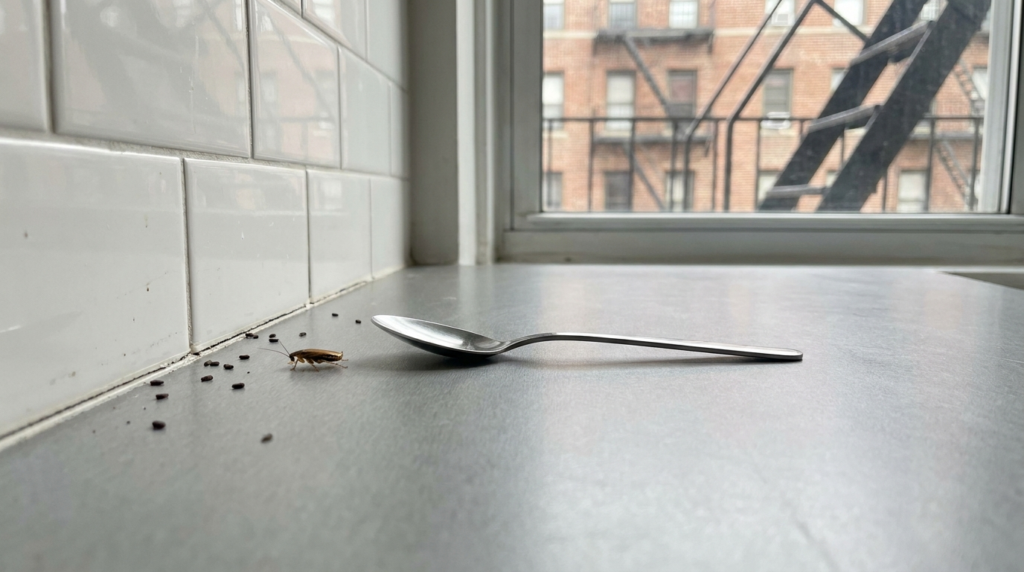
The route is where federal guidance comes in. The CDC’s Guidelines for Environmental Infection Control in Health-Care Facilities lists the cast: “Cockroaches, flies and maggots, ants, mosquitoes, spiders, mites, midges, and mice are among the typical arthropod and vertebrate pest populations found in health-care facilities.”
Ohio State University Extension calls the pharaoh ant “a serious nuisance pest in hospitals,” and the reason is where it forages: drains, bedpans, sealed packs of sterile dressing, surgical wounds and medical equipment. University of Florida extension entomologists note the species is capable of carrying more than a dozen pathogens. Capable of carrying, which is not the same claim as causing.
CDC is unusually direct about that distinction. The presence of insects in a hospital “likely does not contribute substantially to health-care associated disease transmission in developed countries.” What CDC describes instead is outbreaks attributed to microorganisms carried by insects occurring because of “infestation coupled with breaks in standard infection-control practices.” It is a compound risk, and any vendor telling you roaches are giving your patients infections has gone past the evidence. CDC’s own bar is that “insects should be kept out of all areas of the health-care facility, especially ORs and any area where immunosuppressed patients are located.”
The best framing we found came from a nursing forum, at 203 upvotes: “Any sufficiently large building has mice and roaches. The fact that they’re getting plentiful and bold enough to be out in the light is concerning.” A commenter, not a regulator, but the instinct is right: visibility is the signal.
How Do Bronx Hospitals Treat Pests Without Disturbing Patient Care?
The EPA’s Integrated Pest Management in Health Care Facilities toolkit (EPA Pub. 907K21002, 2021) answers this twice, as a critical note: “It is not necessary to cancel or delay scheduled appointments, procedures, surgeries or exams for patients who report experiencing a pest control problem.” The clinical schedule wins.
EPA’s model also makes clear the pest company is not who gets called first. Clinical staff who see something escalate internally — “contact Environmental Services (EVS) and request an EVS Manager consultation” — and the “work order for pest control will be made only after EVS Manager approval.” Timing runs the same way: EPA’s sample policy tells staff to settle “the best time of day and notification to staff” with the named department first. When we work is not ours to decide alone.
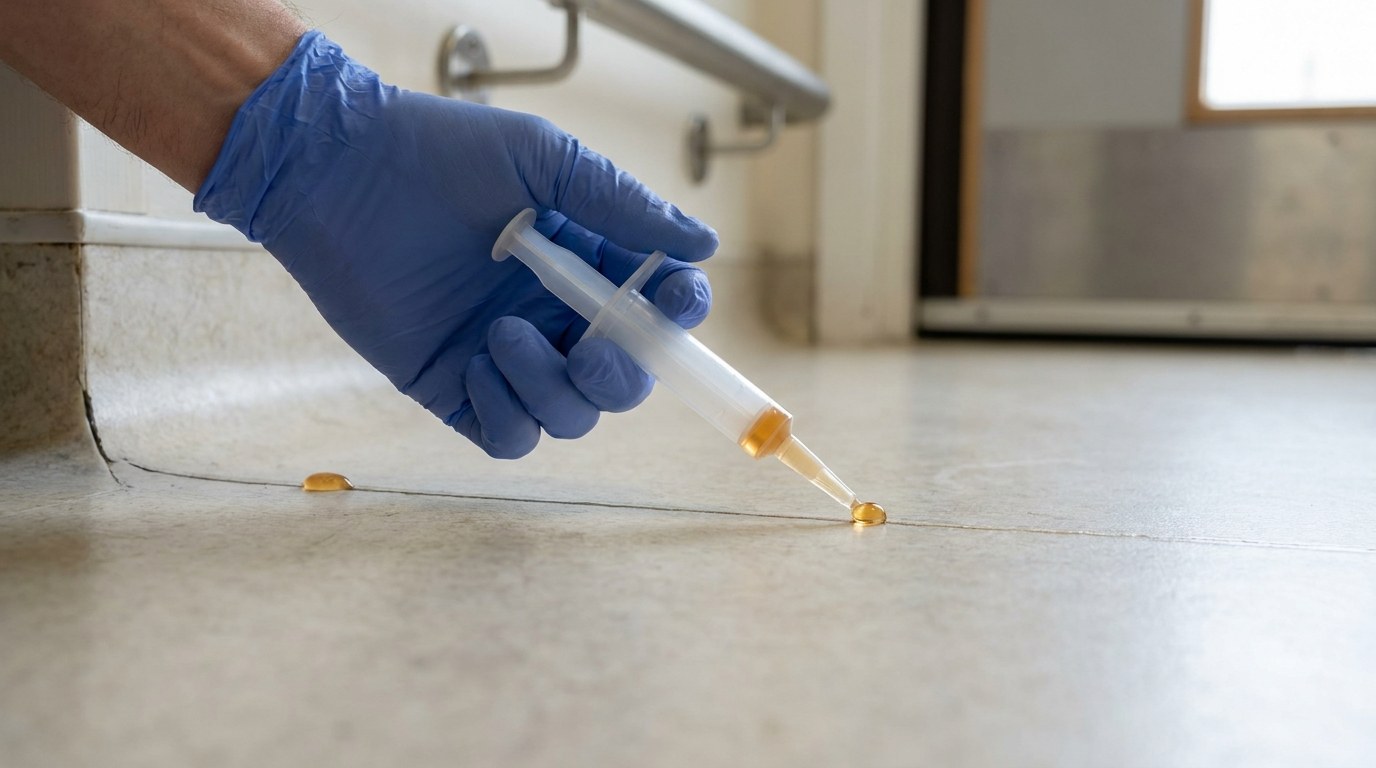
Product form is the other lever. Because children, the elderly, pregnant women and people with weakened immune systems are “at the greatest risk of injury or negative health impact from exposure to pesticides and pesticide residues,” EPA says liquid sprays, foggers and volatile formulations “should be limited,” while “baits, pastes, gels, or crack and crevice treatments should be favored due to lower risks of exposure.” Aerosols and machine-generated fogs, mists or space sprays “should not be used except in extraordinary situations.”
One move avoids the conflict entirely: take the item to the treatment, not the treatment to the patient. University of Kentucky entomology’s healthcare guidance says infested beds and furniture “should ideally be treated with heat in a designated area of the hospital.” It also notes that spot killing of bed bugs on beds, sleep chairs and flooring “often can be accomplished with disinfectants used for terminal cleaning.”
Why Don’t Bronx Hospitals Spray to Kill Pests in Patient Rooms?
First, clear away the myth, because it is everywhere and it is false: there is no legal prohibition on using pesticides in a hospital patient room. A hospital can treat. CDC’s description of the modern institutional approach has three steps — eliminating food sources and indoor habitats, excluding pests from the building, and “applying pesticides as needed” — and pesticides are step three, not a forbidden step. CDC goes further, recommending facilities “contract for routine pest control service by a credentialed pest-control specialist.” New York’s rule pushes the same way: a hospital that must be kept free of insects and rodents is compelled to control pests effectively, not restrained from it.
So the question was never permission. It is instrument choice, and four things stack up against routine scheduled spraying of an occupied patient room.
- Integrated pest management puts pesticides last on purpose. Sanitation and exclusion come first because they remove the reason the pest is there.
- There is no low-exposure window. Practice Greenhealth, a nonprofit working with hospitals on chemical reduction, notes that because hospitals operate “24 hours a day, seven days a week,” there is “no ‘after-business’ window with reduced exposure risks” for chemical work.
- The occupants are the reason. CDC singles out immunosuppressed patients as the population insects must be kept away from, and EPA lists that same population among those at greatest risk from pesticide exposure.
- Hospitals reducing chemicals design the schedule out. Practice Greenhealth describes facilities adopting programs that “eliminate regularly scheduled pesticide applications.”
With one pest, spraying makes things worse. Ohio State’s pharaoh ant guidance warns that contact applications, “especially repellent products such as pyrethrins, may spread infestations to new areas with multiple colonies blossoming within the structure.” A single hospital can hold dozens or hundreds of colonies, and the wrong chemistry buys more of them.
The decision itself is not ours. What goes into an occupied patient room is set by the facility’s policy and its environmental health and safety group. We bring the options, the labels and the reasoning. The hospital signs off.
How Do Bronx Hospital Kitchens Prevent Roaches and Flies?
Here is the New York City wrinkle. The city’s Health Code names hospital cafeterias — in order to exempt them. Section 81.51(f), which sets the scope of the letter-grading program, states that the section does not apply to a list of establishments including “hospital-operated cafeterias.” The carve-out is from the grading program specifically, not from the Health Code’s food rules. What a given hospital kitchen answers to in practice is for the facility and its regulators to say.
The guidance is clearer on the work itself. CDC’s first pest-control recommendation names kitchens and cafeterias before anything else, and EPA is blunter still: “Sanitation is the first and most important step in controlling pests.”
- Grease is the food source. Clean preparation equipment promptly after use and routinely pull grease off vents, ovens and stoves.
- Floor drains are a scheduled task. EPA says clean them weekly to remove the grease and food waste that attract flies. Texas A&M AgriLife Extension’s institutional kitchen guidance, written for schools rather than hospitals, says at least twice per week. Two documents, two numbers, and we would rather show both than average them into a figure neither gives.
- Waste moves daily, with outdoor cans serviced daily and nothing left overnight. Rodent traps and glue boards get checked daily too, with anything caught disposed of within 24 hours.
Small flies are the most misdiagnosed pest in an institutional kitchen. Drain and phorid flies breed in the film inside drains and grease traps, and Texas A&M’s guidance is direct that they can carry microorganisms onto food contact surfaces. The diagnostic is cheap: tape a glue board or a strip of duct tape into a tent over the suspect floor drain and look at it in a day or two.
This is ordinary food-service discipline under harder conditions, the same work we do for the commercial accounts our team services across the city.
How Should a Bronx Hospital Control Bed Bugs Brought In by Patients?
This is the section most hospital pest coverage gets wrong. Programs get built around wards and kitchens. The recurring route is a patient’s belongings coming through the emergency department. The intake bench is the untreated surface.
The evidence comes with limits attached. A 2019 study in Emergency Medicine International surveyed 706 patients at a single academic level-1 trauma center in Cleveland, Ohio, over five months in 2017. Not New York, not a national rate, one hospital. Within those limits: the study hospital had previously reported finding a bed bug in the institution about every two days, “with most insects found in the ED at a frequency of every 3-5 days.”
Then the number that reframes the problem. Of the patients in that study with bed bugs, only 18 percent — two of eleven — told EMS providers or ED staff about their home infestation. The denominator is tiny and we will not dress it up, but the people doing the work describe the same thing. One inner-city ED nurse, in the best-supported comment we found at 51 upvotes, wrote that “most of the time I don’t know a patient has these until the discovery phase of removing clothing or doing assessments.”
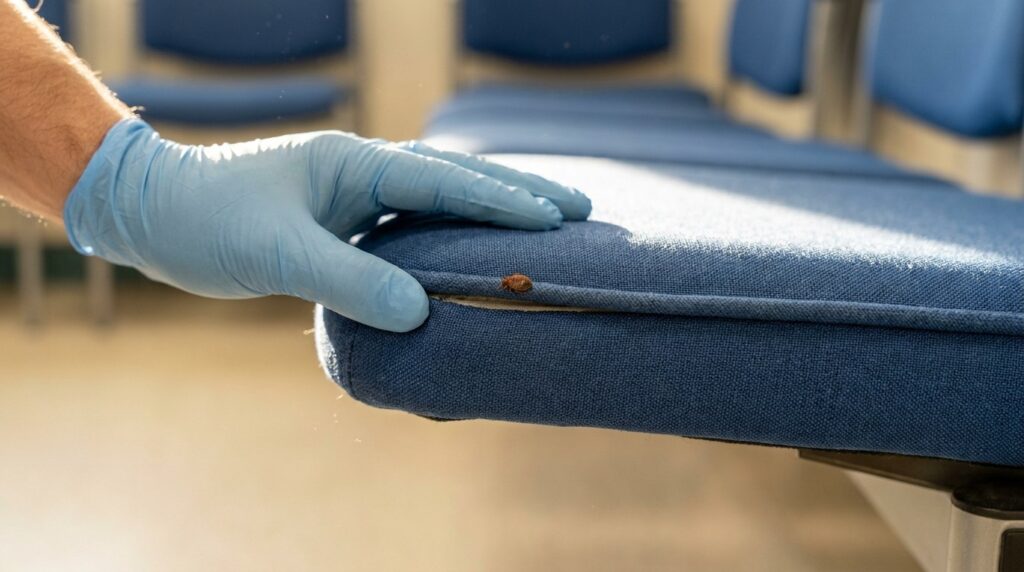
If most infested patients are not telling you, a program built on being told rests on a number that does not hold. Monitor the places belongings sit instead. University of Kentucky’s healthcare guidance says exactly that: “periodic, pro-active inspection of waiting rooms, lounges, sleep-study/dialysis clinics, etc. is advisable by in-house staff and their pest professional.” Triage seating, waiting-room upholstery, the chairs in dialysis and infusion, the bench where a bag sits for six hours. Those are the surfaces to inspect on a rotation.
Identification matters, because much of what gets escalated as a bed bug is not one. One commenter in a nursing thread, at 22 upvotes, described their unit being expected to catch a live insect in a specimen jar “so we can prove what it is.” Staff who can read the physical evidence that confirms an infestation escalate better.
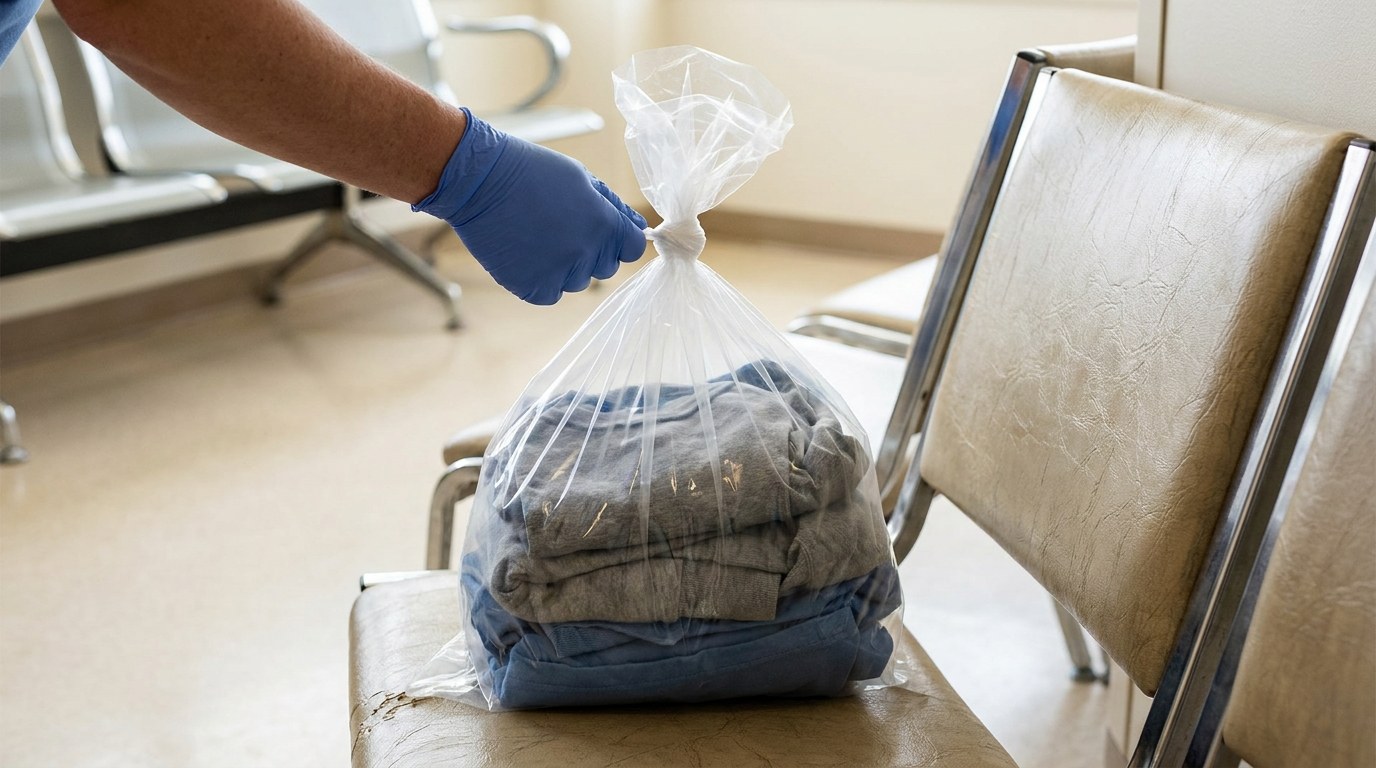
EPA’s toolkit gives the clearest model for belongings, and one detail is easy to get catastrophically wrong. Non-essential items — anything other than a phone, wallet or keys — go into a patient belongings bag sealed with a knot, and EPA explicitly warns against red biohazard bags or blue linen bags, “as these may accidentally be discarded.” Sealed bags go home with a family member, items stay sealed for the hospitalization, and the patient gets a clean gown and fresh linens.
Across three separate threads, three self-identified hospital staff described the same core protocol: belongings double-bagged, the patient showered and re-gowned, a move to a clean room, and the contaminated room sealed until an exterminator treats it. These are commenters describing their own workplaces, not a standard.
On isolation, practice genuinely varies. EPA’s model procedure says to take standard precautions and that “transmission-based isolation precautions are not indicated.” The Cleveland study describes its own institution using bed bug isolation precautions. Both are true at once, because EPA publishes a model and each hospital writes its own policy. Isolation for bed bugs is neither required nor forbidden by anything we can point you to. Your infection prevention team owns that call.
When a problem starts moving between units rather than sitting in one room, it stops being a room job and becomes a building-wide bed bug response. One last point, and EPA puts it plainly: “It is important to maintain patient dignity and respect when encountering a suspected bed bug introduction.” A protocol that embarrasses people produces fewer disclosures, and disclosure was already the weak link.
Pest problem in your Bronx hospital?
26+ years in NYC commercial pest control. We will work around your patient care schedule and monitor the intake areas most programs never touch. No annual contracts, and an inspection we waive when you book the work.
What Pest Control Records Do Bronx Hospital Inspections Require?
We looked hard for the enumerated list of pest-control documents a hospital is legally required to hold, and it does not exist. That is not a research failure. It is the finding.
New York’s hospital code sets an outcome and stops: the facility shall be kept free of insects and rodents. It names no document. On the federal side, the CMS Condition of Participation for the physical environment, 42 CFR 482.41, contains no mention of pests, vermin, insects, rodents or pest control anywhere in it. What it requires is that the physical plant and overall hospital environment be maintained so that “the safety and well-being of patients are assured.” So if someone tells you Medicare requires a pest log, ask for the citation. There is not one.
Which leaves the real answer: records are how a hospital proves it met an outcome standard nobody itemized. A surveyor who walks a unit and sees nothing is looking at one hour of one day. The log speaks for the rest of the year.
Two non-regulatory sources give the record set a defensible shape. EPA’s healthcare toolkit describes a pest management log holding the IPM policy and procedures, pesticide use and service schedules, the label and Safety Data Sheet for every pesticide used on site, surveillance sheets recording the date, number and location of pests observed, and diagrams of every trap and bait station. Massachusetts’ health department, in guidance written for state public buildings rather than hospitals and for Massachusetts rather than New York, adds a tighter incident-log list: date of concern, concern type, room or unit number, date of inspection, and results with follow-up.
Note what neither claims. EPA’s own hedge points at state pesticide-use recordkeeping requirements, not at any hospital pest-records rule, and neither document makes any of this law for a New York hospital. EPA names one cadence that belongs here: the program should be reviewed annually with the pest control company involved. That is a review of the program, not a service visit.
On our side: every visit documented with what was found, where, what was applied or placed, and what corrective action the building needs. What a surveyor finds persuasive on the day is the surveyor’s call. Our part is making sure the record exists and is accurate.
How Often Should a Bronx Hospital Schedule Pest Control Service?
There is no mandated interval. We checked New York’s hospital code, the CMS physical environment condition, CDC’s pest recommendations and EPA’s healthcare toolkit. None sets a service frequency for a hospital. Anyone quoting you a legally required cadence is quoting you a sales term.
The ceiling of what is claimable is CDC’s recommendation to contract for “routine pest control service” by a credentialed specialist who will “tailor the application to the needs of a health-care facility.” Routine and tailored, with no number attached. EPA, the most hospital-specific federal source on the subject, pushes back on the industry default outright: “Pesticide use should be targeted and applied on an as-needed basis only. In general, routine (e.g., monthly) applications of pesticides are not a component of an IPM program.”
EPA’s objection is to calendar-based treatment, not to regular inspection — the same document says the contractor “should regularly use appropriate inspection and monitoring tools and procedures.” Visit often, inspect thoroughly, treat when the monitoring says to. University of Kentucky gives the rule in one sentence: “Frequency of inspection should depend on the history of prior incidents and risk of future infestation.”
What is documented is a set of cadences, and every one belongs to a task rather than to a visit.
| Cadence | What it applies to | Source |
|---|---|---|
| Daily | Rodent traps and glue boards checked; anything caught disposed of within 24 hours | EPA healthcare IPM toolkit |
| Daily | All trash removed at end of day; outdoor cans serviced daily, nothing left overnight | EPA healthcare IPM toolkit |
| Weekly | Floor drains cleaned of grease and accumulated food waste | EPA healthcare IPM toolkit |
| At least twice weekly | Drains, traps and strainers cleaned — a second document’s recommendation, written for school kitchens | Texas A&M AgriLife Extension |
| Risk-based | Bed bug inspection frequency, set by incident history and risk | University of Kentucky entomology |
| Annually | Review of the IPM program itself, not a treatment visit | EPA healthcare IPM toolkit |
What should a hospital specify instead? EPA suggests minimum service times per visit in the bid, a walk-through of every site before bidding, and not selecting on lowest bid alone. An interval on its own only buys attendance.
For what it is worth on our side, and labeled clearly as ours rather than anyone’s requirement: our recurring commercial plans run month to month with no annual lock-in, our large warehouse accounts sit at two scheduled visits a month, and we offer same-day service during business hours. A warehouse cadence is a warehouse cadence — what our commercial model looks like, not what a hospital owes anyone. If budget is the live question, we broke down what a New York City business pays for this in a separate guide.
The Bottom Line on Bronx Hospital Pest Control
Stripped back, the regulatory picture is small. One binding sentence in New York’s hospital code says the facility shall be kept free of insects and rodents. The federal Condition of Participation says nothing about pests at all. CDC contributes four pest-control recommendations and a firm warning against overstating what pests do to patients. Nobody mandates a visit frequency and nobody enumerates a record list.
What fills that space is judgment, mostly about where you look. The evidence says the recurring introduction arrives through admissions, in a bag, with a patient who most likely has not told anyone.
The rest is division of labor. The regulation sets the outcome. The surveyor judges the evidence on the day. The facility writes the policy and decides what goes into an occupied room. We inspect, monitor, treat with the least disruptive method that will hold.
We have done commercial work in New York City since 1999 — 26 years, 27 people, about 20 technicians in the field, 4.8 stars across hundreds of reviews, and memberships in the state and national pest management associations and the Better Business Bureau. Commercial accounts are the majority of what we do, month to month with no annual contract, across all five boroughs including the Bronx side of our coverage map.