Almost nobody meets a clothes moth before meeting the damage. You pull a sweater out in October, hold it up, and there are two small holes near the shoulder seam that were not there in March. By then the insect that made them has usually finished feeding and moved on, which is why so much closet advice is aimed at a moth fluttering past a lamp that is almost certainly a different species entirely.
This page is about reading the evidence instead. Manhattan closets are unusually good habitat for it: deep, dark, often built into plaster, frequently holding wool that goes untouched for most of the year. That combination is the whole problem, and it is a common enough call across the Manhattan buildings we treat that we have a settled way of working out what we are looking at.
Two pests do this damage in the city, and they fail in opposite directions. Learning which one you have takes about thirty seconds once you know what separates them, and it is worth doing before you throw anything away or buy anything to fix it. We will get to the difference, and to the point where evidence stops being a curiosity and starts being an infestation.
Holes in your Manhattan wool?
26+ years treating NYC fabric pests. We identify what is actually eating the wool before anyone recommends treating a closet, and we tell you when the answer is nothing. No annual contracts, and an inspection we waive when you book the work.
What Are the First Signs of Clothes Moths in a Manhattan Closet?
The first sign is nearly always damage, not an insect. Small, irregular holes in wool, cashmere, silk or a wool blend, and usually not one hole but a scatter of them in a small area.
The second sign is texture, and it is the one people notice without understanding. A gritty, sandy residue on the garment or on the shelf under it. That is frass, which is to say droppings. It reads to the hand like fine sand, and it is one of the clearest signs you can find without a magnifier. In one widely read knitting thread, the poster described exactly this: sweaters starting to “disintegrate,” with “something sandy all over them.” The most upvoted reply in that discussion, at 695 votes and well clear of anything else in the thread, identified it as the insects’ droppings.
The third sign is what is not affected, and it is diagnostic in its own right. The same poster noticed that some sweaters stored right next to each other were untouched. That is the pattern, not an accident. New Mexico State University’s extension guide to clothes moths and carpet beetles explains why: these pests feed in “quiet, dark areas-closets, attics, bureau drawers, storage trunks or boxes,” and “such pests seldom infest items used on a regular basis.” Damage concentrates on what sits still. A coat worn weekly is usually fine while the good jacket two hangers along is not.
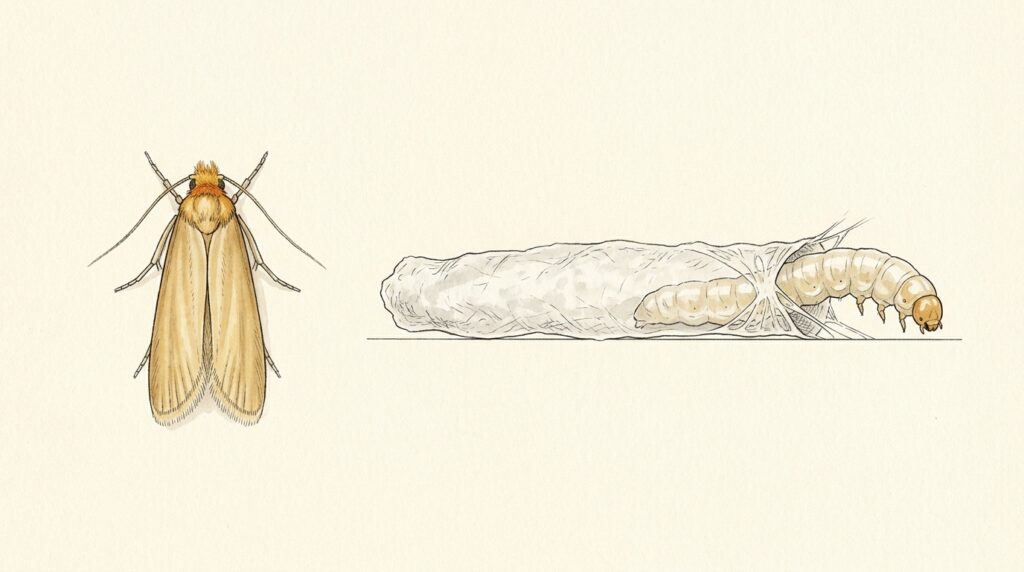
What is almost never the first sign is an adult moth. Purdue University’s extension bulletin on fabric pests is clear that the adult “is a tiny, buff-colored ‘miller’ that avoids light” and, more to the point, that adults “do not feed.” The moth cannot eat wool. It has no functioning mouthparts for it. Its only role is laying the eggs whose larvae do all of the damage, so a moth sighting tells you eggs may have been laid, and nothing about how much has already been lost.
And the moth by the lamp is very likely innocent. As NMSU puts it: “Clothes moths are not the moths seen flitting about lights.” Adult clothes moths are about half an inch long, light tan, narrow-winged, and they run from light rather than toward it.
Where Should You Look for Clothes Moth Larvae and Casings in a Manhattan Closet?
Search where the light does not reach and the air does not move. In a typical Manhattan closet that means the back of the rail, the floor behind the shoe rack, the top shelf where the winter things live, and the interior of storage boxes and garment bags that have not been opened since spring.
On the garments themselves, work the folds. Under collars. Inside cuffs. The underside of a shoulder where a jacket meets the hanger. The inner face of a folded sweater in a stack, particularly the ones at the bottom. Larvae feed where they are hidden, so the damage sits where you do not look.
What you are looking for depends on which clothes moth you have, and there are two.
The casemaking clothes moth gives you the more obvious object. NMSU describes its larvae as “cream-colored caterpillars less than 1/2 inch long” that “spin protective cases incorporating pieces of the items they are eating.” That detail is the useful one: the case is built from the garment, so it carries the garment’s own color. A small beige tube on a beige sweater is easy to walk past, and it moves, because the larva drags the case around with it as it feeds. Those cases eventually harden into cocoons. Illinois’ Department of Public Health guidance adds a way to tell the two larvae apart if you can see one closely: the casemaking caterpillar has a dark brown plate, the prothoracic shield, behind its head.
The webbing clothes moth does not build a portable case. It spins silk directly onto the item, which is the subject of the next section.
Both are small. Under half an inch, cream or white, and slow. Also worth knowing: the shed casings and cocoons persist long after the insect has gone, so finding them tells you there was an infestation, not necessarily that there is one now. That distinction matters, and we come back to it.
How Do You Spot Clothes Moth Webbing in a Manhattan Wardrobe?
Webbing is the most specific evidence available to a homeowner, because the other fabric pest does not produce it at all.
NMSU describes what to look for precisely: webbing clothes moths “spin a silken web to form feeding tubes that they attach to the item being eaten.” So the shape is not a loose cobweb draped between two points. It is a tube, lying flat along the fabric, fixed down at both ends, often with frass caught in the strands and the fabric’s own fibers worked into it. On a dark wool it reads as a pale streak. On a light wool you may only catch it at an angle.
The other place it turns up is the closet itself, and there is a good description of this from a Manhattan-adjacent context. In a fashion forum thread, one commenter, at 159 votes, described noticing “weird, stringy cobwebs in the corners” of the apartment, cleaning them away, finding no spider, assuming it was just an old building, then seeing them return the following week. Their conclusion: no spider means it is probably not a spider’s web. Cobwebbing that reappears in a closet corner with nothing living in it is worth a proper look at the wool nearby.
One commenter, who described handling a lot of moth-damaged clothing at home, put the same point more simply: the cocoon looks “a little bit like spider web,” which they called the most notable sign, while noting the larvae themselves “are very small.” That was one person’s view in a small thread rather than any kind of consensus, but it matches what the extension services describe, which is the reason to trust it.
The reason webbing is worth this much attention: it is the fork in the diagnosis. Purdue’s description of carpet beetle damage is that it is “similar to that of the clothes moth larva, but without webbing.” Silk present, think moth. Silk absent, start looking for the beetle’s signature instead.
What Damage Signs Do Manhattan Clothes Moths Leave on Wool Sweaters?
Moth damage has a geography, and once you see it you cannot unsee it.
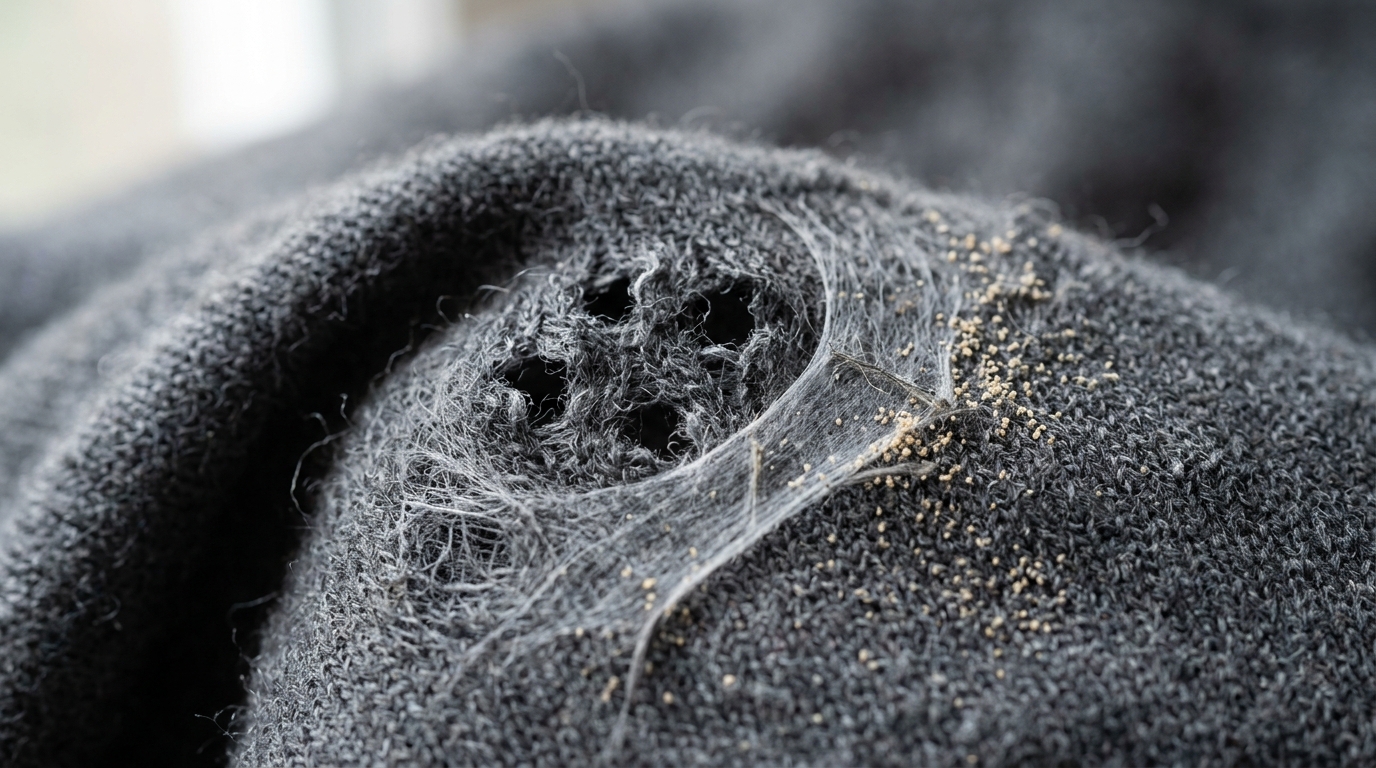
The holes cluster. Because the larva feeds where it shelters rather than roaming, you get several holes in one small region rather than a hole here and a hole there across the garment. They tend to be irregular rather than round, they sit in folds and along the dark side of a garment, and they come with company: silk, frass, sometimes a case, usually all three within an inch or two of the damage.
On a knit, the failure looks like thinning before it looks like a hole. The larva grazes the surface, shaving the pile down, and the fabric goes sheer in a patch before it finally opens. Hold the sweater up to a window and the thin areas show as bright spots before your fingers can find them.
What they eat narrows it further. These larvae feed on animal-based materials: wool, silk, feathers, fur, leather, hair. A hole in a pure cotton shirt or a synthetic is almost certainly not this. NMSU adds an important qualifier though, which is that they will also take “fabrics blended with wool” and, critically, “items soiled with food stains or body oils.” That is why the cashmere you wore twice and hung back up gets hit while the one you had cleaned before storing does not. The soiling is the attractant.
Compare that with ordinary wear. As one commenter in a thread about repairing moth-damaged knitwear put it, wear-and-tear holes turn up “in specific areas where there is wear/rubbing/stretching,” and “they aren’t usually tiny.” Elbows, underarms, the edge of a cuff, where a bag strap crosses a shoulder. A hole in a high-friction spot with clean edges and no residue is wear. Three small holes in an untouched fold, with grit and silk, is not.
A word on the scale of the response, because we see it go wrong. One widely read thread was started by someone who threw out years of cashmere and merino after finding damage, describing losing sleep over it and throwing out “thousands of dollars worth of clothing.” That is a completely understandable reaction and, more often than not, a bigger one than the evidence warranted. Identify first. Damage that is already done does not get worse on its own, and the count of currently active larvae is usually far smaller than the count of holes suggests.
Holes in your Manhattan wool?
26+ years treating NYC fabric pests. We identify what is actually eating the wool before anyone recommends treating a closet, and we tell you when the answer is nothing. No annual contracts, and an inspection we waive when you book the work.
How Do You Tell Clothes Moths From Carpet Beetles in a Manhattan Closet?
This is the question the ranking pages answer badly, because they compare the adults. You will almost never see the adult of either. The larvae are what you have evidence of, and the larvae are easy to tell apart.
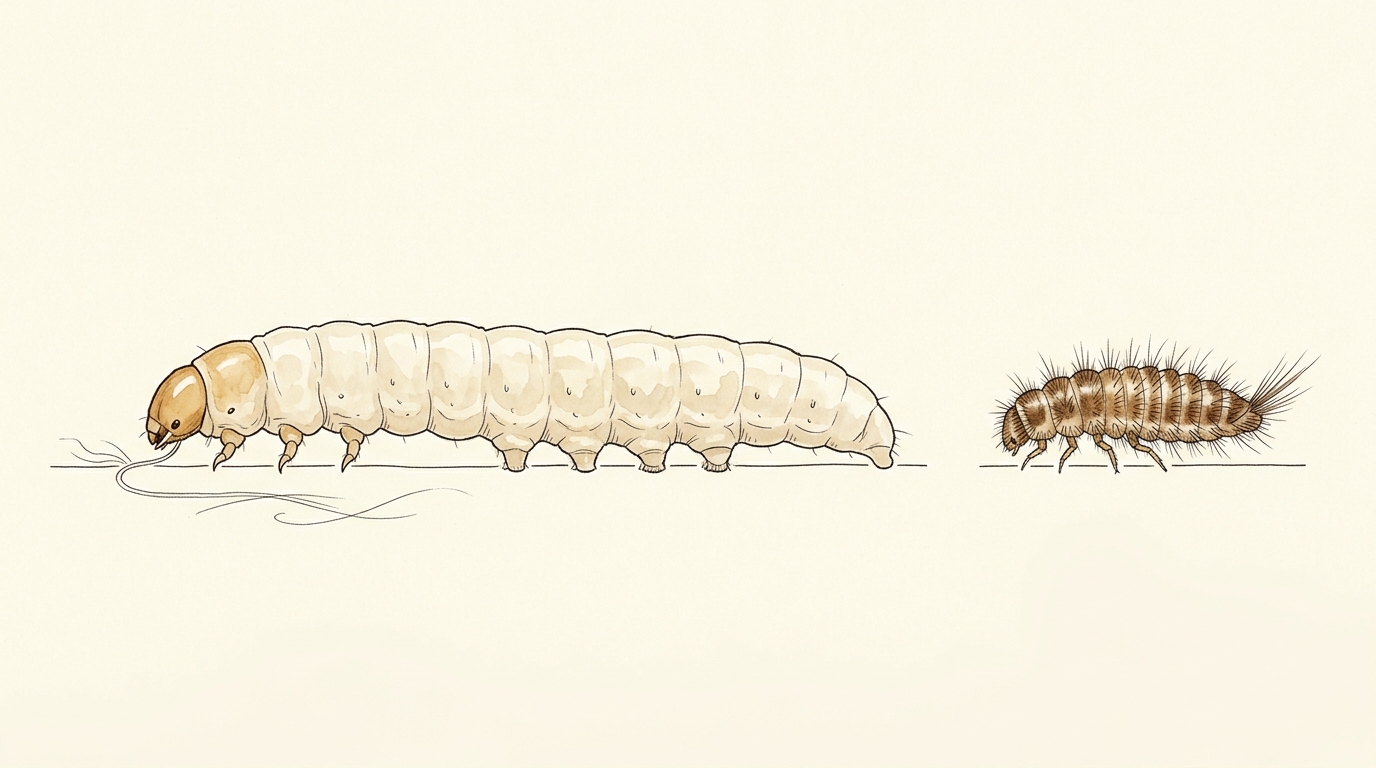
Three discriminators, in the order they are useful.
Webbing. Clothes moth larvae produce silk, either as feeding tubes attached to the fabric or as a portable case. Carpet beetle larvae produce none. NMSU states it directly: carpet beetle larvae “do not spin webs or make cocoons.” If there is silk on the garment, you are not looking at a carpet beetle.
What they leave behind. Carpet beetle larvae molt as they grow, and NMSU notes the shed skins “look like living larvae,” which is exactly how they fool people. So carpet beetle evidence is a scatter of empty bristly husks. Purdue notes those shed skins turn up “mixed with lint and dust.” Moth evidence is silk plus frass. Both leave droppings; only one leaves silk, and only one leaves what appears to be a small crowd of dead insects that were never insects.
Size and build. Clothes moth larvae are cream or white, smooth, and under half an inch. Carpet beetle larvae are, in Purdue’s words, “a fuzzy, slow-moving, light brown or blackish worm about 1/4-inch long,” visibly hairy or bristly, and roughly half the length. Side by side, the moth larva is about two and a half times the beetle larva.
The damage pattern differs too, and it follows from behavior. Moth damage concentrates in one hidden area because the larva stays on its food. Beetle damage scatters across a garment’s surface, and turns up in places with no food at all, because the larva wanders while it feeds.
If what you find points to carpet beetles rather than moths, that is a different post: we cover the full range of carpet beetle signs, including the skin reaction some people get from the larval hairs, separately.
One neighboring confusion worth clearing in a sentence, because it sends people down the wrong path entirely: the small moths in your kitchen cupboard are a third insect again, and we sort out pantry moths and what tells them apart from closet pests in its own guide.
Where Do Carpet Beetle Larvae Hide That Manhattan Clothes Moths Do Not?
The single most useful difference between these two pests is not anatomical. It is how far they travel.
NMSU puts it in one sentence: “Clothes moth larvae are usually found on their food material. Carpet beetle larvae are more adventurous and may crawl from one room to another, or from one apartment to another.”
Read that last clause again, because in a Manhattan apartment building it is the whole ballgame. Clothes moth evidence stays in the closet. Carpet beetle evidence turns up in places you would never store wool, and it can arrive from a neighbor through the same gaps that carry everything else between pre-war units.
So the places to check for beetles and not moths are the places with no clothing in them:
- Lint along baseboards and in corners, which Purdue names specifically as a likely find
- Beneath the edges of rugs, and under furniture that never moves
- Inside wall voids, under floors and behind built-in storage, where lint and debris accumulate out of sight
- Window sills and sunny sides of rooms, because unlike the moth, the adult beetle is drawn to light and feeds outdoors on flower pollen
That last point produces a genuinely useful reversal. An adult clothes moth avoids light and stays near the wool. An adult carpet beetle heads for the window. NMSU notes those adults are “small, oval-shaped insects that are black with varied patterns of orange and white” and are “sometimes mistaken for common garden lady beetles.” A small round mottled beetle dead on a Manhattan window sill in spring is a far more common find than anyone expects, and it is a reason to check the rugs rather than the closet.
Nowhere else in the building explains a moth. If your evidence is spread across rooms, the odds have moved decisively.
When Should Manhattan Residents Identify a Moth Problem as an Infestation?
Evidence of feeding is not the same as an active population, and the gap between them is where most bad decisions get made.
Three questions settle it.
Is anything alive? Old casings, empty cocoons and cured holes can sit in a closet for years. A live larva, a case that has moved between inspections, or fresh frass appearing on a shelf you cleaned last week are what indicate activity. Clean a surface, wait two weeks, look again. Grit that comes back is a live problem; grit that does not is a historical one.
Is it spreading? One affected garment in one box is a contained find. Damage in two separate storage areas, or damage plus evidence in a room with no wool in it, is a different scale of problem, and as noted above, evidence in rooms with no clothing points at beetles rather than moths.
How long has it been running? This one surprises people. The carpet beetle’s larval stage, per NMSU, lasts anywhere from 60 to 325 days. An insect that spends the better part of a year in the stage that does the eating is an insect whose damage long predates the day you found it. The holes you are looking at may be the record of last winter, not evidence of a crisis this week.
Our own threshold, for what it is worth: a live larva or fresh frass on more than one item, or evidence in more than one part of the home, is the point at which we would want to inspect rather than have someone keep checking. A single hole in a single stored jumper, with old casings and nothing fresh, usually is not.
Once identification is settled and the problem is live, the work moves from looking to treating, and treatment is a different discipline with its own protocol. We set out the full removal process for fabric pests, laundering, storage and closet treatment included, in a dedicated guide rather than repeating a compressed version of it here.
The Bottom Line on Clothes Moth Signs in Manhattan Closets
You will find the damage before you find the insect, and that is normal rather than a failure of attention.
Work from the residue. Grit means frass. Silk means moth. Bristly shed skins mean beetle. Clustered holes in a fold, on wool that has not moved in months, means clothes moth larvae feeding where they hide. Scattered surface damage, with evidence turning up in rooms that hold no clothing at all, means carpet beetles that walked there, possibly from another apartment.
And the two things most likely to mislead you: the moth circling your lamp is probably not the culprit and could not eat wool if it wanted to, and a closet full of old casings with nothing fresh in it is a record of something that already finished rather than something happening now.
Identify before you act. It costs you a careful half hour, and it is the difference between treating the right pest, treating the wrong one, and doing what one very unlucky poster did, which is throwing out a wardrobe of which much was probably fine.
We have treated New York City apartments since 1999, so more than 25 years, with 27 people and about 20 technicians in the field, 4.8 stars across hundreds of reviews, and memberships in the state and national pest management associations and the Better Business Bureau. If you want a second opinion on what is in your closet before you commit to anything, that is a reasonable thing to ask for across the neighborhoods we cover in Manhattan.