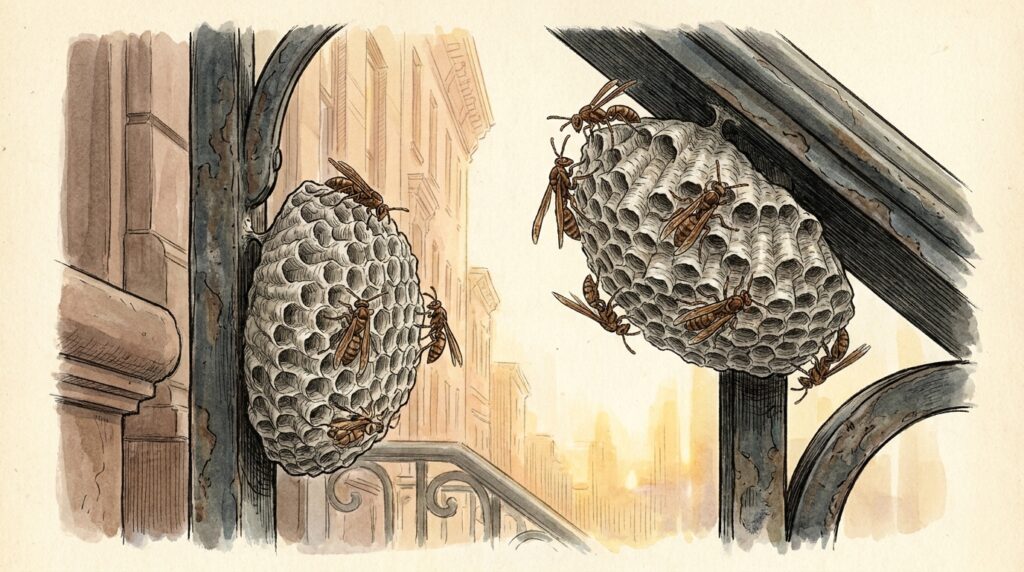
Spotting a single wasp on your Manhattan fire escape or Brooklyn balcony might seem harmless — until a steady stream of them starts appearing every afternoon. For NYC residents living in apartments, brownstones, and high-rises across all five boroughs, identifying a wasp nest early is critical for safety and peace of mind. This guide walks you through the telltale signs of a wasp nest specific to New York City living, helps you distinguish between species (no, it’s probably not a murder hornet), and explains exactly what to do next — whether you’re a renter, homeowner, or someone who just wants to stop dreading their balcony.
Wasp or hornet nest at your NYC home?
26+ years on NYC and Long Island stinging insect work. Same-day removal with the right gear for high eaves and aggressive species, no annual contracts.
What Are the Most Common Signs of a Wasp Nest Near Your NYC Home?
Increased Wasp Traffic Around a Fixed Point
The single most telling sign is a flight pattern. If you notice multiple wasps flying in a consistent path to and from the same spot on your building’s exterior, eaves, or window frame — especially during warm afternoon hours — you’re likely looking at a nest nearby. A sudden jump in wasp sightings over several days, particularly near garbage areas, rooftop gardens, or outdoor dining spaces, is another red flag.
Pay close attention to wasps hovering persistently around a gap in siding, a vent opening, or a crack in your building’s masonry. These aren’t random visits — they’re commuters heading home.
Visible Nest Structures in Common NYC Locations
Paper-like, umbrella-shaped nests hanging under window ledges, fire escape platforms, balcony railings, or building cornices are the work of paper wasps. Enclosed, football-shaped gray nests in trees, shrubs, or attached to upper-story building facades belong to bald-faced hornets. And if you see no visible nest but notice wasps entering and exiting a hole in the ground — common in parks, yards, or tree pits — you’re dealing with yellowjackets. Wasp nest shapes and materials vary dramatically depending on the species, so knowing what to look for helps with early identification.
Auditory and Behavioral Clues Inside Apartments
A faint scratching, buzzing, or rustling sound coming from inside a wall, ceiling, or near an HVAC vent is a strong indicator of a hidden nest in a wall cavity. If wasps keep appearing inside your apartment with no open windows, they’re likely entering through gaps around window AC units, HVAC ducts, or central air systems. Finding dead or sluggish wasps on windowsills or near light fixtures indoors — especially in late summer or early fall — means a colony nearby has peaked in size and workers are spilling into your living space.
Which Wasp Species Should NYC Residents Watch For?
Paper Wasps, Yellowjackets, and Bald-Faced Hornets
Paper wasps build small, open-celled nests and are the most common species on NYC balconies and under eaves. They’re relatively docile and are actually beneficial pollinators and pest controllers, but they will sting if the nest is disturbed.
Yellowjackets are more aggressive, nest in concealed locations — underground, inside walls, behind siding — and their populations surge dramatically in late summer. They’re confirmed nesters on Manhattan apartment building exteriors and are the species most likely to crash your outdoor dinner.
Bald-faced hornets build large aerial nests and are highly defensive. Their distinctive black-and-white coloring helps distinguish them from yellowjackets, and their nests — sometimes as large as a basketball — are hard to miss once you know where to look.
Borough-Specific Species to Know
European hornets are established on Staten Island and occasionally found in the outer boroughs. They’re large, brown-and-yellow, and active at night, which alarms many residents who aren’t expecting wasps after dark. If you encounter them, pest control in Staten Island can confirm the identification and recommend treatment.
Distinguishing invasive European paper wasps from native species requires close observation — invasive varieties have slimmer bodies and similar coloring to yellowjackets, leading to frequent misidentification across the city.
NYC’s “Murder Hornet” Panic — What You’re Actually Seeing
Large wasps in NYC are almost certainly cicada killers or European hornets — not northern giant hornets (formerly called “murder hornets”), which have not been established in New York State. Cicada killers can reach 1.5 inches and cause alarm, but they rarely sting humans. Their presence in NYC parks and yards is normal.
When in doubt, snap a photo and contact a pest control professional for species confirmation before taking any action.
How Do You Find a Hidden Wasp Nest in an NYC Apartment Building?
Tracing Entry Points Around Windows, Vents, and HVAC Systems
Start by inspecting the perimeter of window-mounted AC units, gaps around through-wall HVAC sleeves, and bathroom or kitchen exhaust vents — these are the most common wasp entry points in NYC apartments. Do not seal entry points until the nest has been professionally treated. Blocking access can redirect wasps deeper into your living space or into neighboring units.
Watch the exterior of your building from the street or a neighboring window to track where wasps are entering. The flight path almost always leads directly to the nest.
Using Sound and Thermal Imaging for Wall Nests
Press your ear against the wall — or use a drinking glass as an amplifier — in areas where you’ve seen wasp activity. A faint buzzing or scratching sound confirms a nest inside the wall cavity. Professional pest controllers use infrared thermal imaging cameras to pinpoint hidden nests within walls without opening them up, a technique especially useful in multi-unit NYC buildings where exploratory demolition isn’t practical.
Wall nests can contain thousands of yellowjackets by late summer. If you suspect one, contact pest control in Manhattan or your borough’s provider immediately — this is not a wait-and-see situation.
Apartment Balconies and High-Rise Challenges
Even residents on the fourth floor and above experience wasp problems. Wasps are strong fliers and will nest on balcony furniture, under railings, and inside planter boxes at any height. Limited balcony space makes DIY traps risky, as trapped wasps release pheromones that attract more wasps to the area.
Check the undersides of balcony chairs, tables, grills, and storage bins regularly from spring through fall — especially after a stretch of warm weather. Residents dealing with other warm-weather pests may also benefit from mosquito control in Queens during the same seasonal window.
What Should NYC Renters Know About Wasp Nest Removal Responsibilities?
NYC Housing Code and Landlord Obligations
Under NYC housing maintenance code, landlords are generally responsible for pest control in common areas and building exteriors. Wasp nests on shared structures — facades, hallways, roofs — fall under building management’s duty to address. Renters should report wasp nests to their landlord or management in writing to create a record.
If your landlord fails to act, you can file a complaint through NYC 311 to escalate the issue. Some renters hesitate to report due to concerns about maintenance entering their apartment — specify that exterior-only treatment may be sufficient, and request advance notice for any interior access.
When to Call a Professional vs. Handle It Yourself
Call a professional for yellowjacket nests, bald-faced hornet nests, any nest inside a wall or HVAC system, nests larger than a golf ball, and any situation involving allergy concerns. Our wasp and hornet nest control team handles every species in this guide across the five boroughs and Long Island. Small, early-stage paper wasp nests — fewer than a dozen cells with only a few wasps — can sometimes be removed at dusk using a long-reach tool and soapy water spray, but only if you can do so safely without a ladder near an open window. For those exploring least-toxic wasp management options, several non-chemical approaches can be effective on small nests when applied early in the season.
For pest control in Manhattan, ensure the provider is licensed by New York State and experienced with urban multi-unit buildings. The same diligence applies to other urban pest issues like cockroach control in Brooklyn, where building-wide coordination is equally important.
Wasp or hornet nest at your NYC home?
26+ years on NYC and Long Island stinging insect work. Same-day removal with the right gear for high eaves and aggressive species, no annual contracts.
When Is Wasp Nest Activity at Its Peak in NYC — and When Does It End?
Month-by-Month Seasonal Timeline for NYC
-
April–May: Queens emerge from overwintering sites and begin building small starter nests. This is the easiest time to spot and remove nests before colonies grow.
-
July–September: Colony populations peak. Yellowjacket nests can reach thousands of workers, aggression increases, and wasps become more attracted to human food at outdoor events across the city.
-
October–November: First hard frosts kill off worker wasps and males. Only newly mated queens survive by finding sheltered overwintering spots in wall voids, attics, or behind bark.
Understanding the Winter Die-Off
Paper wasp and yellowjacket nests are not reused the following year. Old nests are abandoned and will naturally deteriorate over winter. Removing an empty winter nest is safe and can be done without professional help, though it eliminates a visual cue that might attract new queens to the same sheltered spot.
Queens overwintering inside wall voids, attics, or window frames may emerge indoors on warm winter days, causing alarm. This is normal and does not indicate an active colony — just a groggy queen looking for warmth.
Should You Remove a Wasp Nest or Leave It Alone?
A Risk Assessment Framework for NYC Residents
-
Remove immediately if the nest is near a doorway, window, or high-traffic area; anyone in the household has a known insect sting allergy; children or pets are present; or the species is yellowjackets or bald-faced hornets.
-
Consider coexisting if the nest is a small paper wasp colony in a low-traffic area — a rarely used corner of a rooftop or garden, for example. Paper wasps help control garden pests and are generally non-aggressive away from their nest.
-
Monitor and reassess if you’re unsure of the species, the nest is in an inaccessible location, or the season is late enough that the colony will die off naturally within weeks.
Emergency Steps When Wasps Appear Inside Your Apartment
Stay calm and move slowly — wasps are more likely to sting when they sense rapid movement or vibration. Isolate the room if possible, turn off bright interior lights, and open a window to give the wasp an exit path. Avoid swatting.
If multiple wasps are entering your apartment over consecutive days, this confirms a nest nearby. Do not attempt to locate it inside walls yourself. Contact your building management and a licensed pest control provider in Brooklyn — or whichever borough you’re in — for an inspection using thermal imaging or other detection methods.
What’s the Bottom Line on Identifying and Dealing with Wasp Nests in NYC?
The most reliable signs of a nearby wasp nest are repeated wasp sightings along a consistent flight path, buzzing sounds inside walls, and wasps entering through HVAC gaps or window frames — all extremely common in NYC apartment living. Correct species identification matters: paper wasps, yellowjackets, bald-faced hornets, and European hornets each require different responses, and many large wasps in NYC are harmless cicada killers, not “murder hornets.”
NYC renters have the right to a pest-free home. Document the issue, notify your landlord in writing, and use NYC 311 if needed. Inspect your apartment’s exterior entry points and balcony furniture for early-stage nests, especially from April through June when removal is easiest and safest.
Whether you need pest control in Queens or across the Bronx, a licensed NYC pest control professional can identify the species, locate hidden nests, and remove them safely. Browse our full range of services to find the right solution for your situation. When in doubt, don’t risk a sting. Get it handled right.
Related guides for NYC residents: If you’re dealing with other pests, check out our guides on Signs of Mosquitoes in Your Yard NYC and Signs of Ants in NYC.