Every spring, our phones light up with the same panicked call: “There’s a swarm of winged bugs by my window and I can’t tell if they’re flying ants or something worse.” It’s one of the most common questions we get, and it matters more than most homeowners realize. One of these insects is a harmless nuisance that wandered in from the yard. The other is a warning sign that a colony may be quietly eating the wood inside your walls. Telling flying ants vs termites apart in the first few minutes can be the difference between a shrug and a repair bill.
After 26 years inspecting basements, brownstone cellars, and Long Island crawlspaces since 1999, our team has learned that the winged insects New Yorkers see are almost always one of two things: a flying ant (usually a carpenter ant swarmer) or a termite swarmer. They look shockingly similar at a glance, which is exactly why so many people either ignore a real termite problem or spend money panicking over harmless ants. If it does turn out to be termites, you’ll want professional termite treatment in NYC rather than a hardware-store spray — but first, let’s make sure you actually know what you’re looking at.
This guide breaks down exactly how to tell a winged ant from a termite swarmer using three quick physical tells, which termite species actually swarms here in the five boroughs and on Long Island, when swarm season hits, and what to do the moment you spot one indoors. No entomology degree required.
Termite swarmers around your NYC foundation?
26+ years treating NYC termites and ants. Soil-applied barriers and bait systems, same-day inspections during business hours, and no annual contracts. Book a free estimate today.
What Is the Difference Between Flying Ants and Termites in NYC Homes?
The short version: flying ants are a nuisance, and flying termites are a structural threat. Both are simply the winged, reproductive members of their colonies — the ones that sprout wings, fly off in a swarm to mate, and try to start a new colony somewhere else. Seeing them is normal insect behavior. The problem is what they signal.
A flying ant is the same insect as the ants you already know, just in its dating phase. Winged ants belong to the same colony as the wingless workers marching across your kitchen counter — they’re not a separate, scarier species. Ants are omnivores; they eat crumbs, grease, sweets, and other insects. They do not eat wood, and even carpenter ants (the big black ants that excavate wood to nest in) don’t actually consume it. The worst a flying ant will do to your home is annoy you.
A flying termite — properly called a swarmer or alate — is a very different animal. Termites feed on cellulose, the fibrous material in wood, paper, and drywall. Here’s a piece of trivia that makes the difference stick: ants are close cousins of wasps and bees, while termites are essentially social cockroaches, more closely related to roaches and mantises than to ants. Their similar swarming behavior is a coincidence of nature, not family. That’s why, once you look closely, their bodies are built completely differently — and why one costs you an afternoon of annoyance and the other can cost you thousands in structural repairs.
How Can You Tell a Flying Ant From a Termite Swarmer in Your NYC Home?
You don’t need a microscope. If you can get a clear look at one insect — or better, catch one under a piece of clear tape or in a jar — three features give you a near-instant answer. This is the same triad our technicians use in the field, and it’s the same one entomologists rely on.
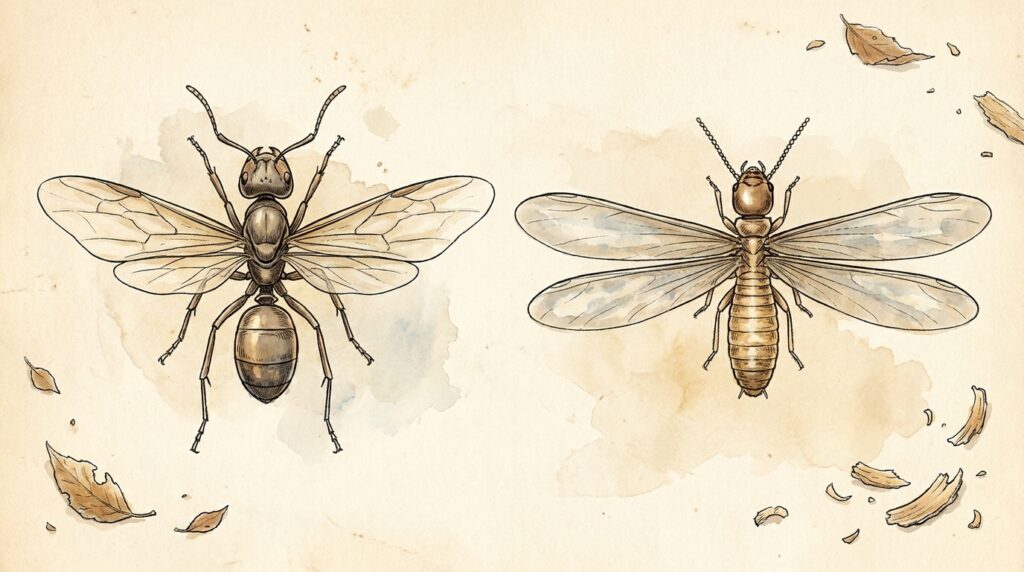
- The waist. Flying ants have a dramatically pinched, narrow waist — three obvious body segments like a tiny hourglass. Termite swarmers have a broad waist with no pinch; the body looks like one thick, straight tube.
- The antennae. Ant antennae are bent, or “elbowed,” at roughly a 90-degree angle. Termite antennae are straight and look like a tiny string of beads (they may droop slightly).
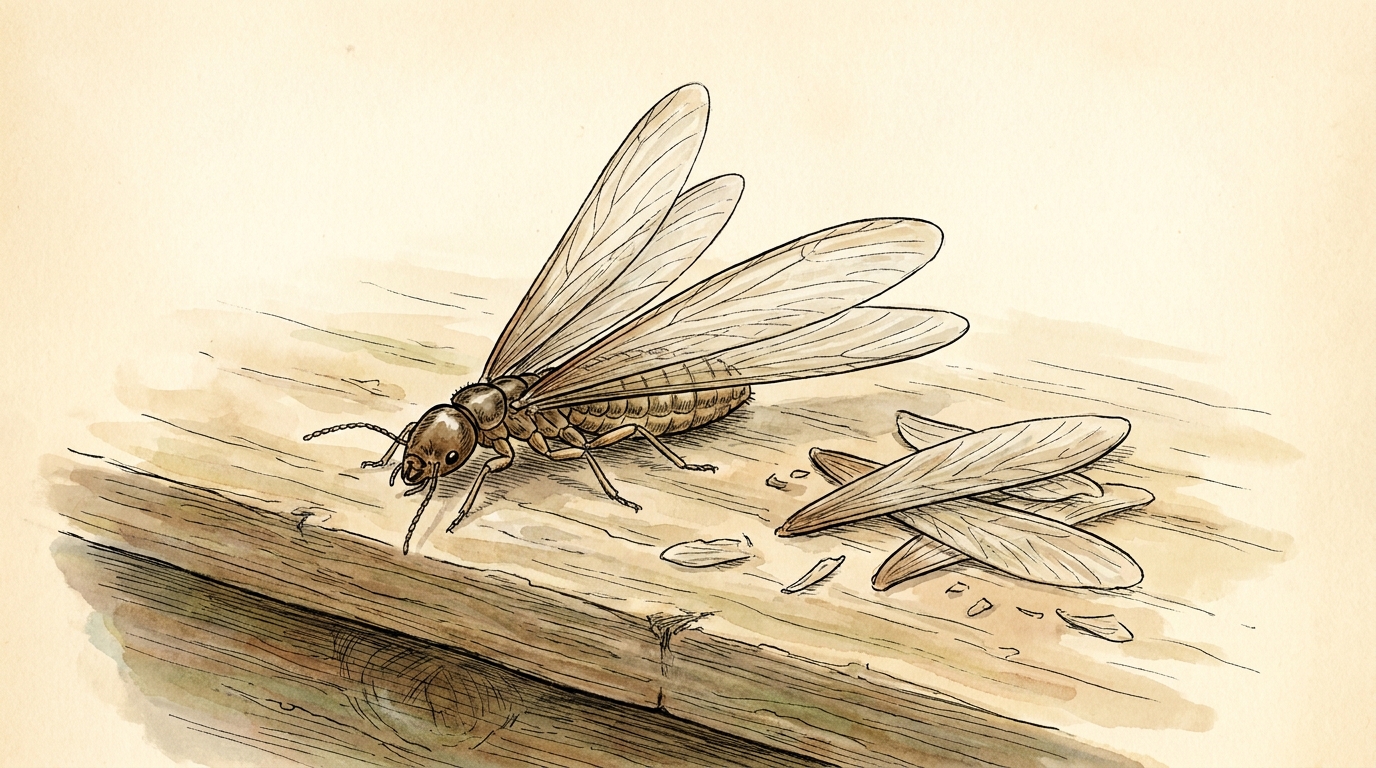
- The wings. This is the tell most people online reach for first. A flying ant has two pairs of unequal wings — the front pair is noticeably longer than the back pair. A termite has four wings of equal length, and here’s the giveaway: a termite’s wings are about twice as long as its body, extending well past the tip of the abdomen. Termite wings also snap off easily, which is why you’ll often find little piles of shed wings on a windowsill.
When the signals seem to conflict — “the waist says ant but the wings say termite” is something we hear constantly — don’t fixate on one feature. Look at all three together, and if you’re still unsure, catch a few and set them aside. Color is a weaker clue (both can be dark brown to black; ants can also be reddish), so we don’t recommend leaning on it. Here’s the full side-by-side:
| Feature | Flying Ant (Winged Ant) | Flying Termite (Swarmer / Alate) |
|---|---|---|
| Waist | Pinched and narrow; 3 clear body segments | Broad and straight; no visible waist |
| Antennae | Bent / elbowed (~90° angle) | Straight and beaded; may droop |
| Wings | Two pairs of unequal length (front longer than rear) | Four equal wings, ~2× body length; shed easily |
| Behavior | Forages openly for food; a few indoors is normal | Stays hidden; swarmers indoors suggest a nearby nest |
| Swarm season (NYC / LI) | Late spring into summer (carpenter ants ~May–June) | Early spring, roughly March–June |
| Damage risk | Nuisance only; does not eat wood | Structural; feeds on wood, paper, and drywall |
If you’d rather not play entomologist at all, that’s genuinely fine — catch two or three specimens in a small container (a medicine bottle or zip bag works) and our technicians can confirm the identification during a visit, with the inspection fee waived when you book treatment. Correct identification is the entire ballgame here, because everything you do next depends on which insect you’re actually dealing with.
Are the Flying Termites in NYC and Long Island Subterranean or Formosan?
If you’ve read national pest articles, you may have seen scary mentions of the Formosan termite — an aggressive, fast-eating species that forms enormous colonies. Here’s the reassurance our team wants New Yorkers to hear: Formosan termites are not established in NYC or on Long Island. They’re an invasive species largely confined to the warm Gulf Coast and Southeast. The EPA’s termite identification guidance lists the Formosan as a less common, invasive termite, separate from the native subterranean termite that dominates most of the country.
What you almost certainly have here is the Eastern subterranean termite (Reticulitermes flavipes) — the only termite species native to our region. As Cornell Cooperative Extension of Nassau County puts it plainly, Long Island has essentially one species of termite, and it’s this one. Out on Long Island, termites are one of the pests we get asked about most. They live in colonies in the soil, tunnel up through mud tubes to reach wood that touches or sits near the ground, and are a genuine concern for the wood-frame homes, decks, and pre-war basements we inspect across Nassau and Suffolk County on Long Island, along with the outer boroughs.
This is also why the winged “ant” you find is so often a carpenter ant swarmer rather than a termite. Carpenter ants are the other big springtime wood-associated insect in New York, and they’re constantly confused with termites — we wrote a whole companion guide on telling carpenter ants apart from ordinary black ants if that’s the rabbit hole you’re heading down. The key difference: carpenter ants typically tunnel through wood that’s already water-damaged and leave behind clean galleries plus little piles of sawdust-like “frass.” Eastern subterranean termites eat sound, undamaged wood and leave mud-caked galleries with no sawdust at all.
Why Do Winged Ants and Termite Swarmers Suddenly Appear Inside NYC Apartments?
One day there’s nothing; the next, there are dozens of winged insects battering a window. That “out of nowhere” feeling is normal — swarming is a brief, coordinated event that can last only a few minutes to an hour, so if you happen to be home for it, it feels like an ambush. Both ants and termites time these flights to warm, humid days, often right after rain, when conditions are best for mating and starting new colonies.
The critical distinction is where you see them. A handful of winged ants outdoors, or even a few that drift inside, usually means nothing more than a colony somewhere in the neighborhood. But swarmers emerging inside your home — from a baseboard, a windowsill, a crack near the floor — is a different message. It strongly suggests the colony is inside or directly beneath the structure. This holds for both insects, but it’s far more serious with termites, because it means they’re already established in or under your home. Termite swarmers are also strongly attracted to light, which is why they cluster around windows and doors when they emerge indoors.
Here’s the counterintuitive part worth knowing so you don’t panic: the swarmers themselves cause zero damage. They can’t chew wood, and the vast majority die within hours. If a few get inside, the practical move is simply to vacuum them up and empty the bag into an outdoor trash can. The swarmers are a smoke alarm, not the fire. If the winged insects turn out to be ordinary nuisance ants, clearing out a carpenter ant or pavement ant colony is straightforward work. If they’re termite swarmers, the smoke alarm has gone off and it’s time to look closer.
Not sure if those swarmers are ants or termites?
26+ years identifying and treating pests across NYC and Long Island. We confirm the species first, use pro-grade treatments, and never require an annual contract. Your estimate is free.
When Is Termite Swarm Season in NYC and Long Island?
For the Eastern subterranean termite in our region, swarm season runs roughly March through June, peaking on warm, humid spring days. Unlike some pests, subterranean termites here do not swarm in summer or fall — so a big indoor swarm of dark, equal-winged insects in April or May is a classic termite signature. Occasionally a colony will send out swarmers on an unusually warm late-winter day, but the heart of the season is spring.
Flying ants overlap but skew a little later, with carpenter ant swarmers most active from late spring into early summer. This overlap is exactly why April-through-June is peak confusion season for New York homeowners, and why our inspection calendar fills up in those months. If you want the deeper regional breakdown, our guide to flying termites in NYC and what their swarms mean walks through the timing and triggers in detail.
The reason season matters for identification: timing is a supporting clue, not proof. An early-spring indoor swarm tilts the odds toward termites; a midsummer backyard swarm around a tree or chimney tilts toward ants (which famously gather around tall structures to mate, a behavior called “hill-topping”). But the three physical tells — waist, antennae, wings — always beat the calendar. Use the season to raise your suspicion, then confirm with the body.
What Other Signs of Termites Should NYC Homeowners Look For Beyond Swarmers?
Most homeowners never actually witness the swarm — they find the aftermath. Because Eastern subterranean termites are so secretive, the evidence they leave behind is often the first and only warning. When our technicians inspect a home, these are the signs we hunt for, and you can check for them yourself:
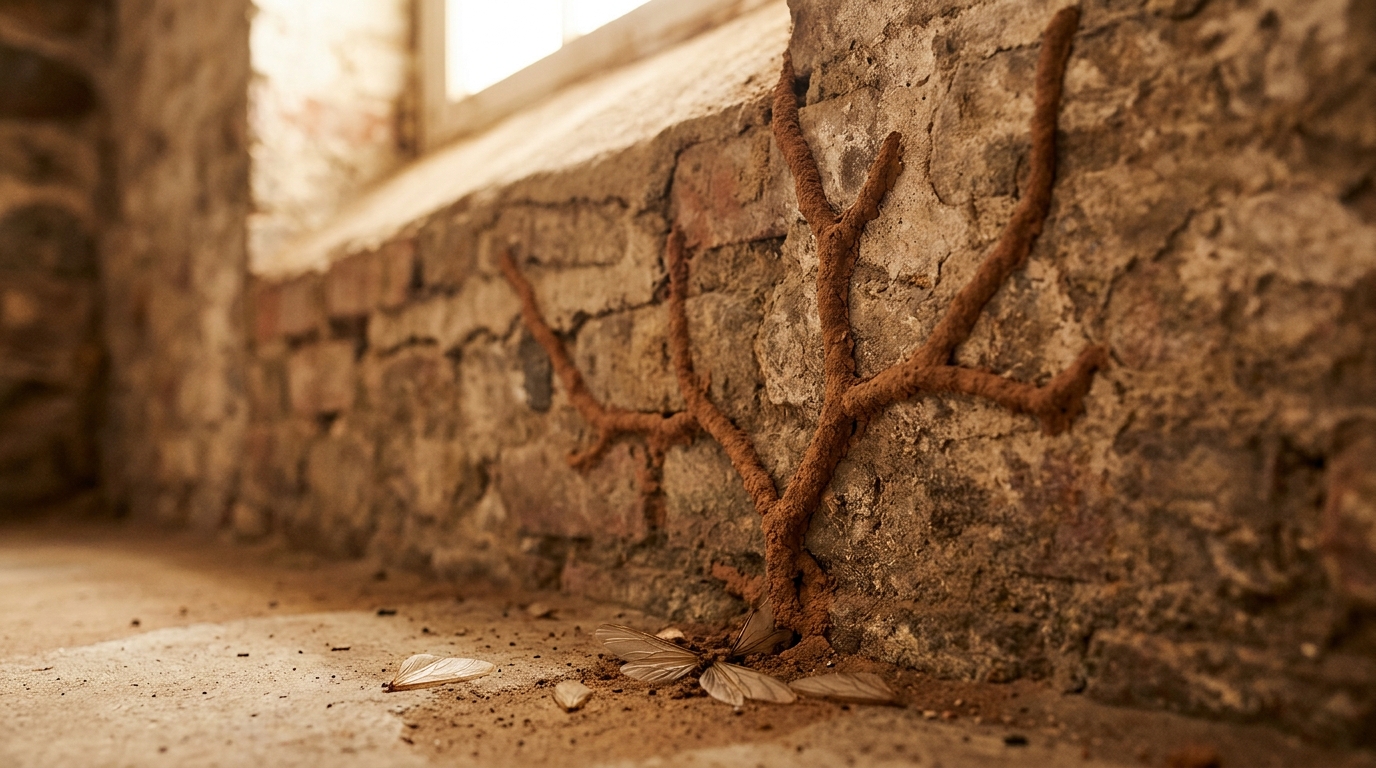
- Discarded wings. Small piles of identical, teardrop-shaped wings on windowsills, along baseboards, or caught in spider webs. Because termite wings snap off after the flight, a scatter of shed wings is one of the most reliable calling cards. University of Maryland Extension notes that a flight of alates or a pile of shed wings is frequently the very first sign a homeowner ever sees.
- Mud tubes. Pencil-width tubes of dried soil running up a foundation wall, a basement joist, or a crawlspace pier. Subterranean termites build these shelter tubes to travel between the soil and your wood without drying out. They’re the single most diagnostic sign of this species.
- Damaged wood that looks “dirty.” Termite-eaten wood sounds hollow when tapped and, when opened, is packed with mud-flecked galleries — a mix of soil, saliva, and waste. That dirt-streaked look is the subterranean-termite signature. Carpenter ant galleries, by contrast, are clean and sawdust-lined.
- Blistering or buckling. Paint that bubbles or wood trim that warps for no obvious reason can hide termite activity or the moisture that invites it.
If you want a room-by-room checklist for spotting these, we put together a full rundown of the warning signs of termites in NYC homes. The takeaway: swarmers get the attention, but mud tubes and shed wings are what actually confirm an active colony — and they can be present even when you never see a single flying insect.
How Worried Should You Be If You Find Swarmers in Your NYC Home?
Let’s separate real concern from panic, because we field both every spring. If you’ve confirmed flying ants, you can exhale — it’s a nuisance issue, not a structural one. Even a large swarm of ants outdoors typically means a colony is nearby but not necessarily in your home.
If you’ve confirmed termite swarmers, take it seriously but don’t spiral. Here’s the reassuring math: Cornell Cooperative Extension of Nassau County notes that the vast majority of swarmers fail or die without ever starting a new colony, and it usually takes years, not weeks, for a colony to do serious structural harm. Termite damage is slow damage. You have weeks, often months, to evaluate and act — not hours. Alates that fly inside almost always dehydrate and die on your floor. So there’s no need to make a frantic same-night decision.
What we do not recommend is the reflex we see constantly: grabbing a bottle of hardware-store insecticide and spraying the swarm. We’ve had homeowners tell us they had a jug of termiticide “ready to go” before they’d even confirmed what the insect was. Killing the visible swarmers accomplishes nothing — the colony is elsewhere, in the soil or the structure, untouched. Worse, a subterranean termite infestation isn’t a DIY spray job at all; effective control means a proper soil-applied barrier or a bait system installed and monitored by a New York State-licensed technician, which is a very different animal from squashing a few nuisance ants.
This is where 26 years in New York homes actually helps. When you call us, we confirm the species first — no treatment plan until we know exactly what we’re dealing with. If it’s termites, we inspect the full perimeter, locate the mud tubes and entry points, and map out a targeted treatment backed by a one-year guarantee with an annual renewal option. If it’s carpenter ants or another nuisance, we treat accordingly and you’re not paying for termite work you don’t need. Either way, our inspection is free, we offer same-day service during business hours across all five boroughs and out to Nassau and Suffolk, and we never lock you into an annual contract. With 27 people on our team, roughly 20 of them technicians, and a 4.8-star rating across hundreds of reviews, correctly telling these two insects apart is genuinely routine work for us.
The Bottom Line: Flying Ants vs Termites in Your NYC Home
When you find a swarm of winged insects, run the three-part check: pinched waist, bent antennae, and unequal wings mean a flying ant — a nuisance you can handle. A broad waist, straight antennae, and four equal wings twice the length of the body mean a termite swarmer — a signal to look for mud tubes and shed wings and to book an inspection. Timing helps too: an early-spring indoor swarm here is far more likely to be the Eastern subterranean termite, the one species that actually threatens New York and Long Island homes, and never the Formosan termite you’ll read about in national articles.
The most expensive mistake we see isn’t overreacting to a few harmless ants — it’s ignoring a genuine termite swarm because someone assumed it was “just flying ants.” If you’ve got a jar of winged insects and any doubt at all about what they are, that’s exactly the moment to have a licensed set of eyes take a look. Catch a few, keep them, and let our team confirm it for you before the calendar turns and the swarm season passes.