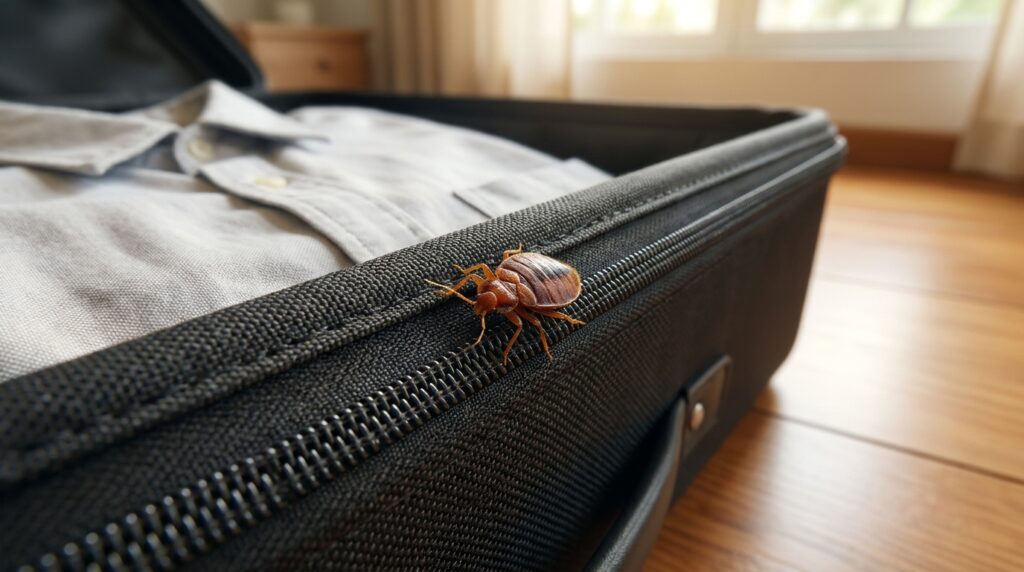
You unlocked your apartment door, dropped your bag in the bedroom, and collapsed onto the mattress after a long summer trip. A week later you spot a couple of itchy welts on your arm and a tiny rust-colored speck on the sheet, and your stomach drops: did I bring bed bugs home? We hear that exact question every summer from New Yorkers across all five boroughs and out on Long Island, so let us start with the reassuring part. Most trips do not end in an infestation, and the ones that do are far easier to handle when you catch them in the first week or two instead of the third month.
We are Advanced Pest Management, and we have handled professional bed bug treatment in NYC since 1999. This guide is the post-trip companion to our pre-trip playbook. It covers what to do the moment you walk in the door, the early signs that mean a bed bug actually hitched a ride home, and the point where a quick call to our team saves you weeks of stress. Think of it as the “you are already home, now what” version of the story, written for cramped city apartments and shared-wall buildings where a single hitchhiker can become the whole building’s problem.
Worried you brought bed bugs home from a trip?
26+ years treating NYC bed bugs. Catching them early is cheaper and easier, so we move fast with Crossfire residual where it counts, no annual contracts, and a free estimate to confirm what you are dealing with.
Do Bed Bugs Travel Home to NYC on You, or in Your Luggage?
Here is the first myth we want to kill, because it changes how you think about the whole trip home. Bed bugs do not live on your body or in your hair the way head lice do. They cannot fly and they cannot jump. What they do brilliantly is crawl into the soft, folded, dark places you carry with you, which means your suitcase, your clothing, your travel pillow, and the tote you stuffed under a seat. According to the NYC Health Department, bedbugs hitch a ride on clothing and luggage, especially in the places where travelers sleep, and are only rarely found on planes, trains, and cars. In other words, they ride in your gear, not on you.
It helps to know what actually rode home. An adult bed bug is about the size and shape of an apple seed, flat and oval, and reddish-brown, turning darker and more swollen right after a blood meal. The young ones, called nymphs, are smaller and nearly translucent, so they are easy to miss against light fabric, and the eggs look like pale, pinhead-sized specks tucked into a seam. This is why summer is prime time. Bed bug activity tends to peak in the warm months, right when the city empties out for vacations, weddings, and long weekends upstate.
The NYC twist is the ride itself. You do not just walk into a single-family house and shake out one bag in the garage. You take a cab or the subway home from the airport, drag the suitcase up four flights of a pre-war walk-up, and set it down three feet from where you sleep. It only takes one pregnant female, or even a single fed adult, to start a problem that spreads along shared walls and pipe chases into your neighbor’s unit. For the trip in the other direction, before you ever check in, our companion guide on checking a hotel room for bed bugs before you unpack walks the room down seam by seam so fewer of them ever get the chance to stow away.
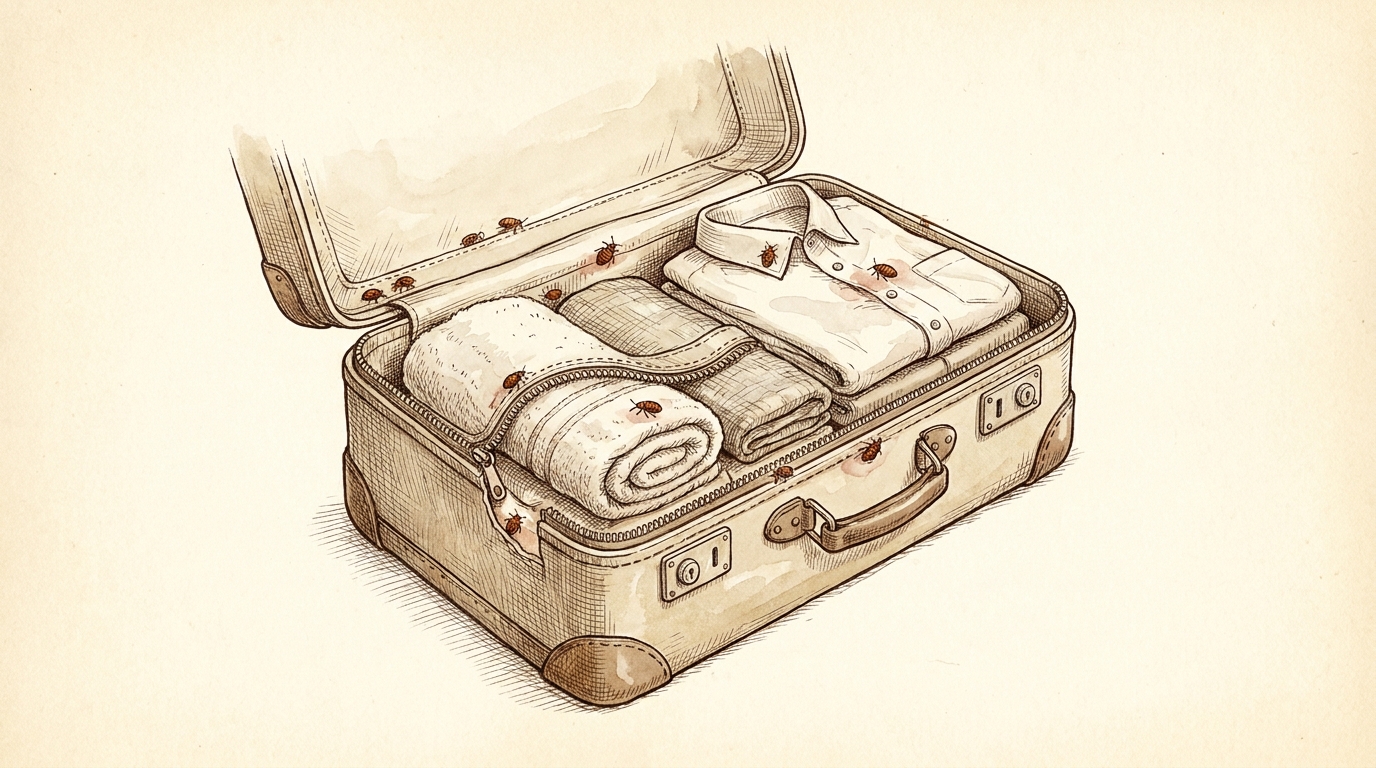
How Do You Kill Bed Bugs in Luggage and Clothes Once You’re Home in NYC?
The single most useful habit we can give you is a deliberate unpacking routine, done the day you get back while it is still fresh in your mind. The goal is simple: never let an unopened, un-inspected suitcase sit in the bedroom overnight. Where you unpack matters as much as how. Choose a hard, bright, easy-to-scan surface such as the bathroom tile, the kitchen floor, an entryway, or a balcony. Michigan State University Extension recommends unpacking somewhere other than the bedroom, on a hard surface under good light, precisely because a bug crossing tile is easy to see and has nowhere to burrow.
Then let heat do the heavy lifting. Take everything washable straight from the bag into the dryer and run it on high for at least 30 minutes. We want to stress this because it trips people up constantly: it is the dryer, not the wash, that reliably kills bed bugs at every life stage. A normal-temperature wash can leave eggs behind, while sustained heat around 120 degrees finishes all of them. Dry first on high, then wash and dry again for cleanliness if you like. Clothes that cannot take a hot wash can still go through a hot dryer cycle, and anything truly delicate can be sealed in a bag and set aside for treatment rather than tossed onto the bed.
Now deal with the luggage itself, which is where the hitchhikers actually hide. Empty the bag completely and run a flashlight slowly along every seam, zipper track, fold, and interior pocket, looking for live bugs, pale eggs, dark specks, or shed skins. Vacuum the whole case, inside and out, then immediately seal the vacuum canister contents or bag into a plastic bag and drop it in an outdoor trash bin so nothing crawls back out. Wipe the shell down, and store the empty suitcase somewhere other than the bedroom closet, ideally a hard-floored storage space or the back of a hall closet. Done in one sitting, this is the routine that stops nearly every near miss from ever becoming an infestation.
What Are the First Signs of Bed Bugs After a Trip Back to NYC?
Even with a clean unpacking routine, you want to know what a real problem looks like in its opening days, because early evidence is subtle and easy to explain away. There are five signs worth watching for, and the more of them you can find together, the more confident you can be about what you are seeing.
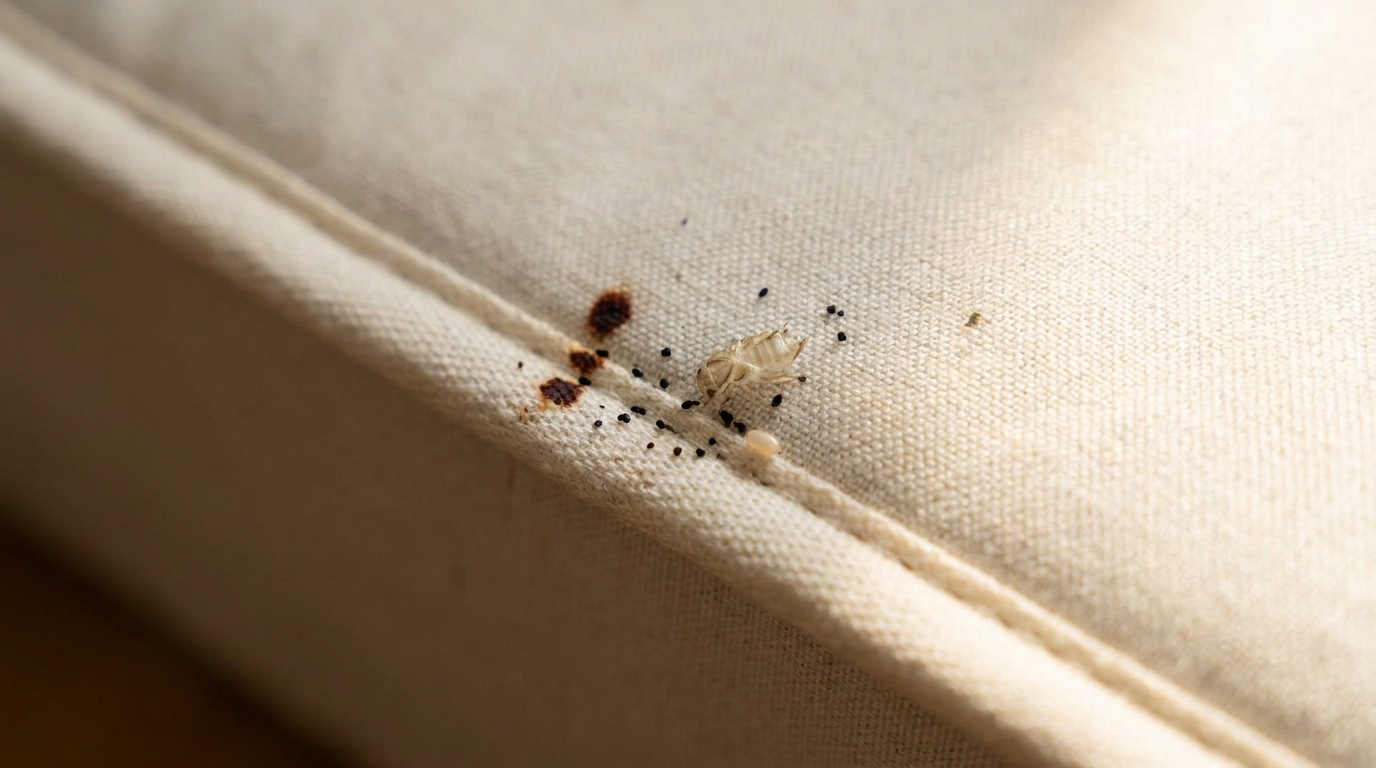
First, live bugs. Seeing an actual reddish-brown, apple-seed-shaped insect on the mattress or box spring is the only one-hundred-percent confirmation, so if you find one, capture it in a piece of clear tape or a jar rather than squashing it. Second, rusty or dark blood spots on sheets and pillowcases, left when a feeding bug is rolled onto in your sleep. Third, fecal marks, which look like tiny black dots made by a fine felt-tip marker and smear rust-brown if you wipe them with a damp cloth. Fourth, shed skins, the translucent empty shells the nymphs leave behind as they grow, which collect in seams and crevices. Fifth, the eggs themselves, pale and only about the size of a pinhead.
Where should the flashlight go first? The EPA’s guide to finding bed bugs notes that they harbor close to where people sleep and only travel a short distance to feed, so the bed and the area within about fifteen feet of it are your highest-yield zone. A musty, sweetish odor is sometimes mentioned as a sign, but it usually only shows up with a heavy, established infestation, so do not wait to smell anything. In the early window we care about here, you are hunting for those small visual clues, not a dramatic scene.
Where Do Bed Bugs Hide First in an NYC Bedroom the Week You Get Home?
This is the part people get backwards. Inspecting a hotel room you are about to sleep in is one job, and we cover that room-by-room in the pre-trip guide linked above. Inspecting your own bedroom in the days after a trip is a different job with a different rhythm, because now you are looking for a brand-new, tiny population that has not had time to spread, and you get to take your time.
Start where they start. Strip the bed and check the mattress seams and piping first, then the tufts and the label, then lift the mattress and examine the box spring, especially the stapled fabric and the wooden frame underneath. Move outward to the bed frame joints and the headboard. In a lot of NYC apartments the headboard is bolted to the wall, so it goes undisturbed for months, which makes it a favorite. From there, widen the circle to the nightstand and its drawer runners, the baseboards behind the bed, the edge of the carpet, and outlet covers on the wall the bed touches. Bed bugs are flat enough to slide into any gap a credit card fits into, and older housing gives them plenty: crevice-heavy vintage wood, gaps around radiator pipes, and the seams of pre-war molding.
Use a strong flashlight held at a low angle so it throws long shadows across the surface, and do this in the first days and weeks after you get home rather than waiting for a reason. The whole advantage of a post-trip check is timing. A single hitchhiker in week one hides in a couple of obvious places and is trivial to knock out. The same bug, unnoticed for two months, is spread across the frame, the wall, and possibly the next apartment.
Not sure those bites actually mean bed bugs?
We have treated NYC bed bugs since 1999. Our team confirms it fast, treats with a family and pet-friendly plan, keeps you off annual contracts, and starts every job with a free estimate.
Do Post-Trip Bites Mean Bed Bugs, or an NYC Look-Alike?
For most people the whole scare starts with bites, so let us be honest about what they can and cannot tell you. Bed bug bites often show up as small, red, itchy bumps in a rough line or tight cluster on skin that was exposed while you slept, like an arm, shoulder, or ankle. Because they feed in more than one spot, people sometimes call the pattern “breakfast, lunch, and dinner.” That pattern is a reasonable prompt to go looking, but it is not a diagnosis.
Here is the catch that surprises people. Bites alone are not proof, in either direction. Cornell University’s integrated pest management program points out that reactions to bed bug bites vary enormously from person to person, with some people breaking out in obvious welts while others sleep next to the same bugs and show nothing at all. Reactions can also take up to two weeks to appear, which is why you might only notice marks long after the trip that caused them. The reassuring flip side, from that same source, is that bed bugs are not known to spread disease, so this is a comfort-and-peace-of-mind problem, not a medical emergency.
So treat bites as your cue to confirm with physical evidence, the live bugs, spots, skins, and eggs from the section above. It also helps to rule out the look-alikes that send New Yorkers into a panic every year. Carpet beetle larvae, young cockroaches, and round little spider beetles all get mistaken for bed bugs, and the differences matter for treatment. If you want to line the suspects up side by side, our deeper tenant’s guide to identifying bed bugs in NYC breaks down the evidence and the common impostors in detail. On timing, keep this in mind: if you did bring one or two home, it may be roughly a month before they become obvious, which is exactly why a deliberate early check beats waiting for certainty.
When Should You Call an NYC Exterminator About Travel Bed Bugs?
Call us the moment you have a genuine sign rather than a vague worry. That means you saw a live bug, you found fecal spotting or shed skins in a mattress seam, or bites keep appearing night after night even after you have laundered everything and cannot pin down a source. You do not need to wait until you are certain. With bed bugs, certainty usually means the population has grown, and growth is the expensive part.
The reason we push early is straightforward math. One hitchhiker caught in the first couple of weeks is a small, contained job. Left alone, that same bug can multiply into an infestation spread across your frame, your walls, and your neighbor’s apartment within a few weeks, and in a shared-wall building that turns a private problem into a communal one. This is also why we steer people away from drugstore sprays and foggers. They rarely reach where bed bugs hide, city populations have grown resistant to common over-the-counter products, and a fogger mostly scatters the survivors deeper into walls and adjacent units.
When you call, you are getting a team that has done this in New York apartments since 1999, with 26-plus years of local experience, a crew of 27 including about 20 field technicians, and a 4.8-star rating across more than 300 reviews. We serve all five boroughs and Long Island, we offer same-day service during business hours, and we treat bed bugs with proven residual products like Crossfire placed exactly where the bugs travel, using family and pet-friendly plans and no annual contracts. If early detection is the goal, professional tools like careful inspection and targeted treatment find and finish a young infestation far faster than guesswork. The whole thing starts with a free estimate, so you are never paying just to find out where you stand.
The Bottom Line on Bed Bugs You Bring Home to NYC
Coming home from a trip should not fill you with dread, and it does not have to. The playbook is short and it works: unpack on a hard surface away from the bedroom, run everything through a hot dryer, inspect and seal your luggage, and keep the empty bag out of your sleeping space. Over the next couple of weeks, glance at the mattress seams, the headboard, and the frame for live bugs, blood spots, fecal marks, shed skins, or eggs, and remember that bites alone are a prompt to look, not a verdict. If a real sign shows up, move on it early while the problem is still small and cheap to solve. New Yorkers travel, and bed bugs are a manageable risk, not a reason to stay home. When you want a second set of eyes, we are a phone call away and happy to help you sleep easy again.