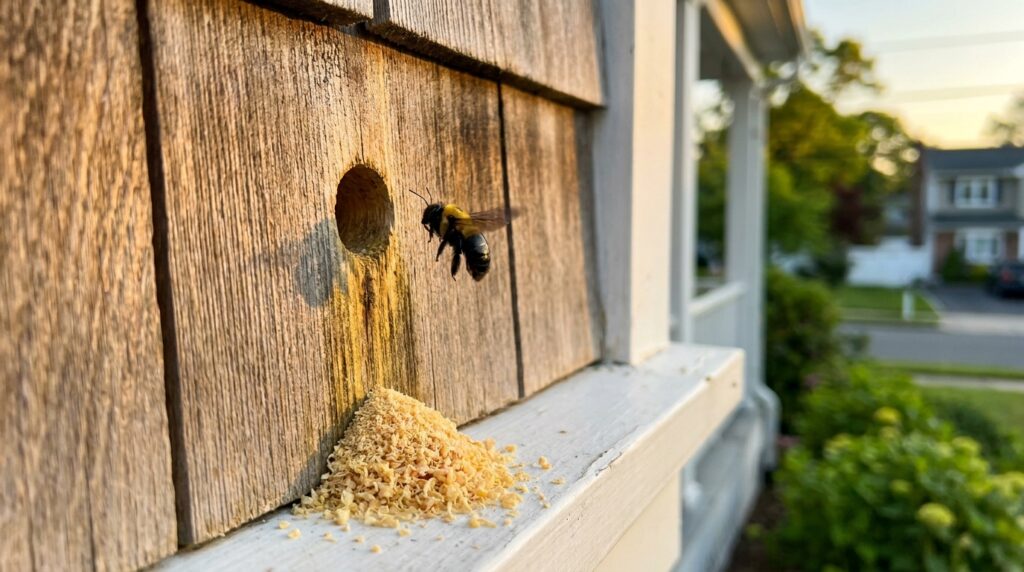
If you’ve spotted perfectly round half-inch holes drilled into the unpainted cedar siding of your Huntington home, watched large fuzzy black bees hovering aggressively near the eaves of your Bayport ranch, or noticed sawdust piles accumulating below the mahogany deck rails of your Garden City colonial — you have carpenter bees, and on Long Island, you have lots of carpenter bees. After 26 years inspecting Long Island homes for wood-boring insect damage, our team has learned that carpenter bees are by far the most common wood-damaging pest on Long Island suburban housing stock, ahead of termites and ahead of carpenter ants. The damage is rarely immediately structural, but ignored for 5 to 10 years carpenter bee infestations can hollow out fascia boards, deck rails, and pergola posts to the point where structural repair becomes the bigger bill.
This guide walks through what carpenter bee damage actually looks like on Long Island homes specifically, how to tell carpenter bee holes apart from termite damage, why they keep coming back to the same fascia or deck year after year, when damage is structural vs cosmetic, the DIY methods that work for Nassau and Suffolk yards, and the New York State legal context for killing or relocating carpenter bees. If you’d rather skip the DIY and book professional Long Island pest control for a free yard inspection, our front-office team can usually book a same-day visit. Read on for the LI-specific guide.
Carpenter bees drilling your Long Island home?
26+ years treating Long Island carpenter bees. Targeted dust application, hole sealing, and the seasonal protocol that breaks the re-nesting cycle, no annual contracts, and a free inspection that's waived when you book.
What Does Carpenter Bee Damage Look Like on a Long Island Home?
Carpenter bee damage is unmistakable once you know what to look for. The diagnostic features:
- Perfect round entry holes about 1/2 inch in diameter. Carpenter bee females drill nearly geometrically perfect circular holes in wood. The hole is usually drilled upward at a slight angle for about 1 inch, then turns at right angles to follow the wood grain.
- Sawdust piles below the entry hole. Light-colored fresh wood shavings accumulate on horizontal surfaces below active entry holes — windowsills, deck boards, the ground below a fascia. Old damage produces darker weathered sawdust; fresh damage produces light yellow-tan shavings.
- Yellow staining around the hole. Carpenter bee excrement stains the wood directly below the entry hole. Brownish-yellow streaks running down from the hole indicate active occupation.
- Aggressive hovering and territorial behavior. Male carpenter bees hover aggressively near the nest entrance, swooping at anything that approaches. The males look threatening but cannot sting — only females can sting and rarely do.
- Buzzing inside wood. Established colonies in fascia or deck rails create faint buzzing audible at close range during peak activity (April through July).
- Multiple holes in the same wood face. Carpenter bees prefer to re-nest in the same wood year after year, often adding new holes adjacent to existing ones. A 5-year-old infestation can have 20+ visible entry holes on a single fascia run.
- Damaged wood underneath paint. Where unpainted or weathered wood is exposed, carpenter bees drill directly. Painted wood is rarely damaged in the first instance, but once paint fails and bare wood is exposed, they colonize quickly.
The single most important diagnostic feature: perfect round 1/2-inch holes. Almost no other wood-boring pest produces this exact hole geometry. Termites don’t drill external holes; carpenter ants exit through small 1/8-inch holes; powder-post beetles produce 1/16-inch holes. Carpenter bees are unique.
How Do You Tell Carpenter Bee Holes from Termite Damage on Long Island Wood?
Confusion between carpenter bee and termite damage is rare but expensive when it happens. Here’s the diagnostic difference:
| Diagnostic feature | Carpenter bees | Subterranean termites |
|---|---|---|
| External holes | YES — 1/2 inch perfect circles | NO external holes; termites stay enclosed |
| Sawdust/frass | Light-colored sawdust below holes | NO frass; termites pack mud into damage |
| Visible workers | Large 1-inch bees with a shiny black abdomen and yellow thorax | Rarely visible; termites stay enclosed |
| Mud tubes | NO | YES — quarter-inch mud tubes on foundation |
| Damage pattern | Round galleries following the grain | Rough muddy galleries cross-grain |
| Wood location | Above-ground unpainted wood (fascia, deck, pergola) | Soil-contact wood (sill plates, basement framing) |
| Long Island treatment cost | $200 to $600 typical | $1,500 to $4,500 typical |
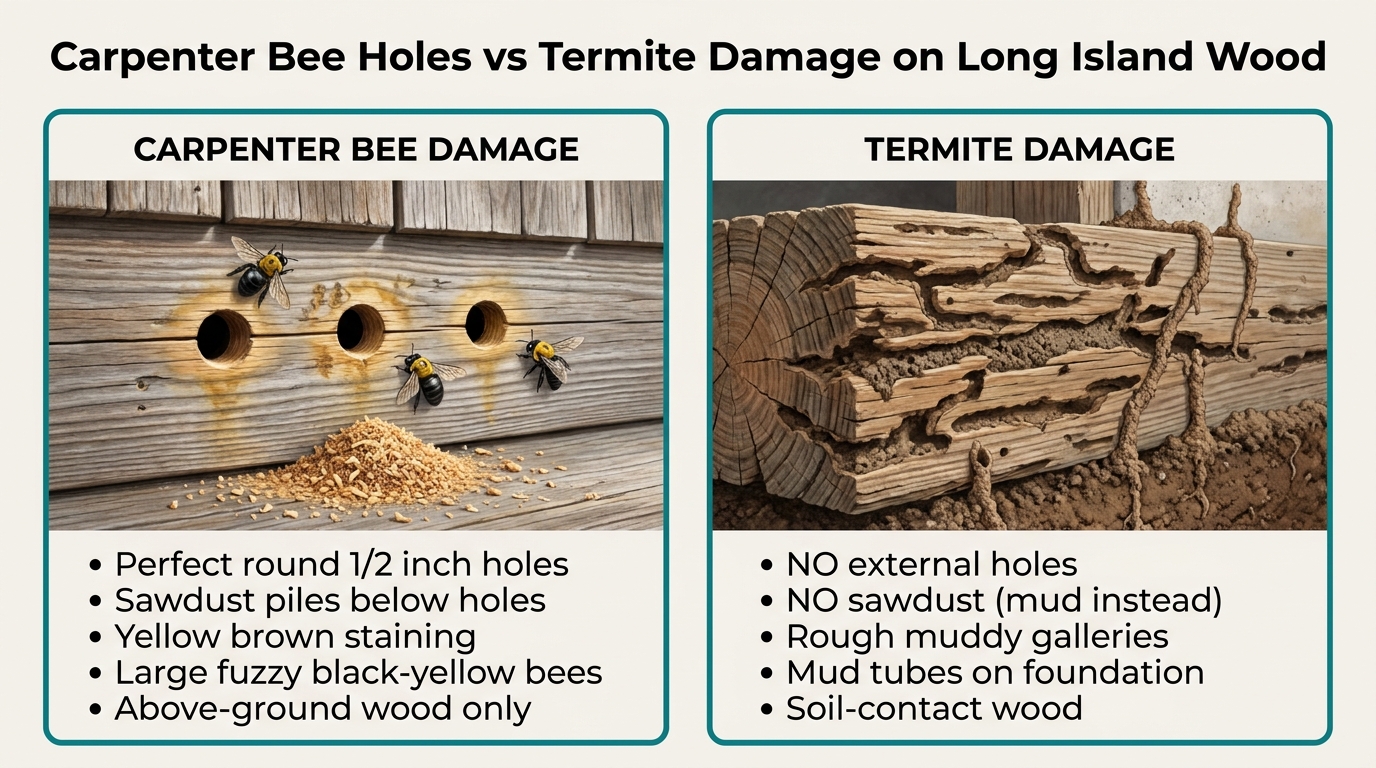
The damage pattern is the giveaway. Carpenter bees create round galleries that follow the grain — clean, smooth, geometric. Termites create rough muddy galleries cross-grain. If you find perfect round 1/2-inch holes, it’s carpenter bees. For comprehensive termite identification, our flying termites in NYC guide covers the swarmer ID step, and our guide to signs of termites in NYC walks through structural evidence patterns.
How Do You Stop Carpenter Bees From Coming Back to the Same Long Island Fascia or Deck?
Carpenter bees are aggressively site-faithful. Females overwinter inside existing galleries, emerge in spring, mate, and either expand the existing gallery or drill new holes adjacent to it. A single fascia run that’s been infested for 5 years can have 3 to 4 generations of overlapping galleries. The structural reasons:
Once wood is colonized, it’s pheromone-marked. Female carpenter bees release pheromones that attract future generations to the same wood. Untreated wood that hosted a colony will be reoccupied year after year, even after the original colony dies.
Cedar, mahogany, and old oak are preferred substrates. Long Island construction uses cedar siding, mahogany deck rails, and oak pergola framing — all carpenter bee preferred substrates. Properties built with these materials will have ongoing carpenter bee pressure unless treatment + sealing breaks the cycle.
South-facing and west-facing wood is preferred. Carpenter bees prefer sun-warmed wood for nesting. The south and west elevations of Long Island homes get the highest carpenter bee pressure.
Failed paint or stain. Carpenter bees rarely drill through intact paint. Once paint fails or stain wears off, bare wood becomes vulnerable. Maintenance painting is the single most effective long-term prevention.
Untreated existing holes. Existing holes that aren’t sealed after treatment are open invitations for next year’s generation. Treatment without hole sealing is incomplete work.
When Is Long Island Carpenter Bee Damage Cosmetic vs Structural?
For most Long Island homes, carpenter bee damage stays cosmetic for years before becoming structural. Here’s how to assess:
Cosmetic damage (no immediate structural risk):
- Single or few entry holes in fascia, deck rails, or trim wood. Galleries under 6 inches deep.
- Damage in decorative pergola posts, fence rails, or arbor framing not load-bearing.
- Damage in cedar siding panels that can be replaced or repaired without structural rework.
- Yellow staining below entry holes (aesthetic concern, not structural).
Structural damage (treatment + repair required):
- Galleries longer than 12 inches inside fascia boards. Extensive horizontal tunneling weakens the wood significantly.
- 20+ entry holes on a single fascia run signaling decades of accumulated damage.
- Damage in deck post bases, deck framing, or stair stringers where load-bearing integrity matters.
- Damage in window frame structural elements where rot may follow.
- Multiple-generation damage where galleries from different years interconnect.
For Long Island homeowners, the diagnostic step is: count visible entry holes, estimate the age of the infestation, identify whether the wood is load-bearing or decorative. Single-year cosmetic damage costs $200 to $600 to treat and seal. Multi-decade structural damage costs $1,500 to $8,000+ for fascia rebuild plus $400 to $800 for treatment.
Carpenter bees drilling your Long Island home?
26+ years treating Long Island carpenter bees. Targeted dust application, hole sealing, and the seasonal protocol that breaks the re-nesting cycle, no annual contracts, and a free inspection that's waived when you book.
How Do You Get Rid of Carpenter Bees in a Nassau or Suffolk Yard?
For Long Island homeowners with mild to moderate carpenter bee infestations, the DIY protocol that actually works:
- Apply insecticidal dust into each visible entry hole. Use a dust applicator with permethrin dust, boric acid dust, or diatomaceous earth. Puff a small amount of dust into each hole at dusk when bees are inside. The dust kills returning females and developing larvae.
- Wait 24 to 48 hours. Don’t seal holes immediately — surviving bees need to be able to exit through the dust-treated hole and die. Sealing immediately traps them inside but doesn’t kill them.
- Seal holes with wood putty or caulk after 48 hours. Use exterior-grade wood putty or paintable caulk. Smooth the surface flush. Once dry, sand and paint.
- Paint or stain the affected wood. Painted or stained wood is dramatically less attractive to next year’s carpenter bees. Treating wood that stays unpainted is short-term work.
- Consider hanging carpenter bee traps for late-season prevention. Wooden trap boxes with internal angled holes catch carpenter bees searching for nest sites. Cost: $15 to $30 per trap. Most effective when placed before nesting season starts (early April).
- Repeat treatment in early April annually. Carpenter bees emerge in early spring on Long Island. Annual April spot-check + dust treatment of any new activity breaks the re-nesting cycle.
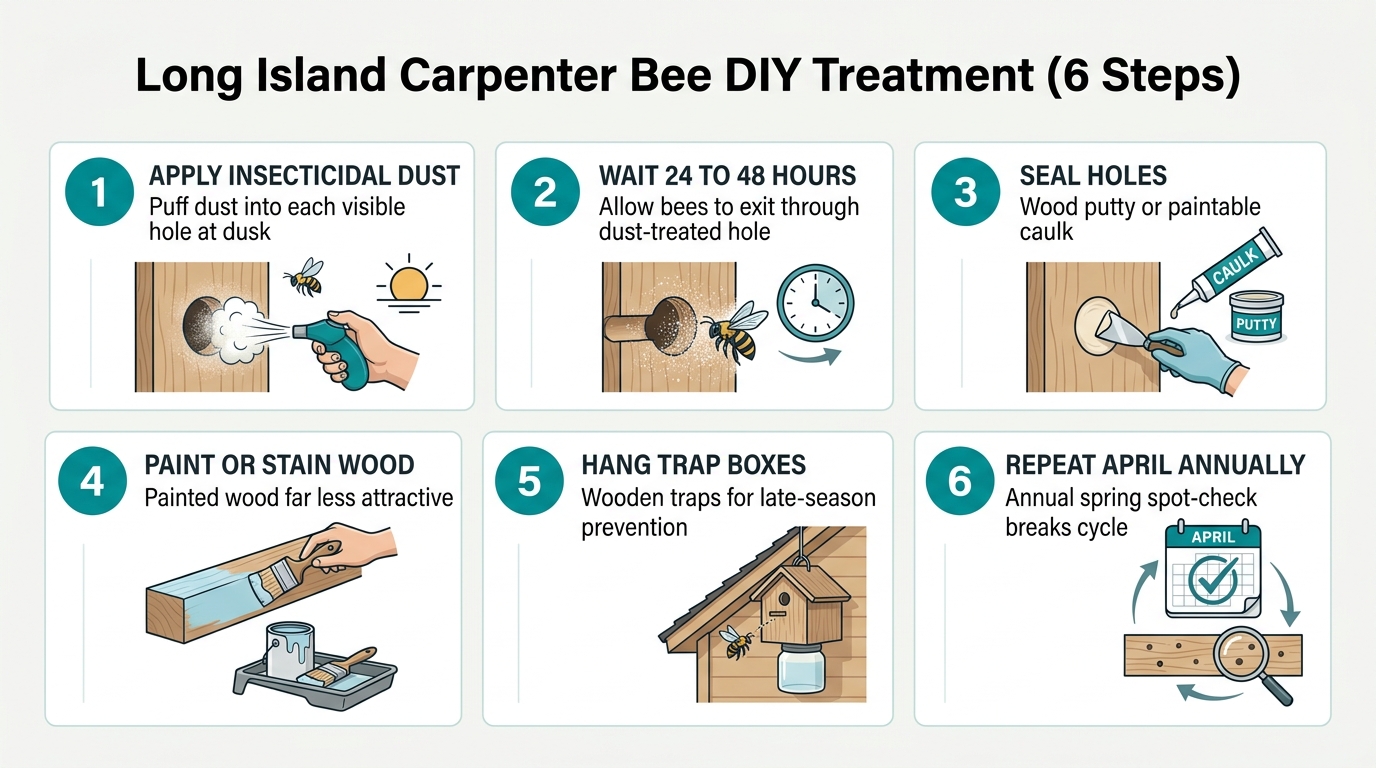
The DIY approach works for properties with under 10 active entry holes in accessible locations (eye-level fascia, deck rails, pergola posts). For properties with 10+ holes, holes above ladder height, or multi-elevation damage, professional treatment is more cost-effective. Per Penn State Extension’s carpenter bee management guide, professional treatment uses similar product classes but applied more thoroughly with better equipment.
Are Long Island Carpenter Bees Protected and Is Killing Them Legal in NY?
This question comes up constantly because honey bees are protected and homeowners worry about misidentification. Honest answer: carpenter bees are NOT protected in New York State and treating them is fully legal. Per NY DEC pesticide guidance, carpenter bees are classified as a structural pest and can be treated under standard pesticide licensing.
The confusion arises because:
- Honey bees are protected. Don’t spray honey bees. If you find a honey bee swarm or colony, call a local beekeeper for free relocation. Honey bee colonies are dense clusters of golden-brown fuzzy bees around a queen, NOT individual large black bees hovering near wood.
- Bumblebees are protected ecologically and shouldn’t be killed. Bumblebees nest in ground cavities or insulation, NOT in drilled holes in wood. If you see large fuzzy black-and-yellow bees emerging from underground or attic insulation, they’re likely bumblebees, not carpenter bees.
- Carpenter bees are clearly distinguishable. Large, glossy black, often with a yellow thorax, drilling perfect round holes in wood. The hole geometry is the diagnostic feature.
If you’re not sure whether you’re looking at carpenter bees or another bee species, our comparison guide for hornets vs wasps in NYC and Long Island covers the stinging-insect ID step. Carpenter bees are the only wood-drilling bee on Long Island, so the perfect round 1/2-inch hole is the giveaway.
When Should You Call a Pro vs DIY for Long Island Carpenter Bees?
DIY works for contained early-stage carpenter bee problems on accessible wood. Call a pro for:
- 10+ entry holes in accessible wood — DIY scope, but the labor adds up. Pro treatment is faster.
- Damage above ladder-reach height. Carpenter bees colonize 2nd and 3rd story fascia, dormer trim, and high gables. These are pro-only locations.
- Suspected structural damage. Gallery damage in deck post bases or load-bearing fascia needs professional assessment plus possible repair coordination.
- Multi-year recurring infestation. If you’ve DIY-treated for 3+ years and the problem persists, professional treatment + maintenance painting + sealing is the durable fix.
- Allergic individual in household. Even though carpenter bees rarely sting, the work area can have aggressive male hovering. Allergic households should not attempt DIY ladder work near active nests.
- Time-sensitive treatment (property sale, refinance, HOA compliance). Pro treatment + documented WDI inspection covers disclosure requirements.
A real professional Long Island carpenter bee treatment looks like: ladder access, insecticidal dust application into every visible hole, hole sealing 24-48 hours after treatment, optional perimeter spray for repellency, and recommendation on paint/stain maintenance for prevention. Most LI carpenter bee jobs run $250 to $700 for typical single-family properties with moderate damage.
Who Pays for Long Island Carpenter Bee Treatment — Owner or HOA?
Carpenter bee treatment cost responsibility on Long Island depends on building structure:
- Owner-occupied single-family Nassau or Suffolk home. Cost is yours. Carpenter bee treatment is a normal maintenance expense for Long Island wood-construction homes.
- Rented single-family. Depends on the lease. Most leases assign landlord responsibility for structural pest issues including wood-boring insects. Carpenter bees count as structural pests.
- HOA or condo community (Long Island townhomes, condos, planned communities). Common-element exterior wood (community fence rails, gazebo posts, community building fascia) is HOA responsibility. Unit-specific exterior wood (your townhome’s fascia) is typically the unit owner’s responsibility. Bylaws vary.
- Co-op apartment buildings (rare on Long Island). Common-area exterior treatment is the building’s responsibility.
- Commercial property. Property owner responsibility for structural maintenance including wood-boring insect control.
For broader Long Island termite + carpenter bee combined inspection, our termite swarm season guide for Long Island and Queens covers the parallel spring inspection timing.
The Bottom Line: Long Island Carpenter Bee Action Plan
If you’ve found perfect round 1/2-inch holes in the cedar siding, fascia, or deck of your Long Island home: (1) confirm species — perfect round 1/2-inch holes + large black-yellow bees = carpenter bees; (2) count visible entry holes and assess whether wood is structural or decorative; (3) for under 10 holes on accessible wood, DIY with insecticidal dust + 48-hour wait + sealing works; (4) for 10+ holes, above ladder height, or structural wood, call a pro within 60 days; (5) paint or stain affected wood after treatment — bare wood will be re-colonized within 12 months.
For most Long Island homeowners, realistic 2026 carpenter bee treatment pricing breaks down: $30 to $80 in DIY dust + sealant + paint supplies for early-stage manageable damage, $250 to $500 for single-visit professional treatment on accessible-height damage, $500 to $1,200 for multi-elevation damage with significant hole counts, and $1,500 to $8,000+ for structural fascia or deck rebuild work (separate from treatment, billed by carpentry contractor).
We’ve been treating Long Island carpenter bees since 1999, and the most common mistake we see is treating without sealing holes and without addressing the paint/stain issue — which guarantees re-infestation the following spring. The second most common mistake is misidentifying carpenter bees as bumblebees and not treating them, then discovering years of accumulated structural damage. If you’d rather skip the experiment and have it handled by a team that’s treated thousands of Long Island wood-boring insect calls across Nassau and Suffolk, our front-office team offers free same-day inspections — Lisa or one of our front-office team can usually book a same-day visit, and the assessment you get will document active hole locations, structural vs cosmetic damage, treatment scope, and paint/stain maintenance recommendations for long-term prevention.