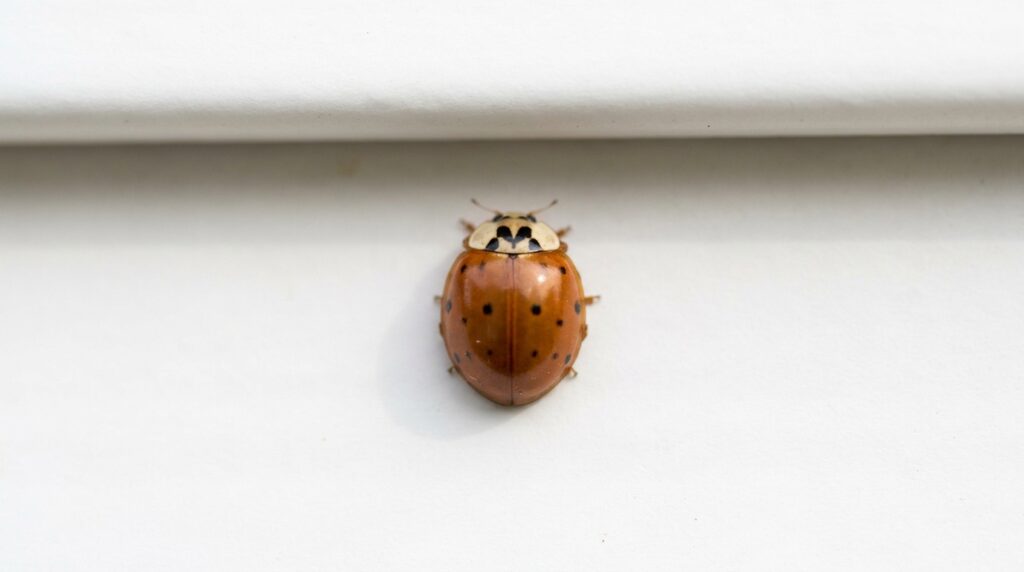
Every October we get the same call from Nassau and Suffolk: the south wall of the house is covered in orange beetles, and by dinner a dozen are crawling across the kitchen ceiling. They look like ladybugs, and most people assume that is exactly what they are, because the ladybug is the one insect everybody was raised to leave alone.
They are almost certainly Asian lady beetles, a different insect with a different set of habits. They pile onto siding, work their way in for the winter, leave yellow stains on trim and curtains, and carry one specific risk for dog owners that hardly anybody writes about. It is the same beetle we deal with on fall Long Island pest control calls from Levittown out to Smithtown.
This post is the identification half: what it looks like, how it differs from a native ladybug, when it shows up here, and what it means if your dog is a bug chaser.
Lady beetles all over your Long Island siding?
26+ years treating Long Island fall invaders, with our team working the sunny walls, trim and fascia boards where beetles pile up, family and pet-friendly products, and an inspection fee we waive when you move forward with treatment.
How Do You Identify an Asian Lady Beetle in a Long Island Home?
Start with size and shape, because color will lie to you. The multicolored Asian lady beetle (Harmonia axyridis) runs roughly 7 mm long and 5.5 mm wide, with the biggest individuals pushing toward 3/8 of an inch. That is larger than most native lady beetles, and the body is more oval than round, closer to a flattened almond than the perfect dome on a nursery-school sticker. Penn State Extension’s page on the multicolored Asian lady beetle is the cleanest write-up of those measurements we have found.
Here is the checklist our team runs through when a homeowner hands us a beetle in a jam jar:
- The shield behind the head. Whitish or cream, usually carrying a black M or W. The single best tell, and it gets its own section below.
- Body shape. Oval and slightly flattened rather than perfectly round and domed.
- Color. Pale yellow through orange to deep red, which proves nothing on its own.
- Spots. Zero to nineteen, not always black. A beetle with no spots can still be this species.
One quirk worth knowing, from the University of Kentucky’s extension entomologists: heavily spotted individuals tend to be females, and the ones with few or no spots tend to be males. A single wall can hold what looks like three different insects and still be one species.
If the beetle in your hand is a fraction of that size, sort of fuzzy, and turned up in a closet or a dresser drawer instead of a window, it is something else. That would be the small beetles that feed on wool and stored fabric, a different problem with a different fix.
How Do You Tell a Ladybug From an Asian Lady Beetle on Long Island?
Here is the part that trips everybody up: “ladybug” is not a species. Ladybug, lady beetle and ladybird beetle are all common names for the same family, Coccinellidae, which means an Asian lady beetle is technically an Asian ladybug too. Entomologists prefer “lady beetle” because these insects are beetles, not true bugs. The memes promising to show you “ladybugs versus lady beetles” draw a line that does not exist. The question worth asking is whether the insect on your storm door is a native species or Harmonia axyridis.
| What to check | Native lady beetles | Asian lady beetle |
|---|---|---|
| Shield behind the head (pronotum) | Varies by species. The common convergent lady beetle has a dark shield with white edging and two white dashes, never an M | Whitish or cream with a black M or W, sometimes filled in as a solid black patch |
| Body outline | Rounder, more domed | Oval and slightly flattened |
| Size | Most native species are smaller | About 7 mm, among the largest you will see here |
| Color and spots | Usually consistent within a species | Yellow to red, zero to nineteen spots, wildly variable |
| What it does in October | Winters outdoors under bark and in leaf litter | Masses by the hundreds on sunlit walls, then moves inside |
| If you handle it | Rarely an issue | Can nip, smells acrid, releases a yellow fluid that stains |
Yes, they bite. Penn State describes it as anything from slightly annoying to genuinely painful and notes that researchers still do not know why lady beetles bite people at all. Kentucky’s extension calls it a pinprick, seldom serious. Native species nip too. You are just less likely to share a window sill with one in November.
Outdoors this beetle is no villain. Larvae and adults are voracious aphid predators, eating hundreds a day in a garden, which is why the species drew interest for crop pest control in the first place. Deliberate releases here go back to 1916, though the population that took hold in North America was found in Louisiana in 1988 and is thought to have arrived accidentally. It is a summer ally in the yard and a fall nuisance on the house, both at once.
Where Should Long Island Homeowners Look for the Lady Beetle M Mark?
The mark is not on the wing covers. It sits on the pronotum, the small shield between the head and the wing covers, which is the part most people skip past because they are busy counting spots. Look at the beetle from directly above with the light behind you.
Your phone camera, zoomed in, works better than your eyes. On a typical individual you will see a pale, almost white shield with a dark marking that reads as an M or a W depending on which way the beetle is facing. It is one mark seen from two directions, so do not waste time deciding which is correct.
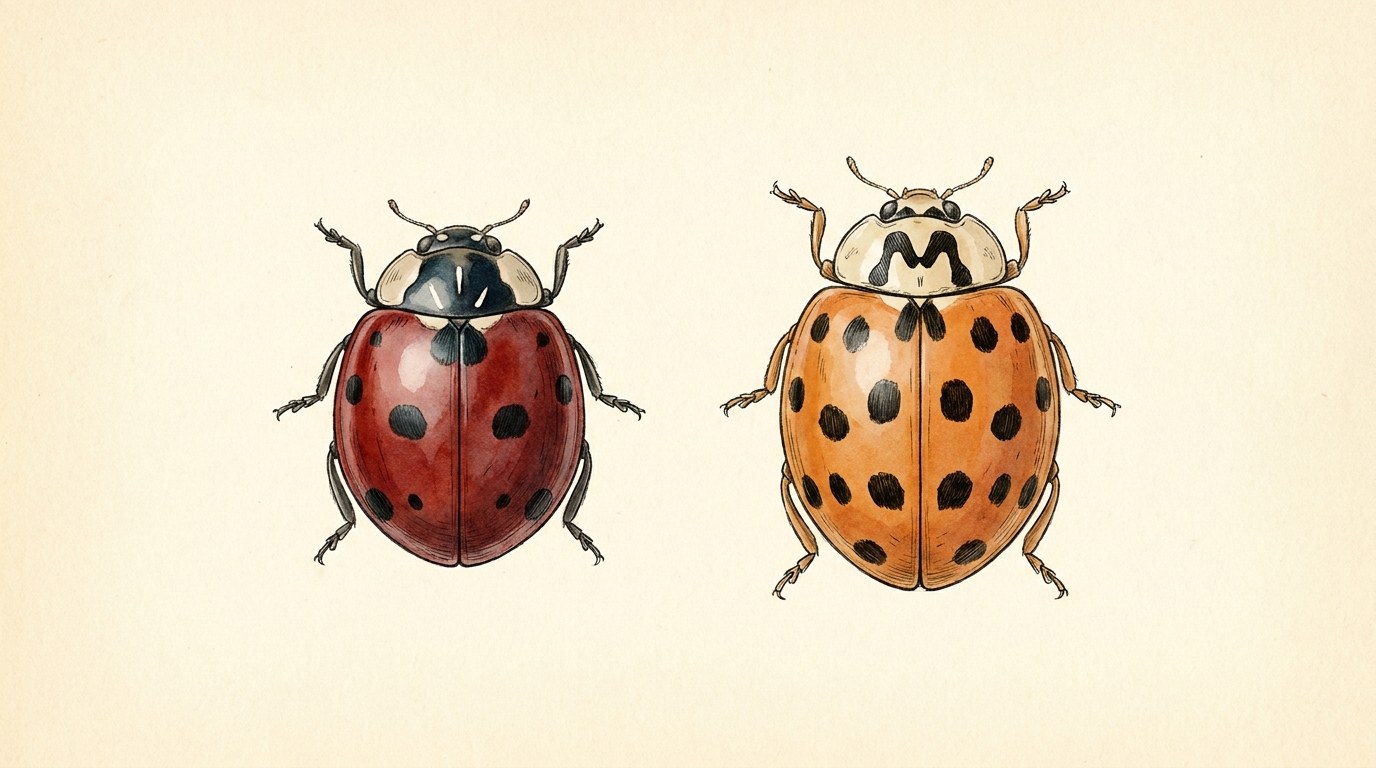
Expect variation. On dark individuals the M fills in completely and the shield reads as a black patch; on pale ones the mark breaks into separate dashes or dots. Both are still Asian lady beetles, which is why we use a combination rather than one feature: a dark marking on a whitish shield, an oval body around 7 mm, and October. Indoors, the easiest places to get that look are sunny-side window sills and storm window tracks, the tops of lampshades, the bathroom sink, and light-colored curtains.
How Do You Spot Asian Lady Beetles Swarming a Long Island Wall?
The swarm is not random. Once you know what it keys on, you can predict which wall of your own house it lands on. The University of Kentucky’s fact sheet on structural infestations is the most specific source we have found on this behavior, and its findings in plain language:
- Beetles are drawn to illuminated surfaces and congregate on the sunnier southwest sides of buildings that catch the afternoon sun. Houses shaded from that light attract far fewer.
- Contrast matters more than color or material. Concrete, brick, wood and vinyl siding are all fair game. What pulls beetles in is the light-dark edge: dark shutters on light siding, windows outlined in white trim, downspouts against a contrasting wall.
- Houses near woods or open fields are the most prone. That describes a great many of the towns we cover in Suffolk, plus any Nassau street backing onto a preserve.
Penn State adds the trigger: the congregating starts around the beginning of October, on a sunny warm afternoon following a cold night. In their native range in Japan they do the same thing to south-facing rock faces. Your white vinyl cape with black shutters does a passable impression of a sunlit cliff.
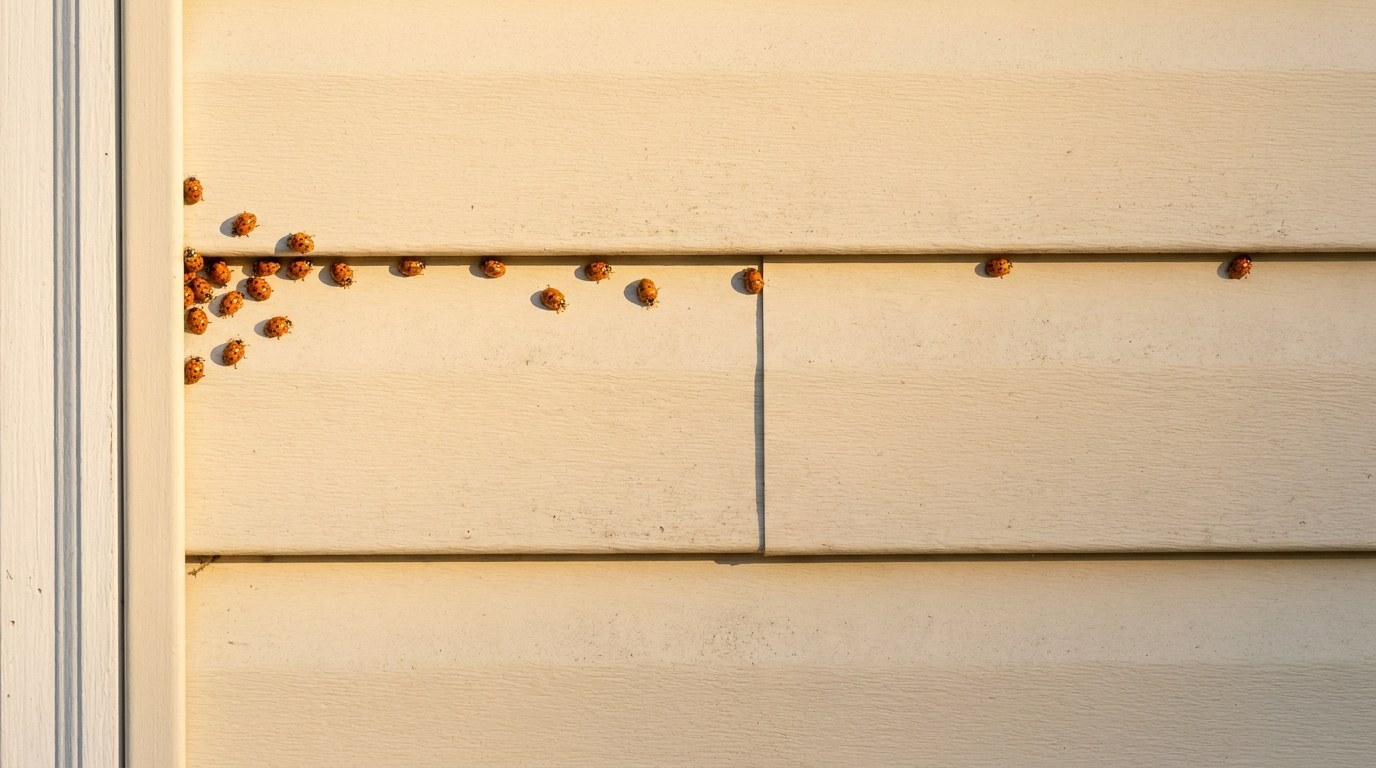
One point of precision, because the wrong version circulates constantly. You will read that an “aggregation pheromone” calls the swarm to your wall. There is a scent to what these beetles produce, but the published review of this species’ biology concluded that volatile chemical cues are unlikely to be what forms the overwintering clusters. The evidence points at vision: light, warmth and contrast. What draws them is what your wall looks like in afternoon light, not what it smells like.
To catch it early, check the right wall on the right day: the southwest corner, around two o’clock, on the first warm sunny afternoon after a cold snap in late September or early October. A scattering of beetles up on the siding and fascia line is what the wall looks like a day or two before the whole thing goes orange.
When Do Long Island Homes Find Lady Beetles Indoors Each Year?
The flights to buildings run September through November, heaviest on sunny days that follow a stretch of cooler weather, once the temperature climbs back to at least the mid-60s. Kentucky’s extension records most of its migration in October, and Penn State puts the start of overwintering behavior at the beginning of that month. We will not hand you a Long Island date, because the calendar is not the trigger. The weather is. A cold snap followed by a bright 68-degree afternoon is the day, whether that lands on September 28 or October 20.
Indoors, the first arrival is quiet. Beetles slip in around window and door frames on the sunny side and settle out of sight. The wave people notice comes later, on warm days in December and January, when heat moving through the walls stirs them up and they wander into the living space. A bigger one arrives in late winter and early spring as they head back out, starting on the southwest side, the same face they arrived on.
Two things take the edge off: they are not feeding, breeding or nesting in there, and they do not chew building materials. You are hosting a dormant insect that picked your house over a hollow tree.
That does not make a heavy infestation pleasant to live with. Penn State’s page notes that rhinoconjunctivitis, asthma and even facial angioedema have been linked to lady beetle infestations in homes, citing published case reports and allergy studies, and Kentucky’s extension makes a similar point about reactions from eye irritation to asthma. If someone gets itchy, wheezy eyes every November in a beetle year, that connection is documented and worth raising with a doctor. The fall calls we run across our Nassau County service area follow the same weather script every year, so the timing at least is predictable.
Yellow stains on your Long Island window trim?
26+ years treating Long Island beetle season, starting on the south and west walls where the clusters form, month to month plans with no annual contract, and an inspection fee we waive once you go ahead with treatment.
Where Do Asian Lady Beetles Leave Stains in Long Island Homes?
The staining is not waste and it is not a bite. It is blood. Disturbed or threatened, these beetles push droplets of yellow-orange hemolymph out through their leg joints, a defense called reflex bleeding that exists to make them taste appalling to birds. The fluid is alkaloid-rich, smells acrid, and on a light surface dries to a stubborn yellow-brown spot.
Where those marks turn up, in the order we usually find them:
- White window trim, sills and storm window tracks on the sunny side, where beetles collect and get bumped.
- Light-colored siding outside, directly under a cluster.
- Painted walls and ceilings in the rooms nearest to where they are getting in.
- Curtains and upholstery. Cornell’s Integrated Pest Management program is explicit that these beetles carry no disease and do no harm to building materials, but that they can stain upholstery, curtains included.
- Lampshades, bedding and light carpet, anywhere a beetle gets stepped on.
As a detection tool the stains beat the beetles, because they persist. Pin-sized yellow dots along a white sill in April are a record of the fall you had and a fair prediction of the one coming, since these beetles return to the same walls. The smell works the same way: a sharp, peppery odor in a closed room in January often means a cluster is active behind the sunny wall.
How Can Long Island Pet Owners Detect a Lady Beetle Risk to Dogs?
This is the part of the lady beetle story that almost never reaches a homeowner article, so we will be careful about what is known and what is not.
Start with the framing. Photos that circulate online make it look as though the beetles swarm into a dog’s mouth on their own. That is not what happens. The risk is a dog that mouths or eats them, which means the dog who chases and snaps at every insect in the yard.
The clearest general-audience statement comes from the ASPCA’s advice for pet owners: when dogs and cats eat them, Asian lady beetles secrete defensive compounds that “may cause irritation and even ulceration in the mouth.” Their hedging is worth keeping intact. One or two beetles are unlikely to be a big deal. The concern is the pet that does not know when to stop, because a large number swallowed is where more serious trouble, including stomach ulcers, comes in.
That guidance rests on a thin but real evidence base. In one documented case published in the peer-reviewed journal Toxicon in 2008, a veterinarian removed 16 Asian lady beetles embedded in the hard palate of a six-year-old mixed-breed dog, and the authors judged the damage to the mouth consistent with a chemical burn, though the dog was also on an anti-inflammatory medication at the time and the study’s own authors could not rule out a drug interaction. You can read the case report abstract yourself. The dog recovered fully. That is one report about one dog. It is not a common outcome, it is not what happens every time a dog crunches a beetle off a window sill, and we are not going to inflate it into something it is not.
You will also find the opposite reassurance in print. One state agriculture fact sheet says flatly that this species does no actual damage to people, pets or structures. Both statements can stand. The state page describes the ordinary case, which is genuinely uneventful: a house full of lady beetles hurts nobody. The ASPCA and that case report describe a rarer, specific scenario, a dog that eats a real mouthful. Read the reassuring version as the general rule, not as a promise about the dog who hunts bugs for sport.
So, detection. What a Long Island dog owner should watch for during beetle season:
- Know your dog’s habits first. A dog that ignores insects is a different risk profile from one that eats flies off the window. This section is about the second dog.
- Drooling, lip-smacking, pawing at the mouth or head shaking after time in a room where beetles are clustered.
- A foul odor from the mouth. In the published case, that smell is what brought the dog in.
- Reluctance to eat, or dropping food from a dog that normally inhales it.
- Beetles stuck to the roof of the mouth, if your dog will let you look. In that case report they had to be removed by hand.
If you see any of that, your veterinarian is the right call and we are no substitute for one. Nothing here is veterinary advice. What we can tell you is the pest half: if your dog eats whatever moves, a wall covered in beetles in October is worth taking seriously, not because the beetles are aggressive, but because they are easy to eat by the handful.
Where Do Long Island Lady Beetles Hide Between Fall and Spring?
Out in the woods this species winters in groups under the bark of dead trees and down in leaf litter. On a house it uses the closest equivalent, and Penn State names the destination directly: buildings, and behind siding.
Kentucky’s list of typical spots matches what we find here: cracks around window and door frames, behind fascia boards, and behind or underneath exterior siding, which on most Long Island housing stock means the lap joints of vinyl on the sunny elevation. Add the gap behind decorative shutters and the tracks of older aluminum storm windows, and you have the short list for a cape, a ranch or a split.
Knowing that pays off in the off season:
- Warm winter days wake them up. A 55-degree Tuesday in January is why beetles appear at an upstairs window in midwinter.
- Spring activity starts on the southwest side. As late winter warms, they get moving again, and they do it first on the sunniest wall.
- A February cluster is not a new invasion. Those are the same beetles that arrived in October, coming back out the way they went in.
Getting them back out, and keeping the next wave from claiming the same wall, is its own job with its own timing, and because these beetles share a calendar and a set of entry points with the other fall invaders, we covered that side of it in our post on getting fall invaders like stink bugs back out.
The Bottom Line on Lady Beetles on Long Island
If you remember one thing, make it the shield behind the head. A pale shield with a dark M or W, an oval body around 7 mm, and a crowd on the sunny wall in October adds up to Harmonia axyridis, whatever color the beetle is and however many spots it carries. Those last two are the features people trust most and the ones that tell them least.
The rest of the picture: they arrive on the first warm afternoon after a cold snap between September and November, they pick the southwest wall for sun and contrast rather than any scent, they tuck in behind siding and fascia rather than nesting indoors, and they stain trim and curtains with a defensive fluid that is their own blood.
On dogs, keep the claim the size it actually is. Eating a mouthful of these beetles has been documented once in the veterinary literature to cause serious mouth injury in one dog, and the ASPCA’s position is that a beetle or two is unlikely to matter while a large number swallowed can. If your dog hunts insects and you are having a beetle year, watch the mouth and call your vet if something looks wrong. That is not a reason to panic.
We would rather a Long Island homeowner identify the insect on the sill in ten seconds than guess for a month. The same identify-first habit works on the house spiders we get asked about most.