A pest control auditor can walk your entire plant, find nothing alive, and still write you up. We have watched it happen in Brooklyn: clean devices, a tidy fence line, a technician who knows the building — and a finding anyway, because nothing on the shelf showed what had happened between visits.
That gap is the job. Passing a Brooklyn food plant pest control audit depends far less on what is caught on the day than on what your records can demonstrate across months.
FDA makes the point better than we can. Its definition at 21 CFR 1.500 calls an audit “the systematic, independent, and documented examination (through observation, investigation, discussions with employees of the audited entity, records review, and, as appropriate, sampling and laboratory analysis)” of a facility’s food safety processes. Observation is one item on that list. Records review sits right beside it. The definition is scoped to FDA’s supplier verification rules, but it is the agency defining the word.
So what passes an audit is the analysis, not the visit: the device map, the sighting log, the trend, and the corrective action you can prove you closed. This is written for QA managers and operations leads who already own a food safety plan.
Pests putting your Brooklyn food plant audit at risk?
26+ years protecting NYC food facilities. We map the bait line, document corrective actions, and hand you the trend report your auditor opens. No annual contracts, and an inspection we waive when you book the work.
What Does a Pest Control Auditor Check in a Brooklyn Food Plant?
Start with which audit you are facing, because two systems get blurred constantly. The legal floor is federal. A Brooklyn bakery, spice packer or beverage bottler is an FDA-registered facility under 21 CFR Part 117, the preventive controls rule for human food. Part 117 is blunt: pests “must not be allowed in any area of a food plant,” and “effective measures must be taken to exclude pests from the manufacturing, processing, packing, and holding areas.” A meat or poultry plant sits under USDA FSIS instead, which requires “a pest management program to prevent the harborage and breeding of pests.”
The audit in the title usually is not that one. It is a certification audit against a private scheme — the SQF Food Safety Code for Food Manufacturing and its peers — bought because a customer demands it. Cornell CALS gives the buyer’s side: an approved-supplier program can be satisfied by “sourcing from certified suppliers (e.g. 3rd party audit).” Nobody is legally obliged to hold that certificate. Your customer just will not order without it.
Then there is New York. A Brooklyn food manufacturing site is licensed by New York State Agriculture and Markets under an Article 20-C Food Processing Establishment license, and the state office handling Kings County sits in Brooklyn, on Hanson Place. That is a different track from the letter grade in a restaurant window — the state’s own guidance tells food service operations to contact their local health department instead. We covered how the DOH inspection process works for restaurants separately.
Cornell CALS describes an audit as covering “the plan, execution of the plan and evidence of success.” Only the middle level is what a technician does on a visit; the other two live entirely on paper.
Someone on the service side described the pull list on a pest control industry forum: “they will look through all the pest control licensing, service tickets, pest findings, us recommendations.” A device missing from the map, or a recommendation nobody acted on, stays in the file long after the auditor leaves. That is why the way we structure commercial accounts starts with the record set.
How Do Brooklyn Food Plants Control Rodents on the Exterior Perimeter?
Brooklyn’s industrial blocks were not laid out with clean fence lines in mind. Your building probably abuts something you do not control: a scrap yard, a bus depot, a vacant lot nobody mows.
Federal rules anticipated that. Under FDA’s grounds requirements at 21 CFR 117.20, if your grounds “are bordered by grounds not under the operator’s control” and not maintained to the same standard, then “care must be exercised in the plant by inspection, extermination, or other means to exclude pests, dirt, and filth that may be a source of food contamination.” In most of Brooklyn that is the normal case, not the exception. The neighbor’s conditions do not excuse you. They raise your burden.
On your own land the same section sets four duties: clear litter, waste and any weeds or grass that could be “an attractant, breeding place, or harborage for pests”; keep roads, yards and lots from becoming a source of contamination; drain standing areas; and run waste disposal so it does not contaminate where food is exposed. Cornell CALS adds the plant-floor version: unused equipment, pallets, bins, drums and waste give vermin harborage.
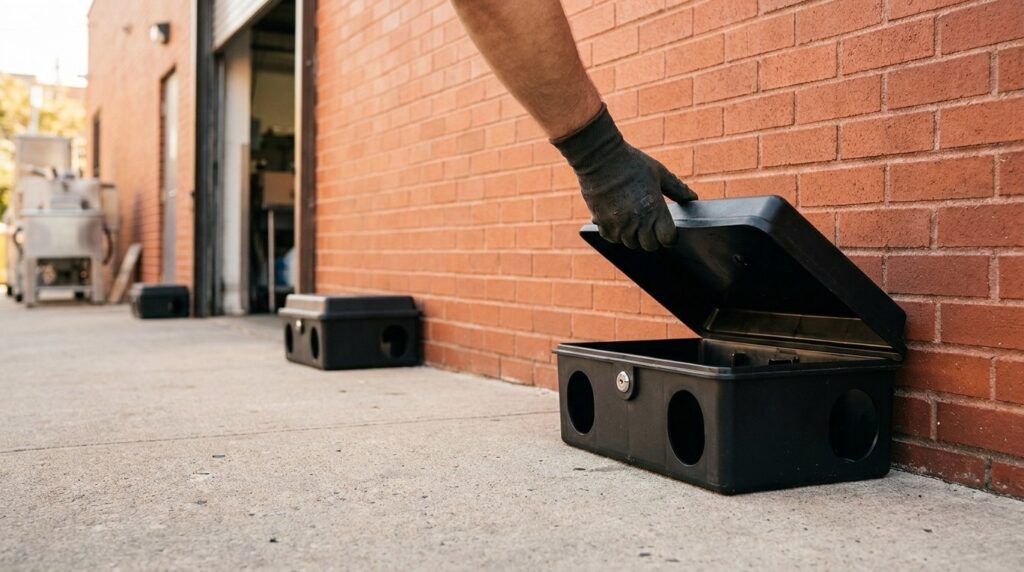
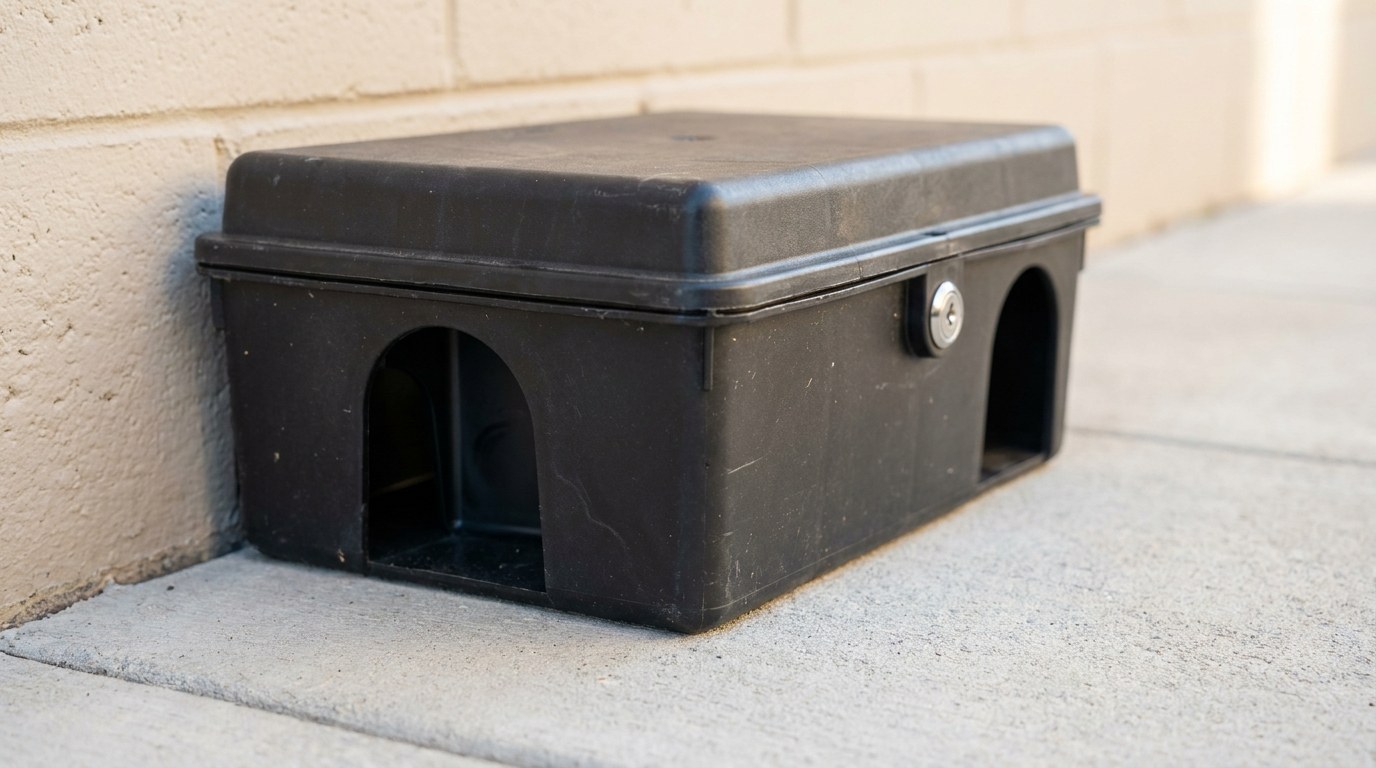
Cornell also draws the line the audit cares about most: “Bait stations should only be used on the perimeter of the facility.” Toxic bait belongs outside; inside, the devices are non-toxic monitoring traps. An auditor who finds rodenticide in a production room has found a real problem, not a clerical one.
EPA label restrictions are conditions of registration, not scheme preferences. Every outdoor, above-ground placement has to sit in a tamper-resistant station — EPA states that professional-market rodenticide labels require them for all outdoor above-ground applications, and anywhere children under six or pets can reach the bait. Burrow baiting outdoors is permitted only with pelleted baits, placed at least six inches down an active rat burrow.
Then the part that gets graded: the map. Cornell CALS and the SQF code both require a site map identifying the location, number and type of every device. Stations get numbered, the numbers match the service record, and the record says what was in each one.
Receiving and dock areas are their own discipline, handled under our warehouse rodent exclusion work. Stored product pests in dry goods sit outside this post as well. The perimeter question is narrower: does a numbered ring of tamper-resistant stations exist, is it mapped, is it read, and does the reading go anywhere?
How Should a Brooklyn Food Plant Control Pests After an Audit Finding?
A finding is not the failure. What you do with it is, and FDA is specific about what “doing something” has to include.
Under 21 CFR 117.150, a corrective action procedure must ensure “appropriate action is taken to identify and correct a problem,” that action is taken “when necessary, to reduce the likelihood that the problem will recur,” that “all affected food is evaluated for safety,” and that affected food is kept out of commerce where adulteration cannot be ruled out.
Four steps, and in the plants we walk into it is consistently the second that is missing. Somebody killed the flies. Nobody changed the condition that produced them. Six weeks later the same drain returns the same count, and there is a pattern in the file with no intervention attached to it.
The rule closes that loop from the other direction too. Corrective action is required, the same section says, when a review of records “finds that the records are not complete, the activities conducted did not occur in accordance with the food safety plan, or appropriate decisions were not made about corrective actions.” The records review is itself a trigger. Your paperwork is not the evidence of the work — it is one of the things being examined, and it can fail on its own terms with the floor spotless.
There is also a clock. The federal verification rule for preventive controls, 21 CFR 117.165, calls for monitoring and corrective action records to be reviewed within 7 working days of being created, by or under the oversight of a preventive controls qualified individual, confirming the records are complete, the activities matched the plan, and the right decisions were made. Longer needs a written justification. It is the hardest deadline in this subject, and it has nothing to do with how often anybody treats.
Two consequences for your procedure:
- The record has to exist when the action happens. FDA requires records “created concurrently with performance of the activity documented.” A corrective action written up the week before the auditor arrives is a separate finding.
- Not every finding needs the full machinery. The rule carves out “corrections” — timely fixes to minor, isolated problems that do not directly affect product safety. One fly in a corridor does not need a formal report. A repeat count at the same drain does.
How Should a Brooklyn Food Plant Treat Pests Without Contaminating Product?
The federal answer is one sentence, and it is a permission with conditions bolted to it. Under 21 CFR 117.35, “the use of pesticides to control pests in the plant is permitted only under precautions and restrictions that will protect against the contamination of food, food-contact surfaces, and food-packaging materials.”
That is not a ban. It puts the burden of proof on the method, which pushes a working program toward control that needs no product at all:
- Exclusion. Part 117 requires “adequate screening or other protection against pests” where necessary. For a meat or poultry plant, USDA FSIS is more explicit: doors, windows and other outside openings “must be constructed and maintained to prevent the entrance of vermin, such as flies, rats, and mice.”
- Harborage removal. The grounds duties above are a control method, not housekeeping. Pallets, drums and standing water are why a treatment keeps having to be repeated.
- Non-toxic monitoring indoors. Mechanical traps inside, bait outside — the line Cornell CALS draws, and the one an auditor checks your map against.
Where a product is used, the chemical file matters as much as the application. Part 117 limits what a plant may hold to four categories of toxic material: what it needs to stay sanitary, for laboratory testing, for maintaining plant and equipment, and for its own operations. Pesticides sit in that set — and they “must be identified, held, and stored in a manner that protects against contamination of food, food-contact surfaces, or food-packaging materials.”
Which becomes three things an auditor can verify without watching anyone treat: an approved chemical list, segregated storage away from product and dry goods, and a Safety Data Sheet for every hazardous chemical on it.
Our own habit is to schedule around exposed product and packaging rather than work over them, and never to place anything the label does not authorize for that spot. EPA labels are not advisory, and an auditor comparing one against your service record sees the difference.
How Do Brooklyn Food Plants Prevent Flies Around Drains and Floors?
Fly problems in a food plant are almost never an air problem. They are a drain problem, usually the nearest drain.
A Texas A&M AgriLife Extension guide to drain management states it flatly: “When it comes to drains, sanitation is fly control. The only way to eliminate a chronic drain fly, phorid fly or fruit fly infestation from a room is to locate and eliminate the breeding site.”
The biology explains why. University of Florida IFAS Extension describes drain fly larvae feeding on “the film of wet organic material that can accumulate in drains,” and notes that females will not lay eggs on dry surfaces. UF/IFAS puts the life cycle at 21 to 27 days, and shorter in heat — the larval stage alone runs nine to 15 days at 70°F, and as few as eight at 85°F. Adults are poor fliers, so the source is nearly always the closest drain.
The film is the target, and that has blunt consequences:
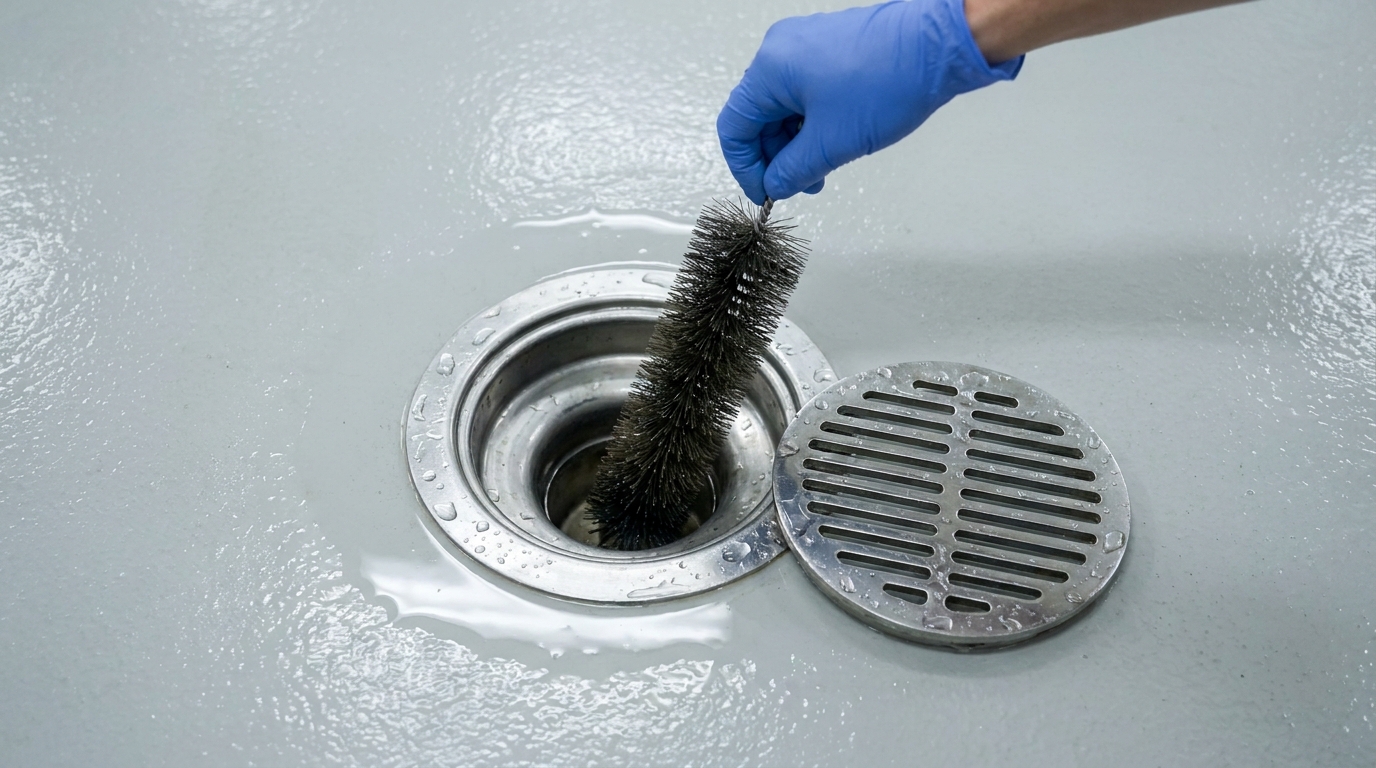
- Flushing does not remove the film. Texas A&M is direct: “A bucket of bleach water is NOT an adequate treatment for a floor drain with flies.” Scrubbing with a brush works, as do bacterial gels that digest the slime layer.
- Find the drain before treating any of them. Cover a suspect drain with sticky tape overnight; emerging flies stick to it and identify the source. UF/IFAS describes the same test with a 24-hour window.
- Check the cracks around the rim. Texas A&M notes that debris building up at the drain edge is routinely missed during a sanitation inspection. A putty knife finds it.
- Do not let a trap dry out. The drain nobody uses is the higher risk: the water-holding trap dries and cockroaches come up the sewer line more easily. Screen it, or flush it weekly with about a gallon of water.
One fly is worth knowing on sight. Phorid flies are humpbacked in profile with heavy wing veins, and Texas A&M flags them as a possible indicator of a broken sewage line — not remote in a hundred-year-old Brooklyn building. Persistent phorid activity is a reason to have the lines inspected, not only the drains cleaned.
Drainage is a federal grounds duty in its own right, and a drain is a numbered location on your site map like any other device. A repeat fly count at the same drain across three visits is the pattern the corrective action loop exists to close, and the one an auditor reads out of a trend without lifting a grate.
Pests putting your Brooklyn food plant audit at risk?
26+ years protecting NYC food facilities. We map the bait line, document corrective actions, and hand you the trend report your auditor opens. No annual contracts, and an inspection we waive when you book the work.
What Pest Control Documentation Does a Brooklyn Food Audit Require?
Every scheme words it differently, but the package is stable — and it helps to see which items are federal and which come from the certification side.
| Record | What it has to show | Requirement source |
|---|---|---|
| Written pest prevention program | Responsibilities, target pests, prevention and elimination methods, defined check frequency | SQF code; Cornell CALS |
| Site and device map | Location, number and type of every device, numbered to the service record | SQF code; Cornell CALS |
| Service records | Findings, inspections and treatments applied at each visit | SQF code; Cornell CALS |
| Pest sighting log | Sightings recorded by plant staff, not only by the contractor | SQF code |
| Trend analysis | Pest activity trended over time, used to target control effort | SQF code |
| Corrective action records | Every corrective action documented, with the review that closed it | 21 CFR 117.150(d); 117.165(a)(4) |
| Chemical list and Safety Data Sheets | Chemicals approved by the relevant authority; an SDS accessible every shift | Cornell CALS; OSHA 29 CFR 1910.1200 |
| Contractor licensing | Contractor licensed and approved by the relevant authority | Cornell CALS |
| Verification records | Signed and dated by the verifier, available to any outside auditor | Cornell CALS |
One note on Safety Data Sheets. OSHA requires an SDS in the workplace for each hazardous chemical, accessible during each work shift, and explicitly permits electronic access in place of paper. The binder is a convention, not a requirement.
Then there is the quality bar every record has to clear. FDA requires records to contain “the actual values and observations obtained during monitoring,” to be accurate, indelible and legible, to be created concurrently with the activity, and to carry the facility, the date and the initials of whoever performed it.
“Actual values and observations” rules out the most common service ticket in the industry. A municipal food inspector in Massachusetts described the tell in a public thread: “when I ask for pest control reports and I see ‘inspected throughout, replaced traps, no activity during service’ on all reports yet when I go in, I see activity I always tell the permit holder that you want to get the full service you are paying for.” A report that reads identically every month is not evidence that nothing happened. It is evidence that nobody wrote anything down.
Trending is what turns the rest into something an auditor can assess. The SQF code requires a plant to record pest sightings and trend the frequency of pest activity in order to target control effort. Food safety practitioners on the IFSQN industry forum describe the same expectation, one moderator quoting scheme guidance that pest control records include “trending of activity by the service provider,” and a HACCP consultant describing validation as review of effectiveness through trending reports and the sighting log.
How Often Should a Brooklyn Food Plant Control Pests Between Audits?
Here is the honest answer: no source we can point to sets a service frequency for a food plant. What the rules fix is not how often somebody visits — it is how often somebody reads.
The SQF code requires a plant to outline the frequency with which pest status is checked: defined, not any particular number. Cornell CALS says trained personnel should inspect “on a regular basis,” and defines verification as confirming that monitoring tasks were completed “at the frequency that is defined.” Defined by you.
Practitioners say the same. A HACCP consultant posting on the IFSQN forum was explicit: “To my knowledge, the SQF Code does not mandate ‘monthly’ verification. The frequency is up to you.” Asked how far apart interior monitoring devices should sit, a quality lead on the same forum answered in three words: “Based on risk analysis!”
What is fixed sits in a different column entirely:
| Activity | The interval | Source |
|---|---|---|
| Review of monitoring and corrective action records | Within 7 working days of creation, or a written justification for longer | 21 CFR 117.165(a)(4) |
| Reanalysis of the food safety plan as a whole | At least once every 3 years | 21 CFR 117.170(a) |
| Checking outdoor bulk vessels for pests | “On a regular basis” | 21 CFR 117.20(b)(3) |
| Flushing infrequently used floor drains | About a gallon of water, weekly | Texas A&M AgriLife Extension |
| Service visits and pest inspections | Your call, defined in your program and defensible on risk | No source sets a number |
One facility quality lead on that forum described her own arrangement — monthly service, a detailed report each visit, trend reports online — and said SQF auditors were satisfied with it. That is one plant’s answer, not a standard: a ready-to-eat line beside a transfer station does not carry a dry blender’s risk.
The framing that matters: a plant serviced every week whose tickets nobody reads is further from passing than a plant serviced monthly whose trend somebody signs and dates. Service frequency is your risk decision. The review clock is not. What the program costs is a separate question, and we break down what a commercial program costs in New York City on its own.
The Bottom Line on Brooklyn Food Plant Pest Audits
Nothing in an audit rewards a plant for simply having no pests on the day. It rewards a plant that can show the system working: a mapped perimeter, devices somebody reads, sightings somebody records, a trend somebody signs, and findings closed and dated inside the clock.
That is a different product from a monthly visit, and it is why we treat the service ticket as the smallest part of the job. If your last audit produced a finding on records rather than activity, the fix is not more treatment. It is a program where every device carries a number, every number carries a history, and every finding carries a name and a date.
Brooklyn’s lot lines make the exterior half of that harder than most, which is why, on the Brooklyn accounts we cover, we walk the perimeter and the paperwork together before an auditor does.