Ask a school facilities director what they are allowed to spray and you usually get the same answer: nothing. The Child Safe Playing Fields Act landed in 2010, word went round that pesticides were banned in schools, and a lot of buildings have run on that summary ever since. It is wrong in a way that costs money and creates roach and mouse problems nobody needed.
The ban is real, but it is narrow. It covers the ground outside. Inside the building, New York does not prohibit pest control at all. What it does is require a particular kind of program, put a notification duty around it, and carve out a list of materials that sidestep the paperwork entirely. Teams who read that list run cleaner buildings than the ones still treating the whole subject as forbidden. That is the practical shape of pest control in a school building.
A note on the year. Nothing material changed for 2026. These are the rules as they stand for the 2026 school year, and most are older than the students: the playing-fields prohibition dates to 2010, the notification law to 2001. Anyone selling you an urgent 2026 compliance update is selling you something.
Pest problem in your NYC school?
26+ years in NYC commercial pest control. We work to your IPM plan and your bell schedule, with DEC certified applicators and the records your district has to file. No annual contracts, and an inspection we waive when you book the work.
What Does New York Law Require of School Pest Control Programs?
Three separate instruments do three different jobs, and most of the confusion we hear comes from people running them together.
The first requires the program itself. The Board of Regents amended Part 155 of the Regulations of the Commissioner of Education, and it now, in the State Education Department’s words, “requires the establishment of a least-toxic approach to IPM (155.4(d)(2)).” That is a regulation of the Commissioner of Education, not an environmental rule, which is why looking for it in the DEC rulebook sends people in circles.
The second is the outdoor prohibition. Education Law section 409-k for schools and Social Services Law section 390-g for day cares are what people mean when they say the Child Safe Playing Fields Act. That is the turf rule, and only the turf rule.
The third is notification. Education Law section 409-h, the Pesticide Neighbor Notification Law, is the 48-hour notice. It is a different statute from 409-k doing a different job, and the two get mixed up constantly because they differ by a single suffix letter.
Underneath all three sits the State Education Department’s seven-element IPM framework: pest identification, preventative actions, tolerance and action thresholds, monitoring, response actions, public notification and education, and recordkeeping. Pesticides appear at element five, and only as a last resort.
What about the city layer? There is not one, in the legal sense: New York City public schools operate under the same state statutes as a district upstate. What is genuinely local is operational rather than legal, and we come back to it below.
How Does the Child Safe Playing Fields Act Stop NYC Schools Spraying Fields?
The prohibition is broad where it applies. Pesticides are barred from school playgrounds, turf, athletic and playing fields, and the New York State Department of Health guidance is specific that this reaches “including the surrounding fence lines.”
Six categories are exempt from the outdoor ban, per the state’s Chapter 85 guidance:
- Antimicrobial products
- Aerosol sprays in 18-ounce or smaller cans
- Non-volatile insect and rodent baits in tamper-resistant containers
- Products containing boric acid or disodium octaborate tetrahydrate
- Horticultural oils and soaps that contain no synthetic pesticides or synergists
- Pesticides classified as exempt from registration by the EPA under 40 CFR Part 152.25
There is an emergency route, narrower than most assume. A one-time application of a prohibited product is possible, but it takes a determination from an authorized entity, a good faith effort at the 48-hour notice, and a DEC-certified applicator.
Who signs off depends on what kind of school you are. A public school seeks its determination from its own school board. Non-public schools go to the county or state Health Department for public health issues, or to DEC for environmental ones. The Office of Children and Family Services and the State Education Department advise but cannot make the determination.
The most useful part of the state guidance is the part that says what does not count. Aesthetic reasons do not qualify. Routine or repetitive pest problems do not qualify. Problems that can be managed by other methods do not qualify, and the guidance adds the pointed clause “even if it takes time to learn and fully practice pesticide alternatives.” And on the question every athletics department eventually asks, the state is blunt: bare patches and ruts “are not considered a public health threat that constitutes an emergency, even for the students playing on them.”
What does qualify, by the state’s own example, is an unusual infestation of a vector population that may carry human pathogens, ticks being the case they name, as distinct from the routine presence of one.
Which Pesticides Can NYC Schools Still Use to Control Roaches and Mice?
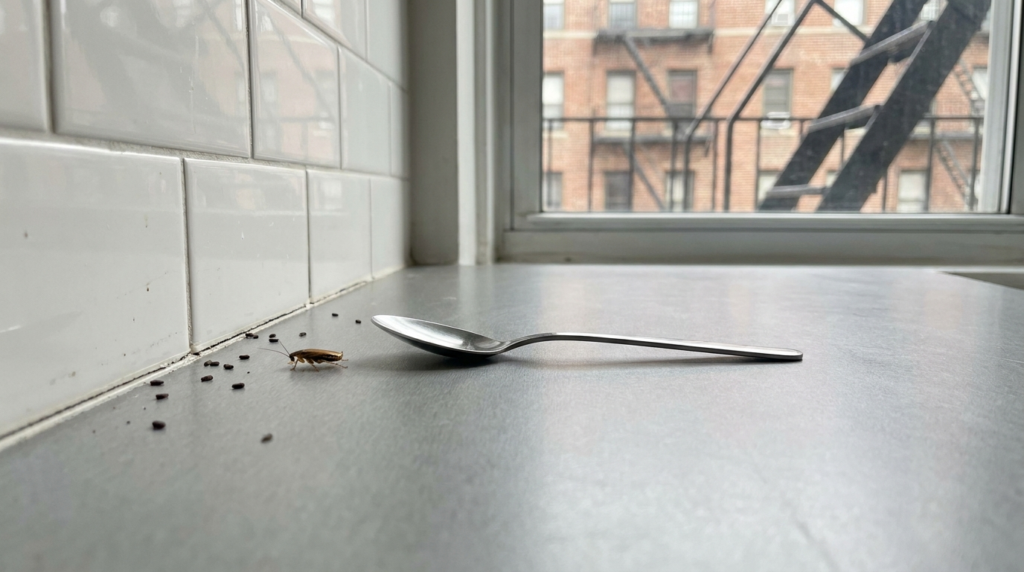
If you take one thing from this page, take this: the playing-fields prohibition governs the ground outside. It does not apply inside the building. Roach and mouse work in a kitchen, a boiler room or a classroom is not covered by that ban at all.
What governs indoor work is the notification law, which carries its own longer list of exempt applications. Get these straight, because merging the two lists is how schools end up believing they have fewer options than they do. The applications not subject to prior notification include:
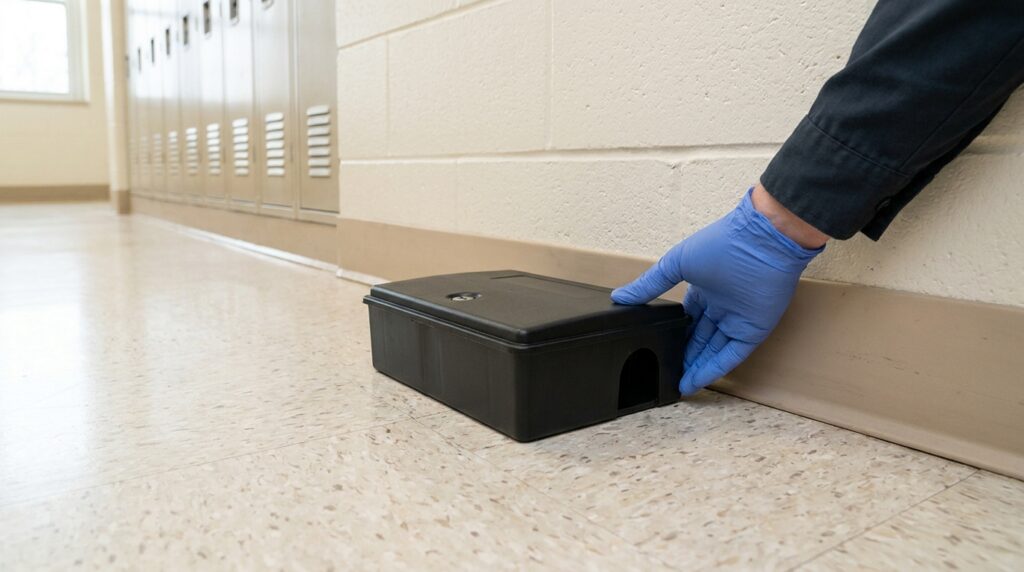
- Non-volatile rodenticides in tamper-resistant bait stations, or in areas inaccessible to children
- Non-volatile insecticidal baits in tamper-resistant bait stations, or in areas inaccessible to children
- Silica gels and other non-volatile ready-to-use pastes, foams or gels in areas inaccessible to children
- Boric acid and disodium octaborate tetrahydrate
- EPA-designated biopesticides
- EPA-designated exempt materials under 40 CFR 152.25
- Antimicrobial products
- Directed-spray aerosols in containers of 18 fluid ounces or less, used against an imminent threat from stinging and biting insects
- Any application where the school stays unoccupied for a continuous 72 hours afterwards
Notice what is on this list and not the outdoor one: silica gels, pastes, foams, biopesticides, and the 72-hour vacancy rule. And what is on the outdoor list and not here: horticultural oils and soaps. They are not interchangeable.
Read that indoor list against a working roach and mouse program and it covers almost everything a competent program would want to do anyway. Gel bait in a cabinet void. A non-volatile bait block in a tamper-resistant station along a wall run. Boric acid where children cannot reach. That is not a hobbled program, it is a normal one.
The State Education Department says the quiet part out loud: “In general, a school district can avoid the 48-hour notification process by designing an IPM program that is restricted to the above-noted items.” That single sentence is the whole game, and it is the reason we push school accounts toward baits, gels and dusts in inaccessible voids rather than anything that would trigger a notification cycle.
One trap to avoid. Exempt from notification does not mean exempt from everything else. The Department of Health is unambiguous that all pesticide applications at schools “must be done by a DEC-certified pesticide applicator” and that “this includes applications of pesticides that are exempt from the requirements outlined in this guidance.” More on that below.
How Do NYC Schools Give 48 Hour Notice Before Pest Treatment?
The notification duty runs in three layers across the year, and schools trip on the second and third far more often than the first.
At the start of each school year, every parent, guardian and staff member gets written notice that pesticide applications may take place, instructions for signing up to receive advance notice, and the name of the school representative to contact. The school maintains that sign-up list as a standing registry.
At least 48 hours before an actual application, written notice goes to everyone on the registry. It has to carry the specific date and location, the product name and its EPA registration number, and the contact name. It also has to carry a prescribed statement pointing readers to the National Pesticide Telecommunications Network on 1-800-858-7378 and the New York State Department of Health Center for Environmental Health on 1-800-458-1158.
Then the summaries, which is where buildings slip, because the deadlines are tied to the calendar rather than to any pest activity. Three times a year, every parent, guardian and staff member gets a written summary of what was applied. The State Education Department sets the timing precisely: within ten days of the end of the school year, within two school days before the end of winter recess, and within two school days of the end of spring recess. Each summary covers the period since the last one and reminds people they can still join the registry.
If a genuine public health emergency does not allow the full 48 hours, the school still has to make a good faith effort to notify the registry, and it has to file the Emergency Pesticide Application Notification Exemption Reporting Form with the Department of Health within three business days. The Department reviews that form to check the circumstances actually warranted it.
The state also recommends, rather than requires, posting a notice at the building entrance so visitors and anyone not on the registry can see it.
Pest problem in your NYC school?
26+ years in NYC commercial pest control. We work to your IPM plan and your bell schedule, with DEC certified applicators and the records your district has to file. No annual contracts, and an inspection we waive when you book the work.
How Should an NYC School Control Pests Without Routine Spraying?
Start from the sentence that rules out the old model. The State Education Department is direct: “IPM must not include any automatic or regularly scheduled pesticide applications.” A monthly spray round is not a compliant program in a school, whatever a vendor’s proposal calls it.
What replaces it is the seven-element cycle, and its useful middle is thresholds and monitoring. A tolerance threshold defines the point at which a specific pest triggers a response, and the state warns against setting them too low: “One fly in a classroom should elicit a very different response than the sighting of a bee’s nest on a playground.”
Monitoring makes thresholds real. Sticky and pheromone traps get dated and numbered before they go down, and what matters is the record they produce: how many, where on the trap, adults or nymphs. The state adds a placement rule anyone who has worked in a school will appreciate, which is that traps should never go anywhere students can disturb or tamper with them.
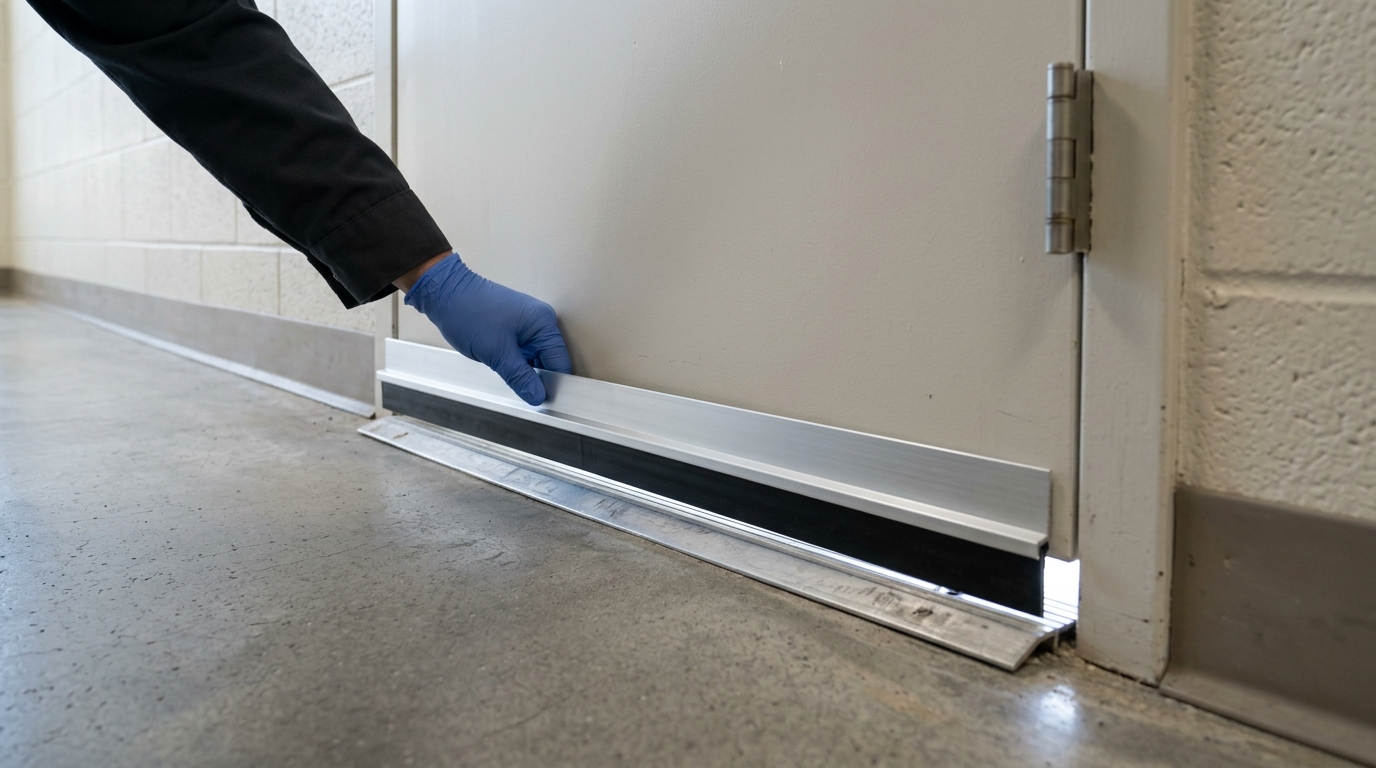
Response actions run mechanical and physical first. A vacuum with a crevice attachment pulls roaches, droppings and egg cases straight out of cracks, and the state’s guidance adds the field trick of a tablespoon of cornstarch in the bag to finish what you collect. Caulk closes the crack afterwards so the same harborage does not refill.
New York City’s own school system demonstrates the model better than any policy document. For bed bugs, the Department of Education runs an in-house IPM unit whose stated default is not chemical at all: the DOE’s protocol says that in most cases “a thorough inspection and vacuuming of the room with a HEPA vacuum by a DOE IPM professional is the best treatment when there is not an infestation.” The same protocol sets a threshold rather than a panic response, noting that a confirmed bed bug does not mean the school is infested. That is IPM working as designed, at the scale of an entire city school system.
It is how we run our own commercial accounts too. Inspect, monitor, treat what the monitoring justifies, and fix the building conditions that caused it.
What Pest Problems Do NYC School Cafeterias Have to Prevent?
A school kitchen is a commercial kitchen that happens to close at three. It generates the same grease, the same waste stream and the same warm wet corners, and it feeds the two pests that drive most school complaints.
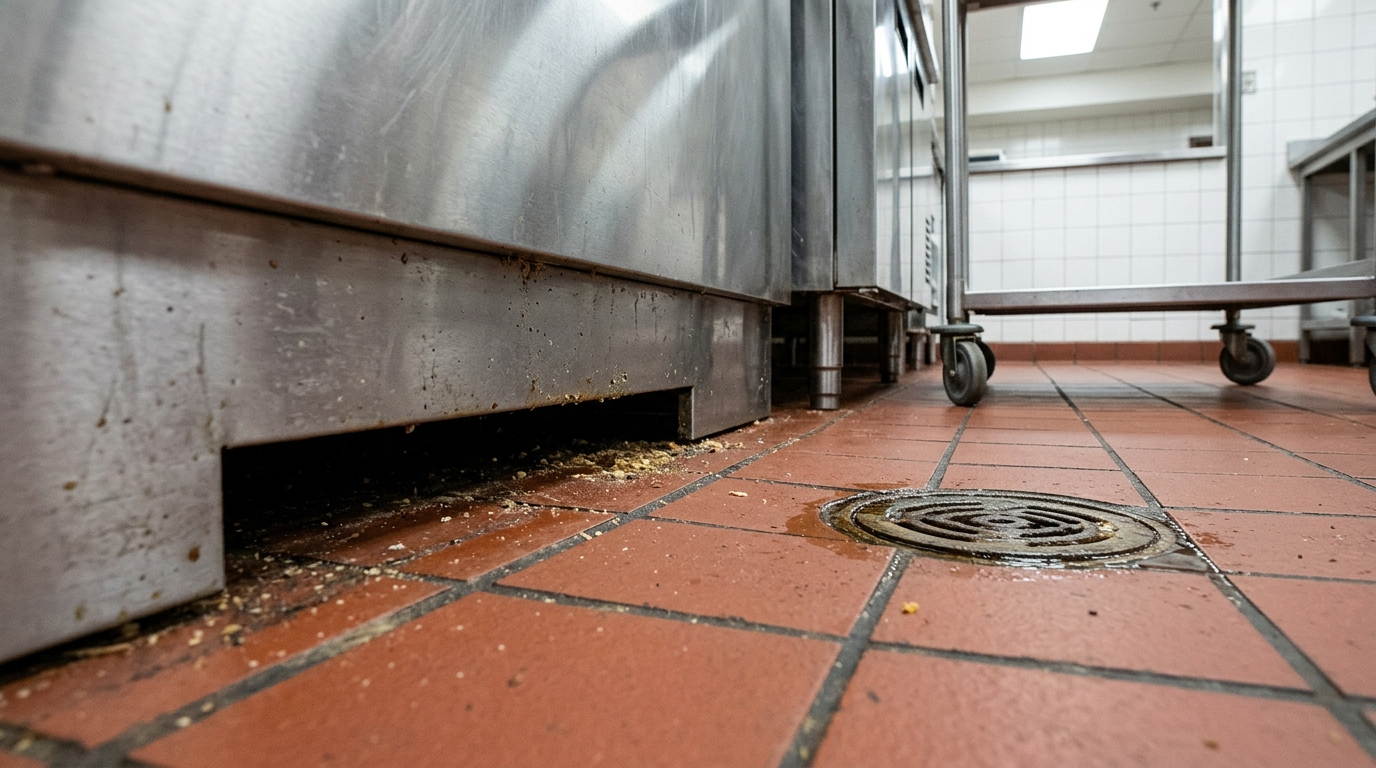
Roaches need water and dark places, so the fix list is plumbing and clutter before it is chemistry: repair leaks, caulk cracks and crevices, clear the stacked clutter that gives them harborage. Flies work on odor, so waste handling is the control. The state’s prevention guidance is concrete about the rest. Power-wash where debris accumulates, naming floor drains, loading docks, dumpsters and food carts. Pull grease off ovens, exhaust vents and grease traps on a schedule. Make sure dumpster, recycling and compactor bins actually close. Site dumpsters away from the building.
The half that gets missed sits outside the kitchen. Food in lockers, food in desks, food in a classroom that was never meant to hold any. The state asks schools to teach students and staff to eat only in designated areas, clear up afterwards, keep instructional food in sealed containers, and keep the areas around refrigerators, vending machines and microwaves clean. A spotless cafeteria does not help much if a hundred lockers each hold half a sandwich.
The discipline is the same food-service work we describe in our guide to how New York City restaurant inspections actually run, and the same standard we hold on commercial kitchen accounts. What differs is the regulatory frame, not the sanitation.
Who Can Legally Treat Pests in an NYC School Building?
This is the question with the least wiggle room, and the one where we most often find schools quietly out of compliance. The Department of Health states the rule without qualification: all pesticide applications at schools and day cares must be done by a DEC-certified pesticide applicator, and that covers even the applications exempt from notification. The exemption buys relief from paperwork. It does not let a custodian pick up a can.
The State Education Department gives the full picture of who qualifies. Applications may only be performed by someone currently certified by DEC as a pesticide applicator, or by a certified pesticide technician, or by an apprentice working under the direct on-site supervision of a certified applicator, under DEC Regulation Part 325.7. Then the sentence that should be on a poster in every custodial office: “It is illegal for individuals other than those noted above to apply any pesticide products in a school building or on school grounds.”
Separately, the State Education Department strongly recommends applicators at least twenty-one years old. That is a recommendation, not a legal threshold, and we would rather say so than let it harden into a rule it is not.
Two duties attach to the applicator rather than the school. DEC requires them to give the building owner a copy of the pesticide label before the application, and to carry the label and their current DEC certification card at the time of the work. If a vendor cannot produce a certification card on site, that is the end of the conversation.
The city adds an operational wrinkle. New York City public schools have their own in-house Department of Education pest management unit, which handles identification and remediation directly, scheduled around the school day with the work taking place after 3:00 PM. Any outside contractor fits into that structure rather than around it. For private and charter schools, that structure is what we replicate through our commercial pest programs.
What Pest Control Records Must an NYC School District Keep?
Records are how a school proves it met a standard nobody itemized as a checklist, and there is more required here than most buildings maintain.
The building-level record is a logbook, and the state specifies it should include a floor plan marking the locations of pests, traps and monitoring devices. Around that sit copies of pesticide labels and safety data sheets, the date, time and location of every application, the applicator’s name with a photocopy of their DEC certification, and the product information OSHA separately requires. One line is easy to skim past and worth reading twice: all IPM and pesticide application records “should be made available for inspection to anyone who wants to review such materials.”
Then there is a reporting duty on its own clock. The State Pesticide Reporting Law, Chapter 279 of the Laws of 1996, requires applicators and technicians, including districts that employ their own certified applicators, to report all pesticide applications to DEC at least annually. That report is due no later than February 1 for the preceding calendar year, and the underlying records must be retained at least three years. Each record carries the EPA registration number, product name, quantity, date, location by address including ZIP code, dosage rate, method of application, target organism and place of application.
Add the three annual parent summaries described above and the picture is complete: a logbook that proves the program, an annual filing that proves the applications, three notices a year that prove the community was told. Our part is straightforward. Every visit is documented with what was found, where, what was placed or applied, and what the building needs to fix. The district files what it has to file; we make sure the underlying record is accurate and actually exists.
Key Takeaways for NYC School Facilities Teams
- The Child Safe Playing Fields Act covers playgrounds, turf and athletic fields, including fence lines. It does not cover the inside of the building.
- Indoor roach and mouse work is legal and normal. The notification law’s exempt list, which includes baits in tamper-resistant stations, gels and pastes in inaccessible areas, and boric acid, covers most of what a good program does anyway.
- The two exemption lists are not the same list. Horticultural oils and soaps are an outdoor exemption. Silica gels, biopesticides and the 72-hour vacancy rule are notification exemptions.
- A program built inside the exempt list avoids the 48-hour notification cycle entirely, which is the State Education Department’s own advice, not ours.
- No exemption reaches the applicator rule. Every application, exempt or not, needs a DEC-certified applicator.
- Scheduled routine spraying is not a compliant school program.
- Records are the proof. A per-building logbook with a trap map, an annual DEC filing by February 1, a three-year retention, and three parent summaries a year.
Nothing here is a 2026 innovation. It is a 2010 turf law, a 2001 notification law and a Commissioner’s regulation, applied to the building you are standing in.
We have worked commercial and institutional accounts in New York City since 1999, so more than 25 years, with 27 people and about 20 technicians in the field, 4.8 stars across hundreds of reviews, and memberships in the state and national pest management associations and the Better Business Bureau. If budget is the live question for your district, we set out what commercial pest control costs in New York City separately, because it deserves its own page rather than a paragraph here.