Usually not. The Insurance Information Institute (Triple-I) lists termite damage among the losses homeowners insurance doesn’t pay for, under maintenance: “Your insurance policy will not cover damage due to lack of maintenance, mold or infestation from termites or other pests.” The standard form (the HO-3 homeowners policy form) has one narrow exception for the damage itself, and it’s for a collapse: part of the house abruptly falling down or caving in because of insect damage that was hidden from view and that no one insured under the policy knew about beforehand. Under the standard form, a floor that’s sagging or a wall that’s cracking hasn’t collapsed, and your own policy may word all of this differently, so read its collapse clause before you count on anything.
Either way, the termites still need dealing with, and if you’re facing them now, our page on termite treatment in Queens is the place to start. We’re a pest control company, not an insurer, so read what follows as a guide to the standard wording. The coverage decision is your insurer’s, under your own policy.
Termite damage your Queens policy may not cover?
Every technician is licensed by New York State, and we waive the inspection fee when you have the work done.
Will a Queens Homeowners Policy Pay to Repair Termite Damage?
Usually not, and the reason is in the policy wording itself. By “the standard form” we mean the HO-3 special form written by the Insurance Services Office (ISO), in the 2000 edition (form HO 00 03 10 00), posted online as a sample homeowners policy. Your own policy may be a later edition or an insurer’s own form, so treat what follows as a guide to the standard wording, with your policy as the final word.
It’s also a form written for the kind of house that stands on most residential lots in Queens. The NYC Department of City Planning’s PLUTO tax-lot data (version 26v2 on NYC Open Data, counted on October 19, 2026) puts 246,939 of the 297,594 Queens tax lots that have at least one residential unit in a one-family or two-family building class, more than four in five. The standard form’s definition of “residence premises” starts with exactly those houses: “the one family dwelling where you reside” and “the two, three or four family dwelling where you reside in at least one of the family units.” If you own a one- or two-family house in Queens and live in it, the standard form’s answer is the one to understand first.
Here’s where that answer comes from. Under the standard form, the dwelling is insured against “risk of direct physical loss,” and then comes a list of losses the form doesn’t insure. One item on it reads “Birds, vermin, rodents, or insects,” in the same group as “Wear and tear, marring, deterioration.” Termites are insects, so that line leaves the termite-eaten sill, joist or post unpaid, and the treatment isn’t covered either: “routine maintenance is the homeowner’s responsibility and termites aren’t a covered peril, your homeowners insurance won’t cover termite treatment,” as Progressive puts it.
Why Do Insurers Treat Termite Damage as a Maintenance Problem?
Because insurers typically view termites as avoidable, and possibly a result of the homeowner’s negligence, while homeowners insurance is designed for sudden or accidental events. Termite damage is neither. A policy is built for the sudden event, and termites are slow.
The same rule is part of owning a house: it’s your responsibility to maintain your home and take reasonable precautions to protect it from damage. Termites land on that side of the line because of how they work. Cornell’s NYS IPM program says wood-destroying insects are a problem “when they compromise the structural integrity of wood, especially if damage is not recognized for several years and populations are high.” Damage that can go unrecognized for years is the opposite of a kitchen fire or a burst pipe, and from where an insurer sits, years are time in which someone could have looked.
There’s one edge to the rule, and it’s worth knowing. In the standard form, the list of losses it won’t insure on the house is followed, at the end of the same section, by this sentence: “any ensuing loss to property described in Coverages A and B not precluded by any other provision in this policy is covered.” Coverages A and B are the house and the other structures on the property. Allstate’s guide gives the example most people need: “If termites were to chew through your home’s wiring and cause a fire, your insurance company may step in to help pay for the damages, as fire is a covered peril under most policies.” So under the standard form, the fire can be covered as a fire, while the termite-eaten wood behind it stays on the excluded side.
When Can Hidden Termite Damage Count as a Covered Collapse in Queens?
Under the standard form, only in a narrow case. The standard form has an additional coverage called Collapse, and one of the causes it accepts is “insect or vermin damage that is hidden from view, unless the presence of such damage is known to an ‘insured’ prior to collapse.” Under the standard form, a termite claim gets through that door only when three things are all true:
- Part of the house actually fell in. The standard form defines collapse as “an abrupt falling down or caving in of a building or any part of a building with the result that the building or part of the building cannot be occupied for its current intended purpose,” and the same passage says a building “in danger of falling down or caving in” isn’t in a state of collapse, and neither is one that’s standing but “shows evidence of cracking, bulging, sagging, bending, leaning, settling, shrinkage or expansion.”
- The damage was hidden from view. Under the standard form, termite damage you could see doesn’t qualify, even if part of the house later gives way.
- No one insured knew about it. Under the standard form, if anyone insured under the policy knew the damage was there before the collapse, the clause doesn’t apply.
For example, picture a joist that termites hollowed out above a finished basement ceiling, out of anyone’s sight, that gives way and drops part of the floor it holds up. Under the standard form, that’s the kind of loss this clause describes, as long as nobody insured knew about the damage; if the same floor only sags and bounces, it hasn’t collapsed, however bad it feels underfoot.
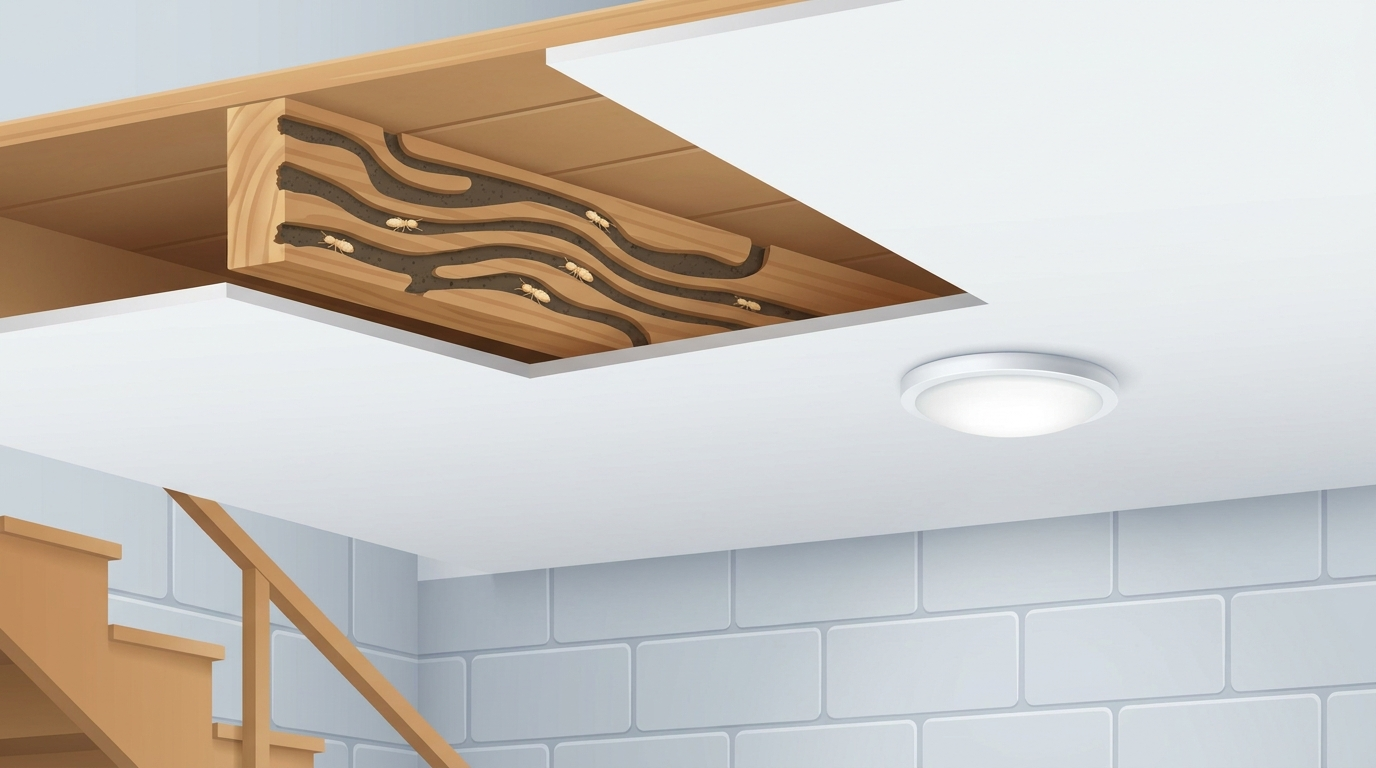
There’s also a carve-out for structures around the house. Under the standard form, loss to “an awning, fence, patio, deck, pavement,” a “foundation” or a “retaining wall,” among other things on its list, isn’t included in the hidden-damage cause “unless the loss is a direct result of the collapse of a building or any part of a building.” So if termites weaken a deck and the deck comes down on its own, the standard form’s hidden-damage wording doesn’t reach it.
Here’s why this door matters on a Queens block. In a one- or two-family house, the wood termites usually reach first is the wood nearest the soil (the next section walks through where that is), and in a finished basement much of it sits behind walls and ceilings. That’s the kind of damage that can stay “hidden from view” until something gives, which is why the wording matters so much for a Queens house. Read the collapse clause in your own policy, because its wording, not the standard form’s, decides a real claim.
How Does a One- or Two-Family House in Queens Let Termites In?
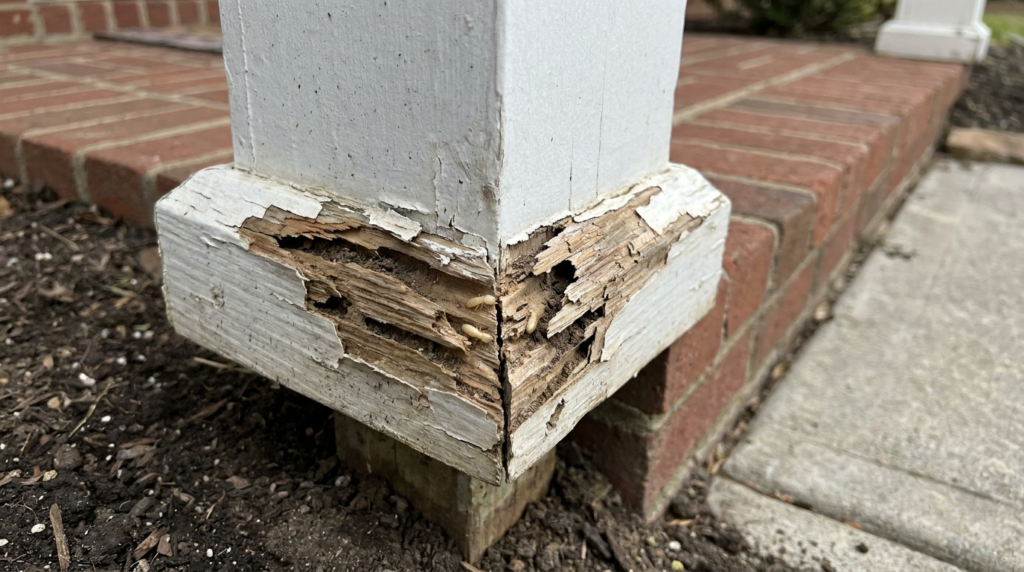
Through the places where the house meets the ground. Cornell’s NYS IPM program says subterranean termites are “the primary termite pest in the northeast,” and that their workers need so much moisture that termites “must feed on wood in direct contact with the soil, or create mud tubes to connect the soil to suitable wood.” As a result, Cornell says, “most problems originate in areas where the home contacts the soil: beams, pillars or other structural supports.”
Cornell’s termite page names the wood most at risk: “All wood embedded in earth or in cracked concrete cellar floors, wood flooring, and framework built on concrete slabs is susceptible.” Termites, it adds, “favor areas around furnaces, chimneys, hot water heaters, and hot water pipes.” Where the supports are stone or metal, Cornell says termites need tubes to reach the wood above, and those tubes “can be hidden inside support structures such as concrete hollow block and hollow metal supports.”
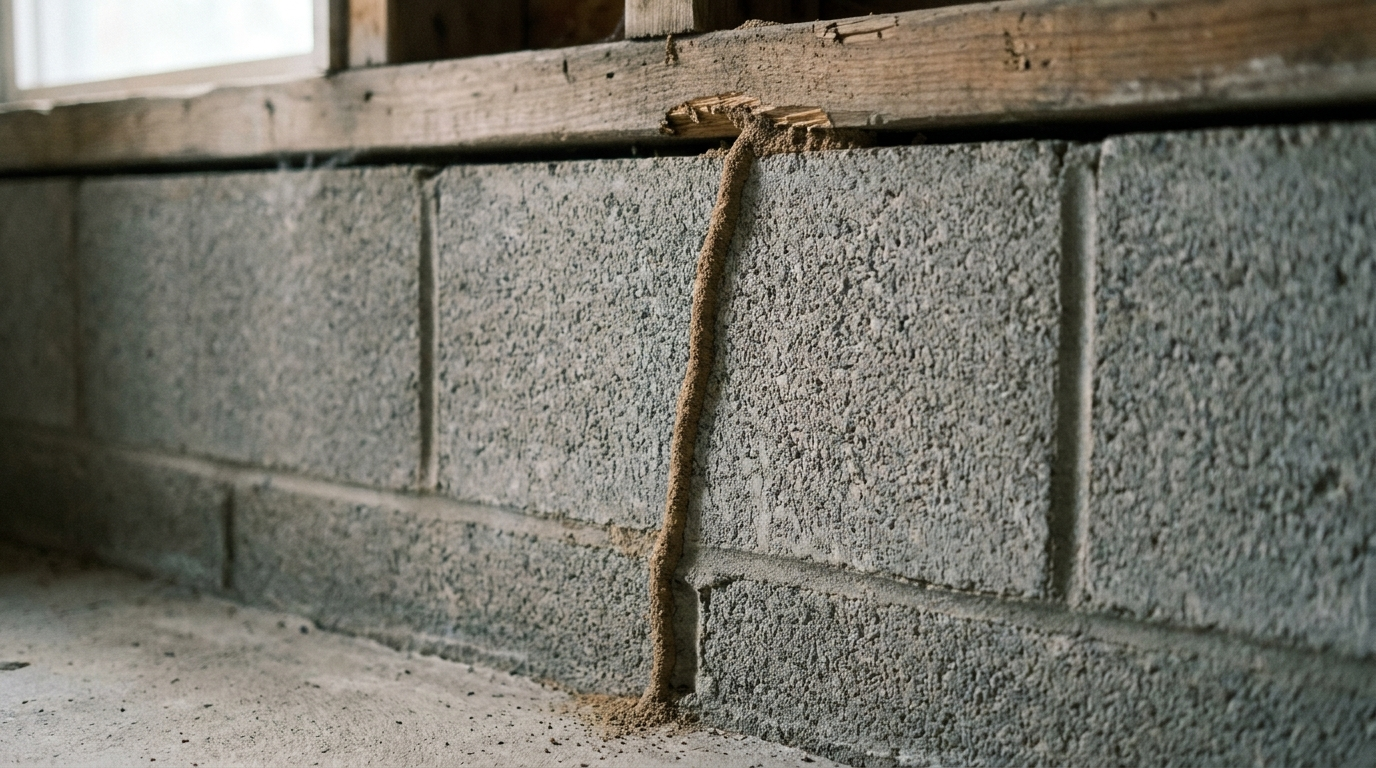
A one- or two-family house stands on its own lot, so the contact points under it are the owner’s to watch. Walk your own house with that list in mind. For example: a wooden step or porch post set right into the dirt, a basement with a cracked concrete floor, the corner of the cellar where the boiler and water heater sit, a foundation built of hollow concrete block. None of those means you have termites. They’re the places to look first, and they’re mostly out of the way, which is how damage can stay out of sight long enough to matter for insurance.
In a two-family house, both households live over the same foundation, but the policy question belongs to the owner who lives there, since under the standard form that’s whose “residence premises” it is. If you rent the other floor and the owner won’t act, our post on what renters can do about termites covers your side. What termite activity itself looks like is a separate question, covered in our guide to the signs of termites to watch for.
Want termite damage checked in your Queens house?
We're NY State certified in Category 7C (termite control). Our technicians show up in uniform and put booties on before they come through your door.
How Do Termite Inspection Records Affect a Claim on a Queens Home?
They can decide it, because the standard form’s hidden-damage door turns on what someone knew. Under the standard form, collapse coverage for insect damage reaches only damage “hidden from view, unless the presence of such damage is known to an ‘insured’ prior to collapse,” and only once part of the house has actually fallen in, not when it sags. An inspection report is a dated, written record of what was found. For example, if a report you received notes termite damage in a sill by the basement stairs, that damage is known to you from the day you got the report, and under the standard form known damage isn’t hidden damage.
Records come into a claim after a loss, too. The standard form’s Duties After Loss let the insurer ask you, “As often as we reasonably require,” to “Provide us with records and documents we request and permit us to make copies,” and to send a signed, sworn proof of loss that sets out “The time and cause of loss.” Old inspection reports, treatment invoices and repair receipts are the kind of paper that request can reach.
None of that is a reason to skip inspections. It’s a reason to act on what they find. Cornell’s NYS IPM program says, “Annual inspections of the foundation, inside and out, can help identify termite damage or locate mud tubes early.” Early is the point: damage found while it’s still a repair is damage you can deal with before anything gives. When a report does name damage, get the termites treated and the wood repaired, and keep every report, invoice and receipt together, so the file shows what was found and what was done about it.
If you’re buying a house rather than insuring one you own, the pre-purchase inspection and its wood-destroying insect report are their own subject, and our guide to the termite inspection before you buy a home walks through it.
Is a Queens Homeowner’s Termite Bond the Same as Insurance?
No. The standard form doesn’t mention termites or termite bonds, but it does keep a service agreement apart from other insurance. It defines a service agreement as “a service plan, property restoration plan, home warranty or other similar service warranty agreement, even if it is characterized as insurance,” and if a loss the policy covers is also covered by one, the standard form says “this insurance is excess over any amounts payable under any such agreement.” In plain terms, under the standard form the policy responds only to the part of that loss beyond what the agreement pays. Whether a particular termite contract counts as a service agreement depends on its wording, and the standard form’s insect exclusion stays the same with or without one, so read the contract and your own policy’s wording together.
As for the question people search as “termite insurance,” Nationwide’s guide to termites and homeowners insurance says, “Insurance companies generally don’t sell termite coverage, but some pest control companies offer plans for annual inspection and treatment.” So whether termite insurance is worth it comes down to whether a particular company’s plan is worth it, and that depends on what its contract actually promises. Before you rely on one, read it for these points:
- Does it pay to repair damage, or only to treat the house again if termites come back?
- Is there a limit on what it pays, and what does it leave out?
- What does it ask of you to stay in force, such as a yearly inspection or a renewal payment?
- When does it end, and what happens if a renewal is missed?
Keep the contract with your policy papers, so you have both in hand if you ever face a claim.
What Should Homeowners in Queens Do First When Termite Damage Turns Up?
Take these in order. None of them needs you to open a wall or pull up a floor.
- Write down what you found. Dated photos of what you can see, and a note of where and when you found it, are the start of the record.
- Get a professional look. Cornell’s termite page advises, “If you suspect termite activity, inspect what you can, but always consider professional pest control technicians or building engineers.” A termite inspection is how you find out whether termites are active and where; a building engineer is the person to ask whether a beam or a floor is still sound.
- Read your own policy’s collapse clause. Find the collapse section and the insect wording in your own policy, and don’t assume they match the standard form’s. If part of the house has actually fallen in, that clause is the one a claim turns on, and under the standard form, damage you could see or already knew about, or wood that’s only sagging, falls outside it.
- Call your insurer or agent if you think a covered loss happened. After a loss to covered property, the standard form’s first listed duty is to “Give prompt notice to us or our agent.” It also asks you to “Protect the property from further damage” and, if repairs are needed to do that, to “Keep an accurate record of repair expenses.”
Then comes the part the standard form leaves to you: getting rid of the termites and keeping them away. Cornell’s advice once an infestation is confirmed is to try to replace damaged wood and put its prevention steps in place: “Reduce moisture sources near the wood, and place non-wood borders between wood and soil.” “Keep the soil dry near the foundation by encouraging ventilation and drainage away from the building.” “Keep lumber, wood debris, trees, and shrubs well away from buildings and building foundations.” “Seal openings in both wood and cement.” For the insecticide treatment itself, Cornell’s advice is to hire a professional. Our termite treatment service page covers that side, and our guide to what termite treatment costs covers the budget.
Your Next Step
If you’ve found damage, or you think you might have termites, get the house looked at before you spend an evening with the claim forms. The insurance question is much easier to answer once you know what’s in the wood, where it is, and whether anyone could have seen it. We cover all five boroughs, Nassau County and Suffolk County, and every technician is licensed by New York State, so start with our page on pest control across Queens.