Yes. The University of California’s Pest Notes: House Mouse calls house mice excellent climbers that “can run up any rough vertical surface,” and says they will “run horizontally along wire cables or ropes.” So a mouse can climb the outside of a Manhattan building wherever the surface is rough; what gets it into your apartment is an opening where the climb ends, like a gap at a window or around a window AC unit. Can a mouse that gets in come near you while you sleep? It can. The same Pest Notes say house mice are active mostly at night, though they can be seen occasionally in daylight, and that “they are active at times when food is available.”
This guide sticks to the outside route: the wall, the cables, the window unit and the facade. If mice are already living in your apartment, start with our page on rodent control in Manhattan.
Mice climbing into your Manhattan apartment?
Every technician is licensed by New York State, and we cover all five boroughs.
Can Mice Really Climb the Walls of a Manhattan Building?
They can, and the word doing the work in that Pest Notes line is “rough.” Picture the outside of an older Manhattan building. A pre-war walk-up typically has a brick front, and the brick can be broken up by sills, lintels, cornices, fire escapes, cable runs and the brackets under window units. That’s a lot of texture and a lot of edges, and the next section goes through which surfaces a mouse can actually grip.
A climb is only half of a way in, though. To get into an apartment from outside, a mouse needs three things in a row: a surface it can grip, a route that leads somewhere, and an opening at the end of it. Take away the opening and the climb goes nowhere.
The opening doesn’t have to be big. UC IPM, the University of California’s integrated pest management program, which publishes the Pest Notes, says house mice “can squeeze under gaps ¼ inch tall, and through openings 3/8 inch wide.” That’s a gap you could easily miss along a window frame, or around a cable where it passes through a wall.
One note on scope: everything here is about the house mouse, the species the climbing figures describe.
Which Wall Surfaces Can a Mouse Climb in Manhattan, and Which Stop It?
The University of Nebraska–Lincoln Extension guide Rodent-Proof Construction — Structural gives the list: rats and mice can “climb almost any rough vertical surface such as wood, brick, concrete, and weathered sheet metal.” On a Manhattan block, that’s the brick of a pre-war walk-up, a concrete wall, wood window frames and trim, and, if your building’s cornice is sheet metal that has weathered, the cornice too.
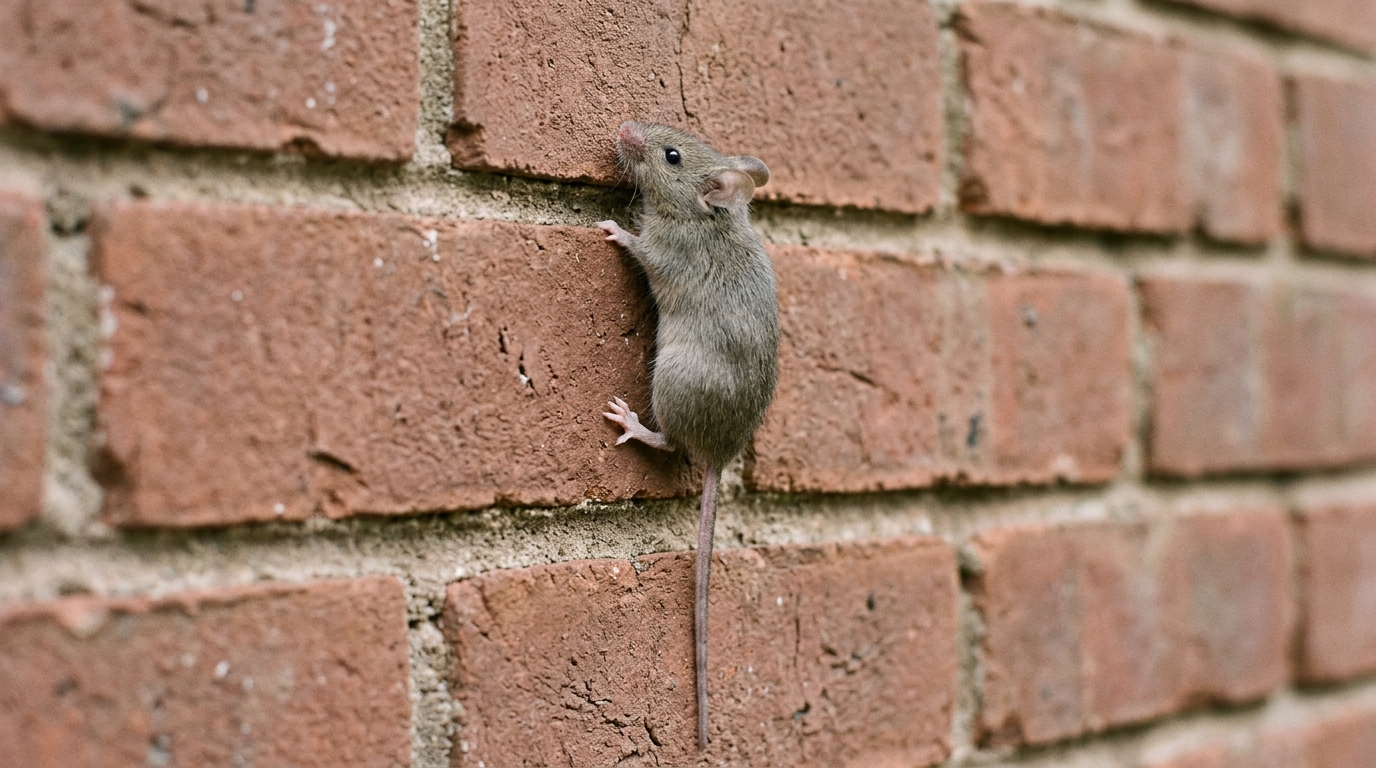
Read that list closely and the deciding word is still “rough.” Weathered sheet metal is on it, which tells you the material isn’t the point. The same guide’s answer to rodents climbing walls indoors is a band of sheet metal fastened to the wall, a guard it suggests for the inside corners of rooms. Put the two side by side and the difference is the surface: metal as a guard, weathered metal on the climbable list. So the answer those lines point to, for which surfaces stop a mouse, is smooth ones, kept smooth.
Outside, though, you can’t change what your building is made of. If you live in a newer tower faced in glass or polished panels, the face is smooth, but a facade is more than its panels: window frames, joints, ledges, vents and anything fastened to the outside break it up, and a mouse needs only one path it can grip. In a brick building, the brick answers the grip question for you.
That makes the useful question for your apartment a narrower one: near your windows, is there anything a mouse can grip, and does it lead to an opening? The rest of this post is about the second half of that question.
How High Can a Mouse Climb Up the Outside of a Building?
UC IPM’s Pest Notes don’t put a height limit on the climb; the line is “any rough vertical surface,” with no number attached. The figures that measure how high a mouse can get are for jumping. UC IPM’s Pest Notes say house mice can jump up to 12 inches from the floor onto a flat surface, and the University of Nebraska–Lincoln guide says house mice can jump up 18 inches vertically. The two figures disagree, and both are jumps, not climbs.
So what does limit a climb up the outside of a building? The surface and the route. A mouse can keep going while the face stays rough, or while something it can grip, such as a cable or a vine, carries on where the rough surface stops, and while there’s somewhere to get to. If a wide smooth stretch does interrupt the climb and nothing it can grip spans it, that’s where the climb stops, at whatever height that happens to be.
A mouse doesn’t know what floor it’s on. What it meets on the way up is the same set of questions at each level: can it grip the surface, is there a path, and is there a way in?
Do Exterior Cables and Wires Let Mice Climb to Upper-Floor Manhattan Apartments?
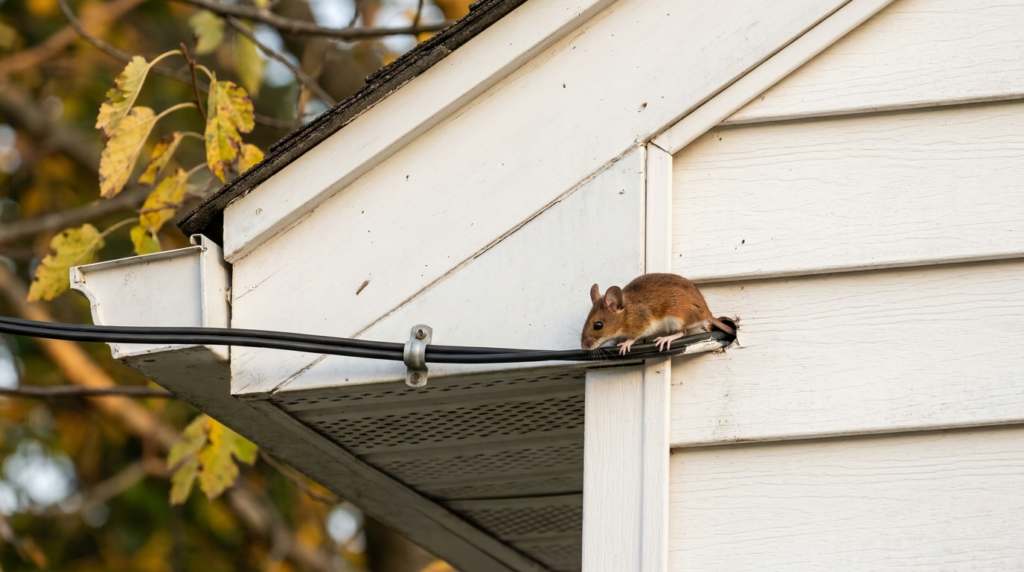
They can be part of the way up. The University of Nebraska–Lincoln guide lists electrical wires, ropes, cables, vines, shrubs and trees among the things rats and mice can “run along or climb” to gain entry to a building. On a Manhattan building, that means the phone, cable and internet lines on the outside, and it also means ivy on a townhouse front or a branch that touches the facade.
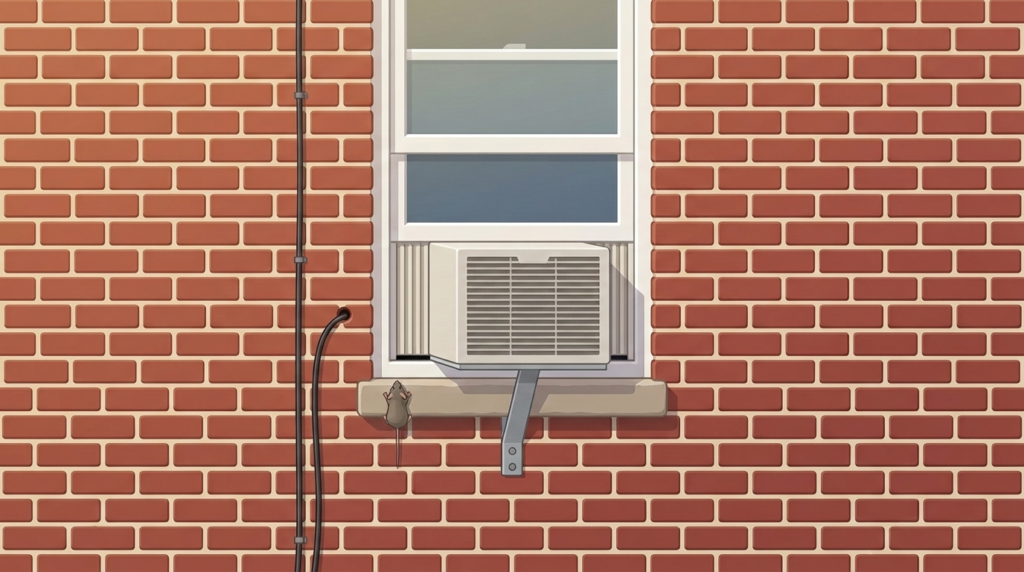
Look at the front or the back of a pre-war walk-up from the sidewalk or the yard and you may see the lines, running up the brick, strung along under the windows, sometimes crossing to the building next door. A line that lies flat against brick doesn’t add much to the climb, because the brick is already climbable. Where a line changes things is where the wall can’t do the job on its own: if it crosses from one building to the next, or runs past a stretch a mouse couldn’t grip, it carries the route across. And wherever it goes into the building, it ends at a hole in the wall.
That hole is the part to look at. The CDC’s page How to Seal Up to Prevent Rodents lists “holes for electrical, plumbing, cable, and gas lines” among the places to check outside a home. From inside your apartment, and without touching any wiring, look at where each outside line comes through the wall: a gap around the line, or a hole that’s bigger than the line itself, is the opening at the end of the route.
If you rent, that hole is in the building’s outside wall, so it goes to the super. Tell them which room, which line and where it comes in; a specific report is easier to act on than “we have mice.”
Mice getting in around your Manhattan window AC?
We do professional pest-proofing and rodent-proofing. Call us and a real person answers.
Can a Mouse Climb In Through a Window AC Unit in Manhattan?
It can get in around one, if the installation leaves a gap. A window unit sits in a window that’s been opened wide enough to hold it, so something has to fill the rest of the opening, and the edges of that fill are what to check. Do it from inside the room: don’t lean out of the window, and don’t loosen or move the unit to see its outside edge. On a double-hung window, look at three places:
- the panels that fill the space on each side of the unit;
- the line where the raised lower sash comes down onto the top of the unit;
- the place where the raised lower sash overlaps the upper one.
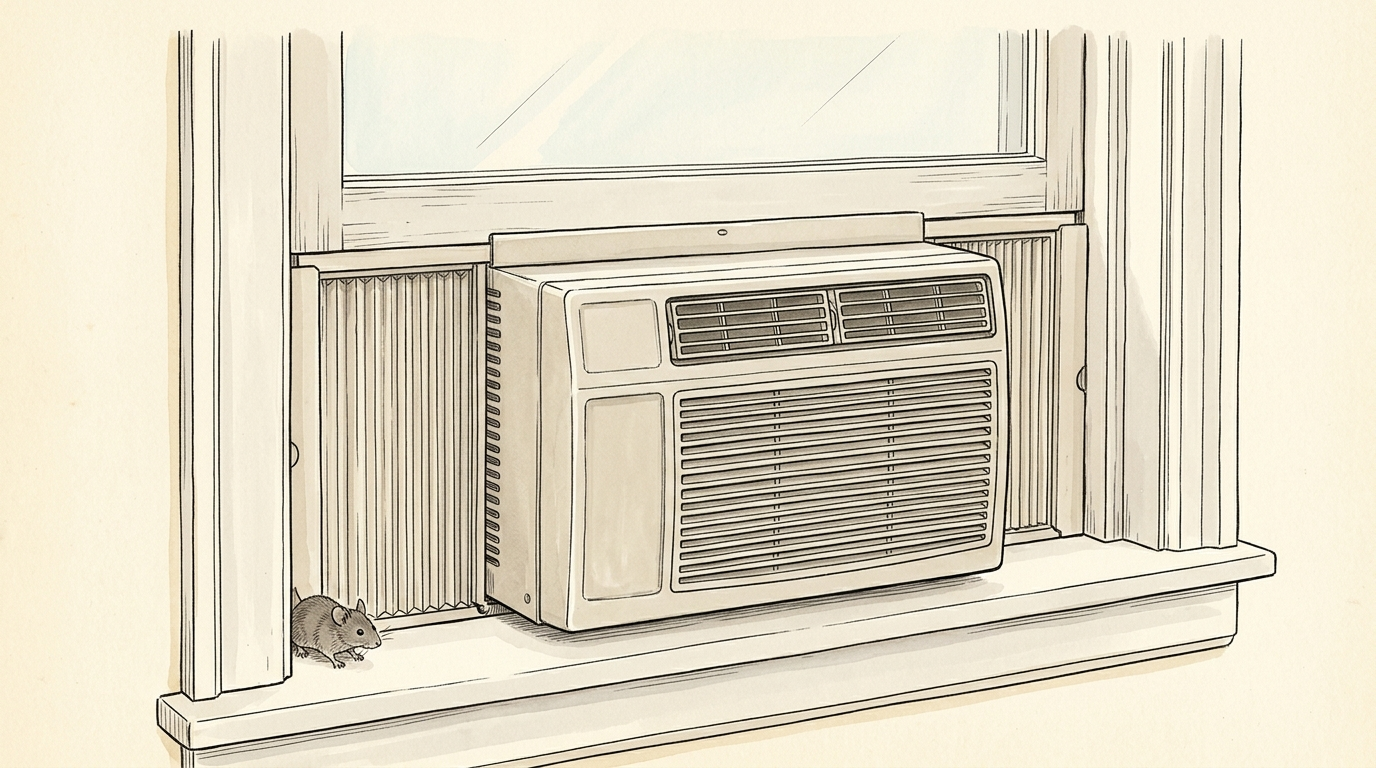
An opening at any of those places that’s the size described earlier is a way in, and so is a spot a mouse can chew open. If the panels or the strip along the sash are plastic, vinyl or rubber, the University of Nebraska–Lincoln guide lists all three among the materials rats and mice can gnaw through. That doesn’t mean your unit has a hole around it today. It means the fill around the unit is where to look first.
A window that closes all the way has none of these gaps. A unit that stays in the window keeps them for as long as it’s there, through the colder months as well as the summer.
If you do find a gap, who fixes it depends on who installed the unit and who owns the window. The NYC Health Department’s guide How to Control Pests Safely lists gaps “along baseboards and windows” among the problems to look for as you go through each room. For the repairs, it says it’s important to wear gloves and follow all package instructions, and that if you can’t or don’t want to do them yourself, you should ask the owner or superintendent.
Why Doesn’t a High Floor Stop Mice From Climbing Into Manhattan Apartments?
Because what ends a climb is the wall and the window, not the floor number. As the sections above show, a climb stops at a surface a mouse can’t grip, a route that runs out, or the lack of an opening at the top, and each of those can be true or false on a low floor or a high one. A gap at a window or around a cable is just as open up high as it is near the street.
The climb also isn’t the only way up. Cornell IPM’s page on mouse and rat biology and behavior says house mice “can successfully live their entire life indoors,” so a mouse in an upper-floor apartment may never have been outside. And the University of Nebraska–Lincoln guide says rodents may “even be carried into a structure in a box or appliance,” which, in a building with deliveries coming in and people moving in and out, is a way up that takes no climbing at all.
The inside route between floors, through risers and the gaps around radiator and pipe lines, is a separate subject, and our guide to the signs of mice in NYC covers it. If you’re hearing mice under the floorboards of an upstairs apartment, read that guide first, because those mice are already inside the building.
None of this means every upper-floor apartment gets mice. It means height on its own isn’t a barrier, and that the outside is one route of several: the one this guide covers.
What Stops Climbing Mice at the Windows and Facade of Manhattan Buildings?
Closing the openings the climb leads to. UC IPM’s Pest Notes call exclusion “the most successful and permanent form of house mouse control,” and describe it as keeping mice out of buildings “by eliminating all gaps and openings larger than ¼ inch.” You can’t change what your building’s walls are made of, but the openings can be found and closed. Everything in this section is about keeping the next mouse out. If one is already living in your apartment, that’s a different job, and our mouse exterminator service is the page for it.
At the Windows
The same Pest Notes say: “Doors, windows, and screens should fit tightly.” In a Manhattan apartment, that means a window that closes fully against its frame, screens without tears or bent frames, and, if you have a window unit, the three places from the AC section above, checked from inside the room.
On the Facade
One more point from the same UC IPM page, with a caution first: don’t climb, or lean out of a window, to cut anything back yourself. The page’s Quick Tips say: “Thin or remove plants next to or climbing up buildings, since house mice are excellent climbers.” On a Manhattan block, that’s ivy on a townhouse front and branches that reach a window or a ledge. If the planting belongs to the building, tell the super or the managing agent where it touches the wall.
The holes where cable, phone and other lines pass through the outside wall are another set of openings on a facade. They’re in the building’s wall, and some sit far from any window you can reach, so they’re a job for the building or a pro and never something to reach for from a window.
If your building has a stoop and an areaway, the openings at the foot of the house are a subject of their own, and our guide to getting mice out of brownstone walls covers them. For what to seal small gaps with from inside the apartment, and what to do if a landlord doesn’t act, see our guide to getting rid of mice in an NYC home.
Who Does the Work
If you rent, or own in a co-op, go to the super or the managing agent first: the facade, the holes in it and the window frames are part of the building. Say exactly what you found and where, down to the window, the side of the unit and the line. Something like “there’s a gap under the left side panel of the bedroom window unit, and the cable by the living room window comes through a hole bigger than the cable” gives them something to fix. We do professional pest-proofing and rodent-proofing. Whether you call us or your building does, start at our rodent control service.
The Takeaway
- Yes, mice can climb the walls of a Manhattan building. House mice can run up rough vertical surfaces and run horizontally along cables, and what lets one into an apartment is an opening where the climb ends.
- Mice can climb almost any rough surface, brick, concrete, wood and weathered sheet metal included. The lines quoted above point to a smooth surface, kept smooth, as the kind that stops a climb.
- UC IPM’s Pest Notes give the climb no height limit. The height figures above are for jumps, not climbs.
- Cables, vines and trees can be part of the route, and the hole where a line comes through the wall is the opening that counts.
- Around a window AC unit, stay inside the room, without leaning out or moving the unit, and check the side panels, the top of the unit where the sash comes down, and the overlap of the two sashes. Plastic, vinyl and rubber can be chewed through.
- A high floor doesn’t keep mice out: house mice can live their whole lives indoors, and the inside of a building is a route of its own.
- What stops climbing mice is closing the openings, keeping windows and screens tight-fitting, and cutting plants back from the building. If you rent, the super or the managing agent is the first call.
- A mouse that gets in is active mostly at night, so yes, it can come near you while you sleep.
We treat mice. If roaches or bed bugs are part of the picture too, our page on pest control in Manhattan covers the wider job.