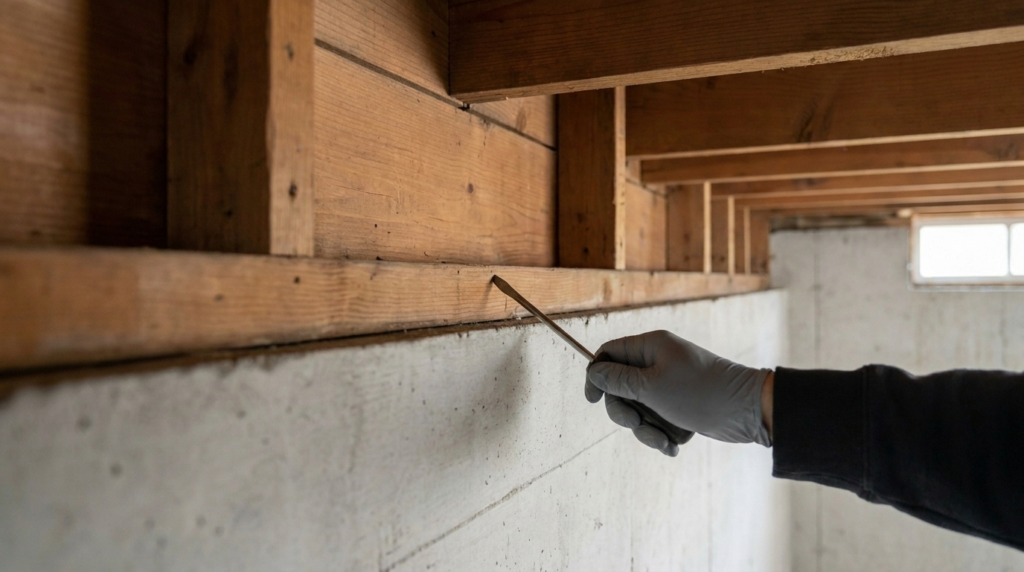
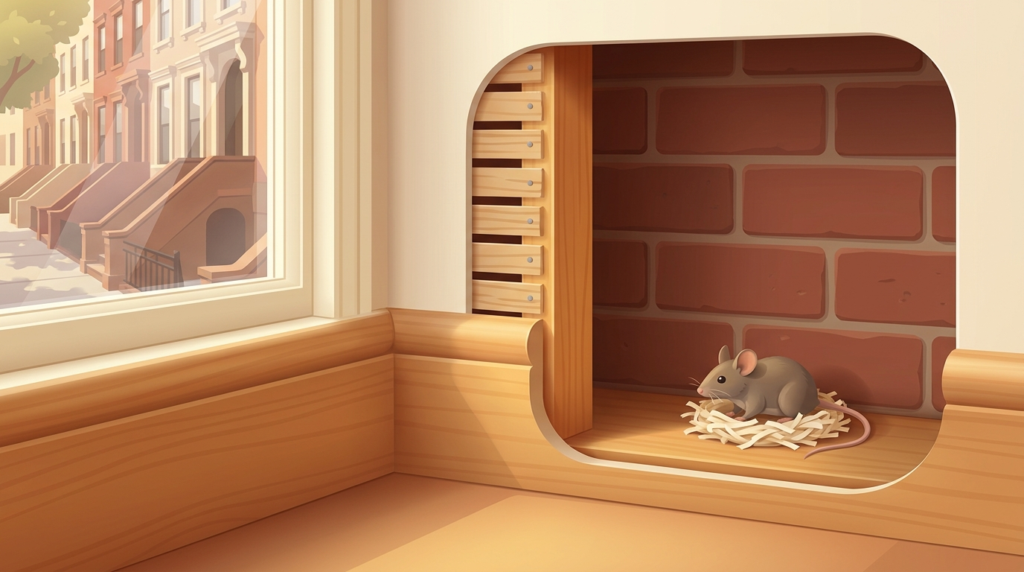
You hear them before you ever see them: scratching behind the parlor wall once the house goes quiet. In a Brooklyn brownstone that sound has somewhere to come from. The National Park Service’s brief on repairing historic flat plaster describes how walls like these were built. It says lime plaster was often applied directly to a masonry wall, with no lath. Wet plaster was also pushed onto wood lath, the lath nailed to the studs and joists or to furring strips, and where a masonry wall was finished in gypsum plaster, furring strips left a dead air space behind it. That hollow is the wall void, and it is where your mice are living.
The short answer to how you get mice out of the walls of a Brooklyn brownstone: trap them at the gaps where they leave the wall, keep poison out of it, close the ways in from under the stoop, and seal the last interior gaps only after the traps go quiet. Before any of it, NYC Health’s booklet, linked below, sets the conditions: traps set as the package directs and out of reach of children and pets, and gloves on with the package directions followed for sealing. We treat mice, and our rodent control in Brooklyn page is the place to start if you would rather hand the job over.
Mice in the walls of your Brooklyn brownstone?
We do professional pest-proofing and rodent-proofing, and one-time services carry a 30-day guarantee.
How Do You Remove Mice Living Inside Brooklyn Brownstone Walls?
You remove them with traps set where they come out of the wall, and you leave those gaps open until the traps stay empty. Cornell Integrated Pest Management’s page on mouse and rat biology says mice can make nests inside walls, and its page on managing mice and rats says house mice may build a nest indoors near a food source. The wall is where they sleep and your kitchen is where they eat, so they come out through a gap somewhere to feed.
That is why the order matters. Cornell’s page on pest exclusion, which covers animals in buildings and is not specific to mice, says that before you close an entry site you should be certain that animals will not be trapped inside, and that if you are not sure an entry site is active you should monitor it for at least two days: put newspaper in the hole, staple cardboard over it, or cover it with duct tape. It adds that animals already living in a building usually need to be removed before exclusion goes ahead.
One poster told r/AskNYC what the wrong order looks like. Their household plugged the holes and stopped seeing the mouse; then a rotten smell arrived, strongest at the wall where the mouse used to come in, and they assumed it had died in there. One account is not a study, but it is what the Cornell rule is there to prevent.
So the traps go at the exits. NYC Health’s booklet on roaches and mice tells residents where to look: gaps, cracks and holes in walls, along baseboards and windows, and around pipes, wires and drains. NYC Health’s trapping routine is four lines, and its test for being done is at least one week with nothing caught. One point first: a caught mouse has to be handled, and the New York State Department of Health’s cleanup steps, given in full in the dead-mouse section below, start with rubber gloves.
- Read the package and follow its directions. The booklet covers snap traps and glue traps; our mice guide, linked below, compares trap types.
- Put the traps where children and pets cannot reach them.
- Check the traps every day, and put any mouse you catch in a sealed plastic bag for disposal.
- Keep setting fresh traps until that week goes by with nothing caught.
Read together, those sources give the order for mice already inside the wall: trap at the gaps, wait until the traps go quiet, then put on gloves and, following the package directions, close them. The closing itself, by the hole-size rule and the steel wool, caulk and foam method, is in our guide to getting rid of mice in an NYC home. That guide seals first, which works when the mice are coming in from somewhere else; when they are nesting in the wall you are about to close, the Cornell rule above is the reason to trap first. The mouse droppings and grease marks that show which gaps are in use are in our guide to the signs of mice in NYC.
What Stops Mice Climbing Into the Walls From Under a Stoop in Brooklyn?
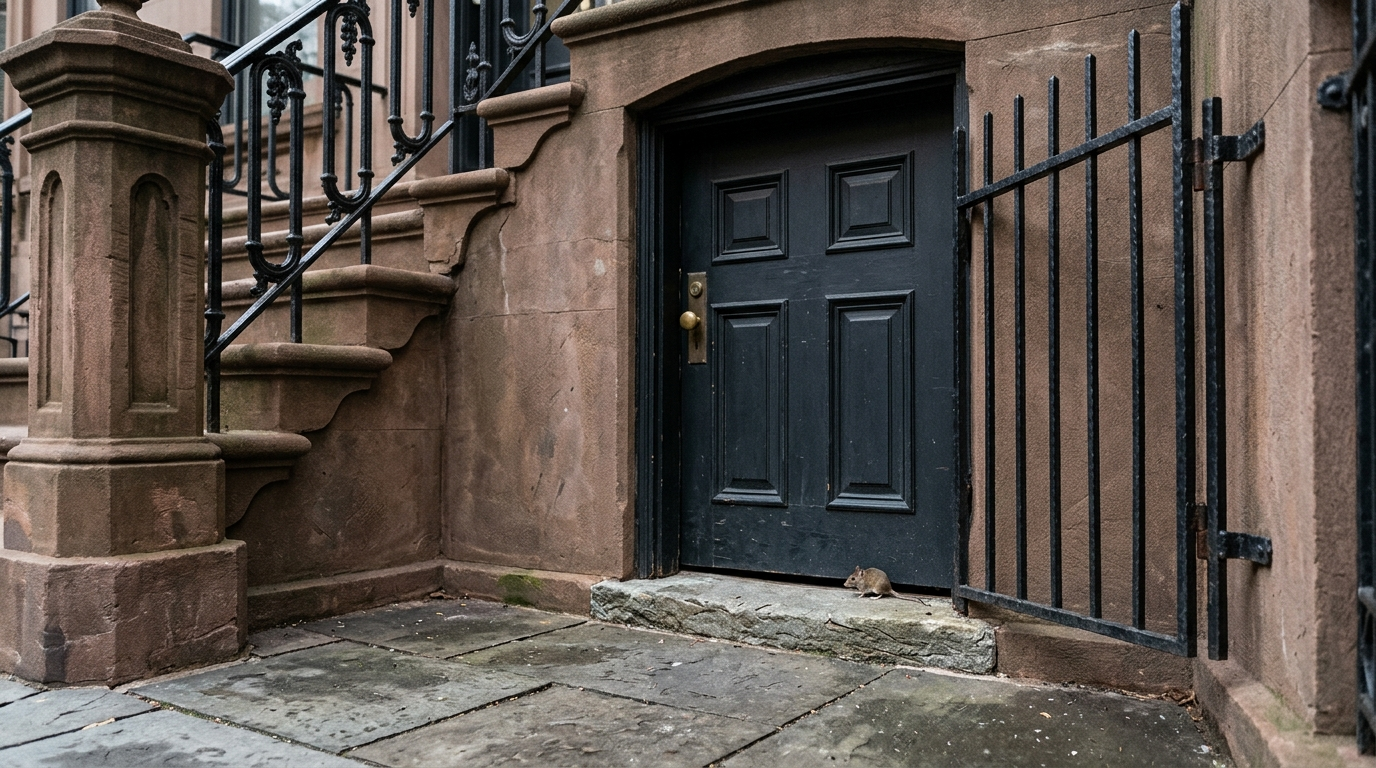
What stops them is closing the openings at the foot of the house: the door under the stoop, the cellar hatch and, if your cellar runs out under the sidewalk, the covers over that space. The New York State Department of Health’s Mouse Control page says mice can jump 12 inches high, run up the sides of buildings and cross cables and wires, and gives that as its reason for telling you to seal or cover all openings.
The city’s own documents name the possible entry points on a brownstone front. The Landmarks Preservation Commission’s Rowhouse Manual defines the areaway as the open space between a rowhouse and the sidewalk, usually beside the stoop. It describes areaways as giving access to basement doorways, refers to the entrance under the stoop, and calls the cellar access hatch a common feature of the areaway, generally built of wood with a protective metal skin.
If your cellar runs out under the sidewalk, that space may be what NYC DOT’s Street Works Manual calls a building vault: an opening below the street that projects past the property line and is covered over. The manual’s definition leaves out some openings, among them ones used only to reach the cellar by steps and ones used mainly for light and ventilation. It also says that building, altering or repairing a vault requires a permit from NYC DOT. So at a vault, the step here is keeping its covers closed.
For the other openings, the state health department’s page lists what to close them with, and NYC Health’s booklet attaches a condition to sealing repairs that belongs first: wear gloves and follow all package instructions.
- Seal cracks and the spaces around vents, wires and pipes with sheet metal, concrete or a knitted copper wire mesh.
- Screen the openings that have to stay open, such as fans and chimneys, with 1/4-inch wire mesh, the size the state health department’s page gives.
- Screen doors and windows with tight-fitting metal screens.
- Keep a tight-fitting door sweep on every exterior door. On a brownstone that includes the one under the stoop.
We do professional pest-proofing and rodent-proofing, and our rodent control service page is where to ask about this kind of work. For rats, our guide to the signs of rats in Brooklyn covers the same areaway from their side.
Why Should You Never Use Poison to Kill Mice in Brooklyn Homes?
Because a poisoned mouse often dies in a place you cannot reach. The flat “never” in that heading is stricter than the agencies are, so here is whose rule it is and how far it reaches.
NYC Health’s booklet uses the word for loose bait: never use it, because it spreads everywhere and lands on surfaces where people sit, prepare food, play or eat. The same booklet says a household that sees mice only occasionally may be able to solve the problem itself with rodenticide baits, in tamper-proof containers only and under the conditions it lists alongside.
The New York State Department of Health’s page comes closer to the heading. It says trapping is effective and generally safer than using poison, and that poisoned mice often die in hard-to-reach places, causing a very unpleasant odor. It still has a section on poison baits for home use, so that is a preference, not a ban.
Cornell’s managing page explains the smell: feeding on bait does not make rodents leave the home in search of water; they tire and look for protected areas, and their death inside walls and other voids produces a smell that can last for days for mice and weeks for rats.
When the mice already nest in your walls, that settles it: the protected place a poisoned mouse looks for is likely to be the void it already nests in. The same page names it as a benefit of trapping that you know where the rodent died and avoid decomposition in hard-to-reach places.
What a certified applicator may put inside a wall is a separate question, and we get to it below.
How Do You Find and Remove a Dead Mouse Smell From a Wall?
You find it with your nose and with the flies, and you remove the smell by removing the mouse. If you cannot reach the mouse, the smell does end on its own: Cornell’s range, given above, is that it can last for days for a mouse and weeks for a rat.
Smell gets you to the wall: the household from earlier found theirs strongest where the mouse used to come through. Flies are the other clue. Cornell Integrated Pest Management’s page on non-biting flies says bottle flies, the metallic blue, green or bronze ones, usually indicate the presence of a dead animal when they are found inside a building. It also says adult flies are often, but not always, found near their breeding source, so the room where you see the most of them is where to focus. Its one caution is that many flies are attracted to light, such as a light fixture or a window.
Then you have a decision to make, because if your walls are still the original plaster, the National Park Service brief says replacing plaster is expensive and recommends retaining historic plaster if at all possible. If you rent, who opens the wall is a rights question, and our renter’s guide to mice in an NYC home covers the landlord’s side and 311.
If the mouse is somewhere you can reach without opening plaster, the New York State Department of Health’s page gives five cleanup steps for dead rodents and their droppings, and the protective step comes first. One rule from NYC Health’s booklet belongs before step 2: never mix bleach with ammonia or other cleaning products. The state’s step 2 does mix bleach with detergent, so the two agencies differ on that point; if you follow the state’s recipe, add nothing else to it. The state’s five steps:
- Wear rubber gloves.
- Make a disinfectant by mixing detergent with 1 1/2 cups of bleach for each gallon of water, the ratio the state health department’s page gives.
- Using a spray bottle of the disinfectant, thoroughly spray the dead mouse, any traps and droppings, and the areas where you found them.
- Do not sweep or vacuum droppings until you have wet the area with the detergent, bleach and water, because dry sweeping or vacuuming might put dust containing viruses into the air.
- Place the sprayed mouse and droppings in a plastic bag and seal it. Then place that bag in a second bag, seal it and put it out with the trash.
Posters trade remedies for the smell, from used coffee grounds to air fresheners. None of the sources we cite here recommends one.
One mouse still loose in your Brooklyn walls?
We drill and dust wall voids with tracking powder, and we offer same-day service during business hours.
Why Is One Mouse So Hard to Eliminate From a Brooklyn Wall Void?
Because everything one mouse needs is a short run from its nest, and because a mouse that has met your traps can learn to leave them alone. The National Pesticide Information Center at Oregon State University says on its page on mice that mice usually stay within 30 feet of their nests, that unlike rats they may not need a source of water if their food is moist enough, that they can learn through trial and error, and that they live only a year to a year and a half. Waiting one out is not a plan.
One r/pestcontrol poster, writing from a renovated Brooklyn brownstone, named theirs Benjamin. By their account they called in exterminators, tried glue, snap and electric traps and poison, baited with peanut butter, bacon and dog food, stuffed steel wool and copper mesh around the edges of every room, and set up cameras that showed a single mouse climbing the curtains. Commenters told them it was a rat. The poster’s update says it was a mouse, and that what ended it was shutting it out of the closets it hid in and setting several traps at once. Our rat vs. mouse guide sorts out which animal you have.
Cornell’s managing page has a name for the trap problem: trap fatigue. When snap traps sit in the same place for a long time, rodents, especially mice, get used to them and stop exploring them or actively avoid them. Cornell’s fix, if the mice are still active and the traps catch nothing, is to remove the traps for a few days and then put them back in new areas that might have activity. The same conditions apply as before: package directions first, and out of reach of children and pets.
If one mouse is still beating you after that, the pesticide information center has a line for it: consider working with a professional for challenging rodent problems.
Can a Pro Treat Wall Voids in Brooklyn Without Opening the Plaster?
Yes. It is work we do: we drill and dust wall voids with tracking powder. The access to the wall cavities is a drilled hole, so the plaster stays on the wall. In a newer building that wall would be drywall; in an original brownstone wall it is the kind of plaster the Park Service brief is about.
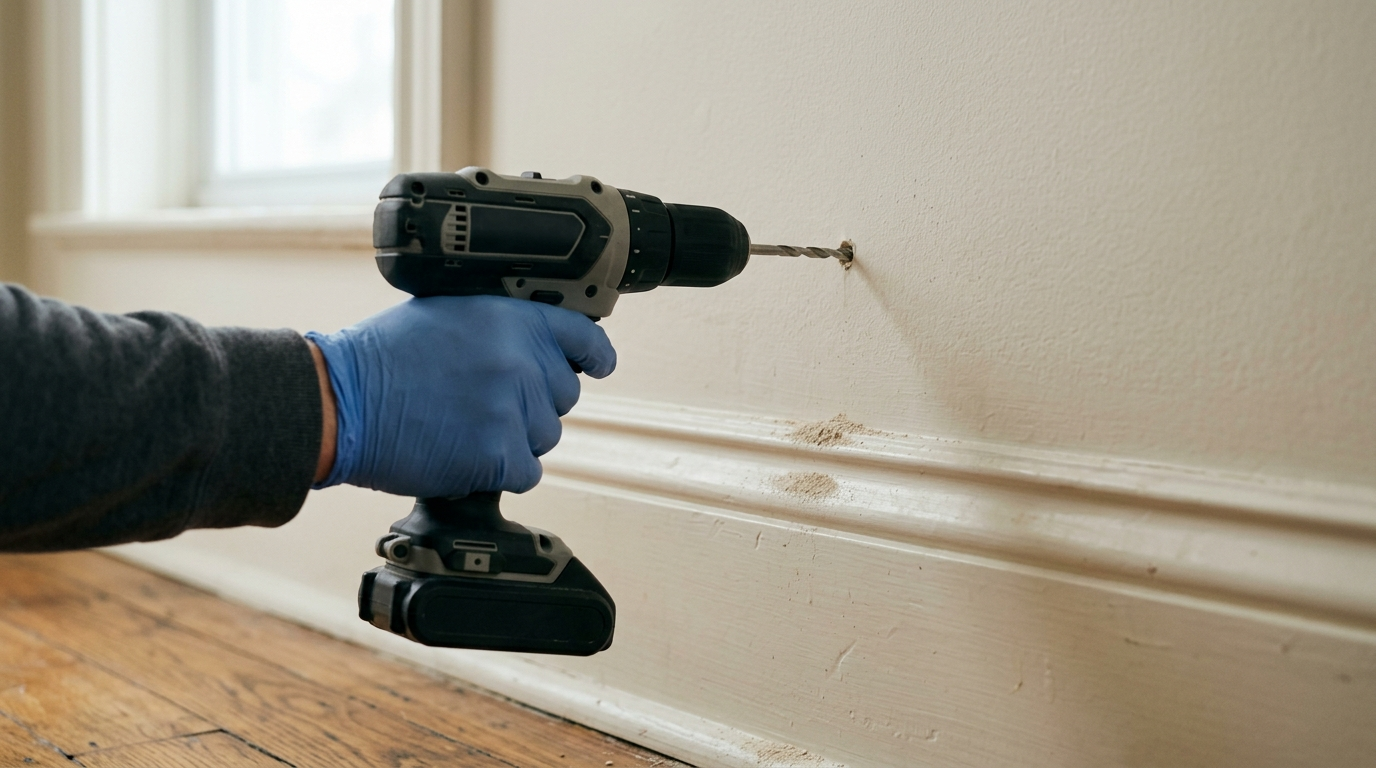
You should know what goes through that hole. A 2018 article from Cornell’s StopPests in Housing Program explains that tracking powders are rodenticides: they are placed where rodents pick the powder up on their feet and fur, and the rodents swallow it when they groom. Used properly, the article says, the powder sits where rodents can reach it and where people, pets and other animals cannot. It also says that in New York all tracking powders are restricted-use pesticides, and that only certified pesticide applicators can purchase and apply them. We are New York State certified in Category 7A (structural and rodent).
The same article is blunt about the limits. It calls tracking powders highly effective and frequently misused. It says they are not a long-term solution, that they should never be used to “protect” wall, ceiling or floor voids from rodents, and that they should be used in a very targeted manner, as the pesticide label instructs. Its example of misuse is a void coated with powder inside a restaurant booth seat, where any rodent walking through could spread the powder wherever it walked next. And because the powder is a poison, it notes that rodents might die in nearby areas and cause the odor described above.
So the questions to ask anyone who offers to treat your walls, us included, come from that article. Who is the certified applicator? Where exactly will the powder go, and how does it stay out of reach of your household? What trapping and sealing come with it? Our mouse exterminator service page is where to start that conversation.
How Can Attached Brooklyn Row Houses Stop Mice Crossing the Party Wall?
By working both sides of it at the same time, because no household can trap or seal the far side of its own wall. The Landmarks Preservation Commission’s manual defines a rowhouse as one of an unbroken line of attached houses that share common side walls, known as party walls.
A mouse may not need a hole through the brick to change houses. The state health department’s line about mice running up the sides of buildings and crossing cables and wires fits a row, where the fronts, the areaways and the stoops run on from one house to the next. And Cornell’s exclusion page warns that rodents are capable of removing insufficient exclusion or opening new holes into a structure, so sealing your side once is not the end of it.
- Your front. Close the door under the stoop and the cellar hatch, keep any vault covers closed, and ask the houses on either side to do the same.
- Your side of the wall. The gaps on your side of the shared wall get sealed in the same order as before: traps first, sealing after the traps go quiet.
- The house next door. Talk to the households on either side and agree on the same weeks for trapping, so that both sides of the wall are worked at once.
The same conditions apply as before: gloves and package directions for sealing, and traps set as the package directs and out of reach of children and pets.
If the building next door is a multi-unit rental, or you manage one, a building-wide program is the owner’s tool, and our guide for Brooklyn property managers covers it. What draws mice to a block in the first place, from trash night to a bird feeder, is in our guide to what attracts mice to NYC homes.
Key Takeaways
- Trap before you seal. Set traps as the package directs, out of reach of children and pets, at the gaps where the mice leave the wall, and wait until the traps go quiet: NYC Health’s test is at least one week with nothing caught. Then, wearing gloves and following the package directions, close the gaps.
- Close the front of the house. That means the door under the stoop and the cellar hatch, with gloves on and the package directions followed for any sealing. Any vault covers stay closed, since NYC DOT’s Street Works Manual requires a DOT permit to build, alter or repair a vault.
- Poison. NYC Health’s rule is against loose bait. With mice in the walls, the case against poison is the smell, which Cornell says can last for days for mice and weeks for rats.
- The wall void itself. We drill and dust wall voids with tracking powder. Cornell’s 2018 StopPests article says only certified pesticide applicators can purchase and apply tracking powders in New York, and that they are not a long-term solution.
- The party wall. It takes both households working at the same time.
If the scratching is still there after all of that, call us and a real person answers. We offer same-day service during business hours. We treat roaches, rats, bed bugs and ants as well as mice, and our pest control in Brooklyn page is the place to start for those.