You come in from raking the back of the lot in Huntington, or from a walk with the dog along a wooded trail out east, and there it is: a tick on your sleeve. On Long Island, the next question is nearly always the same one. Deer tick or dog tick?
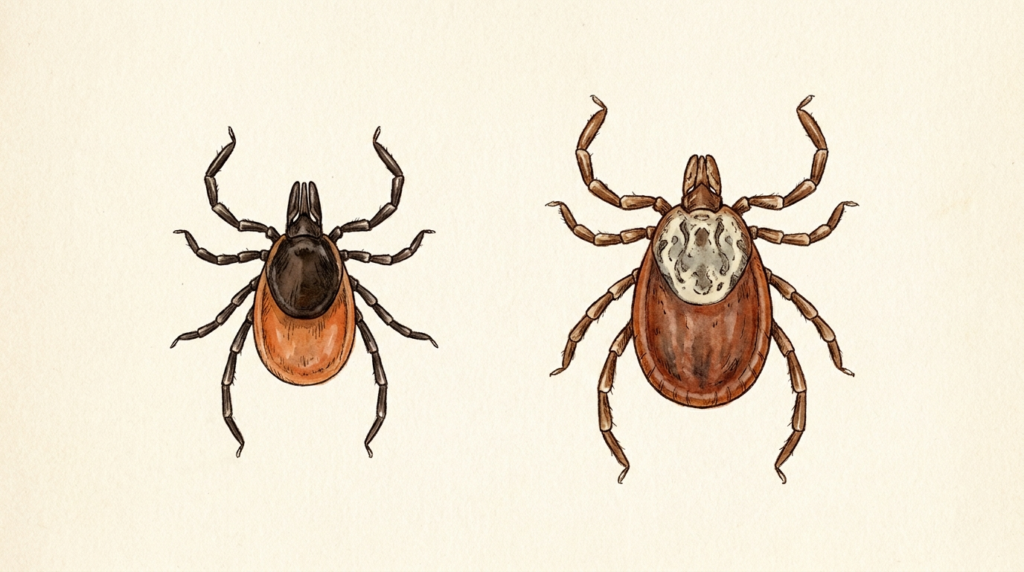
You can tell a deer tick from a dog tick by the shield right behind the head. On a deer tick it is plain, with no light spots. On an American dog tick it carries pale, whitish markings, and the dog tick is the bigger of the two. The difference matters because CDC ties Lyme disease to the deer tick, not the dog tick.
Below, we go through what each looks like from nymph to adult, which one matters for Lyme, where each waits for a host across Nassau and Suffolk, which ticks show up on dogs, why deer ticks still appear in winter, and what to watch for after a bite. When the ticks are coming from your own yard, that is where professional tick control comes in.
One step comes before telling them apart. If a tick is attached to your skin, take it off first: CDC says to remove an attached tick as soon as possible and not to wait to go to a healthcare provider for it, because delaying removal could increase your risk of a tickborne disease. Our guide to checking for and removing ticks has the steps.
Finding ticks in your Long Island yard?
Every technician is licensed by New York State, and we waive the inspection fee when you have the work done.
How Do You Tell a Deer Tick From a Dog Tick on Long Island?
Check the shield first, then the size. The shield, known as the scutum, is the hard plate just behind the mouthparts, and its markings differ between the two species.
Cornell Cooperative Extension of Suffolk County puts the deer tick rule in one line: the blacklegged tick has no light spots on its body. The pale markings belong to the dog tick. Cornell’s Tick Biology for the Homeowner leaflet, which covers the ticks commonly found on Long Island, describes the adult female American dog tick as about 1/4 inch long and chestnut brown with a silvery-gray or creamy-white shield, and puts the adult female deer tick at less than 1/8 inch.
| What to check | Deer tick (blacklegged tick, Ixodes scapularis) | American dog tick (Dermacentor variabilis) |
|---|---|---|
| Shield behind the head | No light spots on the body (Cornell Cooperative Extension of Suffolk County) | Silvery-gray or creamy-white on the adult female (Cornell leaflet) |
| Adult female length | Less than 1/8 inch (Cornell leaflet) | About 1/4 inch (Cornell leaflet) |
| Stages most likely to bite people | Nymphs and adult females (CDC) | Adult females (CDC) |
| Lyme disease | Can spread it (CDC) | Not able to transmit it (CDC) |
If the pale mark is a single white dot rather than a patterned shield, that points to a different tick altogether: the New York State Department of Health’s Ticks & Lyme Disease brochure says adult female lone star ticks have a white dot on their back and are similar in size to deer ticks. We’ll stick to the deer tick and the dog tick here.
A tick that has already fed is harder to read. In one r/longisland identification thread from August 2024, the first reply said the species could not be told from the photos, and that the tick looked very engorged. When a picture will not settle it, ask someone who identifies ticks, once the tick is off. In Suffolk, the county’s Department of Health Services identifies ticks from photos emailed to the address on its tick page, which asks for well-lit, in-focus photos of both the top and underside of the tick. Cornell Cooperative Extension of Suffolk County’s Horticulture Diagnostic Lab identifies tick specimens for a fee and reports the species, the life stage and whether the tick had been feeding. Neither one tests ticks for disease.
What Do Long Island Deer Ticks and Dog Ticks Look Like Up Close?
Size and color change with the life stage, so we’ll take them stage by stage.
The deer tick nymph. The New York State Department of Health’s brochure describes young deer ticks, called nymphs, as brown and the size of poppy seeds.
The adult deer tick. The same brochure says adult female deer ticks are red and black, males are black, and adults are about the size of a sesame seed.
A deer tick that has fed. Cornell’s leaflet notes the change in body color as a female deer tick becomes engorged, and says the tick’s body is the region that greatly expands with blood. The shield is a hard plate, so on a fed tick, judge by the shield, not by the swollen body.
The adult American dog tick. Beyond the pale shield on the female, the dog tick is the bigger tick overall: the state health department’s brochure sums up the species as reddish-brown and larger than deer ticks.
The young dog tick. The Northeast Regional Center for Excellence in Vector-Borne Diseases, a Cornell-led center, says American dog tick larvae and nymphs tend to feed on smaller mammals, while adults prefer larger ones, like dogs, horses and people. That fits CDC’s note, in the table above, that adult females are the dog ticks most likely to bite people.
Which Tick Should You Look for If You Are Worried About Lyme?
The deer tick. CDC’s page on how Lyme disease spreads says the blacklegged tick transmits Lyme disease infection in the northeastern United States, and it lists the American dog tick among the ticks that are not able to transmit Lyme disease bacteria, though the dog tick can transmit the germs behind other tickborne diseases.
How many Long Island deer ticks carry it? The New York State Department of Health tests adult deer ticks collected at publicly accessible sites from October to December. In its fall 2025 sampling, 52.8 percent of the adult deer ticks tested from Suffolk County sites and 58.6 percent of those tested from Nassau County sites tested positive for Borrelia burgdorferi, the bacterium that causes Lyme disease. The department says those figures describe particular places at one point in time, can vary greatly within a very small area, and should not be used to predict disease risk for a whole county. Read them as a sign that the risk is there, not as the odds for any one bite.
The department’s May-to-September 2025 testing found lower rates in nymphs than in adults in both counties, but lower does not mean less dangerous. Suffolk County’s Department of Health Services explains why: smaller nymphal ticks typically carry lower levels of disease than larger adult ticks, yet nymphs are responsible for spreading more disease, because they are harder to find during tick checks.
So what color tick carries Lyme? The deer tick, in either of the looks described in the previous section: the brown, poppy-seed nymph or the red-and-black adult female, which the table at the top lists as the stages most likely to bite people.
Are deer ticks worse than dog ticks? For Lyme, yes, since the dog tick cannot pass it on. The deer tick’s list is also longer: Suffolk County’s Department of Health Services lists Lyme disease, anaplasmosis, babesiosis, Borrelia miyamotoi disease and Powassan virus disease for the blacklegged tick, against Rocky Mountain spotted fever and tularemia for the American dog tick, and it calls Powassan virus very rare, detected only at extremely low levels in Suffolk County ticks. But a dog tick bite is not a free pass. The New York State Department of Health calls Rocky Mountain spotted fever rare, and its fact sheet on the disease says it can be fatal in the first 8 days of symptoms if not treated correctly, even in previously healthy people.
Where Do Deer Ticks and Dog Ticks Wait for a Host Across Long Island?
Neither one drops out of a tree or leaps at you. Suffolk County’s Department of Health Services says ticks do not jump, fly or fall from trees, and CDC’s overview of ticks describes how many tick species wait instead: resting on the tips of grasses and shrubs at spots they pick by identifying well-used paths, front legs stretched out in a posture called questing, until a host brushes past and they climb aboard. That is why trail edges deserve a second look.
Deer ticks stay low and shaded. The New York State Department of Health’s page on Lyme disease and other diseases carried by ticks says blacklegged ticks live in shady, moist areas at ground level, clinging to tall grass, brush and shrubs usually no more than 18 to 24 inches off the ground, and that they also live in lawns and gardens, especially at the edges of woods and around old stone walls. On Long Island that describes a lot of familiar ground: wooded preserves, leafy trail margins and backyards that back onto trees.
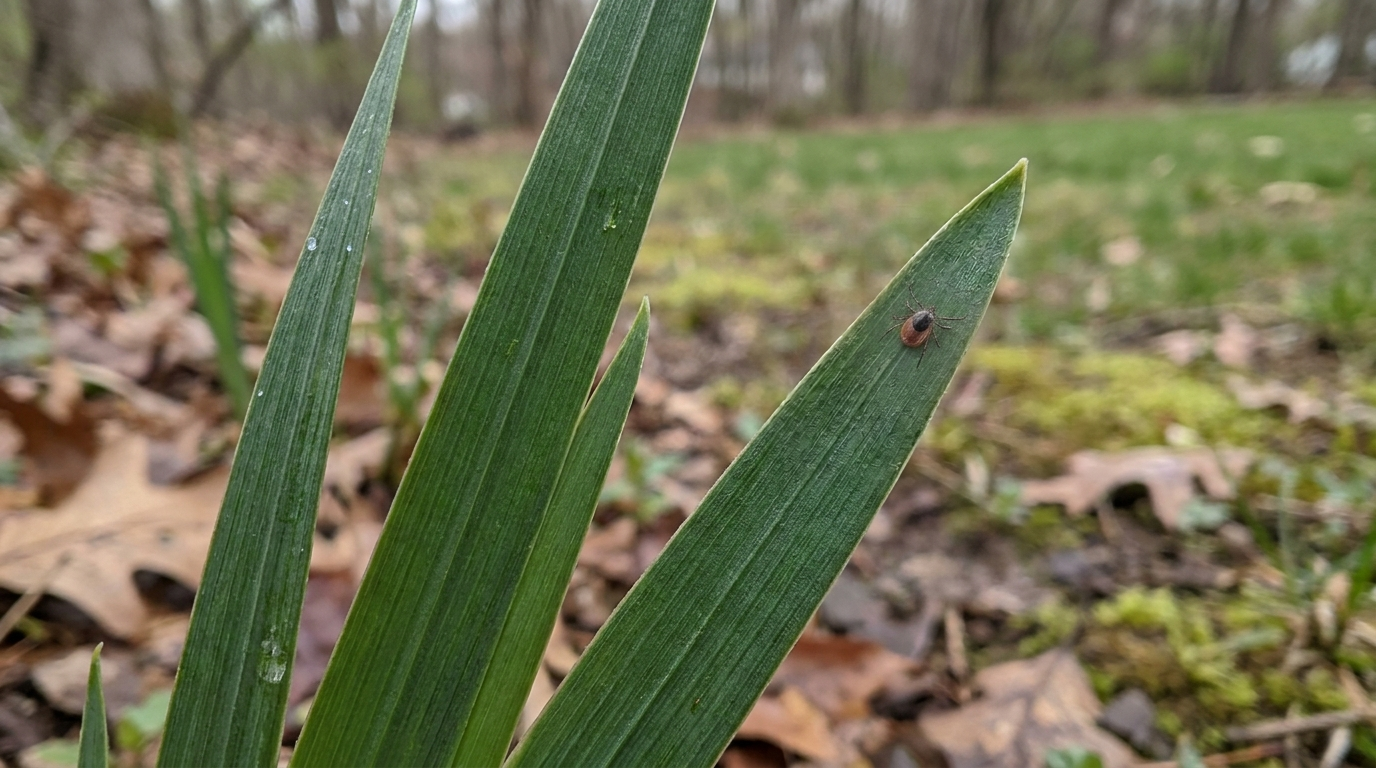
Dog ticks like it open and grassy. The Cornell-led Northeast center says American dog ticks prefer grassy areas with tall foliage, and that large numbers may be found in fields, pastures, fresh and saltwater marshes and meadows. Think of the tall grass at the edge of a South Shore salt marsh, an unmowed meadow beside a bike path, or the high grass behind a ball field.
If the waiting spots are in your own yard, the next question is treatment, and our breakdown of what Long Island tick yard treatment costs covers what that work involves.
Ticks on your dog in Nassau or Suffolk?
We have family and pet-friendly options.
Which Tick Are Long Island Dog Owners More Likely to Find?
Either one can end up on a dog, and the tick’s name only gets you halfway there.
The American dog tick on dogs. Cornell’s leaflet says adult dog ticks occasionally bite people but are more common on dogs and other medium-sized animals, and CDC puts the highest risk of people being bitten by an American dog tick in spring and summer.
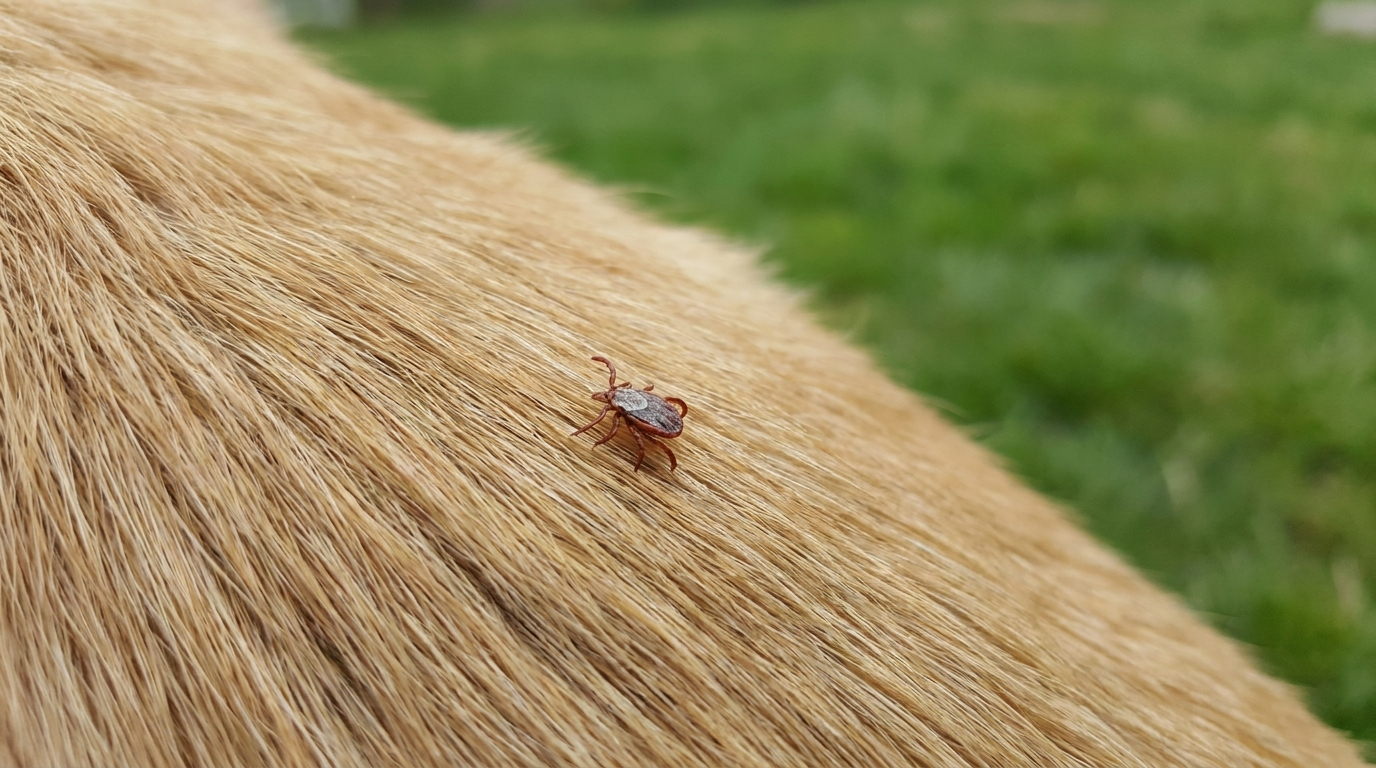
The deer tick on dogs. The Cornell-led Northeast center’s blacklegged tick page lists dogs, along with white-tailed deer and people, among the medium and large mammals adult deer ticks feed on.
The seasons do not sort them either. The New York State Department of Health’s brochure says deer and dog ticks are most active during the spring, early summer and fall, and the next section covers the winter months. Either way, the shield, not the month, tells you which one you have.
The question can start on the dog. In a May 2025 r/longisland thread, a newcomer to the Island found a tick on their own hip after a walk through high grass out east with a young dog, and guessed it had come off the dog. That is the moment one question becomes two: which tick is it, and what does a tick from the dog mean for you? The shield in the first section answers the first.
CDC answers the second. Dogs and cats can get Lyme disease, but CDC’s Lyme page says there is no evidence that they spread the infection directly to their owners; pets can, though, bring infected ticks into your home or yard, and CDC’s page on preventing ticks on pets adds that ticks carried inside may then bite people. A tick on the dog is a reason to check yourself and the kids, not a diagnosis.
For the dog itself, the same pet page notes that, except for Lyme disease in dogs, pets cannot be vaccinated against tickborne diseases, and it sends owners to their veterinarian to talk about tick prevention products and the tickborne diseases in their area.
Can You Still Find Deer Ticks on Long Island in Winter?
Yes, adult deer ticks. CDC’s guide to where ticks live says the greatest risk of a blacklegged tick bite is in spring, summer and fall, but that adults may be out searching for a host any time winter temperatures are above freezing. The Cornell-led Northeast center describes the same cycle for the region: adult blacklegged ticks appear in the fall and can stay active from winter into spring when temperatures are above freezing and the snow has melted. The New York State Department of Health collects adult deer ticks from October to December, the months its dataset describes as when adult deer ticks are most commonly seen.
Dog ticks are a different story. The same Northeast center says adult American dog ticks survive cold periods by overwintering, lying dormant in the soil until temperatures warm. Even so, a tick found after a mild January walk, or on the dog after a thaw, gets the same shield check from the first section.
One Long Island dog owner hit the winter version of the question. In an r/longisland thread posted March 1, 2026, a Center Moriches owner found a tick on the dog’s neck with the yard still under snow and asked where it could have come from.
Suffolk County’s Department of Health Services tells residents that precautions against tick bites should be taken throughout the year. In practice, the tick check after a December leaf cleanup or a thaw-day walk in a Long Island preserve is still worth doing.
What Should Long Island Families Look for After a Deer Tick or Dog Tick Bite?
Removal comes first, and our guide to checking for and removing ticks covers it. After that, the job is watching, for you and for any child who was out there.
Right after the bite. CDC’s page on Lyme disease symptoms says a small bump or redness at the site of a tick bite that appears right away and looks like a mosquito bite is common, generally goes away in 1 to 2 days, and is not a sign of Lyme disease.
After a Deer Tick Bite
Lyme disease is the main thing to watch for. CDC lists early signs that can show up 3 to 30 days after the bite: fever, chills, headache, fatigue, muscle and joint aches, and swollen lymph nodes, which can happen without any rash. When the rash does come, CDC says it begins at the site of the bite after a delay of 3 to 30 days (about 7 days on average), expands gradually over several days, and does not always look like a classic bull’s-eye. Don’t wait for a target shape before you call.
The same tick can carry anaplasmosis and babesiosis, and CDC’s tick overview notes that all tickborne diseases can cause fever, with headache, fatigue and muscle aches common among them. A fever with aches in the weeks after a deer tick bite deserves the same call.
After a Dog Tick Bite
The New York State Department of Health’s fact sheet says Rocky Mountain spotted fever often begins with a sudden moderate to high fever, headache, abdominal pain, vomiting and muscle pain, usually 2 to 14 days after the bite, and that a rash may develop but is often absent in the first few days and in some patients never develops. A missing rash is no reassurance.
Tularemia is the dog tick’s other disease. CDC’s page on tularemia symptoms says its most common form usually follows a tick or deer fly bite, or handling an infected animal, and brings a skin ulcer where the bacteria entered plus swollen lymph glands, usually in the armpit or groin, with fever in every form.
When to Call the Doctor
CDC’s page on what to do after a tick bite says that if you develop a rash or fever within several weeks of removing a tick, see your doctor, and tell the doctor about the recent tick bite, when it occurred and where you most likely picked up the tick. For a child, that call goes to the pediatrician.
Testing the tick for disease is a different matter. The same CDC page says it is generally not recommended, because a positive result does not necessarily mean you were infected, a negative result can lead to false assurance, and results should not be used for treatment decisions.
In Summary
- Check the shield first: no light spots on a deer tick; a silvery-gray or creamy-white shield on an adult female dog tick.
- The deer tick is the smaller of the two, and a fed tick is easier to judge by its shield than by its swollen body.
- For Lyme, look for the deer tick, which can spread it; the American dog tick is not able to transmit Lyme disease bacteria, though it can transmit other tickborne diseases.
- Deer ticks wait low in shady, moist spots on grass, brush and shrubs; dog ticks favor tall grass in fields, meadows and marshes.
- Either tick can end up on a dog, so go by the shield, not the month; CDC says adult deer ticks may be out any time winter temperatures are above freezing.
- After any bite, see your doctor, or your child’s pediatrician, for a rash or fever in the weeks that follow, and say when the bite happened and where you most likely picked up the tick.
Telling the two apart is the homeowner’s half of the job. If the ticks keep coming from your own yard, start with our page for pest control in Nassau County or for Suffolk County pest control, depending on which side of the county line you live on.