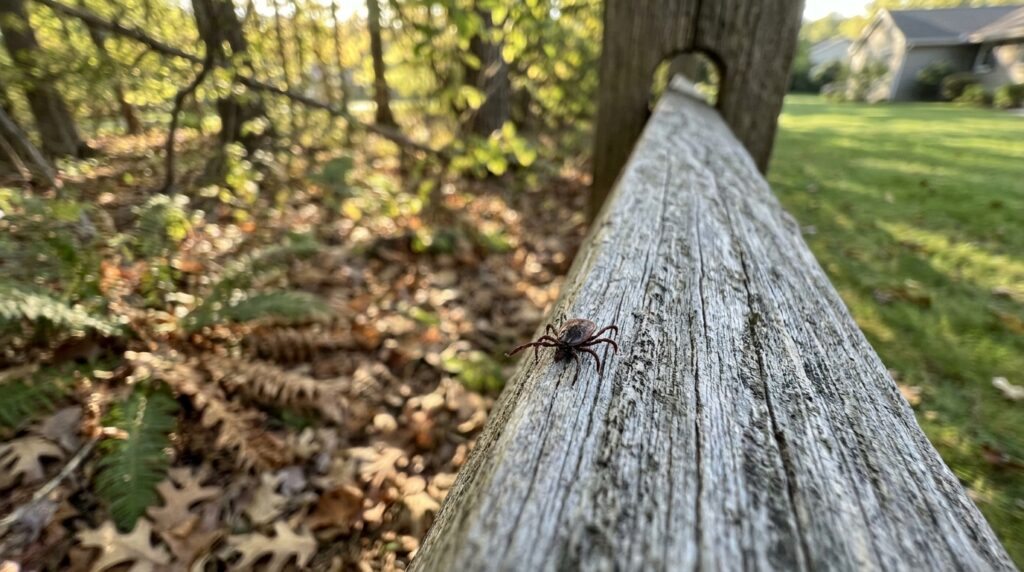
If you live on Long Island and you’ve found a tick crawling up your leg after gardening in your Suffolk yard, pulled an embedded tick off your dog after a Nassau North Shore walk, or watched your kid come back from school sports practice with two ticks attached, you already know what every Long Island homeowner figures out eventually: tick pressure on Long Island is structurally worse than the rest of the NYC metro area. The combination of wooded property edges, deer migration corridors, and high lyme disease incidence makes Long Island tick yard control essential, not optional. After 26 years quoting tick control jobs across Nassau and Suffolk, our team has learned that the gap between a $200 single-visit spray and a $1,200 full-season program comes down to property size, target species, and product selection.
This guide breaks down what Long Island tick control actually costs in 2026 by property size (Nassau quarter-acre lot vs Suffolk wooded acre+), treatment method (synthetic permethrin spray vs eco-friendly cedar oil), and treatment frequency (single visit vs full seasonal program). We’ll walk through what should be on a real itemized quote, why Suffolk tick pressure runs higher than Nassau, who pays in rental and HOA situations, and the red flags. If you’d rather skip the research and book professional Long Island tick control for a free yard inspection, our front-office team can usually book a same-day inspection. Read on for the real Long Island numbers.
Ticks taking over your Long Island yard?
26+ years treating Long Island ticks. Yard perimeter spray, deer-edge treatment, and the seasonal program that actually keeps ticks off your kids and pets, no annual contracts, and a free inspection that's waived when you book.
What Does Long Island Tick Control Cost on Average in 2026?
For most Long Island tick yard treatment jobs we quote in 2026, real pricing breaks down by property size and frequency: $150 to $250 for a single-visit yard treatment on a typical Nassau quarter-acre suburban lot, $250 to $500 for a single visit on a Suffolk half-acre to acre property with wooded edges, $400 to $700 for full-season programs (4 to 5 visits across April through October) on Nassau quarter-acre, $650 to $1,200 for full-season programs on Suffolk wooded properties, and $1,000 to $2,500+ for large estate or commercial properties with extensive deer-pressure perimeters. A standalone tick yard inspection runs $100 to $200 — usually waived when you book treatment.
Long Island tick pricing runs above national tick-control averages because of two structural factors: deer pressure and target species mix. Nassau North Shore and most of Suffolk have heavy deer populations that maintain Ixodes scapularis (deer tick / blacklegged tick) populations at concerning density. Treatment that targets only American dog ticks misses the lyme-carrying species. Our pricing reflects targeted multi-species treatment.
Here’s how Long Island tick yard control quotes typically shake out by scope:
| Scope | Typical Long Island cost | Notes |
|---|---|---|
| Nassau quarter-acre suburban lot, single visit | $150 to $250 | Perimeter spray + targeted bushes/woodpiles |
| Nassau half-acre with wooded edge, single visit | $200 to $350 | Perimeter spray + deer-edge treatment |
| Suffolk half-acre to acre, single visit | $250 to $500 | Property perimeter + leaf-litter zones |
| Nassau quarter-acre, full-season program (4 visits) | $400 to $700 | April, June, August, October timing |
| Nassau half-acre, full-season program (5 visits) | $500 to $900 | 5-visit cadence for heavier pressure |
| Suffolk acre+, full-season program (5 visits) | $650 to $1,200 | 5-visit cadence with heavy deer-edge work |
| Large estate (3+ acres) | $1,500 to $5,000+/season | Custom perimeter mapping, often combined mosquito + tick |
| Commercial property (HOA, condo grounds) | $2,500 to $10,000+/season | Common-area + perimeter, multi-zone |
| Eco-friendly cedar-oil program | +30% to +60% premium | Per-visit pricing higher, environmental tradeoff |
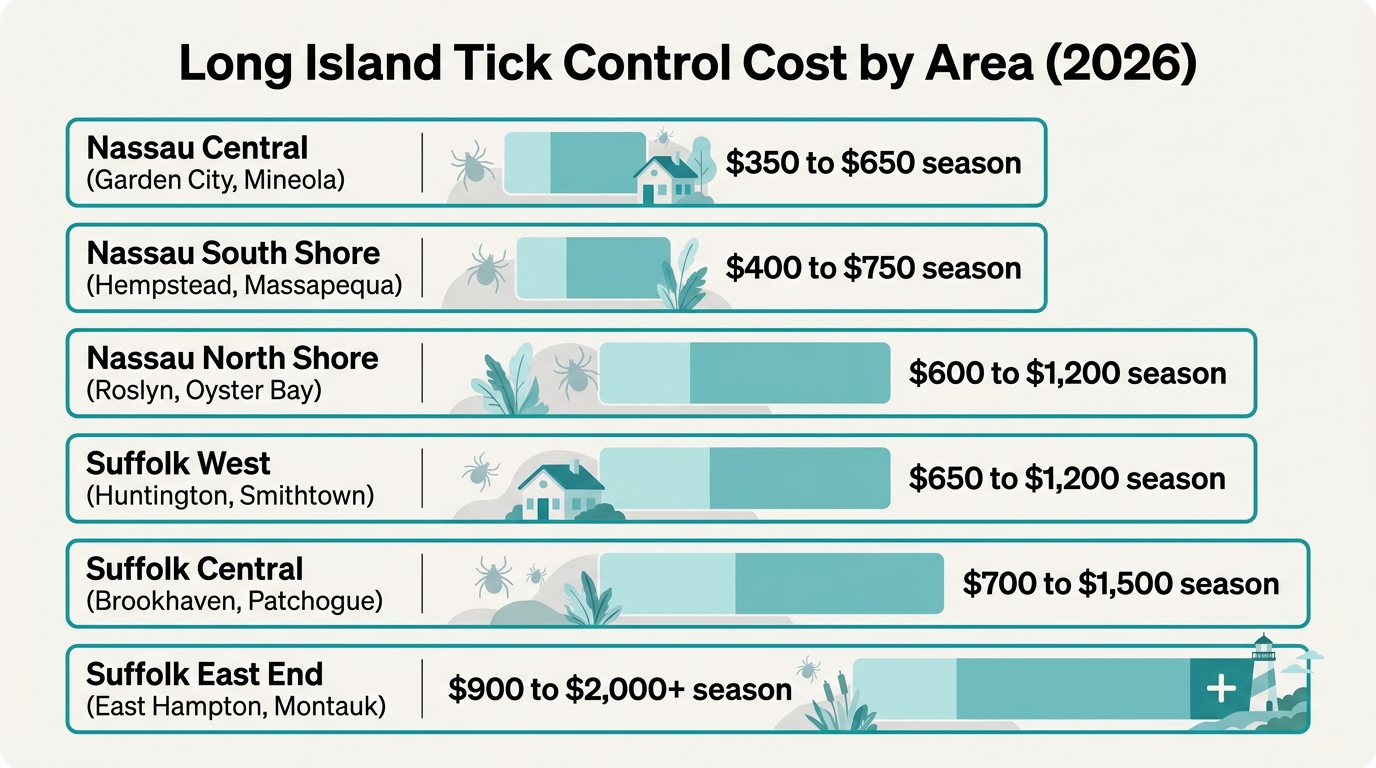
Per the cost ranges other LI operators publish, our pricing falls roughly in the middle of the market. We don’t undercut with single-spray quotes that won’t actually reduce season-long tick pressure, and we don’t add premiums on Nassau properties for being in affluent towns.
Why Does Long Island Tick Treatment Cost More Than Mosquito Treatment?
Tick yard control runs 30 to 50% above mosquito-only treatment on Long Island for three reasons:
Target zones are different. Mosquito treatment focuses on standing-water harborages and adult resting sites (foliage understory). Tick treatment targets ground-level leaf litter, woodpile bases, lawn-to-woods edges, and deer travel corridors. Treating both requires different equipment and different product application patterns.
Product selection differs. Mosquito control uses pyrethroid residual sprays (bifenthrin, lambda-cyhalothrin) applied to foliage. Tick control uses similar actives but applied at ground level, often combined with cedar oil for deer-edge work, and sometimes with deer-feeder permethrin treatment for properties with heavy deer pressure.
Visit cadence is more critical. Tick season runs April through October on Long Island, with two distinct peak windows (nymphal Ixodes in May-June, adult Ixodes in October-November). A single tick treatment in May won’t cover the fall adult activity. Full-season programs at 4 to 5 visits are the only durable solution.
For broader context on Long Island stinging-insect and tick season, our guide to ticks in NYC and Long Island with lyme disease context walks through species ID and prevention.
What’s Included in a Real Long Island Tick Yard Treatment Quote?
A real Long Island tick treatment quote should itemize at least six things:
- Property inspection and mapping. A licensed technician walks the property, identifies tick-zone hot spots (leaf-litter accumulations, woodpiles, deer trails, lawn-to-wood edges, stone wall bases). The inspection produces a treatment map.
- Perimeter spray scope. Itemize the linear footage of property perimeter being treated. Standard Nassau quarter-acre property has 200 to 400 feet of perimeter; Suffolk acre has 600 to 1,000+ feet.
- Product selection. Pyrethroid residual (bifenthrin, lambda-cyhalothrin, permethrin) is the standard. Eco-friendly alternatives include cedar oil and essential-oil-based products at a premium. The quote should specify which products.
- Deer-edge treatment. For properties with wooded edges and confirmed deer pressure, deer-edge treatment uses targeted ground-level application along the woods boundary. This adds 20 to 40% to base pricing but is essential for Suffolk and Nassau North Shore.
- Treatment frequency and timing. Single visit, 4-visit program (April, June, August, October), or 5-visit program (adds late-May nymphal peak). Long Island tick pressure justifies 4 to 5 visits per season for most properties.
- Re-treatment guarantee. Standard Long Island tick treatment includes 30-day spot retreatment if visible tick activity returns within the window. Full-season programs have continuous guarantee through October.
If your tick control work is part of a broader mosquito + tick combination, expect a 10 to 20% bundle discount since the visits and equipment overlap. Most LI homeowners book tick + mosquito control on Long Island as a combined program.
How Do Nassau vs Suffolk Tick Pressure Levels Affect Treatment Cost?
Suffolk County consistently has higher tick pressure than Nassau, primarily because Suffolk has more wooded property edges and larger deer populations per acre. Treatment cost reflects the pressure difference:
| County / area | Typical tick species mix | Treatment intensity | Typical season cost |
|---|---|---|---|
| Nassau North Shore (Roslyn, Sands Point, Oyster Bay) | Heavy Ixodes scapularis + American dog tick | 5-visit program with deer-edge work | $600 to $1,200 |
| Nassau South Shore (Long Beach, Hempstead, Massapequa) | Moderate Ixodes + American dog tick | 4-visit standard program | $400 to $750 |
| Nassau Central (Garden City, Mineola, Westbury) | Lower Ixodes density, mostly American dog tick | 3 to 4 visit standard program | $350 to $650 |
| Suffolk West (Huntington, Smithtown, Commack) | Heavy Ixodes + lone star tick | 5-visit program with extensive deer-edge work | $650 to $1,200 |
| Suffolk Central (Brookhaven, Patchogue, Bellport) | Very heavy Ixodes + lone star + American dog | 5-visit program, often combined mosquito | $700 to $1,500 |
| Suffolk East End (East Hampton, Southampton, Montauk) | Extreme Ixodes + lone star pressure | 5-visit program, deer-feeder permethrin recommended | $900 to $2,000+ |
The single biggest cost differentiator between Nassau and Suffolk is the lone star tick (Amblyomma americanum). Lone star ticks are common in Suffolk, rare west of Nassau North Shore. They require different timing (active May through October instead of just spring/fall) and sometimes different products. Suffolk programs that don’t address lone star ticks miss a significant fraction of the season-long bite risk.
Ticks taking over your Long Island yard?
26+ years treating Long Island ticks. Yard perimeter spray, deer-edge treatment, and the seasonal program that actually keeps ticks off your kids and pets, no annual contracts, and a free inspection that's waived when you book.
What Are Eco-Friendly vs Synthetic Tick Treatment Costs on Long Island?
Per Reddit threads we’ve reviewed and direct customer feedback, Long Island parents and homeowners with pets increasingly request eco-friendly tick treatment options. Here’s the honest cost vs efficacy breakdown:
- Synthetic pyrethroid (bifenthrin, lambda-cyhalothrin). Standard professional treatment. 30-day residual. Highly effective at reducing 80 to 90% of tick population for the window. Cost: standard pricing per the table above. Drawback: not pollinator-safe during peak bloom, requires application timing around bee activity.
- Permethrin (synthetic but lower toxicity profile). Used by CDC for clothing impregnation. Effective on ticks at residual concentrations. Standard professional treatment. Cost: standard pricing. Drawback: similar pollinator timing concerns.
- Cedar oil-based products (Cedarcide, others). Eco-friendly, plant-based, no pollinator timing concerns. 7 to 14 day residual (much shorter than synthetic). Effective at reducing tick activity but requires more frequent application. Cost: 30 to 60% premium over synthetic per visit, but often 8 to 10 visits per season instead of 4 to 5.
- Essential oil blends (rosemary, peppermint, geraniol). Plant-based alternatives. Short residual (5 to 10 days). Less consistent efficacy than cedar oil. Cost: similar premium to cedar oil. Best for properties with confirmed pollinator activity and homeowners committed to frequent application.
- Combination programs. Synthetic pyrethroid for perimeter + cedar oil for high-pollinator zones (gardens, flower beds). Best of both. Cost: 15 to 30% premium over synthetic-only.
Per CDC tick prevention guidance, the most effective tick control combines yard treatment with personal protection (permethrin-treated clothing, DEET on skin, tick checks). No single approach reduces tick exposure to zero — yard treatment reduces ambient pressure, personal protection prevents the remaining bites.
How Does Long Island Yard Size Change Tick Treatment Cost?
Yard size is the second biggest cost variable after location/pressure. Here’s the breakdown:
- Quarter-acre Nassau suburban (10,000 sq ft). $150 to $250 per visit. 30 to 45 minutes on site. Single perimeter application + targeted hot spots.
- Half-acre Nassau or Suffolk (20,000 sq ft). $200 to $400 per visit. 45 to 75 minutes on site. Extended perimeter + deer-edge if applicable.
- 3/4-acre to acre Suffolk (35,000 to 45,000 sq ft). $300 to $600 per visit. 75 to 120 minutes on site. Multi-zone perimeter + multiple deer-edge applications.
- 1 to 2 acre estate Suffolk (45,000 to 87,000 sq ft). $500 to $900 per visit. 2 to 3 hours on site. Custom zone mapping required.
- 2+ acre estate or commercial. $700 to $2,000+ per visit. Custom programs based on detailed property mapping.
Most Long Island homeowners benefit from full-season programs (4 to 5 visits) at 20 to 30% per-visit discount compared to single-visit pricing. Single-visit treatment provides only 30 days of protection in peak season; full-season programs provide continuous April-through-October coverage.
Should Long Island Tick Control Be Single-Visit or Seasonal?
Honest answer: single-visit treatment provides 30 days of reduced tick activity. After 30 days, the residual breaks down, new tick activity establishes, and the property is back to baseline pressure. Seasonal programs are the only durable Long Island tick control. Here’s the math:
| Plan type | Typical LI pricing | Best for | Honest tradeoff |
|---|---|---|---|
| Single visit (one-time) | $150 to $500 | Specific event (outdoor party), summer rental period, exposure-event response | 30-day window; re-treatment needed before next season |
| 3-visit program (May/July/September) | $400 to $900 | Lighter Nassau properties, budget-constrained households | Covers main season but misses spring nymphal peak |
| 4-visit program (April/June/August/October) | $500 to $1,100 | Standard Nassau program, most Long Island households | Covers spring through fall; balanced cost |
| 5-visit program (April/late-May/July/September/October) | $650 to $1,400 | Suffolk properties, high-pressure Nassau North Shore | Covers all nymphal + adult Ixodes peaks + lone star |
| Combined tick + mosquito program | $650 to $1,500 | Households who want both pests addressed | 10 to 20% bundle discount |
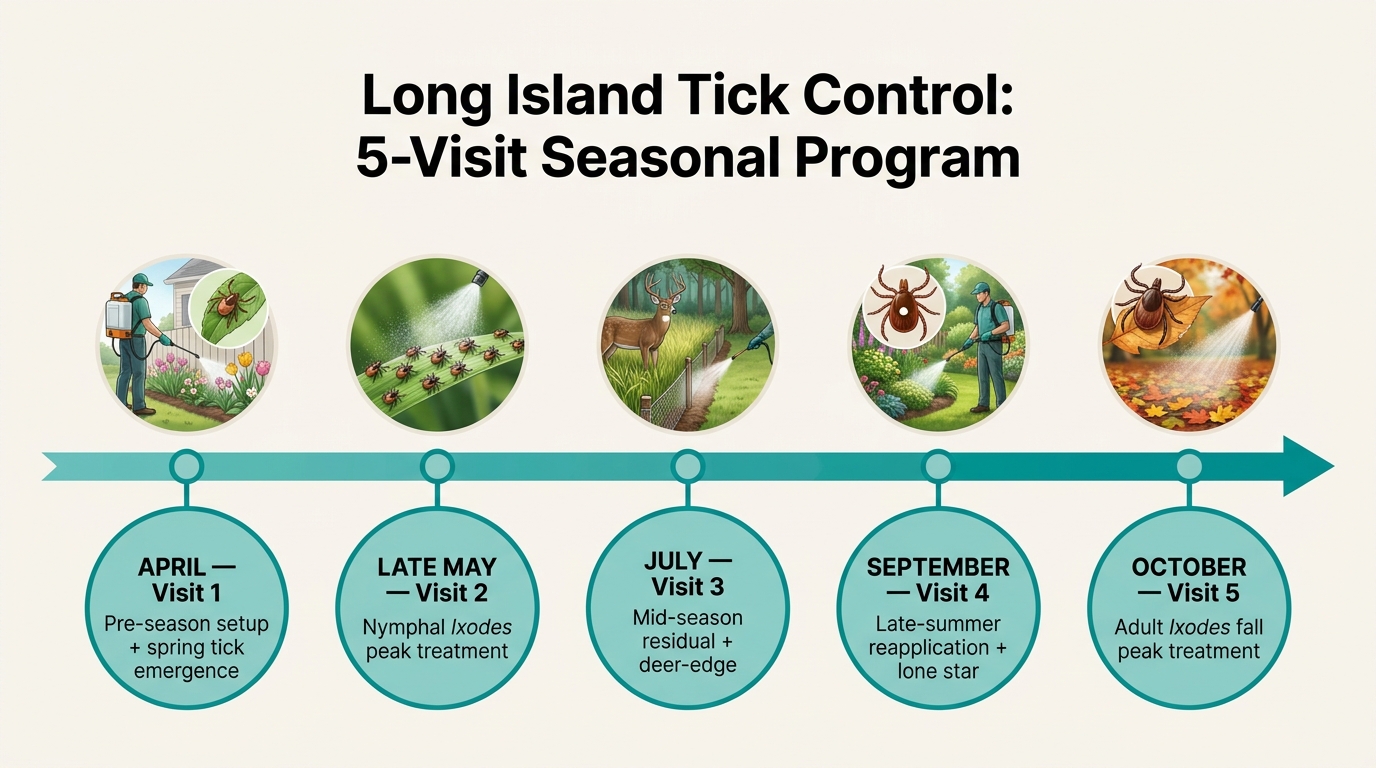
For most Long Island households with kids or pets, our recommendation is the 4 or 5-visit tick program matched to property pressure. Spending $700 per year on yard treatment is dramatically cheaper than treating one case of Lyme disease ($3,000 to $15,000 in medical bills depending on detection timing).
Who Pays for Long Island Tick Treatment — Homeowner, Landlord, or HOA?
Tick treatment cost responsibility on Long Island depends on property type:
- Owner-occupied single-family. Cost is yours. The health-risk reduction justifies the cost for households with kids, pets, or outdoor activity.
- Rented single-family. Depends on the lease. Most LI leases assign tenant responsibility for yard maintenance including pest treatment unless the landlord explicitly retains it. Negotiate this during lease signing.
- Co-op, condo, or townhome HOA. Common-area tick treatment (lawn, woods edge, paths) is the HOA’s responsibility funded by HOA dues. In-unit yards or fenced patio areas are the unit owner’s. Bylaws vary.
- Commercial property (apartment complex, office park). Property owner responsibility for grounds maintenance including tick control.
- Estate or large property with tenant. Per lease terms. Most large-property leases include yard maintenance.
For Suffolk County residents specifically, Suffolk County Department of Health Services maintains a Tick Bite Prevention Program with educational resources and limited free tick identification. Per Suffolk County DHS, residents can submit tick samples for identification (helpful for medical decisions if a bite occurred). The county doesn’t fund private treatment but provides public-property treatment in parks and county-managed areas.
The Bottom Line: Long Island Tick Control Cost in 2026
If you live on Long Island and want to reduce tick exposure for your household: (1) get a property inspection to identify the tick zones (woods edges, leaf litter, woodpiles, deer travel paths); (2) for Nassau quarter-acre properties, expect $400 to $700 for a 4-visit standard season; (3) for Suffolk wooded properties, expect $650 to $1,200 for a 5-visit program with deer-edge work; (4) for eco-friendly programs, budget 30 to 60% premium; (5) combine with personal protection (permethrin-treated clothing, DEET on skin, tick checks) — yard treatment alone doesn’t reduce bite risk to zero.
For most Long Island homeowners, realistic 2026 tick yard control pricing breaks down: $150 to $500 for a single-visit treatment, $400 to $700 for a Nassau quarter-acre 4-visit program, $650 to $1,200 for a Suffolk acre 5-visit program, and $900 to $2,000+ for East End estate properties. Combined tick + mosquito programs at 10 to 20% bundle discount are popular for households who want both addressed. For Long Island seasonal mosquito patterns, our comprehensive Long Island mosquito season guide covers the parallel mosquito treatment cadence.
We’ve been treating Long Island tick yards since 1999, and the most common mistake we see is single-visit treatment in May followed by no follow-up — which leaves the fall adult Ixodes peak completely unaddressed. The second most common mistake is treating only the lawn without the woods edge, which misses the deer-tick reservoir. If you’d rather skip the experiment and have it handled by a team that’s treated thousands of Nassau and Suffolk properties, our front-office team offers free same-day inspections across both counties. Lisa or one of our front-office team can usually book a same-day visit, and the quote you get will itemize property mapping, treatment zones, product selection, visit schedule, and guarantee window.