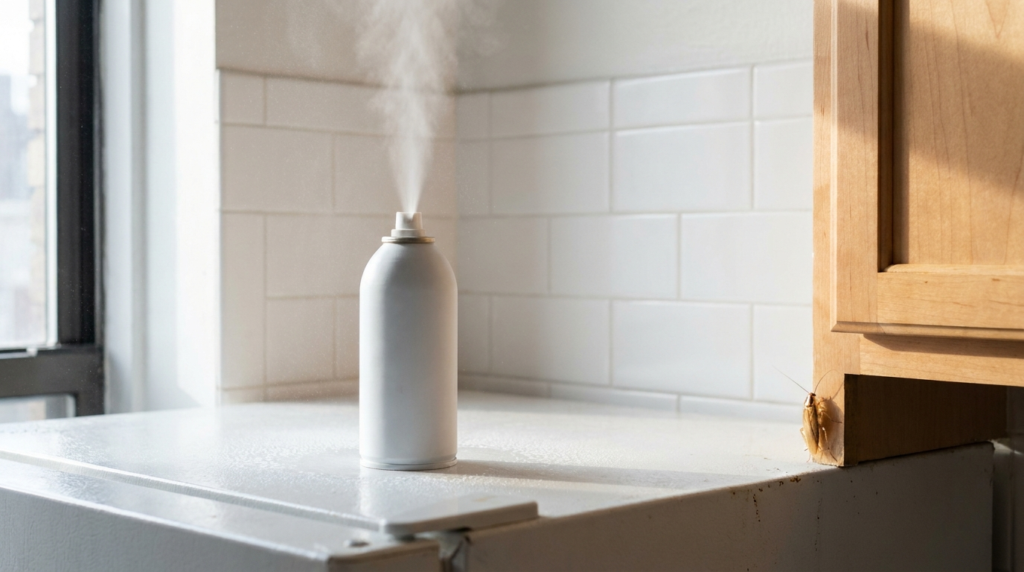
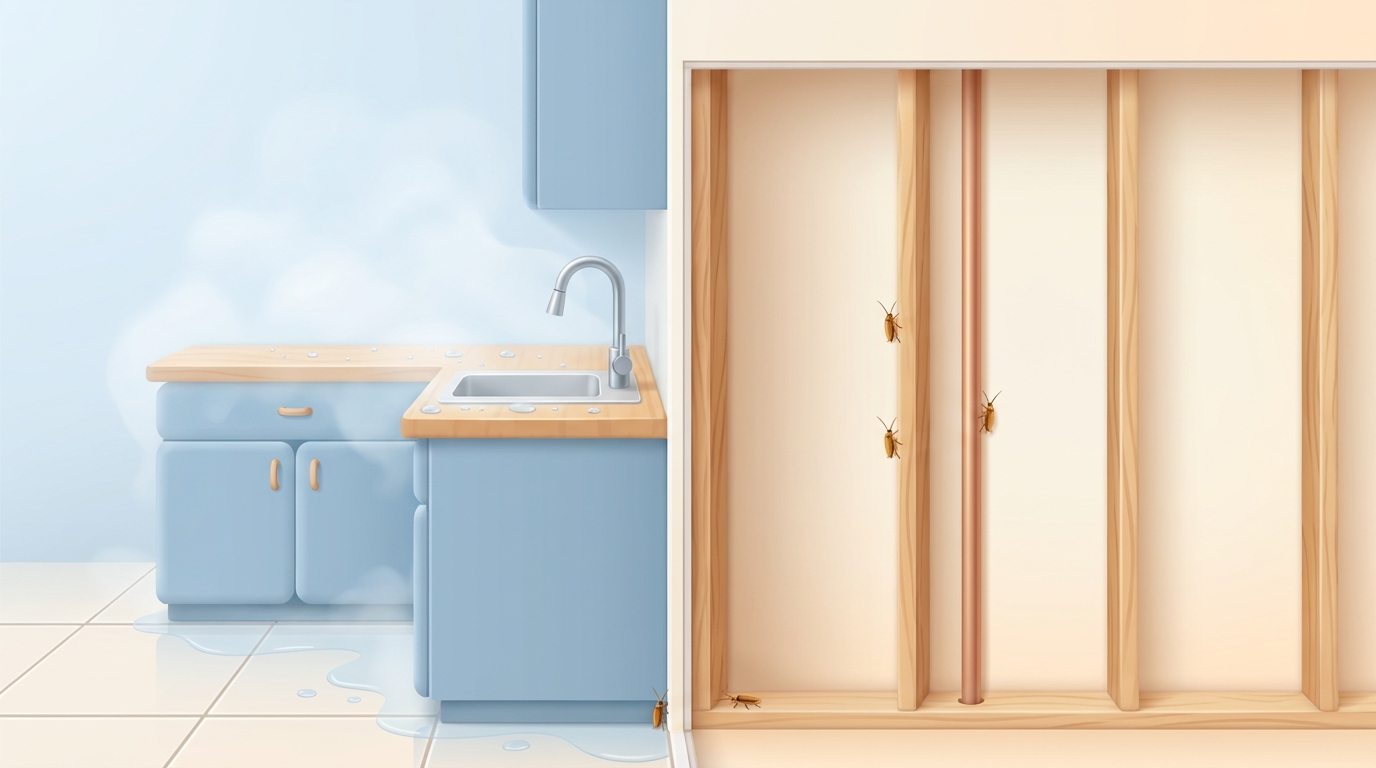
No. A roach bomb won’t clear German cockroaches out of an NYC apartment, and it can push them deeper into your walls. Its fog settles on the open surfaces of your kitchen, while the roaches hide in cracks and wall voids it barely reaches.
So you’re left with pesticide where you cook and eat, and live roaches still behind the walls. Gel bait placed in those cracks works better. If the roaches keep coming back anyway, that’s the point to bring in professional cockroach control.
Roaches back after a bomb in your NYC apartment?
Every technician is licensed by New York State. We waive the inspection fee when you have the work done.
Why Do Roach Bombs Fail to Clear Roaches From NYC Apartments?
Because the fog and the roaches end up in different places. A fogger releases its whole can up into the air, and the droplets settle onto floors, counters and tabletops. Very little of it gets into the cracks and voids where roaches spend most of their time.
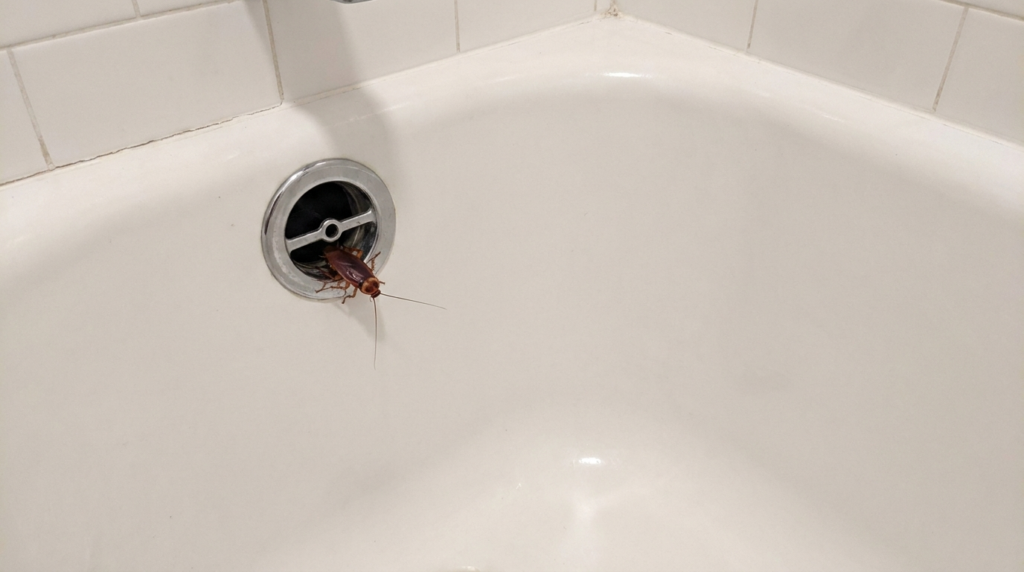
German cockroaches live indoors and generally stay hidden by day, in cracks under sinks, behind fridges and stoves, and inside cabinets. So the pesticide coats open surfaces that roaches tend to avoid, while they sit it out in the walls. Not sure which roach you have? Our guide on how to tell German and American cockroaches apart can help.
Tested in real homes, bombs didn’t make a dent. A North Carolina State University study tested store-bought foggers in 20 apartments across five apartment complexes in Raleigh, North Carolina. All had German cockroach infestations, and the researchers followed the labels and the U.S. Environmental Protection Agency’s prep steps exactly. Two weeks and one month later, the study’s roach traps showed no decline. In the study’s 10 gel-bait apartments, roach numbers showed significant declines at two and four weeks.
Even when the fog does reach them, it may not kill them. The researchers caged roaches from those apartments where the fog would land. No fogger in the study killed more than 38 percent of them, while lab-raised roaches died at high rates.
Here in New York City, the official advice is to skip bombs entirely. “Do not use foggers, bombs or loose rodent bait,” the NYC Health Department’s pest control guide for tenants and owners says. “They spread everywhere and land on surfaces where people sit, prepare food, play or eat.” Pests can also grow resistant until the poison stops killing them, the guide warns.
Can a Roach Bomb Drive Cockroaches Into a Neighbor’s NYC Apartment?
It can. Fogger ingredients tend to repel roaches, so they scatter deeper into wall voids, according to a University of Kentucky entomology fact sheet. German roaches also often travel between adjoining apartments through walls, ceilings, pipes and wires, the same fact sheet notes. That’s why even a clean apartment can end up with them. So a bomb in your kitchen can send some roaches into the shared walls, and from there into the apartment next door.
Shared walls are the norm here. In the city’s 2023 Housing and Vacancy Survey, 73 percent of housing units were in buildings with three or more units. Say your kitchen shares a wall with the apartment next door. Roaches that retreat into that wall can come out on either side of it.
A bomb next door can push roaches toward you, too. And if the roaches are coming from next door, a can set off in your kitchen doesn’t touch the source. That makes it a building problem, not a one-apartment problem. Our guide on how DIY treatment in one unit affects a whole building goes deeper.
Is It Dangerous to Set Off a Roach Bomb in an NYC Apartment With a Gas Stove?
It can be. The propellant in these foggers is typically flammable, and the U.S. Environmental Protection Agency warns that improper use may cause a fire or explosion. Accidents are most likely when lots of fog reaches a flame, a pilot light or a spark from a fridge or AC cycling on. If your gas stove has a pilot light, that small flame is exactly the kind of ignition source EPA means.
EPA recommends placing a fogger at least six feet from every ignition source and using no more than one per room. If you need help putting out a pilot light, it says to call your gas utility or management company. It also warns that a fogger set off in a closet, a cabinet or under a counter may explode. If you use one anyway, read the label and follow every precaution on EPA’s fogger safety page. Those include getting children, pets, toys and uncovered food out of the treated area.
Doubling up doesn’t help either. Using more foggers than the directions call for won’t kill pests any faster, according to New York State’s Department of Health.
In July 2013, fog from bug bombs ignited in a Chinatown apartment, according to the FDNY. It named the oven’s pilot light or another kitchen appliance as the likely spark. The department said 21 spent canisters were recovered and the blast injured 14, partly collapsing some first-floor ceilings and walls.
The fog also leaves pesticide on the surfaces you use most. Four to six hours after the bomb, the Raleigh study found pesticide on horizontal kitchen surfaces on average 603 times higher than pre-bomb levels. One month later, about a third of the study’s horizontal-surface measurements were still significantly above pre-bomb levels.
What Should You Do After Setting Off a Roach Bomb in Your NYC Kitchen?
Stay out, air it out, then clean what food and children touch. Start with the directions on your fogger’s label. The National Pesticide Information Center says foggers may pose more risk to children and people with asthma, so don’t cut corners on these steps:
- Leave right away, close the doors, and stay out for the full time on the label, or longer. EPA says that’s usually two to four hours, and going back in early may make you sick. Keep pets out too.
- Air it out when you return. Open the doors and windows. Fans set in the doors and windows can help clear the fumes.
- Dress for the cleanup. Wear protective clothing, and consider gloves, long sleeves, long pants and shoes with socks.
- Wipe down where food and kids go. Cleaning after a fogger can help reduce exposure, especially on surfaces that food or children might touch.
- Cover up before you set a young child down. Lay a sheet or blanket over recently treated furniture or surfaces first.
- Put leftover cans away. Store unused foggers in their original packaging, out of reach of children and pets.
- If anyone was exposed, move to fresh air and call a doctor or the Poison Control Center. Keep the center’s number handy.
The two most common causes of fogger illness in a CDC report were staying inside during the release and going back in too early. That CDC report covered 10 states, New York among them, from 2007 to 2015.
Short-term pesticide exposure can cause eye, throat and nose irritation, headaches, dizziness and nausea, according to the NYC Health Department. Once the kitchen is aired out and wiped down, skip the second can. The roaches that survived are likely still in the cracks, so that’s where your next move has to land.
Roaches still in your NYC kitchen?
Our technicians turn up in uniform and put booties on before they come through your door.
What Kills Roaches Better Than a Bomb in a New York City Apartment?
Gel bait, placed where roaches hide, does what a bomb can’t. It doesn’t kill on contact. Roaches eat it, crawl back to their hiding spots and die slowly. Other roaches then die after eating their droppings and remains. Bait also skips the bomb routine: you usually don’t need to empty cabinets or cover food-prep surfaces first, and it has virtually no odor.
Before you start, use only products with a manufacturer’s label marked for consumer use, and follow that label closely. Don’t use more than it recommends, and never use a product for a pest the label doesn’t name. Store products away from children, and place traps where children and pets can’t get to them. Never buy pesticides from street vendors, and skip illegal products such as Chinese Chalk. Then follow the NYC Health Department’s gel bait steps:
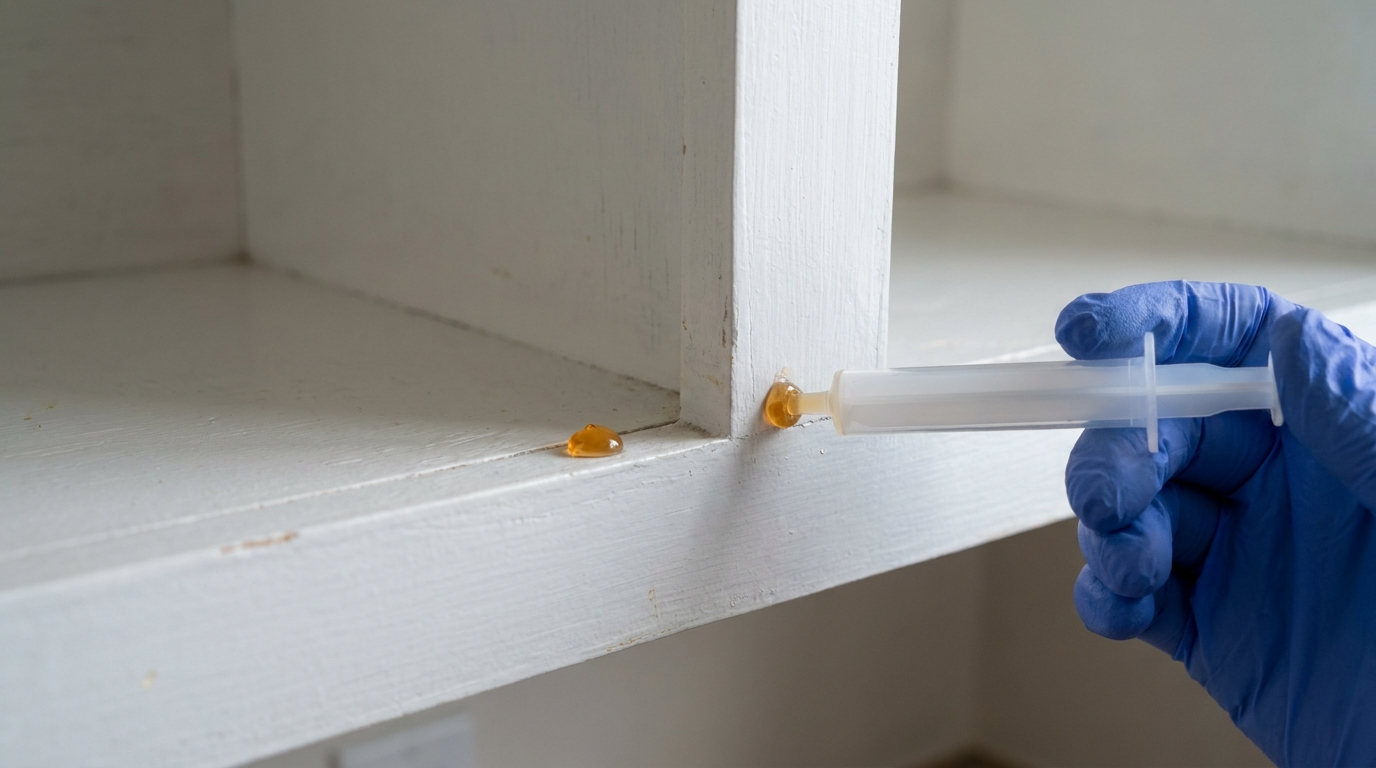
- Squeeze pea-sized dabs about every foot along crevices, cabinet shelves and baseboards.
- Push gel into cracks and holes before you seal them.
- Add more once the bait gets eaten.
Many small dabs beat a few big globs, because roaches find bait while foraging rather than tracking it from far away. Don’t spray cleaners or other insecticides around your bait, since that can put roaches off it.
Bait stations work the same way. Peel off the sticky backing first. Press them where roaches travel, like cabinet corners and edges, behind the fridge and stove, and under the sink. The NYC Health Department’s guide says to replace stations every two to three months and switch brands or types each year.
Then close the routes they use. A roach can squeeze through a crack only 1/8 inch wide, the Health Department’s guide notes. Sealing gaps where pipes and wires pass through walls is especially useful in apartments, because it cuts roach traffic between units. If you’d rather not do the repairs yourself, ask the owner or super.
Starve them out, too. Keep food in containers that seal tight, and don’t leave dirty dishes in the sink overnight. Take tied garbage bags down the chute or out to the building’s bins every day.
Expect weeks, not one night. Even in the Raleigh study, bait cut roach numbers significantly but hadn’t wiped them out within one month. For the full step-by-step plan, see our guide to getting rid of roaches in an NYC home.
For a severe roach problem, the NYC Health Department says you need a professional certified by New York State’s Department of Environmental Conservation (DEC). Ask to see a copy, or search for the business through NYSPAD on the DEC’s website.
When Should NYC Renters Call the Landlord Instead of Bombing for Roaches?
As soon as you see roaches, and before you buy a bomb. In New York City, keeping a rental free of roaches is the owner’s job. That includes fixing the leaks, cracks and holes that can cause pests. “If you rent, the owner is required to keep your home pest-free and must hire a professional if necessary,” the Health Department’s guide says. Tell the owner right away.
Say management hires a pest control professional. The same guide says to tell the professional to use the least hazardous pesticide that will work. On bombs it is blunt: “Don’t allow the use of insect bombs or foggers.”
When an apartment is infested, section 27-2017.8 of the city’s Housing Maintenance Code requires the owner to use integrated pest management. That includes sealing gaps, removing water sources and cleaning out pest debris, and the code says pesticides can’t substitute for those steps. It also says any pesticide must be applied by a DEC-licensed pest professional. The city’s Department of Housing Preservation and Development (HPD) investigates complaints and decides whether to issue violations.
If the owner doesn’t fix the problem, call 311 and file a residential pest complaint. HPD tries to reach the managing agent and, if the condition isn’t corrected, sends an inspector. In buildings with three or more apartments, HPD can issue a Class C violation for roaches. That gives the owner 21 days to correct it, according to HPD’s pest rules. These code and HPD rules do not cover apartments the New York City Housing Authority (NYCHA) owns and operates. NYC311 has a separate complaint for pests at NYCHA developments.
If someone in your rental has asthma, the NYC Health Department’s Healthy Neighborhoods Program offers another route. Renters diagnosed with persistent moderate or severe asthma who have mice or roaches qualify for a free home assessment through a provider’s referral. If its staff find pest triggers, they work with the owner to try to fix them.
Our guide on tenant rights and filing an HPD complaint walks through the full process. Our NYC roach treatment cost guide covers who pays. If you own or manage a building, start with our pest control service for property managers.
The Bottom Line on Roach Bombs in NYC Apartments
A good professional will find the conditions behind your roaches and plan how to get rid of them, the NYC Health Department’s guide says. Some pest problems need several visits, it adds. Let the professional know if children or pets live with you.
We treat roaches, mice, rats, bed bugs, ants, termites, bees and wasps, mosquitoes and ticks. We cover all five boroughs, Nassau County and Suffolk County. If you’re in Brooklyn, start with our roach treatment in Brooklyn. In Manhattan, see our pest control service in Manhattan.