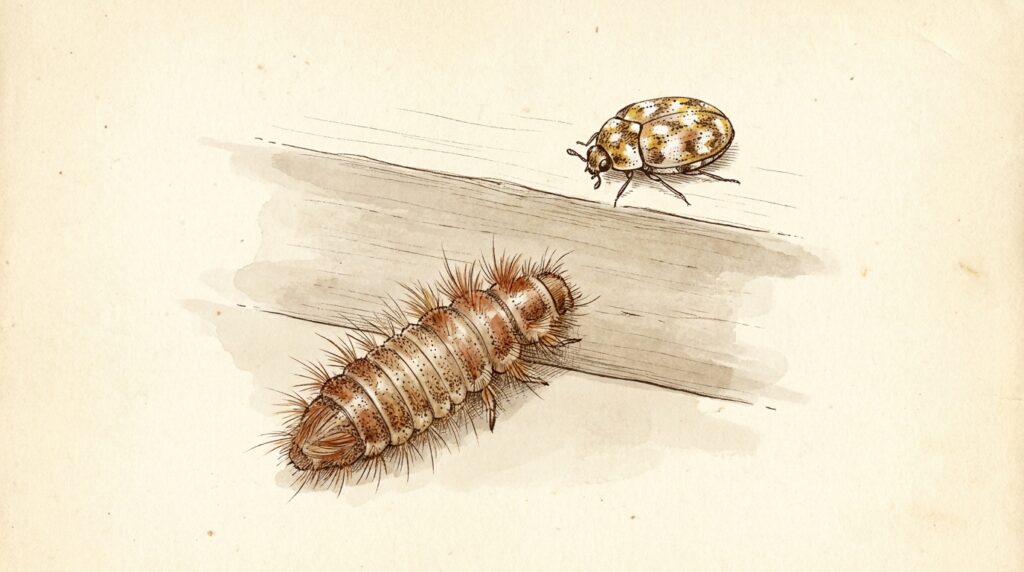
Found tiny bristly bugs shedding their skins along your baseboards — or a scatter of translucent husks tucked in a dresser drawer — and your stomach just dropped? Take a breath first. In 26+ years of NYC pest calls, our NYC pest control team has walked into more “I think I have bed bugs” apartments than we can count, and a large share of those turn out to be carpet beetles instead. They’re common in New York City apartments, they don’t bite, and — unlike bed bugs — they’re genuinely easy to get rid of once you know what you’re doing.
That said, carpet beetle larvae are not harmless. Left alone, they’ll chew through wool sweaters, silk scarves, area rugs, and stored linens, and NYC’s pre-war buildings — with their shared walls and radiator heat — give them plenty of places to spread between units. One thing to settle first: make sure you’re actually dealing with carpet beetles and not bed bugs, the mix-up nearly every renter makes. If you’re not certain what you’re looking at, start with our guide to identifying carpet beetles and telling them apart from bed bugs, then come back here. This is the removal playbook — how to get rid of an active infestation step by step, how to launder and treat the spots they hide, how to protect the fabrics they haven’t reached yet, and when it’s time to call in a professional.
Carpet beetles chewing through your NYC closet?
26+ years clearing carpet beetles from NYC apartments, with targeted harborage treatment and no annual contracts, plus a free estimate when you book.
How Do You Get Rid of Carpet Beetles in Your NYC Apartment?
Getting rid of carpet beetles comes down to four moves, done together rather than one at a time: remove their food source, physically extract eggs and larvae, kill anything left behind with heat or cold, and treat the harborage spots so they don’t just move to the next closet over. Skipping any one of these is the most common reason DIY carpet beetle treatment stalls out.
- Remove the food source. Clear out lint, pet hair, and dust accumulations from behind radiators, under furniture, and along baseboards — this is what larvae actually eat when they’re not in your sweaters.
- Vacuum thoroughly and often. Every carpet edge, closet floor, dresser drawer track, and baseboard gap, then seal and dispose of the bag or canister contents immediately outside the apartment.
- Launder or heat-treat natural-fiber items. Hot water washing or a hot dryer cycle kills every life stage.
- Treat the harborage spots directly — closets, baseboards, and behind heavy furniture — where cleaning alone can’t reach.
Most apartment infestations we treat clear up within three to four weeks of a consistent routine. If you’re still finding fresh larvae or shed skins after three to four weeks of vacuuming and laundering, that’s usually a sign the source hasn’t been fully eliminated yet, and it’s worth moving to targeted treatment or professional help rather than repeating the same steps.
What Fabrics Do Carpet Beetles Damage in NYC Homes, and How Do You Stop the Loss?
Carpet beetle larvae feed on keratin and other animal-based fibers — wool, silk, fur, feathers, leather, and hair, including pet hair and hairbrush bristles. They’ll also work through mixed-fiber items that blend natural and synthetic fibers, and museum-grade concerns aside, the pieces we see damaged most often in NYC apartments are wool sweaters, area rugs with wool or silk content, down pillows and comforters, and vintage or secondhand fur and leather items.
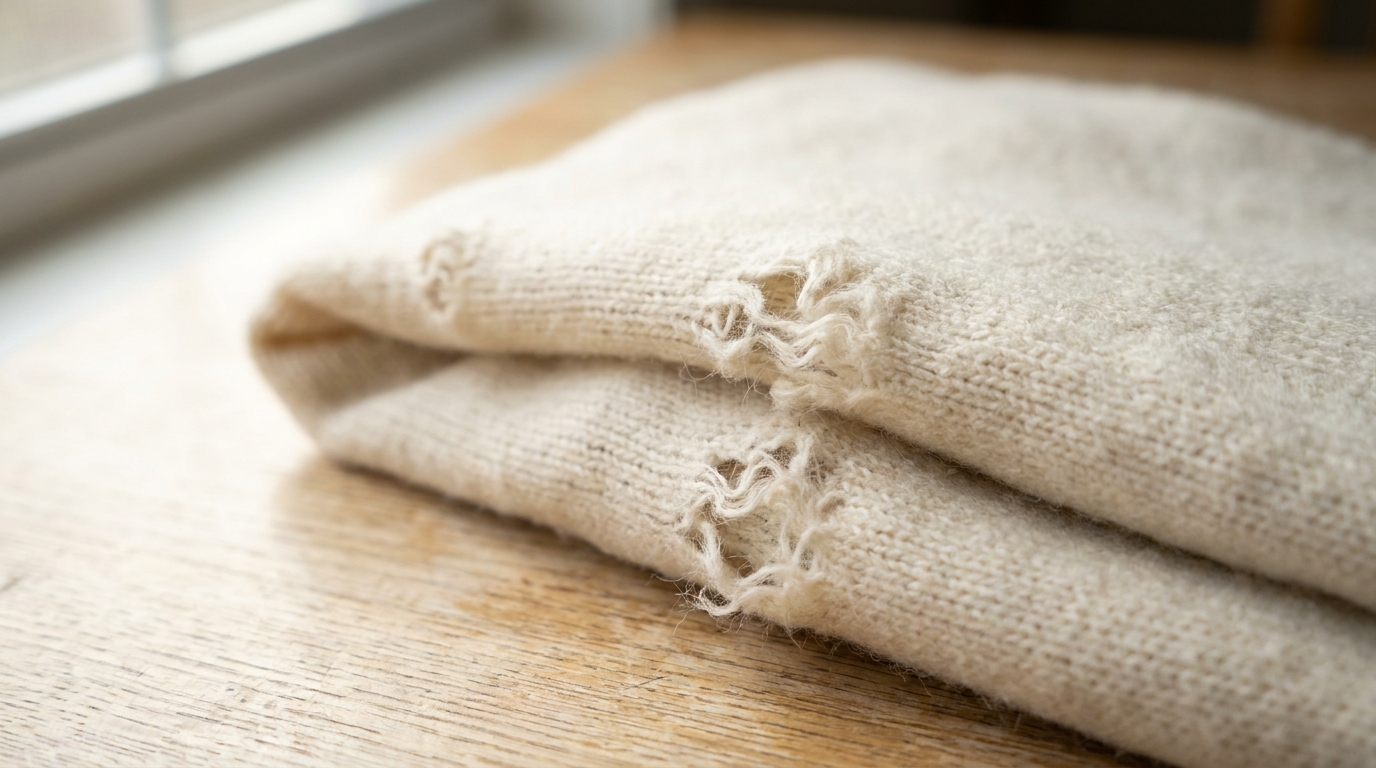
Two things make the damage sneakier than moth damage: it’s caused entirely by larvae (never the adults you spot near windows), and it tends to concentrate in one area of a garment or rug rather than scattering as isolated holes. Check seams, collars, cuffs, and the underside of area rugs first — those are the dark, undisturbed spots larvae prefer.
To stop further loss once you’ve found damage: pull every natural-fiber item out of the affected closet or drawer immediately and isolate it in a sealed plastic bag. Don’t just spot-clean the visible hole — if larvae are still feeding, more damage is coming. Items that can be laundered on high heat or dry-cleaned should go straight there; items that can’t should be sealed and either heat-treated or frozen (more on both below) before they go back into storage. The goal is to remove every larva and egg from an item, not just patch the hole you can see.
How Do You Clean and Launder to Eliminate Carpet Beetle Larvae in an NYC Apartment?
Vacuuming and laundering do the heaviest lifting in any carpet beetle removal plan, and doing them right matters more than doing them fast.
Vacuum everything, not just the carpet. Run a strong suction vacuum with a crevice attachment along carpet edges, under area rugs (both sides if you can lift them), inside closet floors and corners, along baseboards, and underneath and behind furniture you rarely move. This single pass removes eggs, larvae, shed skins, and fecal pellets — the organic debris larvae need to keep feeding. Empty the canister or seal the bag in a plastic bag and take it out immediately; leaving it in the apartment just gives any surviving eggs a second shot.
Launder on hot, every time. Wash washable natural-fiber items — sweaters, blankets, throw rugs — on the hottest water setting the fabric allows, then run a full hot dryer cycle. Heat at 120°F or higher for at least 30 minutes kills carpet beetles at every life stage: eggs, larvae, and adults.
Freeze what can’t be washed. For delicate items that can’t tolerate hot water or a dryer — vintage textiles, some furs, certain wool blends — seal the item in a plastic bag and place it in a freezer at or below 0°F (-18°C) for two full weeks. Both the heat and freeze methods work because they hit every stage of the life cycle at once, unlike a surface spray that only reaches what it directly contacts.
Dry-clean what you can’t wash or freeze. Professional dry cleaning kills carpet beetles just as effectively as hot laundering and is the right call for suits, structured wool coats, and anything with a “dry clean only” tag.
How Do You Treat Closets and Baseboards Where NYC Carpet Beetles Hide?
Cleaning removes the food and the visible insects, but larvae that have already worked their way into closet corners, baseboard gaps, or behind heavy furniture often need direct treatment, not just vacuuming around them.
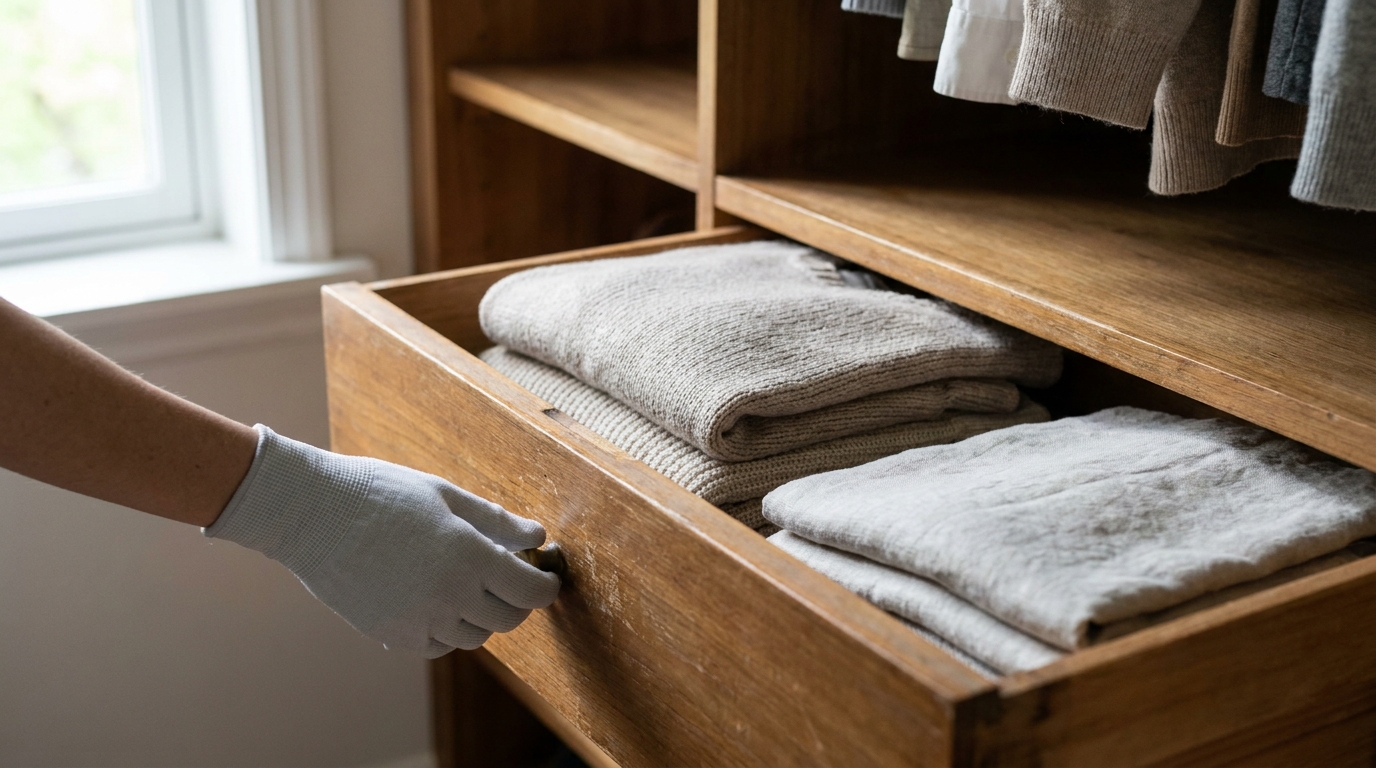
Declutter the closet or storage area completely so you can actually see and reach every corner, edge, and gap. Vacuum the empty space thoroughly, including the inside track of dresser drawers and the underside of shelving. For cracks and crevices that vacuuming can’t fully clear — where baseboard meets floor, gaps around closet trim, behind radiators — a targeted crack-and-crevice treatment or insecticidal dust labeled for carpet beetle control is the tool professionals reach for, because it keeps reaching into those gaps long after a liquid spray has dried. This is also where a professional inspection earns its keep: identifying every harborage point in a pre-war apartment’s baseboards and shared walls is exactly the kind of detail work that’s easy to miss on your own.
Once treated, store items only in sealed containers — plastic bins with tight lids, not cardboard boxes or open bags, since larvae can chew through both. Cedar chests and cedar-lined closets are a popular belief but not a reliable one; cedar oil fades with age and never fully repels an active infestation on its own.
Which Carpet Beetle Treatments Actually Work in an NYC Apartment — and Which to Skip?
Once you know where the larvae are hiding, the products you reach for decide whether the infestation ends or just goes quiet for a few weeks. Here’s what earns a place in a carpet beetle plan, and what to leave on the shelf.
What actually works:
- Desiccant dusts in cracks and harborage. Boric acid and diatomaceous earth, puffed into baseboard gaps, closet corners, and dresser-drawer tracks, kill larvae by drying out their shells — and because they’re a dry powder, they keep working for weeks after a liquid spray would have evaporated. A light film is the goal; a visible pile just gets stepped around.
- An insecticidal dust labeled for carpet beetles. This is the crack-and-crevice product our technicians apply on a professional treatment. It reaches the deep harborage in a pre-war apartment’s baseboards and shared-wall voids that vacuuming and laundering never touch.
- Vacuuming and hot laundering (covered above) — still the two moves that physically remove the most eggs and larvae, and the base every other step builds on.
What to skip:
- Foggers and “bug bombs.” They settle onto open surfaces but never penetrate the enclosed spots where carpet beetle larvae actually live, so the infestation keeps feeding underneath — one reason New York City’s Health Department steers residents away from foggers for indoor pest control.
- Mothballs in an open room. The naphthalene and paradichlorobenzene in mothballs only reach a useful concentration inside a sealed container, and the fumes are a genuine health hazard in living space — never scatter them across a closet floor you use every day.
- Cedar alone, or spot-treating one hole. Cedar oil loses its potency within a year or two and won’t stop an active infestation on its own, and cleaning only the damage you can see leaves larvae feeding a few inches away in fabric you haven’t checked.
Still finding shed skins after cleaning your NYC apartment?
26+ years locating the carpet beetle source in NYC and Long Island apartments, with targeted harborage treatment and no annual contracts, plus a free estimate when you book.
Can You Prevent Carpet Beetles From Coming Back to Your NYC Apartment?
Yes — and prevention here is mostly the same habits that got rid of them in the first place, kept up on a regular schedule instead of a one-time push. Cornell Cooperative Extension of Nassau County lists regular vacuuming and monitoring for building gaps and moisture as the core of an effective long-term approach, and that holds just as true in a Brooklyn walk-up as it does on Long Island.
- Vacuum weekly, focusing on edges, corners, and under furniture — this single habit removes the organic debris larvae need before it can accumulate.
- Check window screens for gaps or tears each spring, since adult beetles fly in through open windows and doors while looking for pollen.
- Inspect cut flowers before bringing them inside — a classic, overlooked entry point.
- Store natural-fiber clothing and linens in sealed, airtight containers rather than open shelving, especially for off-season storage.
- Have wool and silk items dry-cleaned before long-term storage, since food and perspiration residue on fabric is what attracts beetles to it in the first place.
- Don’t rely on cedar alone — pair it with sealed storage if you use it at all.
If you live in a multi-unit building, it’s also worth a conversation with your super or management if a neighboring apartment has had a known infestation — carpet beetles migrate through shared walls, plumbing chases, and electrical conduit just as easily as they fly in through a window.
When Should You Call an NYC Pro to Control a Carpet Beetle Infestation?
DIY carpet beetle control works for most apartments, but a few situations call for professional help rather than another round of vacuuming:
- You’re still finding fresh larvae or shed skins after three to four weeks of consistent cleaning and laundering.
- Damage or larvae are showing up in more than one room.
- The infestation is inside items too delicate or valuable to launder, freeze, or dry-clean yourself — a vintage rug, an heirloom piece, an instrument.
- You can’t locate the source, which is common in older buildings where the beetles are migrating in from a shared wall or neighboring unit.
A professional inspection identifies the species, locates every harborage point — including the ones hidden inside baseboards and wall voids — and applies targeted treatment instead of guesswork. For NYC apartments, an initial treatment typically starts around $250 plus tax, and an inspection runs $150–$200, waived if you move forward with treatment. Service is same-day during business hours across the five boroughs, with 24-hour emergency response available. If you’re in Manhattan specifically, our team offers pest control for Manhattan apartments that accounts for the tight closets, shared walls, and pre-war construction that make carpet beetles harder to fully clear on your own.
The Bottom Line on Carpet Beetles in Your NYC Apartment
Carpet beetles are a nuisance, not a catastrophe — and definitely not bed bugs. They don’t bite, they don’t spread disease, and a consistent routine of vacuuming, laundering, and targeted treatment resolves the vast majority of NYC apartment cases within a few weeks. The larvae doing the damage are patient but not invincible: cut off their food source, remove the eggs and larvae that are already there, and treat the spots cleaning alone can’t reach, and you’ve solved the problem for good. If you’ve worked through the steps here and you’re still finding evidence, or you’d rather have someone locate the source the first time, we’re a call away — schedule a consultation and we’ll take it from there.