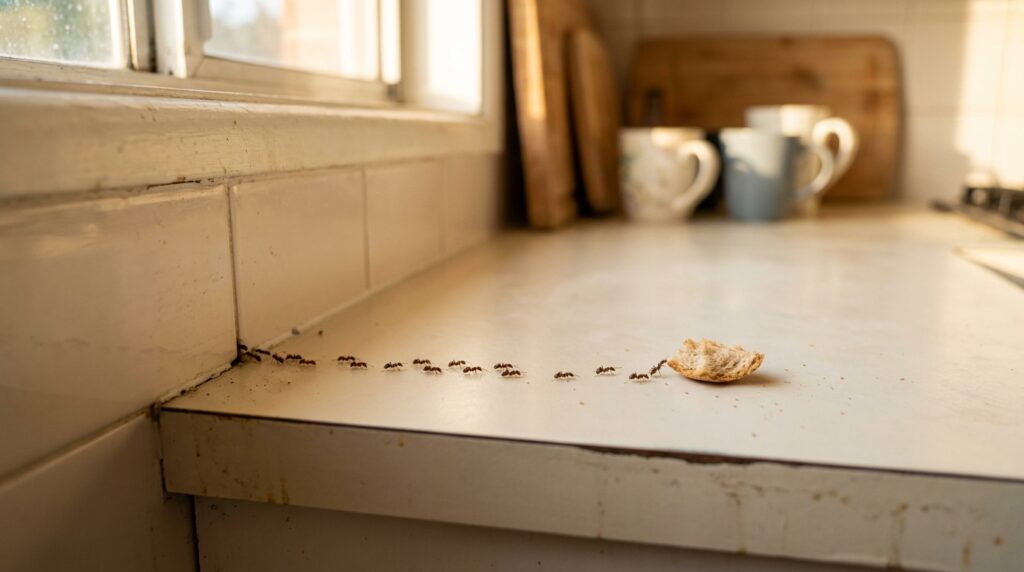
You wiped the counter down before bed, and by the time the coffee is brewing there is a thin line of tiny ants marching from the window frame toward the sink. Yesterday, nothing. Today, a full parade. If you are standing in your kitchen wondering what you did wrong, here is the short version: you did not do anything wrong, and your apartment is not dirty.
In our 26+ years of professional ant control in NYC, we have learned that a sudden ant line almost never means your home changed overnight. It means one scout ant found something worth telling the colony about, or the weather outside your building just shifted. Ants are foragers, and a single one that stumbles onto your sugar bowl can become a hundred by morning.
This guide breaks down exactly why ants show up suddenly in a New York City apartment — the invisible trail, the rain, the hidden crumb, the colony you cannot see — and what actually stops them. (Spoiler: it is not the spray can under your sink.)
Ant trails out of nowhere in your NYC apartment?
26+ years tracing NYC ants back to the colony, not just the trail on your counter. We bait at the source, family and pet-friendly, with no annual contracts and a free estimate.
Why Do I Have Ants in My NYC Apartment Out of Nowhere?
The “overnight” part feels spooky, but it is just good teamwork. Ants send out scouts — lone workers that wander far from the nest looking for food and water. When a scout finds something good, it walks home laying down a tiny chemical trail called a pheromone trail. Every ant that follows reinforces it. So the counter that looked spotless at midnight can be a highway by 7 a.m., because one ant told a few hundred of its closest friends exactly where to go.
Here is the part most people miss: the ants you are looking at almost certainly do not live in your apartment. Colorado State University’s extension team notes that most ants found indoors are merely foragers seeking food or water, returning to colonies established outdoors. In a NYC building, “outdoors” can mean the tree pit out front, the crack between the sidewalk and your foundation, the soil under the back patio, or a wall void two units over. You are seeing the delivery drivers, not the warehouse.
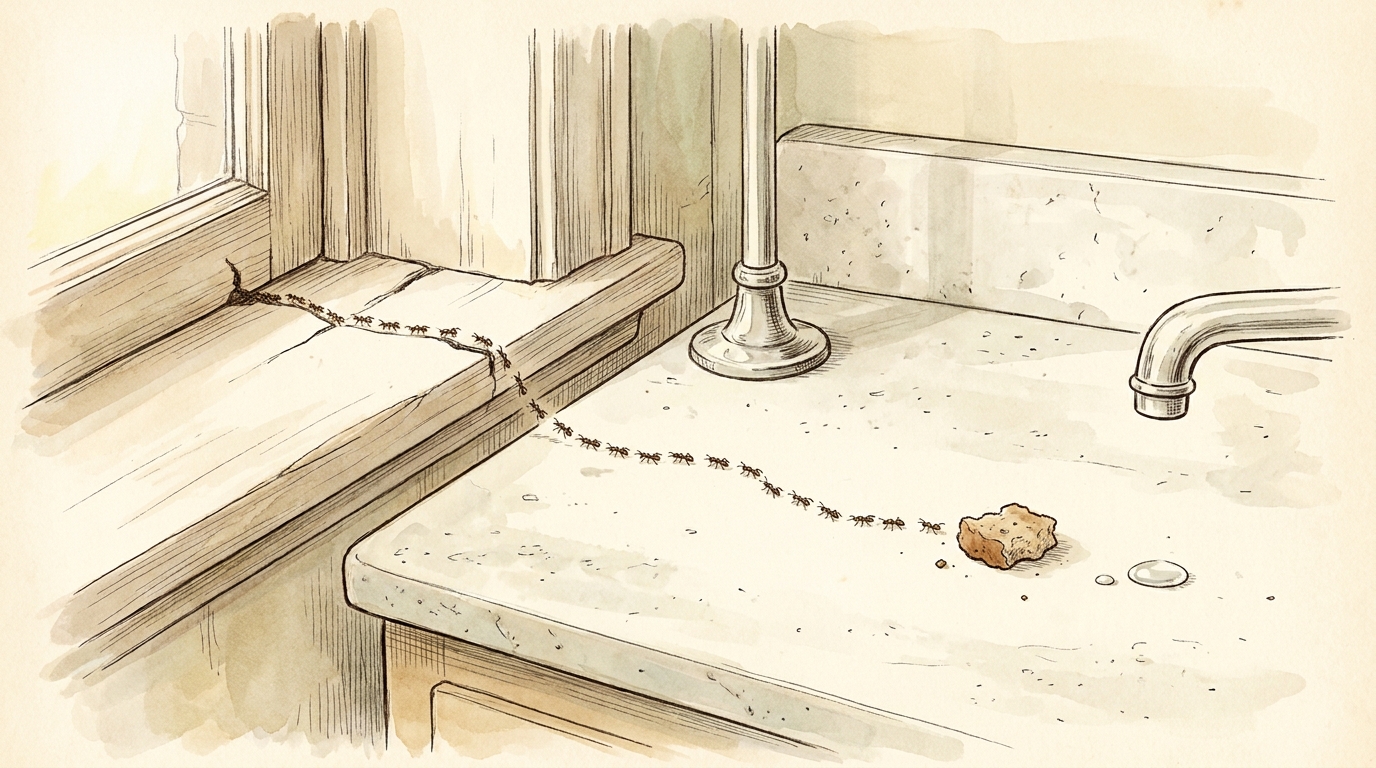
That is also why squishing the ones on the counter does so little. At any given moment only a small fraction of the colony is out foraging, so you could flatten every ant you see and the trail would refill within the hour. The scout system is the whole reason a “sudden” infestation is almost always an old colony that just discovered a new door — yours.
If it helps, picture the ground floor of a NYC block as one giant pantry with thousands of tiny scouts combing it every day. Most days, none of them find a way into your place. Then a screen tears, a caulk line cracks, or the lobby door gets propped open on moving day, and one scout gets lucky. That is the entire difference between “no ants” and “ants everywhere” — it is rarely about you, and almost always about access.
What Are These Tiny Sugar Ants in My NYC Kitchen?
Nine times out of ten, the tiny trailing ants in a NYC apartment are one of two species, and neither one is the scary one people fear.
Pavement ants and odorous house ants: the usual suspects
- Pavement ants (Tetramorium) are about 1/8 inch long, dark brown to blackish, and — true to the name — they nest under sidewalks, driveways, stoops, and concrete slabs, then follow cracks indoors. If your ants are streaming in near the floor of a ground-floor or basement apartment, these are your prime suspects.
- Odorous house ants (Tapinoma sessile) are even smaller, around 1/10 inch, brown to dark brown, and they love sweets. Their party trick: when you crush one, it smells like rotten coconut or blue cheese. These are the classic “sugar ants” that appear on kitchen counters near a spill or a dripping pipe.
Both are tiny, both travel in trails, and both are after the same things — sugar, grease, and water. That is good news, because it means the same bait-first game plan works on either one.
Want a two-second field test? Follow one ant to where the line disappears into the wall, then set out a dab of honey next to a smear of peanut butter and watch which one the crowd swarms. A rush on the sweet usually points to odorous house ants; interest in both leans toward pavement ants, which are the less picky eaters. And because both species happily nest in the shared wall voids and slab cracks of an apartment building, a colony you knock down in your unit can keep re-feeding from a neighbor’s kitchen — part of why apartment ants are stubborner than the same species in a standalone house.
What they are almost certainly NOT
The internet loves to jump straight to carpenter ants, but those are a different animal. Carpenter ants are large (up to half an inch), they are tied to moist or damaged wood, and they hollow out beams rather than raid your sugar bowl. They are worth taking seriously in an old brownstone with a leak, but they are not what is forming a pencil-thin line to your fruit bowl. Confusing the two sends people down the wrong treatment path, so if your ants are tiny and trailing to food, think pavement or odorous house ant, not carpenter ant.
Why Are There So Many Ants in My NYC Apartment After It Rains?
Constantly. Weather is one of the biggest reasons ants show up suddenly, and it cuts two ways.
When a heavy rain rolls through, it floods the shallow outdoor nests these ants build under pavement and soil. The colony does not wait around to drown — it relocates, and the nearest dry, warm shelter is often the building next to it. As the eXtension pest team puts it, during very wet or abnormally hot and dry weather, colonies whose nesting areas are flooded or lack food and water often migrate indoors, and it is not uncommon to see an increase in ants after a heavy rain. If your ants appeared the morning after a summer downpour, that is not a coincidence.
The flip side is a heat wave. During a hot, dry stretch — the kind of July week where the pavement is radiating — ants come inside hunting water, not food. That is when you find them in the bathroom, around the tub, or under the kitchen sink instead of on the counter. Either way, the trigger was outside your walls, which is why the timing can feel so random and so sudden.
There is a very NYC wrinkle here, too: construction. Between sidewalk sheds, scaffolding, street work, and the building next door getting gut-renovated, there is almost always something disturbing the soil somewhere on your block. Digging near a nest scatters the colony and sends it looking for a new home, and dense city blocks give them a lot of walls to choose from.
What’s Attracting Ants Into Your NYC Kitchen and Bathroom?
Once ants are inside, whether they stay comes down to whether they find a reason to. And “clean” by human standards is not the same as “clean” by ant standards.
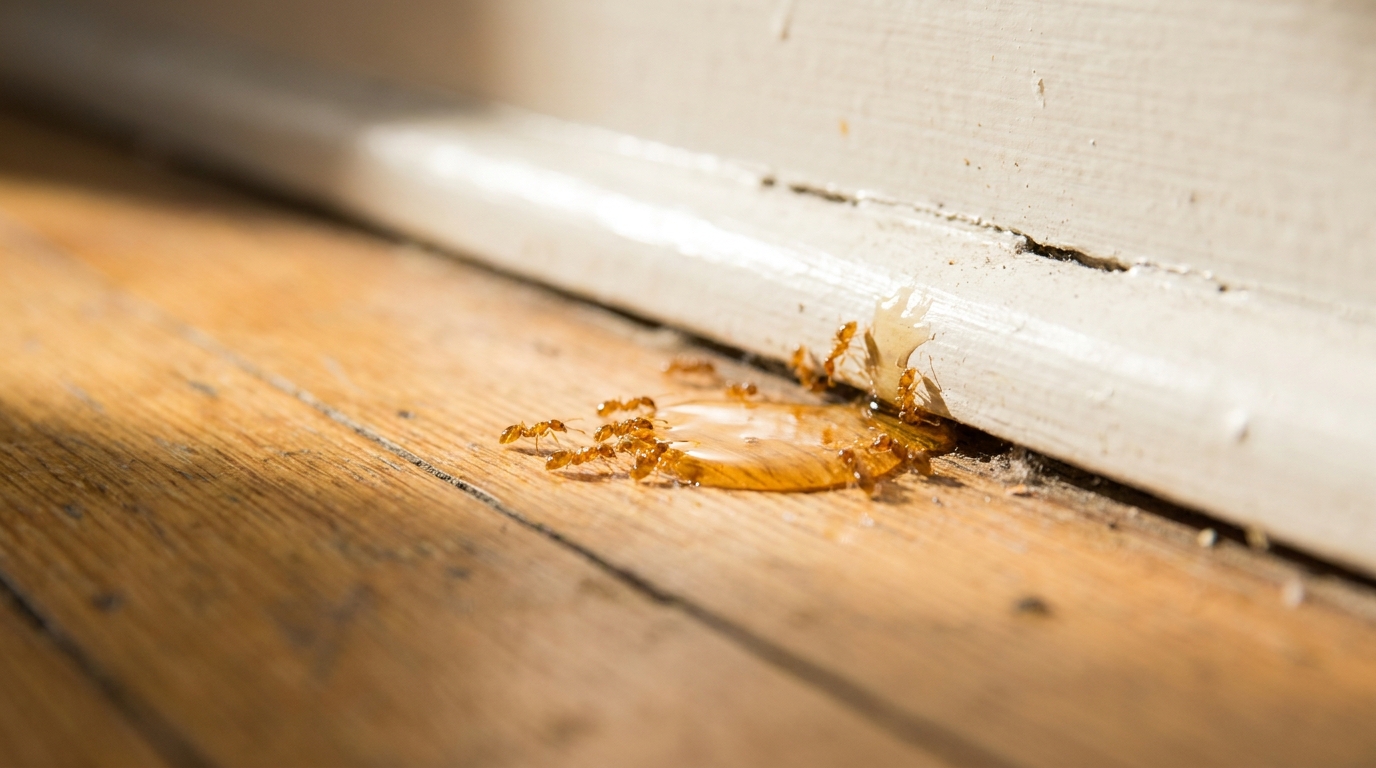
The obvious draws are the ones you would guess: crumbs behind the toaster, a sticky ring under the honey jar, grease film on the stovetop, pet food left down overnight, an open trash bin. But we regularly trace NYC ant trails back to sources people never think of:
- The recycling — a rinsed-but-not-really seltzer can or takeout container is a buffet.
- Cardboard and paper grocery bags stacked in a corner, which hold both food residue and moisture.
- Moisture itself: a slow drip under the sink, condensation on a cold pipe, a radiator that sweats, or a bathroom that never fully dries out. In a hot spell, water alone is enough to keep a trail running.
This is the same reason a spotless apartment still gets ants: you can wipe every counter and still have a leaky P-trap or a crumb-filled gap under the cabinet toe-kick that reads, to a scout ant, as an open invitation. Finding and cutting off that one source often does more than any product on the shelf.
The fastest way to find that source is to stop killing the ants for ten minutes and just watch them. A foraging line is a two-way street — half the ants are heading to the food, half are carrying it home. Follow the “home” direction to where the trail slips into a gap, whether that is behind the fridge, under the toe-kick, or into a baseboard seam, and you have found exactly where to concentrate your bait and your caulk.
Wiped the ants away and they keep coming back?
That is a colony problem, not a cleaning problem. We have chased NYC ant trails back to the nest for 26+ years, with same-day service, no annual contracts, and a free estimate.
Why Do the Ants in My NYC Apartment Keep Coming Back?
Because wiping the counter treats the symptom, not the colony — and ants are built to outlast that.
The trail lingers
That pheromone trail does not vanish when you kill the ants standing on it. Plain water often just smears it around. Unless you break the scent trail (warm soapy water or a vinegar solution helps) and remove whatever the trail leads to, fresh scouts pick the path right back up. You are cleaning the road, but the map is still in their heads.
The colony you are fighting may be several colonies
Many of these ants live in networks with more than one queen, and under stress they split off satellite nests to survive. That is a feature, not a bug, from the ant’s point of view: flood one nest, disturb another, or hit them with a repellent spray, and the survivors simply bud off and set up somewhere new. It is exactly why it can feel like you are chasing them from the kitchen to the bathroom to the bedroom.
Spraying the trail is why DIY stalls
This is the single most common mistake we see. Cornell’s Moreau Lab is blunt about it: indoor sprays kill the individual ant you see, but the nest and queen are still nearby and keep producing new workers. A repellent spray can actually make things worse, because it scatters the colony into those satellite nests instead of killing it. You get the satisfying dead ants on the counter and a bigger problem next week. In a pre-war building, where gaps around radiator pipes, baseboards, and old plaster give ants a dozen ways between units, spraying one trail just reroutes the traffic.
Why Won’t Sprays Get Rid of Ants in a NYC Apartment?
The whole strategy is simple to say and easy to get wrong: you have to reach the colony, and the ants have to carry your treatment there for you. That means bait, not spray.
Slow-acting baits work because they are slow. A forager picks up the bait, thinks it found dinner, carries it home, and shares it with the workers, the brood, and the queen through mouth-to-mouth feeding. Kill the queen and the colony collapses; kill the foragers and you have accomplished almost nothing. The catch is matching the bait to the ants — sugar-loving odorous house ants may ignore a protein bait, and colonies even switch cravings by season — which is exactly why species ID matters and why a bait can seem to “stop working.” For the step-by-step version, we wrote out a bait-first plan built for NYC kitchens.
Alongside the bait, a few things genuinely help — and a few renter-friendly moves are entirely in your control:
- Cut the food and water. Airtight containers, wiped counters, sealed trash and recycling, no standing pet food, and fixing that under-sink drip. Starve the trail and the bait becomes the only game in town.
- Break the trails. Wash active lines with warm soapy water so scouts stop broadcasting your address.
- Seal what you reasonably can. Caulk gaps around pipes, window frames, and baseboards. You will never seal a pre-war apartment perfectly, but every closed gap is one less on-ramp.
- Skip the spray. Especially do not spray over bait — it contaminates the bait and repels the ants you were trying to poison.
The products we use are family and pet-friendly options placed where the ants travel and away from where kids and pets do. What we will not tell you is that any treatment is 100% permanent — in a dense building with neighbors and shared walls, honest ant control is about knocking out the colony and keeping pressure off, not promising you will never see another ant.
When Should NYC Renters Call an Ant Exterminator?
A few stray ants near a window in July is just summer in New York — not an emergency. It is worth calling in help when the pattern changes: a trail that refills within hours of cleaning, ants spreading from the kitchen into other rooms, winged ants (swarmers) showing up indoors, or two-plus weeks of DIY baiting with no real drop-off. If you want a gut check on where you fall, our guide on how to tell a true infestation from a few stray summer scouts walks through the tells.
If you rent, loop in your landlord or management early — in NYC, keeping units pest-free is generally the building’s responsibility, and a quick written note (email works) starts the paper trail. Ants that move between units rarely get solved one apartment at a time, so building-wide coordination beats everyone spraying their own baseboards.
When you are ready for help, this is the kind of problem we handle every day. We have spent 26+ years tracing NYC ant trails back to the nest across all five boroughs and Long Island, we offer same-day service during business hours, and we work month-to-month with no annual contracts — the same approach that has earned us a 4.8-star rating across 300+ reviews. A sudden line of ants can feel like the building is against you, but it is a solvable problem: find the source, bait the colony, break the trails, and get back to worrying about your commute instead of your counters.