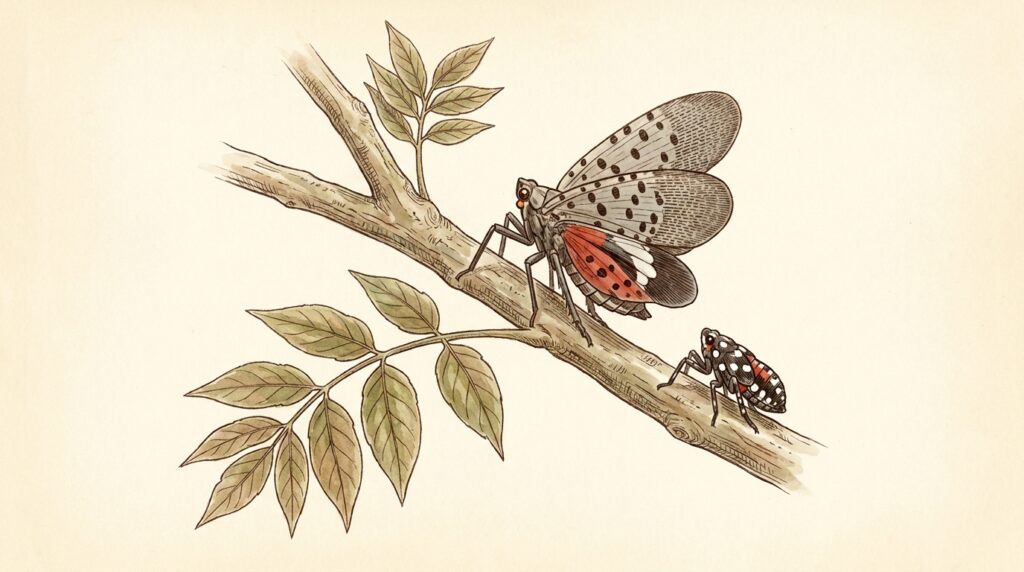
If you’ve spotted a big, gray, polka-dotted bug flashing red underwings on a Bensonhurst sidewalk, in a Queens tree pit, or on the trunk of a maple in your Nassau backyard, you’ve almost certainly met the spotted lanternfly. Over the last few summers it has become one of the most talked-about insects in New York, and the questions we hear are always the same three: What is it? Is it going to hurt my kids or my dog? And what am I actually supposed to do about it?
We’re Advanced Pest Management, and we’ve been treating homes and buildings across the five boroughs and Long Island since 1999. The spotted lanternfly is not a bug anyone can make disappear from the region, but our Long Island pest control team has watched it push east across Nassau and Suffolk, and we field questions about it every week from July through the first frost. In this guide we’ll show you how to identify a spotted lanternfly at every life stage, explain why New York wants you to kill it on sight, walk through exactly what to do the moment you see one, and be straight with you about the single situation where calling us actually makes sense.
Spotted lanternflies swarming your property?
26+ years of seasonal pest control across NYC and Long Island. If clusters are covering your siding, deck, or trees, our routine perimeter treatment can help knock the numbers down, and the estimate is free.
What Is the Spotted Lanternfly, and Why Is It Suddenly All Over NYC and Long Island?
The spotted lanternfly (Lycorma delicatula) is not a fly at all. It’s an invasive planthopper, a sap-sucking insect more closely related to cicadas and aphids than to anything with “fly” in its name. It’s native to Asia, and it hitched its way into the United States on imported goods, turning up in Pennsylvania in 2014 and spreading outward ever since.
New York’s first confirmed infestation was found on Staten Island in the summer of 2020. From there it did what invasive species do when nothing local eats them: it multiplied. By the fall of 2021 it had reached both Nassau and Suffolk counties, and today the New York State Department of Agriculture and Markets lists it in all five boroughs, across Long Island, and in more than two dozen counties statewide. If it feels like they appeared out of nowhere and took over, that’s essentially what happened.
The reason they spread so fast has less to do with flying and more to do with hitchhiking. Adults are clumsy fliers but strong jumpers, and they’ll ride on a car, a truck, a camper, or a piece of patio furniture for miles. Worse, the females lay eggs on almost any hard outdoor surface, so a mud-like smear on a trailer or a stack of firewood can carry the next generation to a brand-new neighborhood. On their own, lanternflies only travel three or four miles in a season. On the back of a moving truck down the Long Island Expressway, they travel as far as we do.
Here’s the part most New Yorkers find frustrating: state officials have largely stopped trying to eradicate the spotted lanternfly downstate. It’s considered established here, which is a polite way of saying it’s here to stay. The fight now is about slowing the spread to protect farms and vineyards upstate, not about clearing them off your block.
Can a Spotted Lanternfly Bite or Hurt Your Family or Pets in NYC?
No. This is the first thing we tell nervous callers, and it’s worth saying plainly: a spotted lanternfly cannot bite you, cannot sting you, and is not dangerous to people, dogs, or cats. Those dramatic red underwings look alarming, but the insect has no stinger, no venom, and no interest in you at all. Its mouth is a straw-like part built for one job: piercing plant bark and drinking sap.
Cornell’s Integrated Pest Management program puts it about as clearly as it can be put: the spotted lanternfly does not attack humans, pets, or other animals, it doesn’t damage the structure of your house, and it doesn’t set up colonies indoors the way bed bugs or roaches do. If your dog eats one off the patio, the current consensus among researchers and vets is that a lanternfly or two won’t poison it, though a stomach full of any bug can cause some drooling or an upset stomach, so it’s not a snack to encourage.
So why all the fuss? Because the damage a spotted lanternfly does is to plants, trees, and agriculture, not to people. It’s an outdoor nuisance that can gather in unnerving numbers, and that’s a real problem for very different reasons, which we’ll get into below.
How Do NYC Residents Identify a Spotted Lanternfly at Every Life Stage?
This is where a lot of New Yorkers get tripped up, because a spotted lanternfly looks like four completely different creatures over the course of a year. Plenty of the “what is this bug?” photos we see are actually early-stage lanternflies that people don’t recognize. According to Cornell’s Integrated Pest Management program, the insect runs through one generation a year, moving from egg mass to nymph to that showy adult everyone photographs.
The single most common mix-up: the tiny black-and-white early nymph gets mistaken for a tick, and people panic. It’s not a tick. Here’s how to tell the stages apart.
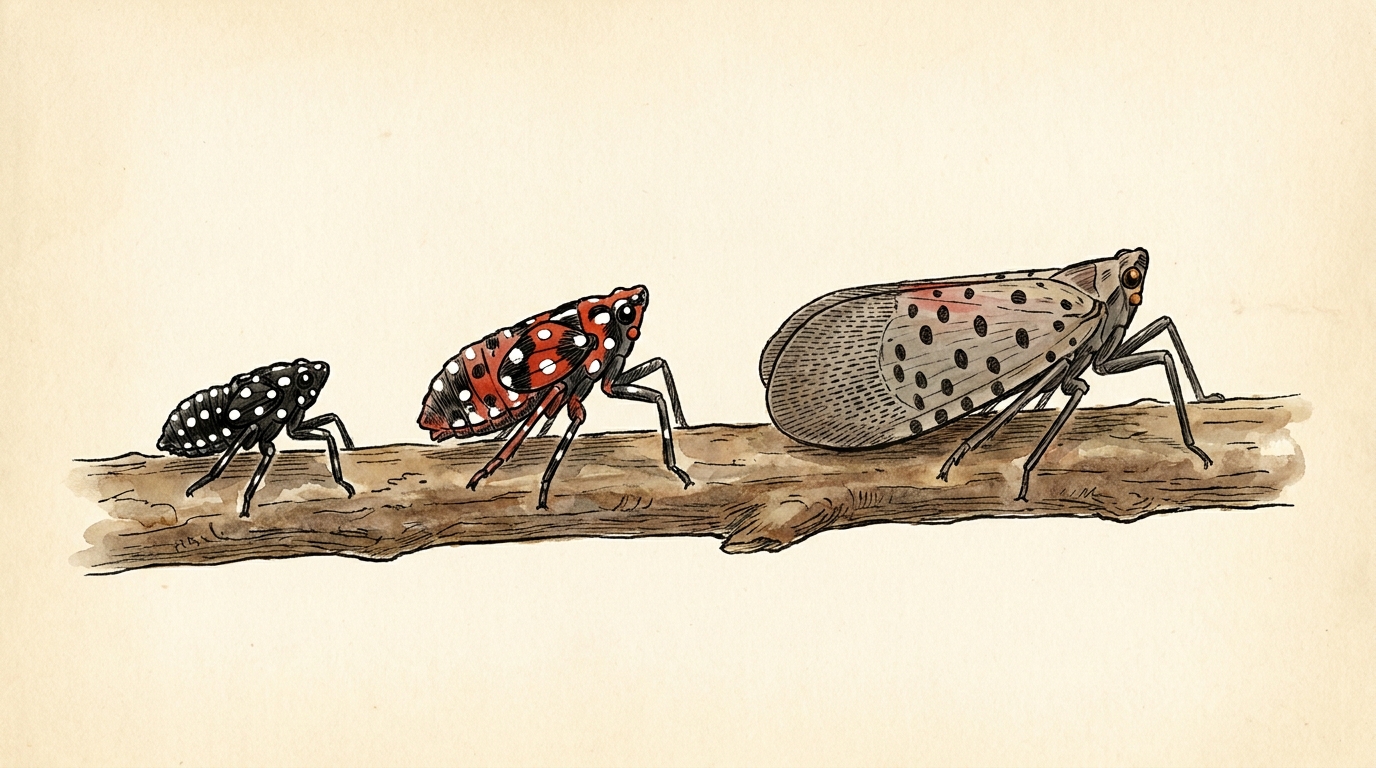
| Life stage | When you’ll see it in New York | What it looks like | Size |
|---|---|---|---|
| Egg mass | September to June | A grayish, waxy putty smear that dries to look like a splotch of cracked mud, stuck to bark, stone, cars, or patio furniture | About 1 inch long |
| Early nymph (first to third stage) | May to July | Jet-black body covered in bright white spots; frequently mistaken for a tick | About a quarter inch |
| Late nymph (fourth stage) | July to September | Bright red with black patches and crisp white spots | Up to three quarters of an inch |
| Adult | July until the first hard frost, sometimes into December | Gray to pinkish-tan front wings with black spots at rest; the hidden hindwings are red, black, and white and only flash when it flies or is startled | About 1 inch at rest |
The adult is the one everyone knows, but notice the trick in that last row: at rest, a spotted lanternfly is a fairly drab tan-and-gray moth-looking thing. It’s only when it opens up to jump or fly that you get the red flash. That color change fools people constantly, and it’s why the same insect gets described as “brown” by one neighbor and “bright red” by another. The egg masses are the sneakiest of all, because a fresh one just looks like a smear of gray putty and an old one looks like a patch of dried mud you’d never glance at twice.
When Are Spotted Lanternflies Active Across NYC and Long Island?
Spotted lanternflies run on a predictable yearly clock, and knowing it tells you what you should be looking for right now. From May into July, the black-and-white early nymphs hatch and start climbing, which is when we get the “is this a tick?” photos. Around July, the flashy red late nymphs appear, and the first adults follow close behind. Late summer into fall is peak adult season, when the clusters on trees, fences, and the sunny side of buildings are at their worst and the honeydew mess is heaviest. Once a hard frost hits, usually late fall, the adults die off, leaving only the overwintering egg masses behind until the cycle restarts in spring.
One thing we hear on Long Island and in the outer boroughs every year: “there were way more last summer than this summer.” That’s real. Lanternfly numbers swing hard from year to year and neighborhood to neighborhood. A block that was carpeted with them one August can be nearly clear the next, which is part of why chasing them with a spray bottle feels like such an uphill battle. If you want to see how the spotted lanternfly fits alongside the other pests that peak in the warm months around here, we lay it all out in our NYC summer pest calendar.
Overwhelmed by lanternflies outside your home?
26+ years treating homes and yards across the five boroughs and Long Island. We cannot clear the whole neighborhood, but a seasonal perimeter visit can take heavy outdoor clusters from unbearable to manageable, and we will give you a free estimate.
What Should You Do If You See a Spotted Lanternfly in New York?
The official guidance in New York comes down to two words: kill it. But the details depend on where you are, and this is where a lot of people get outdated advice.
If you live in the five boroughs, Nassau, or Suffolk, the New York State Department of Agriculture and Markets says you no longer need to report your sighting or collect a sample. The insect is already established across our whole region, so the state has plenty of data. You should simply step on it or crush it when you see one. That’s it.
The reporting request still matters if you travel. If you spot a lanternfly somewhere new that’s outside the established downstate counties, say on a trip upstate near wine country, that’s genuinely useful information. In that case: take a clear photo, collect the insect in a bag or a jar with a little rubbing alcohol or hand sanitizer, and report it to the state at spottedlanternfly@agriculture.ny.gov or through the online reporting form, then kill it. You’re helping protect farms that haven’t been hit yet.
A dose of honesty, though. NYC Parks is upfront that stomping individual lanternflies doesn’t meaningfully shrink the overall population anymore, now that they’re established. So why bother? Because squashing the one on your railing keeps it from laying 30 to 60 eggs on your house, and because slowing the spread genuinely buys time for the farms and forests upstate. Think of it as good citizenship rather than a strategy that will clear your yard. And if you spot an egg mass, don’t just scrape it onto the ground, since the eggs can still hatch there. Scrape it into a bag or container with hand sanitizer or rubbing alcohol so the eggs are actually destroyed.
Why Are Spotted Lanternflies Such a Threat to NYC and Long Island Trees?
If they can’t hurt us, why does New York care so much? Because a spotted lanternfly is a sap thief, and it feeds on more than 70 kinds of plants. It uses that straw-like mouthpart to drill into trunks, stems, and vines and drink the sugary sap the plant needs to live. One or two won’t do much, but these insects gather by the hundreds, and that much feeding stresses a tree, weakens it, and leaves it open to disease. Grapevines are especially vulnerable, and heavy infestations have killed them outright, which is why the state’s vineyards and orchards are the real front line. The New York State Department of Environmental Conservation pegs the combined value of the state’s apple and grape crops at more than $350 million a year, and the spotted lanternfly threatens a real slice of it.
There’s a second problem that hits closer to home for city and suburban residents: honeydew. As lanternflies drink all that sap, they excrete the excess as a sticky, sugary rain called honeydew. It coats everything under an infested tree, your deck, your car, your patio furniture, even your hair if you’re standing in the wrong spot. That sugar then grows a black film called sooty mold, and it draws in other insects. If you’ve noticed more wasps and yellow jackets working a tree or a rail where lanternflies are feeding, the honeydew is why. It’s a genuine outdoor nuisance, even though the lanternfly itself never lays a finger on you.
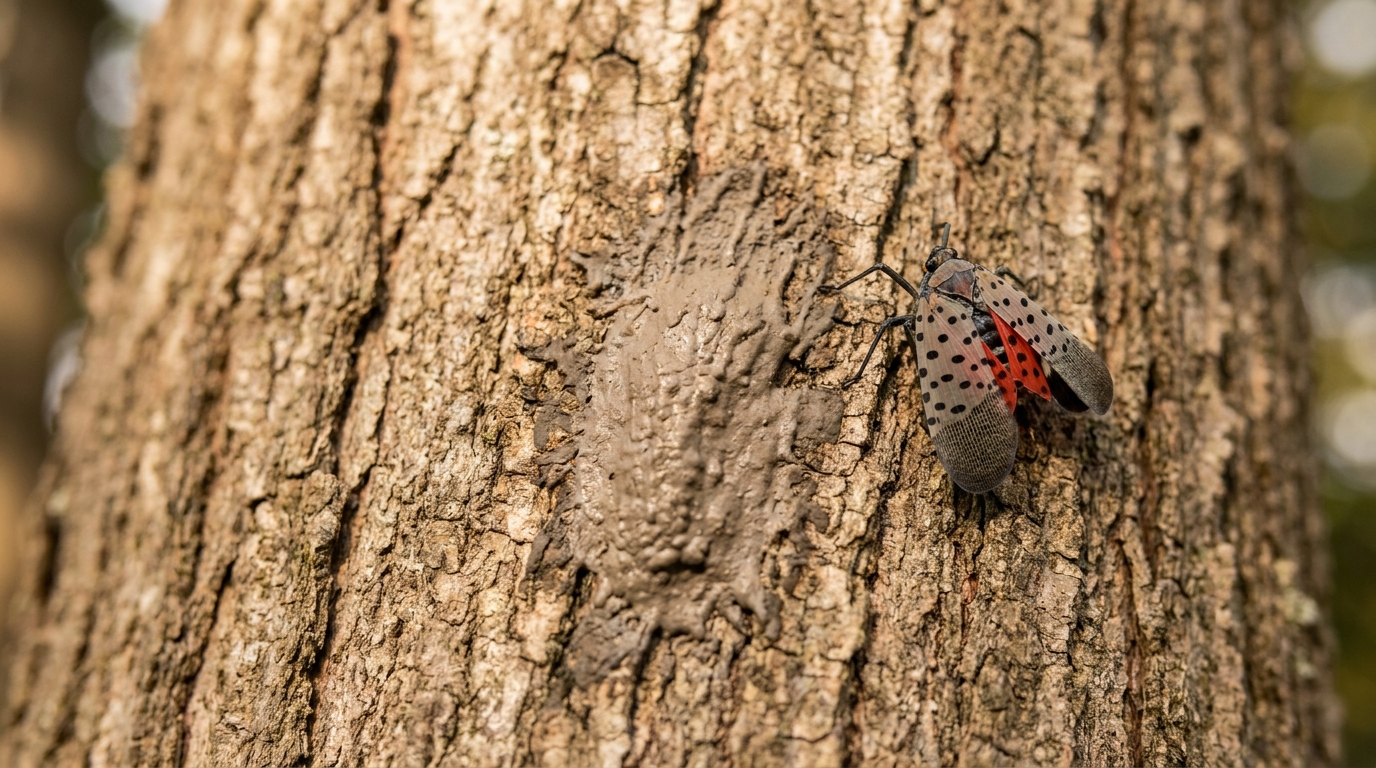
The magnet plant behind most heavy infestations is the tree of heaven (Ailanthus altissima), an invasive weed tree that grows all over vacant lots, rail lines, and alleys across NYC and Long Island. Lanternflies love it. If you have one on or near your property, you have a lanternfly buffet, which brings us to what you can actually do around your own home.
How Do You Remove Spotted Lanternfly Egg Masses on an NYC Property?
Fall and winter are the quiet, high-leverage season for anyone tired of lanternflies. From roughly September through June, the adults are gone but their egg masses are sitting out in the open, and every one you destroy is 30 to 60 lanternflies that never hatch in the spring. New Yorkers often call these “nests,” but they’re really just egg smears, and they hide in plain sight.
Walk your property and check the places a female would pick: tree trunks and the undersides of branches, but also the flat, protected spots people forget, the back of a fence, the underside of patio furniture, wheel wells and bumpers, grill covers, stone walls, and the shady side of your siding. A fresh egg mass is a smooth, gray, waxy putty smear about an inch long. An older one looks like a crackled patch of dried mud.
To destroy one, scrape it off with an old credit card or a putty knife straight into a bag or cup holding hand sanitizer or rubbing alcohol, then seal it and toss it. The alcohol is what actually kills the eggs, so scraping them onto the ground doesn’t count, because they can still hatch down there. It’s a slightly gross ten-minute job, but it’s the single most effective thing a homeowner can do, and it’s completely free. The catch is reach: most egg masses end up high in the tree canopy where you’ll never get to them, which is exactly why no amount of scraping clears the whole population.
Can You Keep Spotted Lanternflies Off Your NYC Home and Yard?
Partly, and it’s worth setting honest expectations. Nobody can lanternfly-proof a property in a region where the insect is established, and any company that promises to is overselling. What you can do is make your yard less attractive and knock down the clusters when they show up.
The highest-impact move is dealing with tree of heaven. If you can identify and remove the tree-of-heaven saplings on your property, you take away the lanternfly’s favorite food and give them a reason to go bother someone else. It’s a stubborn weed tree that resprouts aggressively, so removal usually means cutting plus a targeted herbicide, and it’s often a job for a landscaper or arborist rather than a DIY afternoon. We want to be clear here about our own lane: we are pest control, not tree service. We don’t inject or chemically treat trees, and we don’t run a lanternfly-eradication program, because honestly, no legitimate one exists.
What we do handle is the perimeter. The same kind of seasonal barrier work we do for other warm-weather nuisances, like the yard visits behind our mosquito treatments and the property-line applications in our tick control, can also help knock down heavy lanternfly clusters on the exterior of a home during the season. It won’t clear them off the block, but it can take a swarm on your siding and foundation from unbearable to livable. We’ll say more about when that’s actually worth it next. As for traps: NYC Parks specifically discourages the sticky bands you may have seen online, because they catch and kill birds, squirrels, and beneficial insects. If you do trap, a circle-style trap with proper bird-friendly screening is the responsible option.
When Should NYC Homeowners Call a Pro About Swarming Lanternflies?
Most of the time, the honest answer is that you don’t need to. A handful of lanternflies on the patio is a stomp-and-move-on situation, not a service call, and we’d rather tell you that than sell you something you don’t need. Killing them one by one and treating a perimeter will never wipe them out of the neighborhood, and we won’t pretend otherwise.
But there’s a real scenario where a call makes sense: when the clusters are genuinely overwhelming. If the sunny side of your building is crawling with adults every afternoon, if honeydew is raining down onto a deck or a storefront your customers walk past, or if you manage a multi-unit property on Long Island where tenants are complaining, a targeted seasonal perimeter treatment can meaningfully cut the numbers you’re living with. That’s the same routine, exterior, seasonal-insect work we’ve been doing across NYC and Long Island for 26+ years, and it folds neatly into a regular service plan rather than being some special lanternfly package.
Here’s how we’d frame the call. Reach out to us if lanternflies are swarming the outside of your home or building in numbers you can’t stand, if the honeydew and the wasps it attracts are making a patio or entrance unusable, or if you just want someone to walk the property and give you a straight read on what’s worth doing. What we’ll do is treat the perimeter and the surfaces where they cluster, not your trees and not the whole street. Same-day service is the norm during business hours, the estimate is free, and if you’re curious about the other seasonal pests we handle around here, our guide to ticks across NYC and Long Island is a good next read. Everything we use is family and pet-friendly, applied by licensed technicians who’ve been doing this since 1999.
Quick Recap: Spotted Lanternflies in NYC and Long Island
The spotted lanternfly is an invasive planthopper that’s now a permanent part of summer across the five boroughs and Long Island. It cannot bite, sting, or hurt your family or pets, and it won’t infest your home. Its damage is to trees, vineyards, and orchards, plus the sticky honeydew mess it drops on decks and cars. Learn to spot all four life stages, from the tick-sized black-and-white early nymph to the red late nymph to the gray, red-flashing adult and the mud-like egg masses. If you see one in our region, just kill it, no report needed. Scrape any egg masses into alcohol over the winter. And if the clusters outside your home get truly overwhelming, that’s the one time it’s worth having our team knock down the perimeter as part of routine seasonal service.