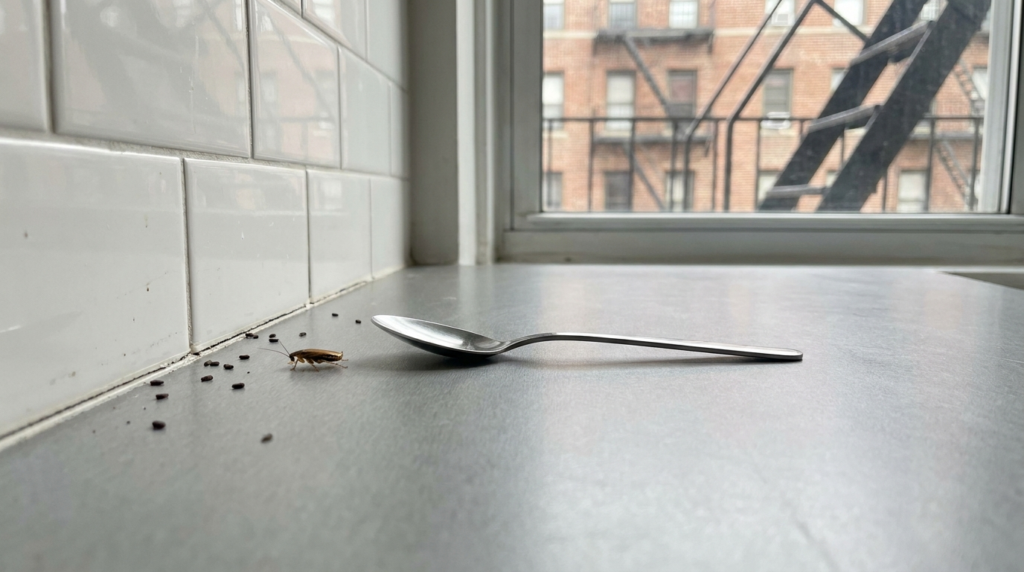

Somebody spots a small dark bug on the edge of a chair by the copier, and within ten minutes half the floor knows. There is a photo in a group chat, two people have decided they are not sitting down, and everyone is looking at the office manager, who did not sign up to be an entomologist.
The short version is calmer than the group chat. One bug on a Manhattan office floor is almost never an office infestation. It is almost always a passenger that rode in on somebody’s bag, coat or commute. What works is a fast, tight inspection of the area around one desk, followed by commercial bed bug treatment only if that inspection actually finds something. What fails is a building-wide panic on Monday and a chair in the freight elevator on Tuesday.
We have been treating New York City workplaces since 1999, and the sequence rarely varies. Here is how we work an office sighting.
Found a Bed Bug in Your Manhattan Office?
We have handled commercial bed bug work across New York City since 1999, using a Crossfire residual program scheduled around your business hours. Ask us for a free inspection.
How Do Bed Bugs Reach a Manhattan Office and How Do You Stop Them?
They ride in. That is the whole mechanism, and the National Pest Management Association’s office guidance says it plainly: employees unknowingly bring bed bugs into the office. A bug leaves an apartment on a bag strap or a coat lining, spends the day on your floor, and gets carried somewhere else at six o’clock.
The EPA is blunt about what an office actually is in that chain. A bed bug infestation developing inside an office is very unlikely, though not impossible. What offices do instead is serve as transfer hubs for bed bugs to hitchhike a ride into your home. The office chair is not the threat. The commute is.
One infested apartment puts bugs onto a shared floor. That floor is touched by everyone who sits on it, drops a bag beside it or borrows a chair from it, and each of them goes home to a different apartment in a different borough. We have watched one desk turn into several separate household problems. That is why a sighting deserves a same-day response, and equally why it does not deserve a building-wide shutdown.
What actually lowers the odds on a Manhattan floor plate:
- Give people somewhere hard to put a bag. Hooks, a shelf, a bin under the desk, anything that is not a fabric chair, partition or communal sofa.
- Keep coats off shared soft seating and out of communal closets where garments press against each other all day.
- Cut the clutter around desks. Paper piles and unopened boxes give a hitchhiker somewhere to sit still.
- Put interception monitors under chair legs and desk pedestals in your busiest zones. They are passive, they take seconds to check, and they turn a vague report into a dated record.
- Deal with the home side. If an employee’s apartment is the source, your office keeps getting re-seeded until it is handled, so the early warning signs to check for are the most useful thing an office can hand its staff.

How Should a Manhattan Employer Treat One Bed Bug Sighting at Work?
Slowly, and in this order. In most mid-size Manhattan offices the person who fields this is the office manager, not HR, and that is right: the first hour is an operations problem, not an employment-relations one. HR is the escalation path for what comes after, not the first responder.
The first hour:
- Capture the bug, do not squash it. A clear bag or a strip of tape on an index card is enough. A smear on a tissue identifies nothing, and plenty of what gets reported to us turns out to be something else.
- Record where and when. Desk number, seat, time of day, and whether the finder has bites. Photograph it in place if you can.
- Do not throw anything out yet. A chair in the freight elevator removes your only physical evidence and tells you nothing about the desk it sat beside.
- Do not announce it floor-wide in the first ten minutes. Tell the immediate area, tell building management, and book an inspection. A full-floor email sent before anybody knows anything turns one specimen into a week of lost work.
- Book the inspection for today. We dispatch for same-day or next-day inspection and work around your business hours, because an office that has to stop trading to be looked at will put it off.
The EPA’s guidance for shared buildings carries the line to hold on to while you do that: a single bed bug is not an infestation. It might be the first sign of one, or a lone hitchhiker that dies under a radiator. The inspection tells you which, and until you have one you do not have a fact to communicate.
Now the part that surprises most employers. Search for New York City bed bug law and everything you find will be housing law, and none of it describes your office. The NYC Bed Bug Disclosure Act, Local Law 69 of 2017 and Administrative Code section 27-2018.1 all run to landlords and to multiple dwellings, and section 27-2018.1 never mentions commercial space, offices or workplaces at all.
The City draws the line itself. Its 311 guidance on bed bug complaints states that the City does not accept reports about bed bugs in businesses or nonprofit organizations, and tells you to report them to the manager or owner of the facility instead. Nobody from the City is coming. The inspection is yours to order.
| What a search turns up | Who it actually binds |
|---|---|
| NYC Bed Bug Disclosure Act | Landlords notifying prospective residential tenants |
| Local Law 69 of 2017 | Multiple dwelling owners, gathering history from tenants and unit owners |
| Admin Code section 27-2018.1 | Housing accommodations, vacancy leases and multiple dwellings. Offices are not mentioned |
| NYC311 bed bug complaints | Residential buildings, hotels, SROs, schools, shelters. Explicitly not businesses |
What does reach a workplace is general workplace-safety law rather than any bed bug statute. Federal OSHA has no bed-bug-specific standard. It has a general vermin-control provision covering permanent places of employment at 29 CFR 1910.141(a)(5), alongside the broader statutory duty to keep a workplace free from recognized hazards. New York sits in an unusual spot here, and the same OSHA guidance spells it out: New York and Connecticut are the only two state plans limited in scope to state and local government employees. For a private Manhattan office, that duty runs straight to federal OSHA rather than through a New York agency.
We are a pest control company, not your lawyers, and none of this is legal advice. How it lands on your lease, your building and your workforce is a question for your own counsel and your building management. What we can tell you is the operational half: no housing rule forces the issue for you, and the practical standard you will be judged against is whether you acted promptly and reasonably once you knew.
Why Should Manhattan Offices Never Spray to Kill Bed Bugs Themselves?
Because a can of over-the-counter spray does the one thing you least want. It scatters them. In our experience the fastest way to turn a problem contained to two workstations into a problem across a whole floor plate is a well-meaning facilities person spending a Friday afternoon spraying baseboards. Bed bugs move away from a repellent contact spray, into wall voids, under carpet edges and sometimes into the suite next door. You will have killed a few adults and relocated the rest where you cannot see them.
Three more reasons it goes wrong:
- A can cannot reach where they sit. In an office that means furniture joints, chair seams, panel voids, baseboard gaps and electrical outlets. Our team drills and dusts wall voids for that reason, and a consumer aerosol has no way in.
- There is no residual plan behind it. Killing what you can see does nothing about what was already laid. A real program is a series, not an afternoon.
- You make the professional job longer. Scattered bugs mean a wider radius, more visits and more disruption than the same job needed on day one.
What we use instead is a two-part chemistry. Crossfire by MGK is our primary knockdown product, EPA-registered and approved for use on mattresses and furniture in commercial settings, and it dries odor-free with no visible residue, which matters when your people have to sit back down at those desks. Tempo Dust goes into the wall voids, with crack-and-crevice treatment along the baseboards.
If heat is what you were expecting to hear about, we wrote our breakdown of heat versus chemical treatment separately. And if the spray can came out of the supply closet for budget reasons, read what bed bug treatment costs in NYC before you spend a weekend making the job bigger.
How Do You Treat Office Chairs and Cubicles for Manhattan Bed Bugs?
Start by not throwing the chair away. It is the most common instinct and the wrong one. A discarded chair removes your only physical evidence, tells you nothing about the desk beside it, and leaves a gap that guarantees the story outruns the facts.
The right move is a radius, not a floor. A University of Kentucky extension entomologist describes office infestations as typically limited and often confined to workstations and seating. A peer-reviewed investigation of one American office outbreak, published in the Journal of Environmental Health, found that thirty-nine of the sixty-one workers interviewed met the case definition, and that working in a cubicle where a detection canine found bed bugs carried a measurably higher risk. Both point the same way: the problem clusters around particular seats.
What we actually check around a flagged desk:
- Chair seams, the underside of the seat pan, the gas-lift housing and the join between back and base.
- Fabric cubicle panels, especially the vertical joins and the channel where a panel meets the desk.
- Keyboard trays, filing pedestals, the underside of the desk, and anything upholstered within a few workstations in any direction.
- Baseboards, carpet edges, outlets and wall voids inside that same radius.
- Coat storage, break room seating and any lounge chair the person used. The EPA singles out offices and lounges with upholstered furniture as a top risk area, and on an open-plan Manhattan floor that seating is shared by people who sit nowhere near each other.
Then we set interception monitors, treat crack-and-crevice along the baseboards inside the radius, dust the panel and wall voids, and come back in ten to fourteen days. We document findings with photos, so the file you hand your building or your insurer is a record rather than a recollection. The same technician handles your case from that first inspection through to the written clearance report, which matters when a floor full of people wants one straight answer.
One caveat, because unlikely is not the same as never. If you are finding bugs repeatedly over weeks rather than once, or finding the small pale immature stages rather than adults, we widen the inspection rather than close it out. That is the gap the EPA leaves open when it calls an office infestation unlikely but not impossible.
What Should a Manhattan Office Tell Staff While Bed Bug Treatment Runs?
Tell them the truth, early, in one voice, and without a name attached. That last part is not optional. SHRM’s guidance on bed bugs at work is built around the stigma problem: the fastest way to lose a workforce’s cooperation is to let people work out who is being blamed. The employee whose apartment turned out to be the source did nothing wrong, and the person who reported the first bug did you a favor.
The EPA’s guidance for shared buildings says to alert everyone and to let staff know how the sighting will be handled, while explicitly discouraging panic. For the office manager, that means one message answering five questions.
- What was found, and where. A single bed bug near the printer on the north side of eleven beats both silence and rumor.
- What is happening about it. An inspection is booked, here is the day, here is how long it takes.
- What is not happening. Nobody is being sent home, nothing is being thrown out, no one is being named.
- What staff should do. Keep bags off soft seating, report anything they see to one named person, and take the going-home routine seriously.
- When they will hear again. Give a date. Silence between visits feeds the group chat.
Two things we would add from watching this play out on a lot of floors. First, do not issue an all-clear you cannot show your working for. Staff do not believe a reassurance, they believe a process they can see, and a written clearance report is worth more than any number of calm emails. Second, route the human questions to HR quickly. Requests to work from home, a colleague who will not come in, anyone raising a health concern: that is HR’s lane, and the office manager should hand it across rather than settle it at a desk.
Worried Your Staff Are Carrying Bed Bugs Home?
Our team has treated New York City workplaces since 1999 and we coordinate multi-visit commercial bed bug work around your floor plan and your hours. Book a free inspection with us.
How Do Manhattan Employees Stop Carrying Office Bed Bugs Home?
This is the part that actually protects people, and the part most offices skip. It is a five-minute routine, and it works both ways: the habits that stop your office reaching somebody’s apartment are the ones that stop their apartment reaching your office.
What we ask staff to do while a treatment series is running:
- Bring the smallest bag you can and keep it off the floor and off soft seating. A hook or a hard shelf, every time.
- Empty and check the bag before you leave the building rather than after you get home. Seams, corners, every pocket.
- When you get home, do not sit down first. Clothes go straight into the dryer on high heat for a full cycle, thirty minutes at minimum, before they touch a bed, sofa or laundry basket.
- Do not take office chairs, cushions or throws home. Ever, but especially now.
- If you drive in, treat the car as a second room. It has upholstery and it sits still.
Tell people what the routine is for, not just what it is. Framed as a rule it reads like an accusation. Framed as what it actually is — the thing that keeps you from finding out the hard way whether your own apartment is now involved — people do it, and without resenting the colleague who reported the first bug.
If somebody is worried they have already carried something back, how to tell if you brought them home is where to send them. And if an apartment does turn out to be involved, our residential bed bug service handles the home end so your office stops being re-seeded every Monday.
How Often Should a Manhattan Office Get Bed Bug Inspections to Prevent Spread?
Start with what is not true. There is no City or State rule setting an inspection cadence for a private office. The mandated-frequency language people half-remember belongs to residential housing law. What follows is our own operational recommendation, not a legal requirement.
After a confirmed sighting. Inspection same day or next day. Treatment visits ten to fourteen days apart until the series is finished. A follow-up inspection after the final treatment, then a written clearance report. That report is the document you keep, because a compliance file wants a dated timeline rather than a reassurance.
As a standing program. For high-risk commercial facilities we recommend monthly monitoring after elimination, and we would put a Manhattan office with high headcount, hot-desking or heavy visitor footfall in that bracket. On a quieter floor, interception monitors in the busiest zones plus a quarterly walk-through is a reasonable line to hold. Either way, the point of monitoring is not to find bed bugs. It is to shorten the gap between the first one arriving and somebody knowing about it.
One more thing about detection, and it is the clearest consensus we have seen from people who have been through this rather than read about it. In the busiest public thread we could find on this exact problem, started by an office manager and carrying hundreds of upvotes, the top-voted answers all converged on one recommendation: bring in a detection dog. One described a professional inspection that turned up nothing and a dog that found them within ten minutes. Another, who said they had worked in property management, seconded it. The reply that stuck with us came from someone who said they were an HR rep, and it was not about detection at all: get the dog in while everyone is there and let them see it, because staff will not believe a human inspector and they will not believe you, but they will believe the dog. That is a communications point as much as an inspection one.
We run this cadence while doing pest control across Manhattan, and the offices that never seem to have a bad month are the ones that had a monitor under a chair before anybody saw anything.
The Bottom Line on Bed Bugs in a Manhattan Office
One bug is a data point, not a verdict. Handle it as one and it stays small. Handle it as a crisis and you will spend a week proving it was not one.
- The chair is not the problem, the commute is. Home to office is the dominant way bed bugs arrive, and the office hands them back out to other homes.
- A single bed bug is not an infestation. Bag it, log it and get it looked at before concluding anything in either direction.
- Inspect a radius around the desk, not the building. Office activity clusters at workstations and seating.
- Do not spray it yourself and do not throw the chair out. Both make the real job longer.
- Tell staff plainly, early and without naming anyone. Operational questions stay with the office manager, human ones go to HR.
- The NYC bed bug rules everyone finds are housing rules. The City will not take a complaint about a business, and what does reach a private office is general federal workplace-safety duty. Your counsel and your building management own that question, not your pest company and not a blog post.
- There is no mandated inspection cadence for an office. Set one anyway.
Commercial accounts make up around sixty percent of our work, the same technician stays with your case from first inspection to clearance report, and we schedule around your trading hours. If bed bugs are one of several things on your floor plan needing a standing answer, that coverage sits inside our full commercial pest control program.