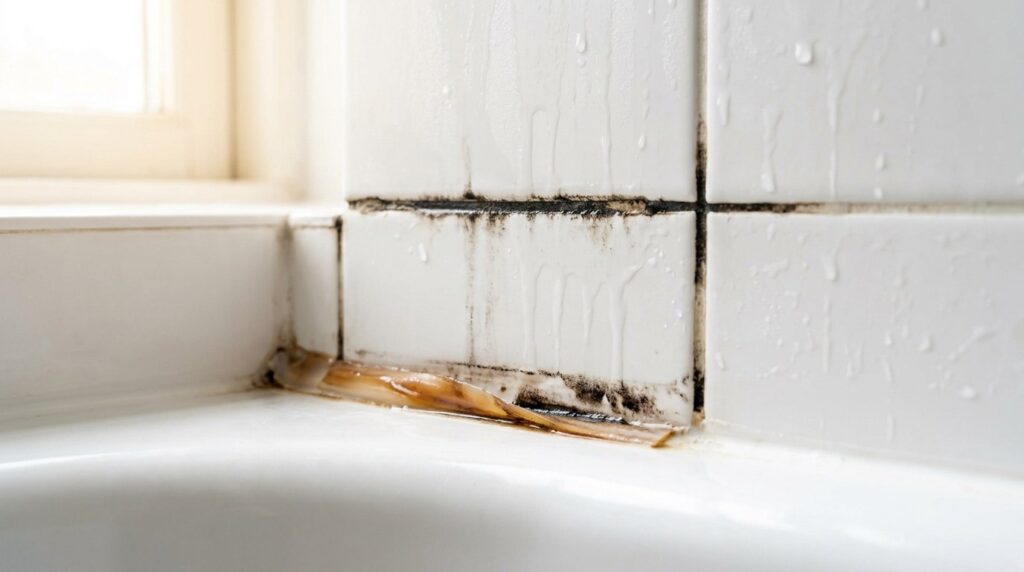
You go to wipe down the tub and the grout line moves. A hundred gray specks, each about the size of a mustard seed, scattering across the tile — and when the cloth gets close they do not run. They vanish. One is here, then three inches away, as if it teleported.
That jump is the giveaway. Those are springtails, and if they are living in your bathroom, the bathroom is telling you something a spray can will not fix.
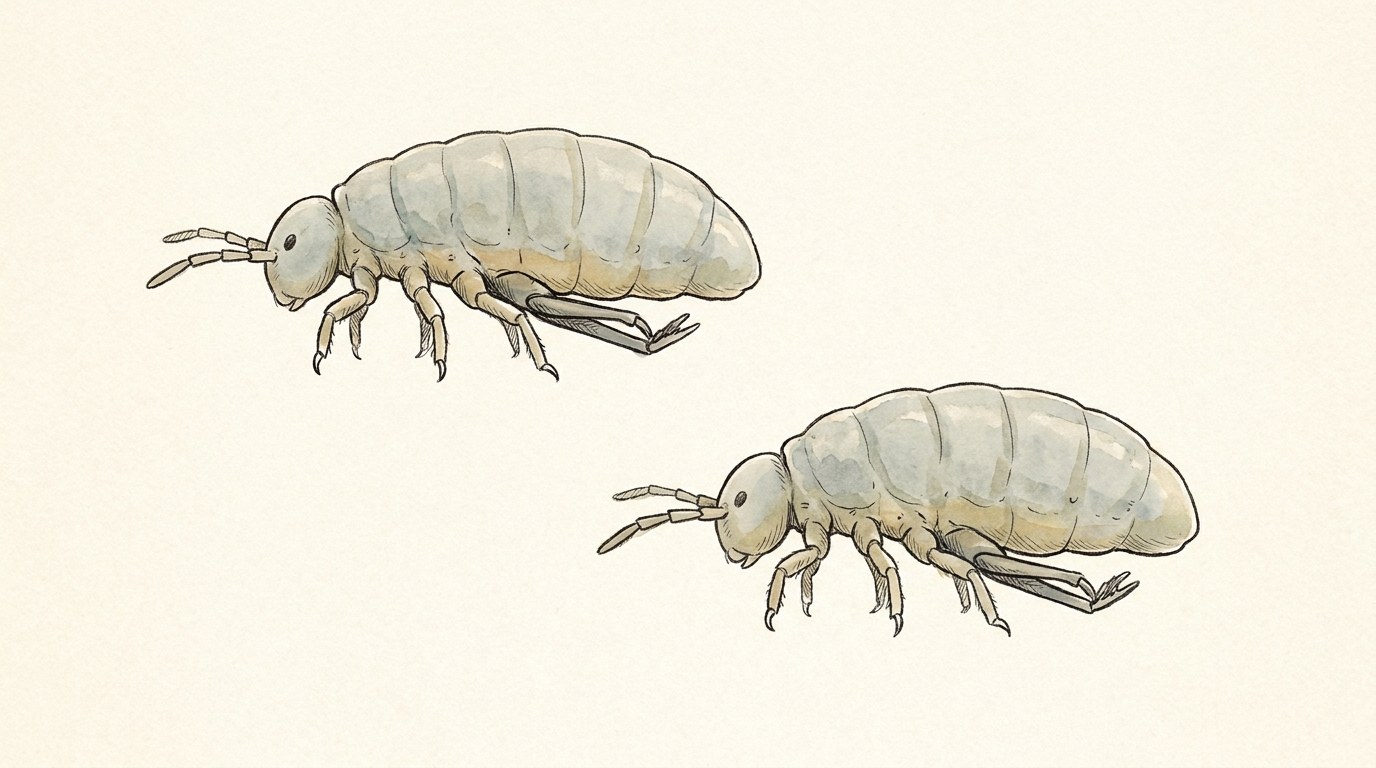
Springtails are Collembola: tiny six-legged arthropods that modern classification separates from the true insects. They do not bite, sting, spread disease or damage anything you own. What they eat is mold — mildew, fungi, the black bloom in a grout line. A springtail on your tile is not a pest that found you. It is a moisture reading.
Which is why the springtail calls reaching our Bronx pest control team so often arrive after two or three rounds of treatment have failed. The spray kills what it touches, then the water grows the food back. The real answer to how to get rid of springtails in a Bronx apartment has little to do with what you spray and everything to do with what stays wet.
Springtails all over your Bronx bathroom?
26+ years treating NYC apartments. We find the moisture feeding them instead of selling you another spray. No annual contracts, and an inspection we waive when you book the work.
How Do You Get Rid of Springtails in a Bronx Bathroom?
Three steps, and the order matters more than any one of them:
- Dry the room and take the mold off the hard surfaces. This is the step that ends it.
- Remove the ones you can see. Vacuum them, or wash them down the drain — UC IPM’s instruction for a sink or a tub.
- Keep air moving while the room dries. UC IPM notes a fan speeds it up.
The University of Kentucky puts it in one line: habitat manipulation is typically the best course of action for removing springtails from structures.
First, confirm what you have. Texas A&M AgriLife Extension gives the field test — if it is very small and jumps, it is probably a springtail. Penn State Extension puts the ones that get into homes at 1 to 2 mm; the University of Kentucky offers a better anchor, a mustard seed or smaller.
The jump is not from the legs. Springtails carry a forked appendage called a furcula, held folded under the abdomen by a latch called the tenaculum. Released, it snaps down and flips the animal into the air — up to 100 times its own body length, says Penn State. They have no wings and cannot fly.
Fleas are the common mix-up. The University of Kentucky draws the line: dark reddish-brown, hard-bodied and flattened side to side, around 1/8 inch — roughly half a grain of rice, and noticeably bigger than a springtail, which Minnesota Extension calls soft, rounded and easily crushed. If nothing you are watching jumps, you may have a different damp-bathroom tenant: start with silverfish in a damp older apartment.
The University of Kentucky’s careful phrasing on harm: there have been no verified reports of springtails causing bodily harm to humans or animals.
Why Won’t Spraying Kill Springtails in a Bronx Apartment?
Because the spray is aimed at the wrong half of the problem. One poster on r/pestcontrol, after repeated treatments from more than one company and a dehumidifier in the bathroom, wrote the sentence this post is about. “The good news is that almost all the springtails I see are dead on the sills. The bad news is that the number of springtails I see inside hasn’t gone down at all.”
That is an insecticide working exactly as designed and solving nothing. In a thread that pulled 67 upvotes, someone else described the same split: “There are tons of dead ones now out there, but there’s just as many still coming in.” A commenter in a New Jersey thread, 3 upvotes, worked out the cause after a year of paying for treatment — “Springtails like to eat mold/mildew so keeping that down is key.”
That is exactly it. Springtails feed on molds, mildew, fungi, bacteria and decaying plant material — Penn State Extension’s list — and UC IPM states that their continued presence indoors is an indicator of moisture. A residual kills the individuals that cross it. It does not remove the mold or dry the wall the mold grows on.
That is not our opinion. Four university extension services put it in print:
| Extension service | What it says about spraying for springtails |
|---|---|
| UC IPM, University of California | “Insecticide sprays are generally not recommended for springtail management. They are often no more effective than vacuuming… At best, pesticides will provide only temporary relief if the conditions favorable for springtail development are not corrected.” |
| University of Minnesota Extension | “Pesticides are not effective against springtails and should not be used inside the home…” |
| Ohio State University Extension | “Control with pesticides is generally not required if moisture management is followed.” |
| University of Kentucky Entomology | “applying insecticides inside will only provide temporary relief as springtails will continue to enter the home as long as outside conditions remain ideal…” |
Now the honest limit, because overstating this would be its own kind of dishonesty. None of them say sprays do nothing. UC IPM and the University of Kentucky both reach for the phrase temporary relief, and Ohio State allows a perimeter residual where moisture cannot be managed. The line we work to is that spraying buys days and drying fixes it.
One habit is worth stopping outright: Ohio State advises against total-release aerosols, or bug bombs, which rarely reach the cracks where springtails hide.
The best evidence is a thread with 129 upvotes that ran a year. Its author worked through product after product, then posted an update: “After about a year, I have seen almost no activity.” What changed was not a chemical. The source turned out to be a condensate line dumping water into a shaded spot that never dried out, since corrected and relocated. That house is not your apartment, but the principle crosses over: the fix came from hunting for water, not from killing springtails.
How Do You Remove the Damp and Mold Bronx Springtails Feed On?
Ohio State puts the extreme version on record: in wet basements, springtails have been known to cover walls that have mold growths. Where the mold goes they follow — in a Bronx apartment, usually the shower grout and caulk, the ceiling above it, or the cabinet under the sink.
The EPA’s guidance on mold, moisture and your home supplies the rule for this section: the key to mold control is moisture control.
- Scrub mold off hard surfaces with detergent and water, then dry completely. Tile, grout, painted plaster and porcelain are your hard surfaces.
- Anything porous may have to go — a bathmat, a cardboard box under the sink.
- Dry water-damaged areas within 24 to 48 hours, and never paint or caulk over a moldy surface.
- Bleach is not the routine answer. The EPA does not recommend chlorine bleach or other biocides as routine practice during mold cleanup, which puts it at odds with most of the internet.
One EPA line is the spray argument one species over: dead mold can still cause allergic reactions, so it is not enough to kill the mold — it has to be removed.
Then find the water. In an older Bronx building the candidates are unglamorous: a slow supply-line drip inside the vanity, a tub surround where the caulk has parted from the tile, cold pipes in a warm wall. One commenter watching springtails collect along the baseboard trim wrote what most people in that position are thinking — it was “freaking me out that I have moisture in there!” That worry is the correct one.
If the leak is not yours to fix, and in a rental it usually is not, that is a different route rather than a dead end. The EPA’s instruction to renters is to report plumbing leaks and moisture problems immediately to the building owner, manager or superintendent. Do it in writing.
How Do You Dry a Bronx Bathroom Enough to Stop Springtails?
Dry enough has a number, and it does not come from the pest world. The EPA puts indoor relative humidity below 60 percent, ideally between 30 and 50, readable with an inexpensive humidity meter. No extension service or health agency publishes a springtail-specific threshold, so treat any figure sold to you as one with suspicion. The EPA range is the right target anyway: it is the range that stops mold.
Getting a pre-war Bronx bathroom into that range is the actual work. These rooms were not designed for it: tile and grout everywhere, an air-shaft window that opens onto not very much, an exhaust fan that may not be ducted anywhere useful, cold supply lines in walls that sweat whenever the air is warmer than the pipe.
- Run the fan or open the window every time you shower, and leave it running afterwards. That is the EPA’s bathroom guidance.
- Put a dehumidifier in the room. Penn State Extension calls lowering humidity through air conditioning or dehumidifiers the best method for managing springtails, and singles out bathrooms.
- Air the room on dry days and keep air moving. Cornell Cooperative Extension (PDF), New York’s own extension service, recommends exactly that.
- Insulate the cold pipes. Ohio State says to wrap and insulate pipes where water may be condensing. Foam sleeves cost very little and a tenant can fit them.
- Treat condensation as a reading, not a nuisance. The EPA is direct: if you see condensation on windows, walls or pipes, act quickly, because it can signal high humidity.
The payoff comes faster than people expect. Minnesota Extension says springtails are generally a temporary problem and die when moisture levels are reduced, and the Missouri Department of Conservation explains why: they do not survive long in houses, because homes are rarely damp continuously. Read that backwards and you have your diagnosis — if they are thriving in your bathroom, your bathroom is continuously damp. One commenter, 13 upvotes, put it briskly: “A dehumidifier in the area will definitely get rid of them. They are usually a sign of high moisture.”
How Do You Treat Springtails Around Bronx Drains and Under Sinks?
Start with a correction, because nearly everyone has this backwards. The drain is where springtails gather. It is not where they come from.
The University of Kentucky states it plainly: while springtails tend to aggregate in areas of standing water such as drains, they often move to those areas after entering the home by another route. One homeowner in Texas got there the hard way, after pouring product after product down the pipes — “We’re fairly certain they don’t actually originate from the sinks and drains. They just congregate there.”
UC IPM says they crawl in search of moisture and are often trapped in sinks and bathtubs. Trapped is the right word: a tub is a smooth-sided basin, easy to fall into and hard to leave.
- Wash the ones in the sink or tub down the drain. UC IPM’s own advice, and it costs nothing.
- Never pour or spray insecticide down a drain. Also UC IPM, and worth taking literally.
- Open the cabinet under the sink and put a hand on the pipes. Under-sink damp is almost always a slow leak at a joint, or condensation on a cold supply line in a warm cabinet. Ohio State’s advice is to repair the leaks and insulate the pipes.
- Dry the basins after you use them. One commenter, 4 upvotes, went from a dozen sightings a day to one or two after a repaired faucet and this habit: “I’m also wiping up any standing water in the sinks and tubs after use.”
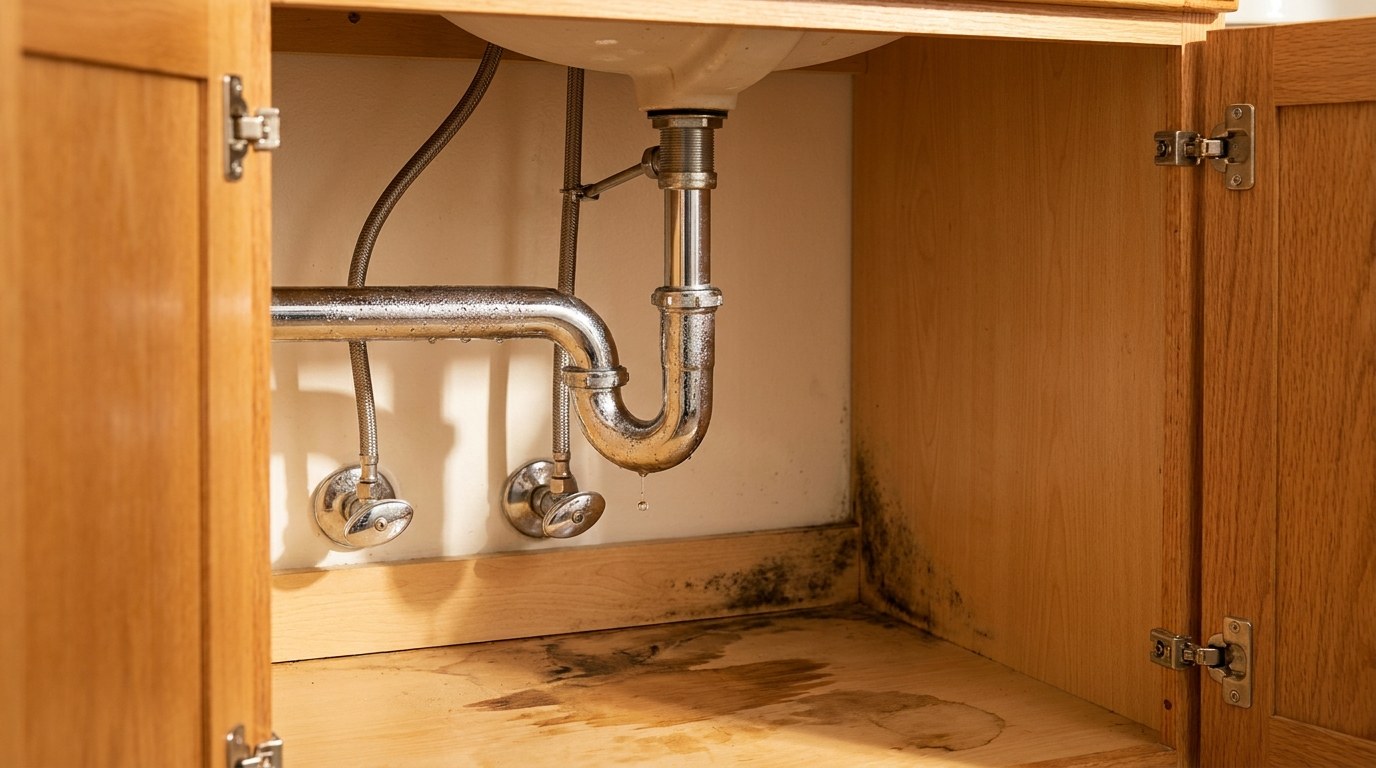
The P-trap is worth understanding rather than treating. That U-bend holds a plug of water to keep sewer gas out, so your bathroom has standing water in it by design. A wet cabinet floor or a stained board under the trap is another matter — that is a leak, and it is what to chase.
In a rental, leaking pipework is the landlord’s job — Local Law 55 puts repairing leaking drains and faucets first in an owner’s pest management. And if the drain itself is the story, with a smell and small flies rather than jumpers, that is a different problem, covered in our guide to drain flies and what they breed in.
Springtails all over your Bronx bathroom?
26+ years treating NYC apartments. We find the moisture feeding them instead of selling you another spray. No annual contracts, and an inspection we waive when you book the work.
Do Springtails in Bronx Houseplants Need a Different Treatment?
Yes, and the difference is one idea: you do not treat the soil, you dry it.
Minnesota Extension’s instruction is to let the soil dry out and water less frequently but more deeply, and it flags mixes high in peat as the ones that stay wet longest. UC IPM and Cornell add the step people skip — empty the saucers, and never let a pot stand in water. Cornell says that if springtails persist after that, repot in sterile soil. Texas A&M notes that a chronic indoor springtail problem often turns out to be living in potted plants, so the pots are worth checking even when the bathroom is the visible problem.
That is the whole difference. If what rises out of your plant pots flies rather than jumps, it is not a springtail — see our guide on getting rid of fungus gnats indoors instead.
How Do You Prevent Springtails Returning to a Bronx Apartment?
Prevention here is not a barrier but a set of standing conditions. The moment the room goes damp again they come back; if it never goes damp, they cannot hold a population at all.
- Hold the humidity. The EPA’s 30 to 50 percent is a place to stay, not to visit.
- Ventilate on a schedule, not on a feeling. The EPA’s note on rooms that are often or always damp is that increasing ventilation and cleaning more frequently will usually prevent mold recurring.
- Close the small gaps. UC IPM’s exclusion list is renter-scale where it counts: spaces under doors and around windows, closed with caulk, weather stripping, fine-mesh screen or steel wool. Where the gap is structural — a sash that no longer closes — that is a work order.
- Expect the window sills. UC IPM notes springtails are attracted to light, which is why sills are where people find them piled up.
Pressure from outside does have a season: Penn State says springtails become a nuisance in homes during extended droughts or prolonged, saturating rains, and UC IPM puts their usual appearance in spring and early summer. An indoor population does not follow that calendar, because your bathroom keeps its own weather.
When Should a Bronx Renter Call a Pro to Eliminate Springtails?
Five situations — and four of them are about water rather than insects.
You dried the room and they are still there. One poster in inland California — arid, no leaks — could not shift them, and found a dehumidifier useless because the local humidity never climbed above 25 percent. That is the opposite of a Bronx bathroom, but it makes a fair point: drying is the lever here because your room is damp, not because drying is a law of nature. If the room reads 40 percent and they persist, the water is somewhere you cannot see. The EPA lists where mold hides — behind drywall, inside walls around leaking pipes, behind furniture — and advises hiring a professional if you suspect a hidden mold problem.
The mold is bigger than about ten square feet. That is the EPA’s do-it-yourself threshold, roughly a three-foot by three-foot patch. In New York City it is a legal line too: HPD requires owners of buildings with ten or more units to bring in a State-licensed mold assessor and remediator above that size.
Your landlord is not acting. This is the most useful thing a Bronx tenant can know, and no article selling you a spray leads with it. Under New York City’s Local Law 55, owners of buildings with three or more apartments must keep tenants’ apartments free of mold and pests, inspect annually for indoor allergen hazards, and remediate mold. Report the leak or the mold in writing; if it is not fixed, file a complaint online or call 311. Springtails are not among the four hazards the law names — mold, mice, rats and cockroaches — so lead with the mold and the leak, which are covered and are what solves your problem anyway.
Pesticide is genuinely warranted. Rare, on the evidence above. Where it is, HPD’s guidance is that it must be applied by a professional licensed by the New York State Department of Environmental Conservation.
You cannot find the water. One commenter, 3 upvotes, set the standard better than we would have: a large number inside means a source of moisture inside that they are living off, and your pest control company should be checking walls and cabinets for it. “If they don’t, I’d find a new company.”
That is a fair test and we would rather be measured by it. On a springtail call in a Bronx apartment, the part that earns its keep is the inspection: reading the humidity, opening the cabinet under the sink, checking the tub surround and the wall behind it, then telling you whether the water is yours to fix or your building’s. We document it either way, because a tenant with a written record gets further than a tenant with a complaint.
The Bottom Line on Springtails in a Bronx Apartment
Springtails are not a threat but a symptom, and an unusually honest one: they cannot hold a population in a room that dries out, so a bathroom full of them is a bathroom that never dries.
- They eat mold, not you. Collembola, a couple of millimeters long, no bite, no sting, no disease, no damage.
- Spraying buys days; drying fixes it. UC IPM, Minnesota Extension, Ohio State and the University of Kentucky all state in print that insecticide is not the answer here.
- Work to 30 to 50 percent relative humidity, the EPA’s range. Fan every shower, a dehumidifier if the room needs one, insulation on the cold lines, mold scrubbed off rather than painted over.
- The drain is a meeting point, not a source. Do not pour anything down it; look at the cabinet around it instead.
- Dry the plant pots between waterings.
- If the water is not yours to fix, Local Law 55 makes it your landlord’s. Report it in writing; 311 and HPD are the next step.
None of that is a treatment schedule, which is the point. Springtails are one of the few pest problems where the room does the work and the chemistry barely matters. If your bathroom is dry, the mold is gone and they are still there, something is wet where you cannot see it — and that is the visit worth booking. When we take one of these calls, the first thing we go looking for is the water, not the insect.