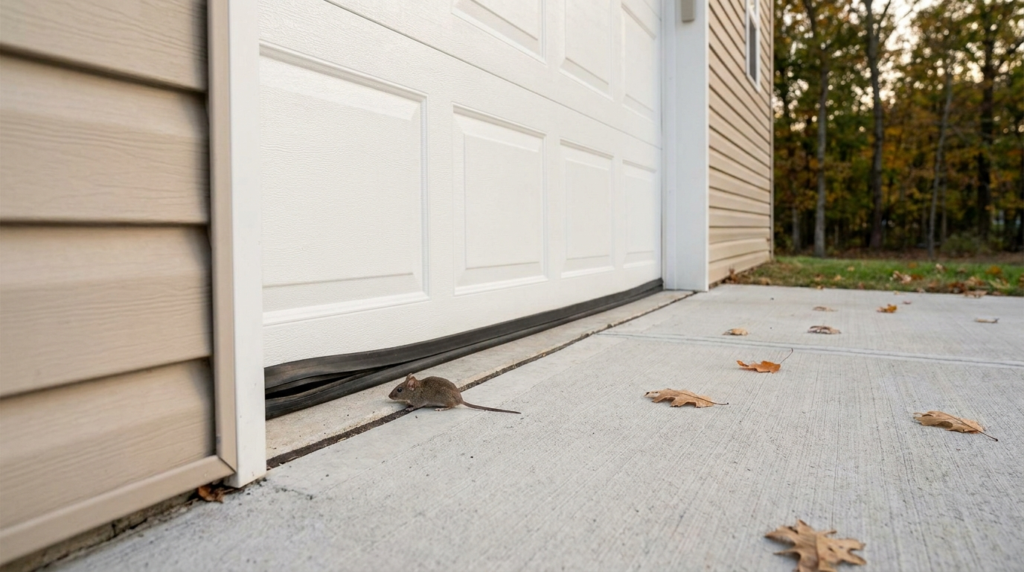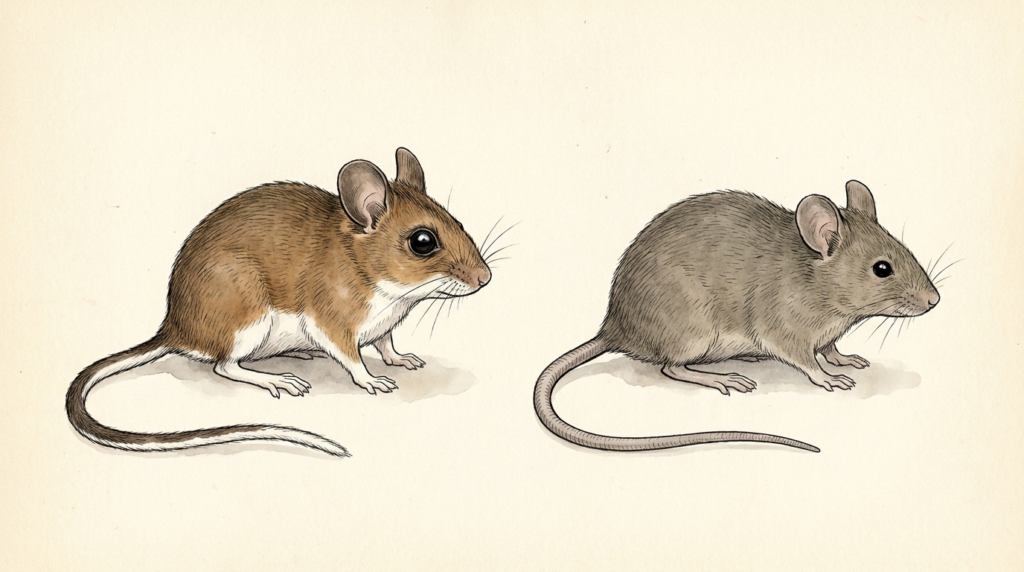
You tip a flowerpot on the back steps, something dark and fast runs out with a pair of curved pincers on its tail, and your finger stings. Or a kid comes in from the yard with two small red marks on one hand and a story about a bug with claws on the wrong end.
It almost certainly was not a bite. Earwigs are built wrong for biting people, and what you felt came from the other end of the insect. We handle pest control in Queens for a living, and that distinction is not pedantry — it changes what the mark means, what it can do to you, and what you do next.
One more thing up front: we are a pest control company, not a medical provider, and this post stays on our side of that line. What we can do is show you the evidence — university fact sheets, a New York State entomology program, two NIH reference chapters and one peer-reviewed case report — and be straight about where it runs out.
Earwigs turning up inside your Queens home?
Our techs find the damp harborage earwigs hide in and treat it directly, with family and pet-friendly options and no annual lock-in. We waive the inspection fee when you have the work done.
Do Earwigs Bite or Pinch Queens Residents, and How Do You Tell?
Start with the mouth, because that is where a bite would have to come from. The New York State Integrated Pest Management Program at Cornell settles it in one sentence: earwigs are “virtually harmless to humans,” they “do not spread diseases,” and “their mouths are too small to bite.” That is the mechanical answer, and it beats every hedge on the subject because it explains why. An earwig’s jaws are sized for decaying plant material, pollen and small soft-bodied insects. Not for your finger.
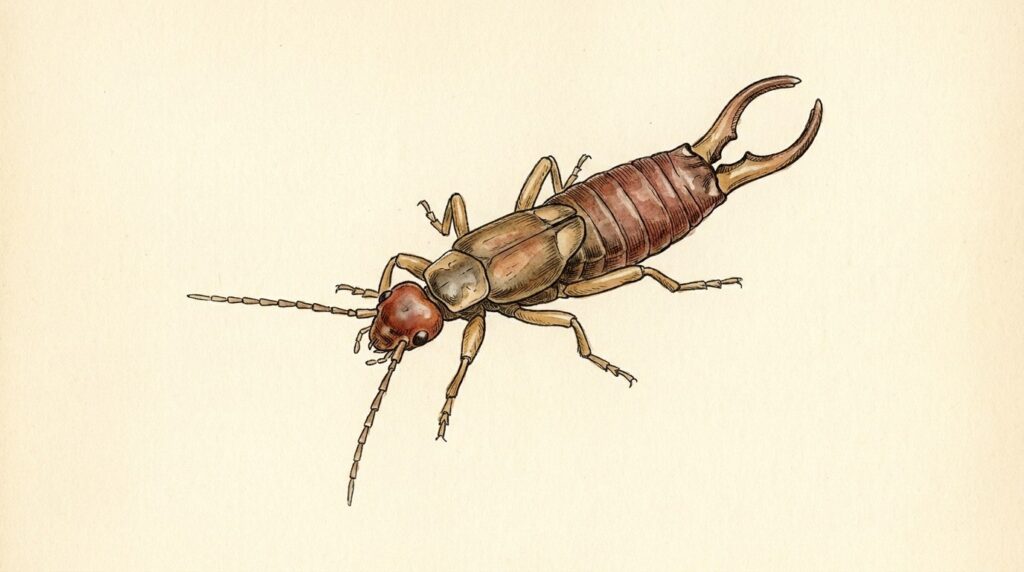
What got you sits at the other end of the body. Earwigs carry a pair of pincers on the tip of the abdomen — entomologists call them cerci, and every source describes them as resembling forceps. University of Minnesota Extension adds the part that matters to you: they “cannot squeeze very hard,” and “earwigs cannot use their pincers to attack. They are harmless to people.” The cerci are equipment for mating, parental care, defense and catching prey. A pinch is what the insect does when it would rather run and cannot.
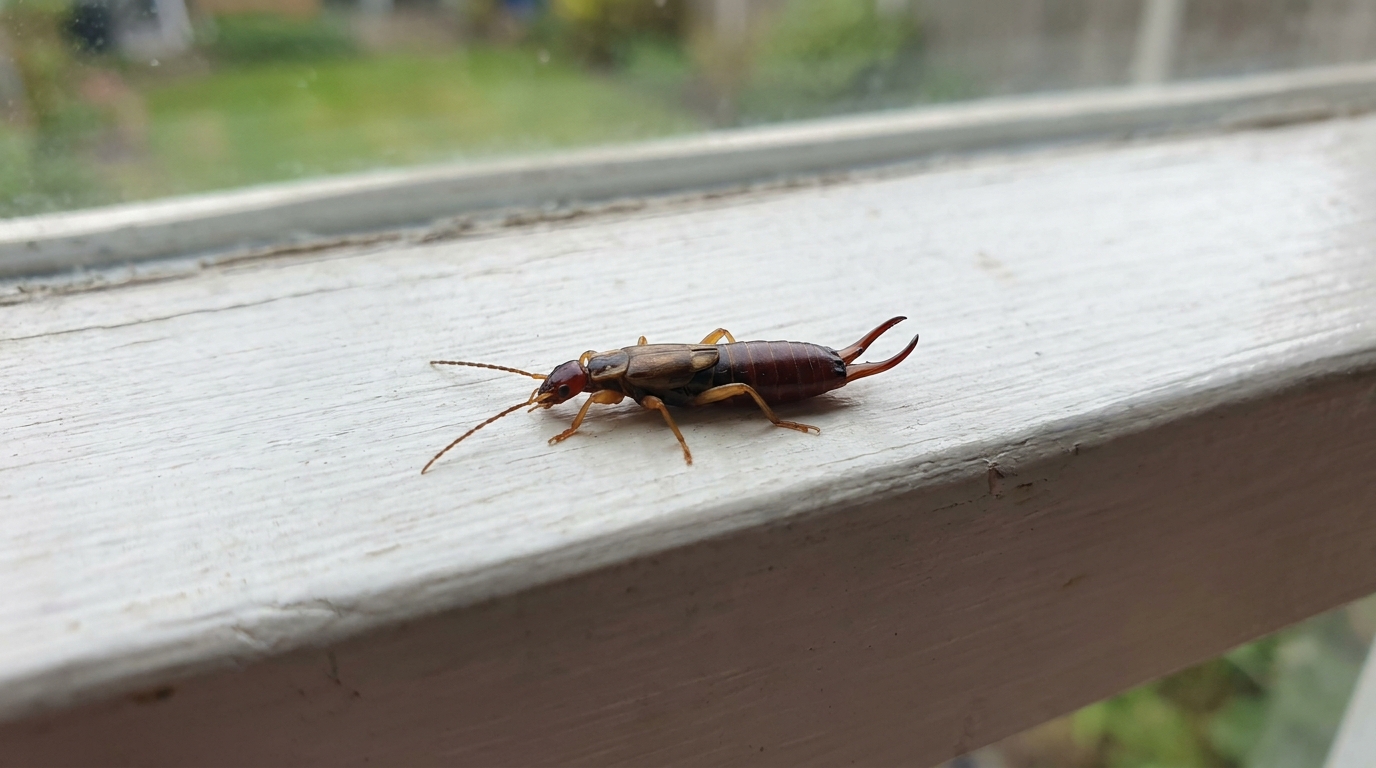
One honest exception, from the University of California’s IPM program: “Contrary to popular myth and despite their ferocious appearance, earwigs generally don’t attack humans, although they are capable of biting if trapped in clothing or sat upon.” So biting is not physically impossible in every circumstance. But if you lifted a pot and felt a sharp nip, that was the pincers.
People online will tell you otherwise, and they are not lying about what they felt. One commenter in a bug identification thread writes that earwigs “totally bite and it hurts”; another corrects it a few replies down — “they don’t actually bite so much as pinch.” Both felt something real; only one has the body part right. One more cue: a disturbed earwig can release a foul odor, so a smell left on your hand fits too.
How Do You Identify an Earwig Pinch on a Queens Child or Pet?
The limit first: we do not diagnose marks on skin, and you should be wary of anyone in pest control who offers to. A clinician looks at the mark. We look at what was in the room.
The mechanism predicts something specific: one structure with two arms closing produces two marks close together, not a single puncture and not a scattered cluster. Verywell Health’s earwig explainer says a pinch typically “doesn’t break the skin,” and that “if it does, you might see two red marks or experience slight bleeding. If your skin is broken, treat it as you would a scratch.”
Context identifies better than the mark does. Earwigs are nocturnal and spend daylight wedged into dark, moist crevices, so the useful questions are about the ten seconds before:
- What did your child pick up, move, or reach underneath — a flowerpot, a doormat, cardboard, firewood?
- Did they close a hand around something, or kneel or sit on it?
- Did it happen once, at that moment, and not again?
A one-off pinch the instant something got disturbed fits an earwig. As one commenter put it: “as long as you don’t go grabbing them they’ll just run away.”
Pets are where we admit a gap rather than fill it. Nothing we verified gives earwig-specific veterinary guidance, and we would not read a mark on a dog for you anyway. What carries across is what the insect brings: no venom, no disease, pincers that cannot squeeze very hard. If your pet is genuinely distressed, call a veterinarian.
Do Earwigs Really Crawl Into Ears, and Where Do Queens Cases Come From?
Take the second half of that question first, because it needs a blunt answer: the “cases” behind this fear do not come from Queens. They come from a name, an ancient superstition, and one case report from a hospital in Seoul. We have no record of an earwig in anyone’s ear in Queens, we found none in the literature, and we will not imply otherwise.
The name is the origin of the whole story. “Earwig” comes from the Old English ēare, meaning ear, and wicga, meaning insect — literally, ear creature. Attached to it is a superstition that the insect crawls into a sleeping person’s ear and burrows into the brain; some versions add eggs laid in the ear, some add fever and insanity. Every source we checked treats the package as folklore with no evidence behind it.
That is why the standard answer is no, flatly. Penn State Extension states it as fact: “Despite the name, these scavengers do not crawl into the human ear.” Cornell’s fact sheet files the ear-and-brain story as an urban myth, and the pest control industry says much the same. That flat no is very nearly right.
Very nearly. In 2021, doctors at Konkuk University Medical Center in Seoul published a case report in the medical journal Cureus. A 24-year-old man arrived at their clinic, woken early in the morning by ringing and severe pain in his left ear, saying a bug seemed to have gone into it. Otoendoscopic examination showed an earwig crawling in his external auditory canal. A bright light failed to draw it out, so they removed it with ear forceps. The symptoms were relieved as soon as it was out; the eardrum and canal were normal with no traumatic lesions, and hearing testing came back normal. The authors’ conclusion: “Although an ancient myth that earwigs burrow through the external auditory canal and eat sleeping persons’ brains is considered unfounded, these bugs sometimes do enter the ear, causing severe ear discomfort.”
Now the limits, because this is where an article like this one goes wrong. That is one patient, one clinic, Seoul, 2021 — not a pattern, not a statistic, not a New York number. It was published as the first video demonstration of the phenomenon rather than a measurement of it, and its authors call the earlier reports anecdotal. It does not tell you how often this happens with earwigs, and neither will we. If anyone hands you a percentage, they made it up.
Verywell Health’s explainer, which now cites that case report, puts it about as well as it can be put: “There is no evidence that earwigs seek out human ears to cause harm. If an earwig is found in a person’s ear, it is likely that the earwig wanders there by chance. While emergency rooms do sometimes see people with small bugs in their ears, this isn’t unique to earwigs.” That is the whole position, in three parts that do not contradict each other: the brain-burrowing story is false, the ear canal is not impossible, and nothing in the documented case points toward harm.
We are not the first to land here and will not pretend to be — a widely read consumer health page already holds this position, and the case report itself now surfaces in search. What is still true is narrower: inside pest control content, and on the extension fact sheets quoted above, the answer given is a flat no — and the flat no is the answer that travels. In one bug identification thread, a confident denial picked up more than twenty times the votes of the more careful answer the same person posted a few comments later.
Are Earwig Pincers Dangerous, and How Do Queens Doctors Look at Them?
The pincers first: no venom and no disease. The Verywell explainer states the pinch “doesn’t transmit venom or disease.” Cornell says earwigs “do not spread diseases.” University of Minnesota Extension calls them “harmless to people.” The University of California program adds that even large accumulations “present no health hazards.” And Clemson’s Home and Garden Information Center answers the fear underneath the whole question: “While they can give you a little nip if you pick one up, they cannot burrow into people.”
The second half of that heading needs care. We cannot tell you what a doctor in Forest Hills or Astoria thinks about earwigs, and we will not put words in anybody’s white coat. What we can tell you is what the medical record contains — and it contains almost nothing about earwig pincers. Across a case report, two NIH reference chapters and five university fact sheets, the pincers never appear as a medical problem. Where earwigs show up in medicine at all, it is in the ear.
Clinical judgment applies here the way it applies to any small break in the skin: Verywell’s guidance is to treat a broken-skin pinch the way you would treat a scratch, and whether a particular one needs attention is a clinician’s call, not ours. For scale, since “harmless” can sound like a dodge — Penn State notes earwigs use their forceps to capture prey, and the UC program calls them voracious feeders on soft-bodied insects such as aphids. Against an aphid those forceps are serious equipment. Against a finger, Minnesota’s line stands: they cannot squeeze very hard.
Where Should Queens Residents Look for Earwigs Before They Pinch?
Pinches happen when a hand and an earwig arrive in the same spot at the same moment. So the practical question is not how to get rid of them — different job, not this post — but where they spend daylight, so your hand does not surprise one.
They are nocturnal, and by day they wedge into dark, confined, damp spaces and stay put. University of Minnesota Extension’s list reads like a walk around a Queens property: under potted plants, under leaves, under welcome mats and other objects, and in the cracks between pavers and bricks. Penn State describes “any dark, moist crevice.” Clemson puts them in mulch and organic debris. Translated into what a Queens property actually has:
- The underside of every flowerpot, planter tray and bag of potting soil on a patio, stoop or deck
- The doormat, top and bottom, on a landing that never gets direct sun
- The joints between pavers, and the gap where a walkway meets the foundation
- Leaf litter and mulch along a fence line, or the damp strip between attached houses
- Indoors, the damp end of a basement, a crawl space, or anywhere a plumbing leak keeps things wet
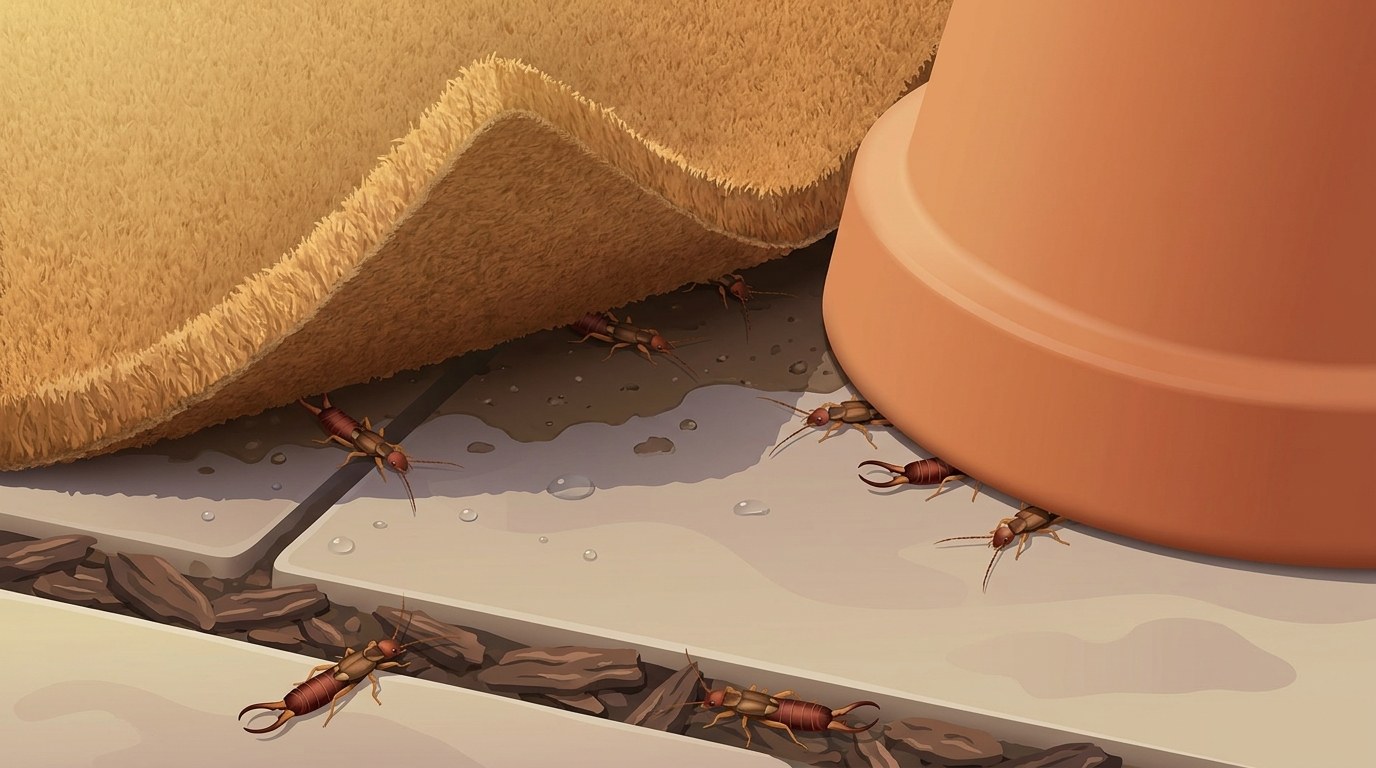
On motive, the Verywell explainer is worth quoting: earwigs do not enter homes to seek people out, and most wander in accidentally looking for moisture, shelter and dark hiding spots at night. They turn up more after rainy weather, in humid conditions, and in homes with damp basements, crawl spaces or plumbing leaks. Minnesota records them moving into buildings during July and August, sometimes in large numbers — a Minnesota observation, not a Queens one, but the driver is moisture, and moisture is not regional.
The avoidance part is unglamorous and it works. Gloves when you lift pots or move stacked material. Shake the doormat out yourself before a kid grabs it. Look at the underside of a thing before your hand goes under it. Do not close your hand around one. What we have deliberately not done here is tell you how to clear them out — that is its own procedure, and we wrote it up separately in our guide to getting earwigs out of a house and off the property.
Earwigs turning up inside your Queens home?
Our techs find the damp harborage earwigs hide in and treat it directly, with family and pet-friendly options and no annual lock-in. We waive the inspection fee when you have the work done.
How Do You Tell an Earwig Pinch From a Bite by Another Queens Pest?
Honestly? Usually you cannot, not from the mark alone. That is the sentence most articles leave out, and leaving it out is how people end up certain about the wrong insect. What identifies an earwig pinch is the insect, not the injury.
Consistent with an earwig pinch:
- Two marks close together rather than one, because it is one structure with two arms
- Often no broken skin at all
- It happened the instant something got disturbed, and it did not repeat
Not consistent with one:
- A single puncture, a cluster, or a line of marks
- Marks that appeared while you were asleep with nothing disturbed
- Anything that keeps happening night after night — a pinch is a one-time defensive reaction to a hand, not a feeding pattern
The default failure is that scary-looking gets convicted. In one earwig forum, a poster blamed a run of marks on earwigs and never got an identification; their own follow-up: “i was in colorado when i made that post, when i got back home the bites stopped.”
Cockroaches are the comparison people reach for most, and they deserve a proper answer rather than a paragraph here, so we wrote one: whether cockroaches bite, and what it actually takes for one to do it. Worth knowing that when the medical literature discusses a live insect in an ear canal, the arthropods it names as common are cockroaches and ticks — not earwigs. That is part of why one earwig case was publishable at all.
Two other regular defendants: house centipedes, which look considerably worse than they are and which we covered in our rundown on house centipedes in New York homes, and spiders, which get blamed for an enormous share of unexplained marks — if spiders are the real concern, we treat for spiders separately. A mark is not an identification. If you need to know what is living in the house, that comes from an inspection, not a photograph of your forearm.
When Should Queens Residents Find a Doctor After an Earwig Pinch?
Our line, stated once and meant: we are a pest control company, not a medical provider. Everything below points at the medical literature, then at the door of a clinic.
If the pinch did not break the skin, nothing in the sources treats that as an injury. If it did, Verywell’s guidance is to treat it the way you would treat a scratch. Whether yours needs a professional look is a clinician’s call — and if you are sitting there wondering, that wondering is your answer.
Something in your ear is the one place we will be blunt: do not try to get it out yourself. No tweezers, no cotton swab, no water, no oil. Go to a doctor or an urgent care.
Two reasons, both from the NIH’s StatPearls reference library. The first is anatomy: the chapter on the external ear explains that the canal is richly innervated, including by the auricular branch of the vagus nerve — Arnold’s nerve — and that mechanical stimulation can set off a cough reflex, gagging, or, less commonly, cardiovascular responses such as a slowed heart rate. It flags foreign body removal specifically. Poking around in your own ear canal is not a neutral act.
The second is that there is a real protocol and it is not a home one. StatPearls’ chapter on ear foreign body removal states that the initial step with a live arthropod — most commonly a cockroach or a tick — is to kill it, and that research shows mineral oil is the most effective agent, followed by lidocaine, which also anesthetizes the canal. That is a trained person, a specific substance and direct visualization. It is not your bathroom, and we will not tell you what your own doctor will decide.
A child who says something is in their ear gets a professional look, not a parent with a flashlight and a pair of tweezers — in the documented case the doctors tried light first and the insect kept crawling anyway. A pet gets the same principle and a different phone number.
In the case that was documented, the symptoms stopped the moment the insect came out and nothing was damaged. That was one patient in Seoul, not a promise about you — but nothing in the record we read suggests an earwig in an ear is the catastrophe the insect’s name implies.
The Bottom Line on Earwig Bites in Queens
- Earwigs do not really bite. Cornell’s New York State IPM program gives the reason: their mouths are too small to bite. What got you was the pincers at the tail end.
- The pinch carries no venom and no disease. It usually does not break the skin, and at worst leaves two small red marks that get treated like a scratch.
- The brain-burrowing story is false, and the ear canal is not impossible. There is one documented case, in Seoul, and the patient’s ear was fine afterward. If you think something is in your ear, that is a doctor’s job — not ours, and not yours.
The part that genuinely is ours is the reason an earwig was somewhere your hand could reach it. These are moisture insects — they shelter under pots, mats, mulch and pavers, and they wander indoors by accident when it is wet. Fix that and the encounters stop.
Earwigs sit in the general and seasonal insect category on our list, and the work is the same as for most damp-loving nuisance insects: find the moisture and the entry points, then treat them directly, with family and pet-friendly options. We work out of Glendale, Queens and cover the whole borough plus the rest of the five boroughs, Nassau and Suffolk, with same-day service during business hours. The Queens Tribune and Queens Ledger named us Best Pest Control in Queens, and we hold a 4.8-star average across more than 330 reviews.
If earwigs are turning up inside, or you would rather have someone identify what is in the house than squint at a photograph of a mark, ask us for a free estimate at (718) 418-8986.