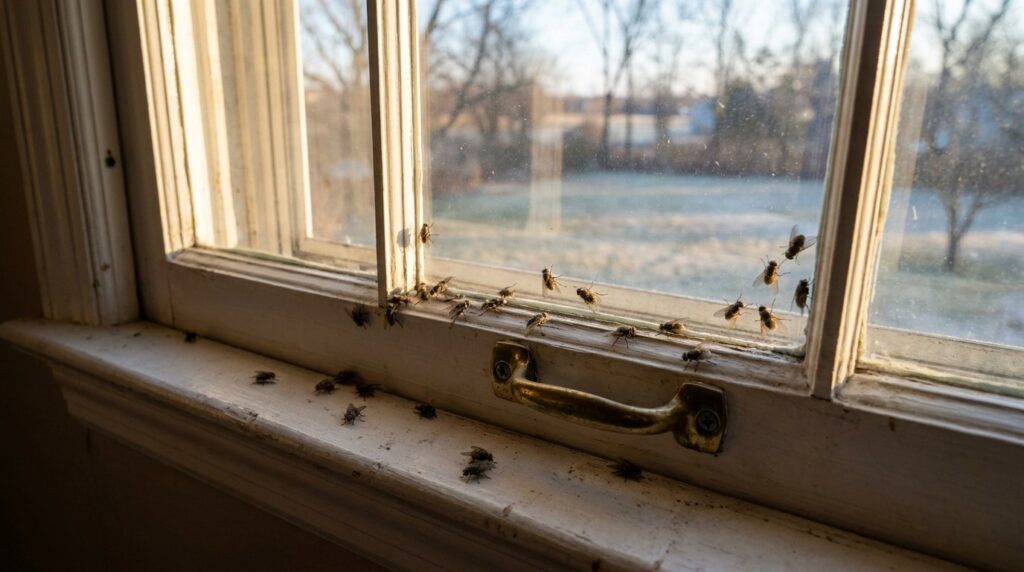
Every February we take the same call from Long Island homeowners. Twenty flies on the sunniest window in the house, 28 degrees outside, nothing left out on the counter. The kitchen has already been torn apart looking for a source. Somebody vacuums them all up, and on the next mild afternoon there are twenty more.
Here is the part almost nobody leads with: there is nothing indoors to treat. Cluster flies cannot reproduce inside a house. The ones on your sill got in last September, went dormant in a wall void or the attic, and are stirring now because the sun warmed that side of the building. You are not watching a new infestation hatch — you are watching last autumn’s arrivals try to leave. We have handled pest control in Suffolk County and Nassau homes for 26 years, and this is one of the most misread calls of our winter.
That single fact changes what you should do about them, and it explains the part that frustrates people most: the flies come back every winter no matter what got sprayed the autumn before.
Cluster flies waking up in your Long Island attic?
26+ years treating Long Island cluster flies. We check the attic, the soffit runs and the wall voids ourselves, keep everything month to month with no annual contract, and the estimate is free.
Why Do Cluster Flies Find Long Island Attics Again Every Winter?
Start with the part that surprises people: the flies in your attic this winter are almost certainly not the same individuals you had last winter. Most of the population that overwinters in a building does not die there. Come spring they move back outdoors and run through several generations on the lawns around your house. Only the last generation of the year goes looking for shelter, and it looks in exactly the conditions that worked the year before.
Three of those conditions never change on a Long Island street. First, sun: from roughly mid-August into early October, cluster flies gather on the sun-warmed south and west walls of buildings, and Colorado State University Extension notes that if there are any entry points there — cracks around a window or the soffits, unsealed areas of siding — the flies will use them. Second, the house: same siding, same soffit, same window that has been shedding its caulk since 2011. Third, the soil, because the lawns that produced last year’s flies are still right there.
That combination is why one house on a block gets a reputation. As one homeowner put it on a forum, chances are the previous owners of your home had cluster flies too and did not tell you.
Now the claim you will find everywhere online, which deserves some care: that cluster flies leave a pheromone behind that pulls next year’s flies back to the same attic. We see it repeated constantly on homeowner forums. But none of the university extension sources we read for this article mention a pheromone trail at all. What they document is plain site suitability — same warm elevation, same gaps, same worm-rich soil nearby producing a fresh crop every August. Until somebody publishes the research, treat the pheromone story as a homeowner theory rather than biology.
The gaps themselves are worth closing, and that is a project rather than a spray — we covered the sealing side of overwintering insects in our guide to sealing out overwintering stink bugs, and it applies to cluster flies line for line.
How Do You Tell a Cluster Fly From a House Fly on Long Island?
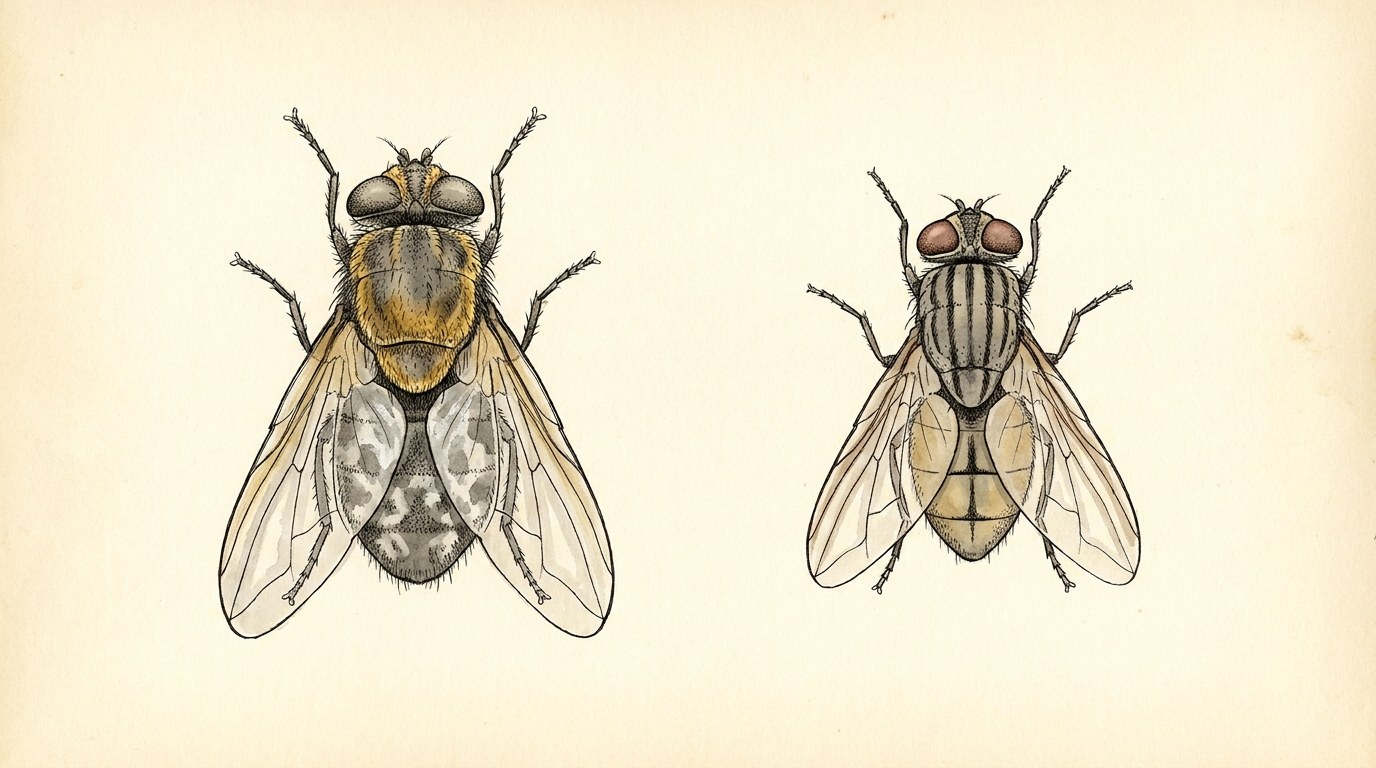
Honestly? Not easily, at a glance. The University of New Hampshire’s extension fact sheet says it straight: to the layperson, cluster flies have no obvious characteristics that distinguish them from ordinary house flies. Both are dull gray. The difference shows up when you slow down and look at three things — the thorax, the wings and the behavior.
The thorax is the reliable marker. A cluster fly carries golden-yellow hairs across the top front of its thorax, which in good light reads as a faint golden sheen over the gray. Under a hand lens the individual hairs are unmistakable. A house fly has no golden hairs at all — it has four dark stripes running down a gray thorax.
The wings tell you at rest. A cluster fly folds its wings flat over its back with the tips overlapping.
The behavior is what most people actually notice. House flies are fast, evasive and very interested in your food and your garbage. Cluster flies are slow, easy to swat and uninterested in any of it — they are on the window, not the counter. If a fly in February lets you walk up and put a cup over it, it is almost certainly not a house fly.
One more tell, up close: a Purdue Extension bulletin notes that captured cluster flies give off an odor like buckwheat honey, which is where the old name buckwheat fly comes from. You will also see them called attic flies.
| What to check | Cluster fly | House fly |
|---|---|---|
| Size | Roughly 1/4 to 3/8 inch, slightly larger than a house fly | Slightly smaller and more compact |
| Thorax | Golden-yellow hairs, a golden sheen over gray | Four dark stripes on gray, no golden hairs |
| Flight indoors | Slow, clumsy, easily swatted or cupped | Fast and evasive |
| What draws it inside | Nothing in your kitchen; not attracted to food or filth | Food, garbage, waste |
| Where the young develop | Lawn soil, inside earthworms | Garbage, manure, decaying material |
| When you see it inside | Warm sunny days, autumn through early spring | Warm months, or year-round in a heated building |
Where Do Cluster Flies Hide Inside Long Island Walls and Attics?
Attics first, and by a wide margin — enough of the population ends up upstairs that “attic fly” became a standard common name for the species. From there they spread into whatever cavity is closest: wall voids behind knee walls, soffit runs along the eaves, the space under loose siding, and the gap between a storm window and the sash. That last one catches people out every year — dozens of flies stacked between the glass and the screen on a window nobody has opened since October.
Long Island housing stock gives them plenty to work with. Capes and split-levels have knee-wall attics, which is really a heated-side wall void with a hatch on it. Older colonials have deep unfinished attics. Newer builds punch recessed lights and bath fans through the ceiling plane. Flies work down from any of those through window frames and around electrical fixtures — which is why the fly that lands on your kitchen table in January came down from above rather than up from a drain.
Worth saying plainly, because it saves wasted effort: this is not a sanitation problem. Drain flies breeding in a sink trap and gnats and fruit flies in the kitchen are a different situation, with a real indoor source you can find and remove. Cluster flies have none.
It is also why “just treat the attic” does not clear the problem. We drill and dust wall voids all week for other pests and we are glad to do the attic work. But an overwintering population is not a nest with an address — it is a dormant crowd spread thin through voids, soffit runs and siding cavities that nothing reaches from the inside. A treatment brings the number down. It does not zero it, and anyone telling you otherwise has not opened enough soffits.
Why Do Long Island Cluster Flies Look Sluggish on Sunny Windows?
Because they are not really awake. Cluster flies spend the cold months in diapause, a true dormancy rather than a slow day. Metabolism drops, reproduction stops, and they sit clustered together and move little if at all for months. What they do not do is switch off entirely: a warm, sunny stretch stirs them, and some wander out of the void into your living space.
The mechanism explains the timing. On a sunny winter day the south and west sides of the house warm first. Michigan State University Extension describes what happens next about as well as anyone: the flies are surrounded by warm air, revive, and try to find their way to the exit — which is probably right next to a window, where the molding has contracted in the dry air. The result, in their phrase, is a number of flies sitting on the sill in a cluster-stupor.
The same thing happens on a bigger scale in the attic: on a sunny day in fall or winter it can get warm enough up there to activate the flies, and once they are moving, plenty work down into the lower floors. That is why they usually show up at a second-floor window before anybody sees one downstairs.
Two practical consequences. First, sluggish does not mean dying. Homeowners read the slow, clumsy flies as proof that last month’s spray is finally working, then get demoralized when a warmer day produces a fresh batch. Nothing killed them; the temperature changed. Second, they leave marks — small dark specks of excrement on the glass and the sill wherever a group has been sitting.
When Should Long Island Homeowners Look for Cluster Flies Each Year?
This is a sighting calendar, not a treatment schedule. Knowing when they move is what separates a cluster fly problem from everything else that flies around a house.
- Mid-August through early October. The part almost everyone misses, because it happens outdoors. Adults gather on the sunny south and west walls on mild afternoons — catch this and you know which elevation to worry about. It lands right around the tail end of mosquito season, when most people have stopped looking at the outside of the house.
- October and November. First indoor sightings, usually one or two flies upstairs on a mild day. Easy to dismiss as nothing.
- December through February. The classic complaint. Nothing for a week, then a sunny 50-degree afternoon and there are flies on every south-facing window on the top floor.
- Late February into April. Peak complaints, and the best news in the calendar: the population is trying to get out. On warm early-spring days they move outdoors and can be seen covering the sunny side of the house, the same walls they arrived on.
- May through July. Gone from the house. They are outside running through generations in the soil, and it stays quiet until August.
Write down the dates and the windows. On a cluster fly call the first two things our team wants to know are which side of the house and which floor, and a homeowner who has kept notes since October answers both in ten seconds. The pattern holds from the Nassau County towns on our route out through the East End, anywhere the lawns get watered.
Flies on the sunny side of your Long Island house?
26+ years treating Long Island cluster flies. Family and pet-friendly options, same-day service during business hours, and we waive the inspection fee when you move forward with treatment.
Where Do Long Island Cluster Flies Actually Breed if Not Indoors?
In your lawn. Specifically, inside the earthworms living in your lawn.
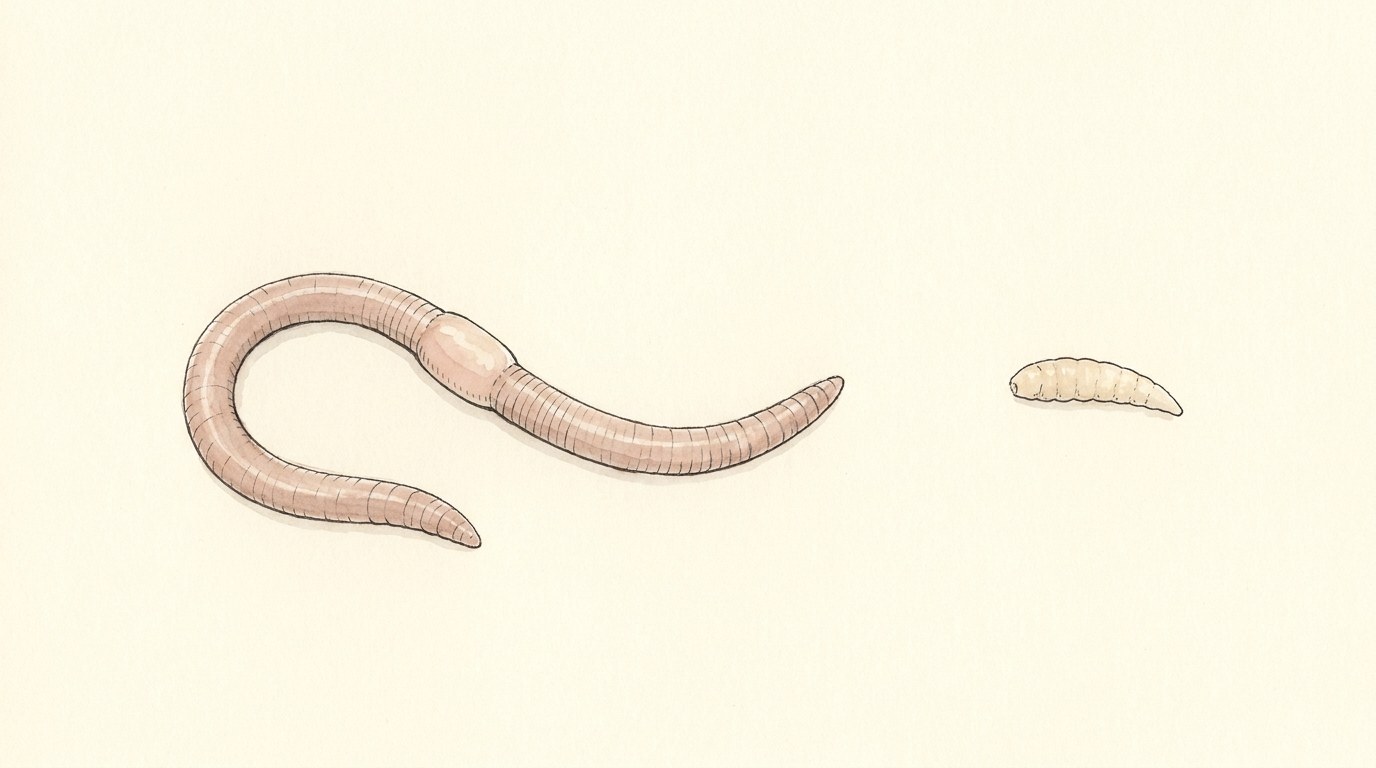
The life cycle is genuinely strange, and it is the most useful thing a homeowner can know about this insect. The female lays her eggs in cracks in the soil, often right at the mouth of an earthworm burrow. The larva that hatches goes hunting down into the soil for a worm, penetrates its body and feeds inside it, ultimately killing it. Two to three weeks later the larva is full grown, it pupates in the soil, and a new adult comes up. A full growing season can run three or four generations. The adults feed on flowers, plant sap and fruit — never garbage, never your kitchen.
The extension office covering this exact geography — Cornell Cooperative Extension in Nassau County — states it about as plainly as we could ask: in their maggot stage the flies are parasitic in the body of earthworms, they are not attracted to food or filth, they are not believed to be a health hazard, and the insect does not reproduce in the house. That last clause is the whole article.
So what makes a property attractive? Moist soil with a healthy worm population. Cluster fly trouble concentrates near irrigated turf and damp ground, which describes a large share of Nassau and Suffolk once the sprinklers run. Michigan State University Extension makes the point that having them has less to do with housekeeping than with bad luck and a healthy earthworm population outdoors. A yard full of worms is a sign of good soil. It is also a cluster fly nursery.
Then the detail that undoes most do-it-yourself plans: it may not even be your lawn. Adults seeking winter shelter can fly long distances, and the flies in a building may have originated several hundred yards away. Your neighbor’s irrigated half-acre counts. So does the ballfield behind the fence.
Which brings us to the question we get asked most on these jobs: can we just treat the lawn? No, and we will not sell you that. Two separate university extension programs say so outright. Colorado State’s fact sheet states that this type of insecticide use has never been shown to kill developing cluster flies. Purdue Extension is blunter: cluster fly infestations cannot be controlled by killing earthworms, and because the flies are strong fliers capable of covering considerable distances, lawn treatments are not effective.
For the real-world version: one homeowner on a pest-control forum described doing exactly what the internet told him to do — 19 bags of granular insecticide across his lawn, about $800 spent, aimed at the worms. His own follow-up months later: “I don’t think that the Talstar did much.” That is one person’s experience rather than a study, but it lines up with what the entomology predicts, and it is a lot of money to spend confirming a fact sheet.
How Do You Spot the Difference Between Cluster Flies and Blow Flies on Long Island?
Fair warning: cluster flies are blow flies, taxonomically. They sit in the family Calliphoridae right alongside the metallic blue and green flies everybody pictures, so the confusion is earned. What separates them is what the young eat and what the adults do in winter.
The visual check is the same golden hairs from earlier. Colorado State’s fact sheet notes that black blow flies and blue bottle flies are roughly similar in size and shape to cluster flies but lack those distinguishing golden hairs, and that a blue bottle gives itself away further with a dull metallic blue abdomen. Dull gray with a golden sheen is a cluster fly. Anything genuinely metallic is not.
The life-history split matters more. Blue bottle flies and black blow flies develop as scavengers, feeding as larvae on recently dead animals, meat and garbage, while cluster fly larvae are inside earthworms out in the soil. Winter divides them too: the black blow fly, like the cluster fly, goes into full dormancy and suspends reproduction, so it can legitimately turn up mixed into the same overwintering group. Blue bottle flies do not go fully dormant and may reproduce year-round as long as temperatures and food for their young allow.
Here is the practical fork, and it is the one to remember, because the two situations get handled completely differently:
- A slow build of dull gray flies at upstairs windows on warm days, autumn through early spring. That is an overwintering cluster. Nothing died in your house, and nothing is breeding in your house.
- A sudden burst of large flies with a metallic sheen in one room, often in warm weather, sometimes with an odor. In our experience that points at something dead in a wall or under a floor, most often a mouse or a rat. That is a locate-and-remove job, and no amount of spraying substitutes for finding it.
We take both calls every year, everywhere we work on Long Island, and the first thing we do is get a good look at the actual fly. The identification is not academic — it decides whether we are inspecting a soffit or opening a wall.
Quick Recap on Cluster Flies on Long Island
If you take one thing away: you are not fighting an infestation growing inside your house. You are hosting a dormant crowd that arrived last September and is trying to leave.
- They cannot breed indoors. Cluster fly larvae develop in lawn soil as parasites of earthworms, so there is no indoor source to hunt for.
- The flies you see now got in last autumn, from roughly mid-August into early October, mostly by way of the sun-warmed south and west walls.
- Identify by the thorax. Golden-yellow hairs and a golden sheen, slightly larger than a house fly, slow, easy to swat, indifferent to food.
- They hide upstairs. Attics first, then wall voids, soffit runs, under siding, and between the storm glass and the screen.
- Sluggish means cold, not dying. Warm sun revives them and they head for the nearest window. It is not evidence a treatment is working.
- Complaints peak late winter into early spring, when the population is trying to get back outside. Summer is quiet.
- Treating the lawn does not work. Colorado State and Purdue both say so, and the flies can arrive from several hundred yards away regardless.
- They are not believed to be a health hazard. Cornell’s Nassau County office describes them as a nuisance that is not attracted to food or filth and does not reproduce indoors.
- The pheromone story is unverified. They return because the house still suits them, not because of any chemical trail the extension literature has documented.
That is the whole picture. The flies are a nuisance, the biology is fixed, and the only variable that changes from year to year is how well the house keeps them out.